Can Young Children Canoe the Dordogne River?
The minimum age for canoeing on the Dordogne River is not decided by height, confidence, or whether a child can sit still in a boat.
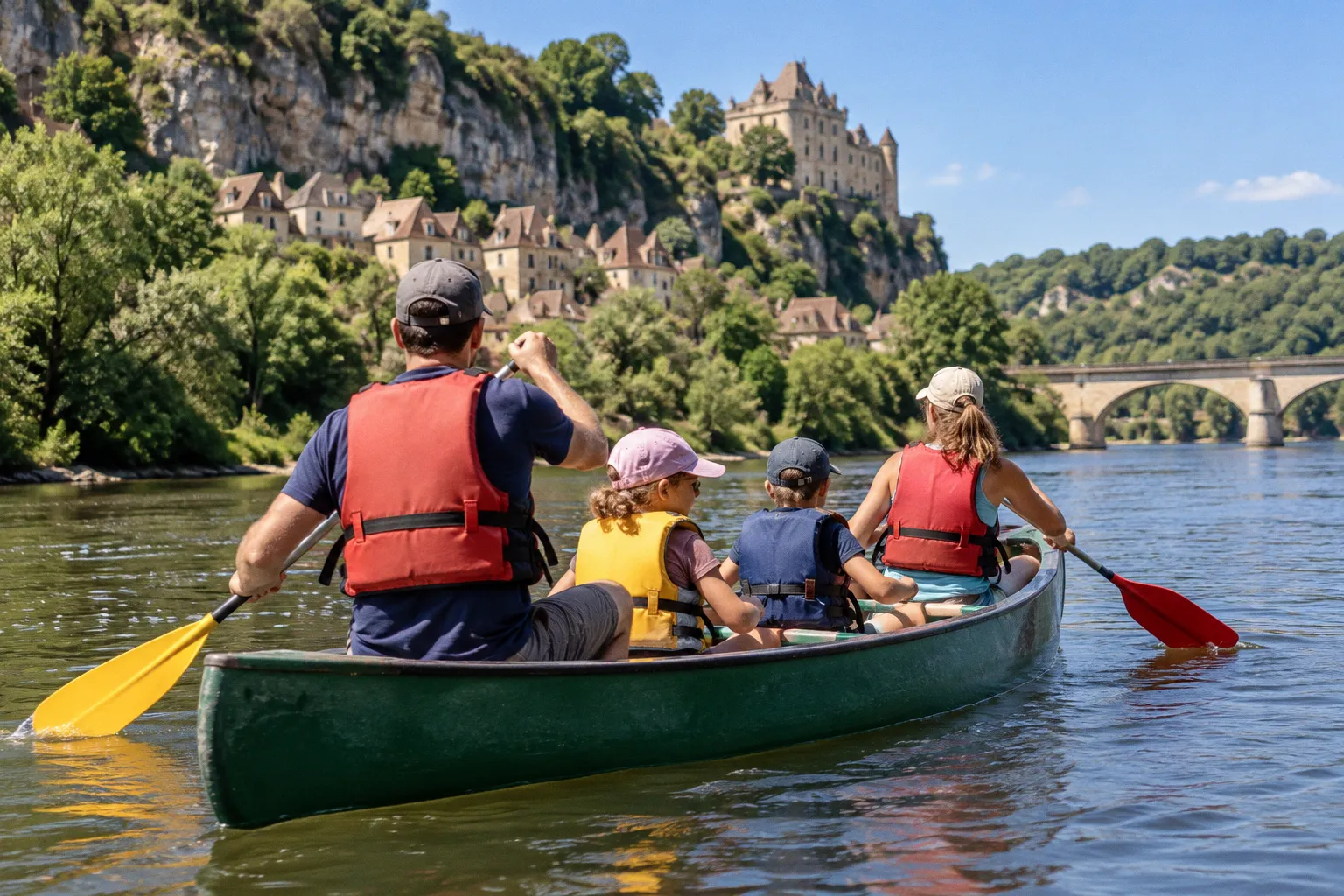
The hard gate is age combined with swimming ability, river category, water level, equipment, and supervision.
On Category I sections, children may legally canoe from around 5 or 6 years old, depending on the applicable local rules and the operator’s conditions. Every participant must be able to swim at least 25 metres without assistance and submerge underwater. A life jacket does not replace that requirement. Children under five are not permitted on self-guided canoe or kayak trips on Class 1 river sections.
That gives families a workable route into canoeing in the Dordogne valley, but only if the planning is disciplined. Choose the wrong section, launch during a restricted water level, or treat a non-swimmer as protected by flotation equipment alone, and the trip stops being a family activity. It becomes an avoidable exposure.
The age rules: start with the river category
The phrase “canoeing Dordogne River minimum age” sounds like it should produce one clean number. It does not. The river is managed by section, and the section determines the operating envelope.
For calmer Category I sections, the legal minimum is generally 5 to 6 years old. That is the range families should use when planning an ordinary self-guided descent, but it is not a universal promise that every rental company will accept every child in that bracket. Operators can impose stricter limits based on the route, the day’s conditions, the boat configuration, and their own risk policy.
Category II water raises the threshold. On the Argentat-to-Beaulieu section, children must be at least 7 years old. Do not assume that a child accepted on a lower-grade family route can automatically join a more demanding descent. River category is not a label for marketing copy. It changes the age requirement and the supervision profile.
Use this operating table before you compare routes:
| Factor | Category I family sections | Category II sections |
|---|---|---|
| Typical minimum age | Around 5–6 years, subject to local rules and operator policy | 7 years and older |
| Example | Suitable sections of the main Dordogne used by family operators | Argentat to Beaulieu |
| Swimming requirement | 25 metres unassisted and ability to submerge | Same legal swimming requirement |
| Flotation equipment | Approved personal flotation device required at all times | Approved personal flotation device required at all times |
| Route planning priority | Short distance, stable water level, straightforward recovery points | Higher attention to current, supervision, and child readiness |
| Self-guided participation | Permitted only when age, swimming, conditions, and operator rules align | More restricted by age and section conditions |
The practical conclusion is direct: a five-year-old may be eligible for some Category I trips, while a seven-year-old may still be unsuitable for a longer or more demanding route. Age opens the gate. It does not complete the assessment.
Age is only the first waypoint. The real clearance comes from swimming ability, river category, water level, and route length.
The non-negotiable swimming test
Every participant must be able to swim 25 metres without assistance and submerge underwater. This applies regardless of age. It applies regardless of whether the child is in the middle seat, travelling with two adults, or wearing an approved buoyancy aid.
Treat this as a capability test, not a formality on a rental form. If a child cannot swim the distance independently, do not book a self-guided Dordogne descent. Do not try to solve the problem with a larger life jacket or by promising that an adult will hold the child in a capsize. The regulation is clear on the prerequisite: the participant must be able to swim 25 metres unassisted and submerge.
That requirement matters because a capsize creates several separate tasks at once:
1. The child must remain calm in moving water.
2. The child must keep the airway clear while wearing the flotation device.
3. The child must move away from the canoe if necessary.
4. The child must reach a bank, boat, or rescuer without being physically carried through the entire recovery.
5. The group must manage the empty or overturned canoe without losing contact with the child.
A confident pool swimmer is not automatically a river-ready swimmer. Before the trip, assess how the child reacts to water on the face, unexpected immersion, current flow, and instructions delivered under pressure. The legal minimum is 25 metres. The operational standard for a family trip should be higher: the child must be able to follow a simple command immediately and remain functional after an unexpected splash.
Do not create a false distinction between “the child is not swimming today” and “the child can swim.” The requirement concerns ability, not whether you intend to let the child leave the boat.
Select the route by friction, not by postcard appeal
Family canoeing in the Dordogne valley works best when the route is short enough to preserve attention and simple enough to leave margin for changing conditions. Beginner and family routes are commonly around 5 to 9 kilometres, with approximately two hours on the water. That is a useful planning range, not a command to choose the longest available option.
A child’s first descent should not be measured only in kilometres. Add the real workload:
- loading and launching the canoe;
- adjusting seats and flotation equipment;
- paddling against small changes in current flow;
- steering through bends;
- handling a stop on a bank;
- carrying the boat around a difficult landing;
- restarting after a break;
- staying alert for the full operating window.
A nominal two-hour route can consume much more of the family’s energy once transfers, equipment handling, waiting, and recovery are included. Build the day around the water section, not around an ambitious lunch reservation or a second activity that leaves no recovery margin.
Build the route around the youngest participant
The youngest eligible child sets the pace. That means the adults should carry the navigation load while the child receives a simple, repeatable role. Do not expect a young passenger to contribute meaningful propulsion for the entire descent. The adult in the stern controls direction and must retain enough reserve to correct the boat when the child stops paddling, shifts weight, or becomes distracted.
For a first trip, the preferred profile is:
- a Category I section;
- a short route in the 5–9 kilometre family range;
- a launch that does not require a difficult carry;
- a water level within the free-navigation range;
- a forecast that allows the group to stay within the operator’s normal hours;
- an exit plan that does not depend on the child remaining cheerful and strong until the final minute.
If the child is five or six, select conservatively even when the rules permit participation. The narrow legal margin is not a reason to push the route. It is a signal to reduce the physical and logistical load.
Respect the age limit on Category II water
The Argentat-to-Beaulieu section is a clear example of why route selection must come before booking. Category II navigation restricts participation to children aged 7 and older. A younger child cannot be moved into eligibility by placing them between two adults in a larger canoe.
At seven, the question still does not end with age. Consider swimming competence, ability to remain seated, tolerance for spray and immersion, and whether the child can follow instructions without negotiation. If the route requires constant correction from the adults, the child is not adding a passenger; the child is adding a moving variable to the boat’s balance and the crew’s workload.
Water level controls the mission
The Dordogne is not a static recreational channel. Water level changes the conditions under which navigation is permitted and changes the risk profile for every crew, including families on calm-looking sections.
The key reference is the Pont de Cénac gauge:
- below 1.50 metres: free navigation applies;
- from 1.50 to 2.00 metres: certified supervision is required;
- above 2.00 metres: all boating is prohibited.
These thresholds must be checked for the actual day of departure. A route that was suitable earlier in the week can move into a supervised or prohibited operating bracket after rainfall upstream. Do not rely on the appearance of the water at the launch point. The gauge and the operator’s current instruction control the decision.
Flow-rate restrictions also apply. Navigation is prohibited above 80 cubic metres per second downstream of Argentat, with a higher threshold of 100 cubic metres per second for experienced paddlers. At the Souillac gauge, the stated limit is 150 cubic metres per second. These are not figures for casual comparison. They define when the river has moved beyond ordinary family navigation.
What higher water does to a family crew
Higher water can increase the speed of the current while reducing the time available to correct a poor line. Banks, bends, landing points, and obstacles arrive faster. A child who was relaxed on low-flow water may become unsettled when the canoe accelerates or pivots unexpectedly.
The adult crew must then handle three jobs simultaneously:
1. Maintain the correct line through the current flow.
2. Keep the child seated, balanced, and responsive.
3. Make a controlled decision about whether to continue, land, or return to the operator.
That is why the 1.50-to-2.00-metre bracket requires certified supervision. Do not treat supervision as an optional upgrade for nervous families. It is a change in the legal operating condition.
If water exceeds the prohibition threshold, the launch is off. No family itinerary, restaurant booking, or pre-paid transfer changes that result.
Flotation equipment and footwear are part of the route plan
An approved personal flotation device must be worn at all times on the water. Fit the device before launch and confirm that it is secure without restricting breathing or movement. The child should not be allowed to loosen it because it feels uncomfortable, pull it over the head, or wear it open to make paddling easier.
Adults need correctly fitted flotation equipment as well. The recovery plan is only as strong as the person who must manage it. A parent who is trying to stabilise a capsized canoe while their own device is poorly adjusted has already lost capacity.
Closed-toe shoes are compulsory on board. Water shoes or sneakers are suitable examples. Bare feet, loose sandals, and flip-flops create a weak point during boarding, landing, and any unplanned contact with the riverbed or bank. The requirement is not cosmetic. Shoes protect the feet and improve stability when the crew is moving around a wet canoe or stepping out under instruction.
A family loadout should be stripped to what supports control and recovery:
- approved, correctly fitted personal flotation device for every participant;
- closed-toe water shoes or secure trainers;
- clothing that can get wet and will not impede movement;
- sun protection that stays secure during paddling;
- drinking water in a container that will not become loose in the boat;
- a dry change of clothes stored according to the operator’s instructions;
- a small towel and basic weather protection;
- any essential medication sealed against water;
- a phone or emergency contact method protected from immersion, if permitted by the operator;
- no loose valuables that can shift under the seats or obstruct movement.
Do not overload the canoe with picnic equipment, oversized bags, inflatables, or decorative gear. Every extra item becomes a loose object during a capsize and a balance problem during boarding.
Operating hours create a hard return deadline
Daily rental departures and navigation are restricted to operating hours, typically from around 9:00 or 9:30 in the morning until approximately 6:00 or 6:30 in the evening, depending on the department and operator.
This affects families more than it first appears. A late launch compresses the route, reduces the time available for breaks, and increases the temptation to keep paddling when the youngest participant is already tired. A long lunch stop can become a navigation problem if the group then has to cover the remaining distance under pressure.
Set the day in this order:
1. Confirm the operator’s launch and return window.
2. Check the water level and any flow restrictions.
3. Select the route length.
4. Allow time for transport, fitting equipment, and launching.
5. Plan only a short number of stops that the child can manage.
6. Keep a hard turnaround mindset even if the route is downstream.
7. Return with margin before the operator’s final collection or landing time.
Do not use every available minute of daylight as your timetable. The river trip should finish before fatigue starts degrading decisions.
Breaks must serve the route
Children need breaks, but every landing consumes time and introduces another transfer point. Choose stops that are easy to approach and leave. Keep the boat stable while the child exits. Secure paddles and bags. Recheck flotation equipment before relaunching.
The most common family error is allowing a ten-minute break to become an unplanned half-hour stop, then trying to recover the schedule with faster paddling. That tactic transfers fatigue directly into steering errors. On a family descent, the correct response to a delayed stop is to shorten the remaining plan, not increase the pace.
If the child becomes cold, distressed, or unable to follow instructions, land at the first practical safe point and contact the operator. The objective is not to complete a pre-selected distance. The objective is to finish the descent with control.
How to brief a child before launch
A young passenger does not need a lecture on river hydrology. The child needs a compact set of commands that can be executed immediately.
Give the briefing on land, then repeat the key instructions at the launch point:
- stay seated unless an adult gives permission to move;
- keep hands and feet inside the canoe;
- hold the paddle correctly and do not swing it across another passenger;
- follow the stern paddler’s commands without delay;
- do not lean over the side to touch the water;
- if the canoe tips, stay calm, keep the flotation device on, and listen for the adult’s next instruction;
- never attempt to stand in the current unless specifically directed by a trained operator;
- tell an adult immediately if the child feels cold, frightened, unwell, or has lost a shoe or item of equipment.
Keep the commands directional and consistent. Use the same words for left, right, stop, forward, and hold. A child who receives five different versions of the same instruction will hesitate at exactly the wrong moment.
The adult crew needs a command structure
The stern paddler navigates and controls the canoe. The front paddler supports propulsion and can monitor the child, but should not issue contradictory steering instructions. If there are two adults, agree before launch who makes the final call during a correction or landing.
This is basic crew discipline. Without it, the boat receives competing inputs: one adult says paddle, another says stop, and the child shifts weight to see what is happening. The canoe loses its line while the adults lose attention.
For canoeing with kids in the Dordogne valley, the strongest configuration is one competent adult controlling the stern, one adult capable of assisting with the child and equipment, and a child placed where their movement will not compromise the boat’s trim. Follow the operator’s seating instructions; do not rearrange the loadout to create a more convenient snack position.
What to do if the canoe capsizes
A capsize is possible even on a permitted family section. Prepare the response before the boat enters the water.
The child’s first instruction is to stay calm and keep listening. The personal flotation device remains on. The canoe and paddles should be kept together where that can be done without compromising the child’s safety. The adult then directs the child toward the safest available recovery point or follows the operator’s procedure.
Do not allow a child to climb onto the overturned canoe if that creates further instability or moves them away from the bank. Do not send a non-swimmer into the river; under the regulations, that person should not have been on the self-guided trip in the first place. Do not assume the current is weak because the surface looks smooth.
The recovery priorities are simple:
1. Account for every person.
2. Keep the child’s airway clear and flotation device secure.
3. Move toward a safe bank or follow trained supervision.
4. Recover the canoe only when the people are stable.
5. Contact the rental operator if equipment, route position, or conditions require assistance.
If the river is operating under the supervised bracket between 1.50 and 2.00 metres at Pont de Cénac, use certified supervision rather than attempting to manage the route as an independent family crew.
Booking questions that prevent a failed launch
The booking conversation should establish the route’s actual operating conditions, not just reserve a boat. Ask the rental company to confirm:
- the minimum age for the exact section and departure date;
- whether the planned route is Category I or Category II;
- the operator’s policy for children aged 5 or 6;
- the required swimming ability and whether proof or a declaration is requested;
- the expected water level and flow conditions;
- whether certified supervision is required;
- the route distance and estimated time on the water;
- the latest permitted return time;
- the seating arrangement for the child;
- the procedure for an early exit;
- what happens if the river moves into a restricted or prohibited range;
- which equipment is supplied and what the family must bring.
Get the conditions before payment where possible. A generic booking page may show a family route while the actual departure point, river level, or age policy changes the decision.
The safest family route is not the one with the most kilometres or the biggest boat. It is the route that leaves the most control in reserve.
A practical go/no-go decision
Use a strict decision sequence on the morning of departure. The trip proceeds only when every gate is clear:
1. Age gate: The child meets the requirement for the exact river category and operator.
2. Swim gate: The child can swim 25 metres without assistance and submerge.
3. Condition gate: The Pont de Cénac level and relevant flow readings are within the permitted bracket.
4. Supervision gate: Certified supervision is arranged if the water level requires it.
5. Equipment gate: Flotation devices fit correctly and closed-toe footwear is available.
6. Weather and energy gate: The child is warm, rested, and able to follow instructions.
7. Time gate: The launch allows a controlled return inside the operator’s navigation hours.
8. Exit gate: The adults know how to stop the trip if the child becomes cold, frightened, or fatigued.
If one gate fails, pause the launch. Move to a shorter or calmer option only if the operator confirms that the alternative is legal and appropriate. Otherwise, switch to a different Dordogne activity for the day. Poolside leisure at a gîte, a short family walk, or another land-based plan is a better outcome than forcing a river descent outside its operating envelope.
Final gear and readiness check
Before the canoe leaves the bank, run the loadout once more:
- Every participant meets the minimum age for the exact route.
- Every participant can swim 25 metres unassisted.
- Every participant can submerge underwater.
- Every participant wears an approved personal flotation device.
- Every participant wears closed-toe shoes.
- The child understands the commands: stop, forward, left, right, stay seated.
- The stern paddler has accepted navigation responsibility.
- The river level and flow conditions have been checked that morning.
- The route is within the permitted category and distance.
- The group knows the operating hours and return deadline.
- Water, dry clothing, medication, and essential items are secured.
- The adults have agreed on the capsize response and early-exit plan.
- The operator’s instructions override the family itinerary.
Young children can canoe the Dordogne River, but only within a tightly defined operating envelope. On suitable Category I sections, a child aged around 5 or 6 may be eligible. On Category II water such as Argentat to Beaulieu, the minimum is 7. In every case, the child must swim 25 metres without assistance, submerge, wear a flotation device, and travel under conditions that remain within the river’s legal limits.
Plan the age, category, current flow, gear loadout, and return time as one system. Clear every gate before launch. Then the river becomes a controlled family route rather than a gamble disguised as a holiday activity.