Dordogne river: kayaking or canoeing for your family trip?
The question of Dordogne river kayaking vs canoeing for families usually arrives with a practical concern attached: will everyone be comfortable on the water for several hours, and which craft gives…
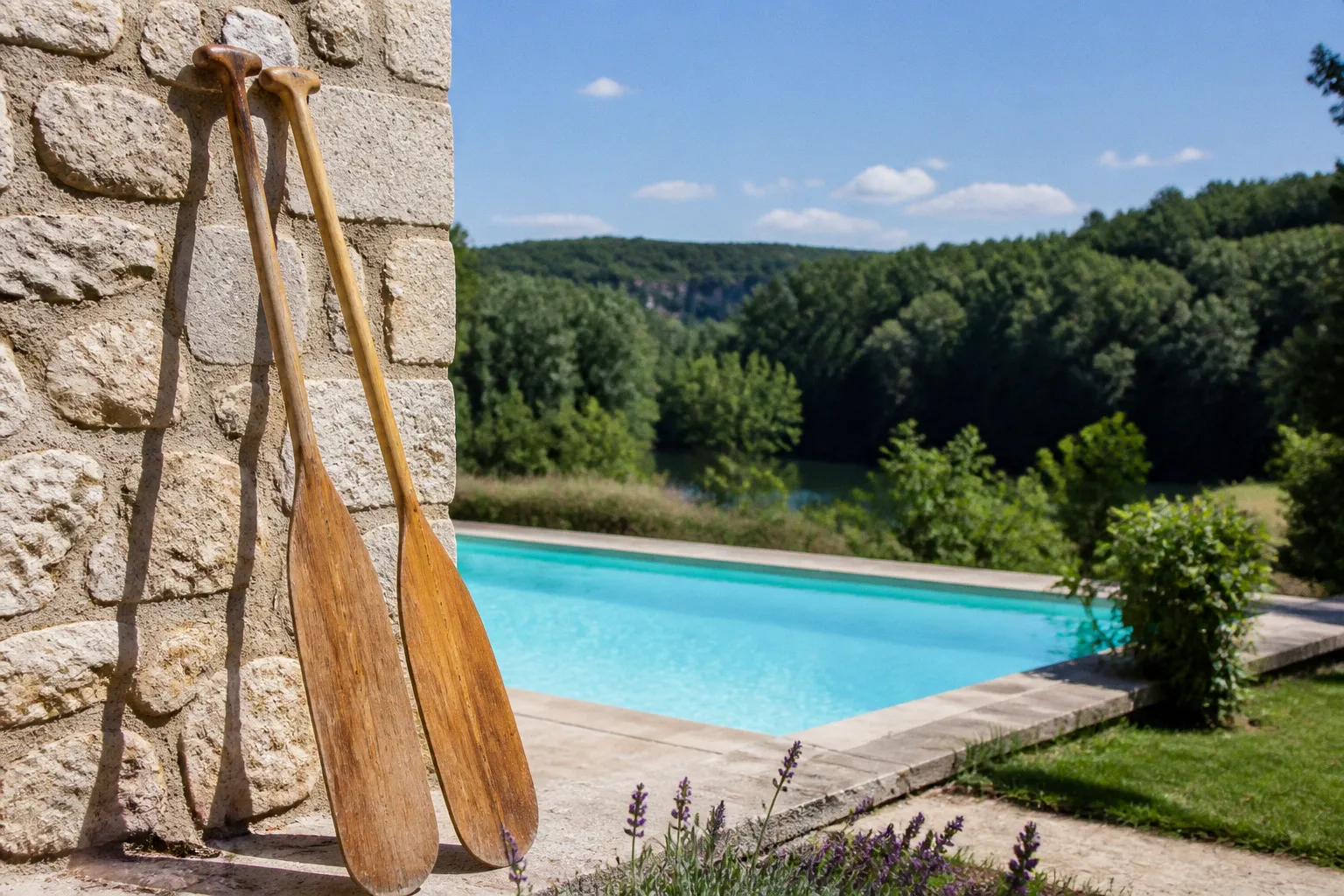
The question of Dordogne river kayaking vs canoeing for families usually arrives with a practical concern attached: will everyone be comfortable on the water for several hours, and which craft gives you the best chance of enjoying the river rather than managing it?
For most family groups, the choice is less about whether a canoe or kayak is universally better and more about the shape of your day. A canoe gives you an open hull, raised bench seats, and room for people or picnic gear. A kayak places you lower in the water, uses a double-bladed paddle, and generally feels more compact and direct. Both can be suitable on the Dordogne, where many routes follow calm stretches past limestone cliffs, wooded banks and historic châteaux, but they create quite different experiences once you add children, bags, lunch and a few hours of sunshine.
The Dordogne basin has been a UNESCO Biosphere Reserve since 2012, recognised for its natural heritage and biodiversity. That is part of the pleasure of paddling here: the river is not simply a sports venue with scenery attached. It is a long, moving route through the valley, and your choice of craft affects how easily your family can settle into its pace.
Start with the shape of your family day
Before comparing stability or speed, look at the group itself. A family of four with a young child and a large picnic has a different requirement from two confident teenagers who want to paddle independently. The best river craft for Dordogne holidays is the one that accommodates the least comfortable member of the party without making the rest of the day awkward.
An open Canadian canoe can carry two to four passengers, depending on its design and the operator’s arrangement. Adults and younger children can sit on raised bench seats, with one-bladed paddles used from either end or by several paddlers. The open structure makes it easier to bring a dry bag, packed lunch, towels and a layer for the return journey. It also allows adults to help with rhythm and direction while children contribute when they are ready.
A kayak is more enclosed and lower to the water. Single and two-seater models are common, often in stable, self-bailing designs intended for recreational use and beginners. Your legs extend forwards, and the double-bladed paddle gives a more continuous stroke on either side. For a teenager who wants a sense of independence, or an adult who prefers a narrower craft, that lower position can feel more engaging.
The practical question is not simply, “Which one is more stable?” It is, “Who needs to be able to correct the boat, keep paddling and stay comfortable when the novelty has worn off?”
Canoe or kayak at a glance
| Parameter | Canoe | Kayak |
|---|---|---|
| Seating | Raised bench seats in an open hull | Lower seating, usually single or double |
| Typical group | Two to four passengers, depending on the craft | One or two paddlers |
| Paddle | Single-bladed paddle | Double-bladed paddle |
| Luggage | Easier to accommodate picnic equipment and extra layers | More limited, particularly in a smaller single kayak |
| Family involvement | Adults can coordinate the boat and include younger passengers | Each paddler usually has a more individual role |
| General feel | Spacious, social and easier for shared conversation | Lower, more compact and direct on the water |
| Best suited to | Mixed-age groups, shared gear and a relaxed day | Older children, teenagers, couples or independent paddlers |
This table describes the craft rather than promising a universal result. A well-designed recreational kayak can feel reassuringly stable, while an overloaded or poorly balanced canoe can be tiring to manage. The operator’s briefing, the river conditions and the experience of the person steering all matter.
The most family-friendly boat is the one that leaves enough attention for the river, the weather and one another.
Canoe stability versus kayak stability on the Dordogne
Families often arrive with a fixed idea that a kayak is unstable because it sits low and a canoe is stable because it is wide and open. That comparison is too blunt to be useful.
A kayak’s lower seating position places the paddler closer to the water, and a stable recreational model can feel secure once you have found its rhythm. The double-bladed paddle provides support on both sides, which may help a beginner make small corrections without changing grip. In a two-seater kayak, the paddlers need to work together, but the narrow format gives a clear sense of where the craft is going.
A canoe offers more room to move and a higher bench, which many families find easier when getting in, settling children and reaching for a water bottle. The open hull also makes the boat feel less restrictive. However, the higher seating position means passengers need to move carefully, especially when boarding or changing position. A canoe responds to the combined weight and movement of everyone inside it, so distributing people and gear sensibly is part of keeping it comfortable.
Neither craft should be treated as a floating platform for standing, climbing or constant seat changes. Children may be excited by the openness of a canoe, but that freedom needs simple boundaries from the start. Keep bodies low, keep bags secured and follow the operator’s instructions when approaching a landing point.
For beginners, the first minutes matter. Ask the rental team to explain:
- where each person should sit and how the weight should be distributed;
- how to hold and recover the paddle if it is dropped;
- what to do if the craft turns across the current;
- how to approach the bank or a landing area;
- where personal items should be stored;
- whether the planned route has any particular sections requiring attention.
These are not dramatic preparations. They are the small pieces of knowledge that protect the yield of the day: more time noticing the cliffs and less time arguing about which direction the boat is facing.
Which feels easier for children?
For younger children who are passengers rather than independent paddlers, the canoe is often the more natural arrangement because it provides an open shared space and allows an adult to manage the general pace. The child can sit between adults or in the position recommended by the operator, with the group travelling as one unit.
That does not make a canoe automatically safer for every child. The child must be able to remain seated, follow instructions and wear the required buoyancy equipment correctly. French regulations prohibit children under seven years old and non-swimmers from taking part in canoe and kayak descents on rivers such as the Dordogne. This is a firm age and swimming requirement, not a detail to negotiate at the booking desk.
Older children and teenagers may prefer kayaks because they can paddle more actively and feel less like passengers. A two-seater can be a useful middle ground: the child participates, but an adult remains in the same craft. If siblings are paired together, consider whether they can maintain a shared rhythm without turning every bend into a disagreement. Sometimes the best family logistics are simply two compatible paddlers in one boat.
Capacity, luggage and the all-day question
The length of the route changes the decision. A short five-kilometre outing may take approximately one to two hours of paddling time, depending on the pace and the number of stops. A 15-kilometre or 25-kilometre route is a fuller day, with more exposure to sun, wind, tired arms and the familiar family search for snacks that were supposedly packed five minutes earlier.
A moderate, constant pace downstream is approximately six kilometres per hour, before rest stops. That figure is useful for understanding the scale of a route, but it should not be treated as a strict arrival time. Families pause to swim where permitted, look back at a château, adjust a sandal, wait for a slower boat or simply drift for a while. A river route is not a treadmill, and an itinerary that looks short on paper can still occupy most of the day once transfers and breaks are included.
For a longer trip, canoe capacity can be decisive. The open hull gives you somewhere sensible to place a picnic, sun cream, spare layers and a small amount of equipment. The distinction is particularly helpful when your group is staying in a self-catering gîte and wants to prepare food rather than buy every meal on the riverbank. Pack items in sealed dry bags, keep the weight low and avoid turning the canoe into a storage cupboard. The boat still needs room for people to sit naturally.
Kayak storage is more restricted. A recreational single or double kayak may take a modest dry bag, but it is not the right place for bulky luggage or a full family hamper. Use compact food, refillable water bottles that can be secured and only the layers you are genuinely likely to need. Anything loose becomes a nuisance when you are trying to paddle, and anything absorbent can become uncomfortable very quickly.
A useful packing division looks like this:
1. Water and essential food first. Each person should have access to drinking water, with lunch and snacks packed so they can be reached without unpacking the whole craft.
2. Protective layers in sealed bags. A light layer, sun protection and a spare dry top are more useful than a large change of clothes.
3. No fragile containers. Choose equipment that will tolerate being moved around, set down on a bank and exposed to splashes.
4. Keep valuables minimal. Phones, keys and wallets should be protected according to the operator’s storage arrangements rather than carried loose in pockets.
5. Balance the load. In a canoe, heavy items should not all be placed at one end. In a kayak, follow the operator’s guidance about storage compartments and access.
There is also a comfort difference. In a canoe, you can shift your posture more easily and speak across the boat. In a kayak, your legs remain extended and your lower position can be relaxing for some people but tiring for others. If anyone in the group has stiff hips, back discomfort or difficulty getting up from a low seat, discuss the seating arrangement before booking rather than discovering the problem halfway through the route.
The river season and the timing of your launch
The main paddling season generally runs from May to September, when operators offer their fullest service. July and August are the peak months, and morning departures before 10am are often recommended. The reason is practical rather than ceremonial: an early start usually gives a family cooler temperatures, a calmer beginning and more margin in the day if the group takes frequent breaks.
A late launch can still work for a short route, but it leaves less flexibility. If you are choosing a 15-kilometre or 25-kilometre descent, ask exactly how the operator manages the return transfer and what time the final arrival is expected. Do not assume that a long route can be shortened whenever you feel tired. River logistics are organised around designated departure and collection points.
The river itself is part of the planning. Water levels and flow can change outside the main season, and exact conditions vary by date. A route that feels gentle in one set of conditions may demand more concentration in another. This is one reason to use the local operator’s current advice instead of relying entirely on a description saved from a previous holiday.
The Dordogne is a working landscape as well as a leisure destination. Its protected character is visible in the wooded banks, cliffs and wildlife habitat, so treat the waterway with the same care you would give a walking trail:
- take rubbish back with you;
- avoid scraping the craft unnecessarily along shallow banks;
- use only designated landing and picnic areas;
- keep noise reasonable near homes, wildlife and other river users;
- do not plan to leave a canoe or kayak unattended while walking up to a château or hilltop village.
That last point is particularly important for families who see an attractive building from the water and imagine a spontaneous detour. River equipment remains part of the operator’s system. If a route includes a visit on foot, the landing arrangements should be clearly designated, with the craft returned or managed according to the rental company’s instructions.
Choosing the route length without overestimating your group
The most common planning mistake is to choose a distance based on the strongest paddler rather than the whole family. A confident adult may comfortably maintain the pace for several hours, but a younger passenger can become hungry, restless or cold long before the boat reaches the collection point.
A five-kilometre route
A five-kilometre descent, taking roughly one to two hours of paddling before generous stops, is a sensible introduction for a mixed group. It lets you learn how the craft handles, how children respond to the water and whether everyone enjoys the repetition of paddling. It also leaves time for another activity the same day, such as a village visit, a cycle ride or an afternoon by the pool at your gîte.
This is often the right choice for a first family river trip, particularly if the holiday includes several active days and you do not want the first outing to consume everyone’s energy.
A 15-kilometre route
Fifteen kilometres creates a more substantial river day. The group will need a workable paddling rhythm, enough water and food, and a clear understanding that the route is an activity rather than a sightseeing transfer. There is still room for pauses, but a slow start can become a tiring finish.
A canoe may suit families who want to share the work and carry a proper picnic. A pair of kayaks may suit older children or adults who prefer to control their own pace, provided everyone can keep moving comfortably.
A 25-kilometre route
Twenty-five kilometres is a full commitment for a family group. The approximate downstream paddling speed of six kilometres per hour does not mean the trip will be finished in a little over four hours once stops, boarding, landing and transfers are included. Ask about the total day structure, not just the river distance.
Choose this scale only when the group is comfortable with sustained activity and is happy to spend most of the day on the water. The reward is a deeper sense of the valley, but the route will not feel relaxed if one family member is already unsure about the boat, the heat or the length of time seated.
On the Dordogne, route distance is only half the calculation; the other half is your family’s storage temperature for patience, water and energy.
Cost, transfers and the details that affect the day
Typical family river routes generally cost between €15 and €30 per person, depending on the route length and the operator. Exact prices vary, so compare the complete arrangement rather than focusing only on the headline rental figure.
Ask whether the quoted price includes:
- the canoe or kayak itself;
- paddles and buoyancy equipment;
- transport to the departure point;
- collection at the end of the descent;
- parking;
- any booking or seasonal conditions;
- the ability to change craft or route if the group’s needs become clearer.
A cheaper route may be shorter, have a different transfer arrangement or exclude an element you assumed was standard. Conversely, a slightly higher price may make sense if it includes the transport that prevents you from organising two cars or trying to return to the starting point with tired children.
For guests staying at a luxury self-catering gîte, the simplest plan is often to organise the river day around the accommodation rather than treating it as an isolated booking. Prepare breakfast the evening before, fill water bottles before departure and keep a straightforward meal ready for the return. After several hours of paddling, nobody benefits from a complicated supper that requires a second expedition to the shops.
This is where local food habits can help rather than complicate matters. A picnic does not need to be elaborate: sturdy bread, fruit, a prepared vegetable dish, cheese that travels well and a properly wrapped butcher’s cut can be more satisfying than food that becomes delicate in a warm boat. Keep everything below the point where heat will damage it, use a cool bag if the operator permits one, and do not rely on a riverbank stop having the exact lunch your family wants.
Kayaking or canoeing with children in the Dordogne: a practical decision
If your family is still undecided, use the following questions in order:
1. Who is actually paddling?
If younger children will mainly be passengers, the open space of a canoe may be more convenient. If older children want to paddle independently, kayaks may give them a stronger sense of participation.
2. How much gear are you carrying?
A canoe is generally more forgiving for a family picnic, spare layers and a modest amount of luggage. Kayaks favour a lighter, more compact packing list.
3. How long is the route?
For a first outing, five kilometres can provide a useful trial. Longer routes reward a group that already knows how it behaves on the water.
4. How does everyone manage low seating?
Kayaks place paddlers lower with legs extended. That suits some people beautifully and is uncomfortable for others. Consider knees, hips and backs before choosing the narrow craft simply because it looks sporty.
5. Can the least confident person follow instructions?
This matters more than enthusiasm. Everyone must accept the operator’s rules, wear the required equipment and remain within the limits of their swimming ability and the French age regulations.
6. Does the day need to include something else?
A short canoe or kayak route can sit comfortably beside a market visit, a château or poolside rest. A 25-kilometre descent is likely to be the main event.
There is no prize for selecting the more demanding option. Active holidays work best when the activity leaves you with enough energy to enjoy the evening, not when the family spends dinner calculating whose turn it is to carry the wet bags.
The decision in plain terms
Choose a canoe when your priority is shared space, flexible seating and carrying a family picnic. It is usually the more natural arrangement for a mixed-age group, especially when adults will coordinate the day and younger passengers need support. Its open hull also makes the practical side of a longer route easier.
Choose a kayak when your group prefers individual control, lighter packing and a lower, more direct position on the water. It can suit older children, teenagers and adults who want to paddle actively rather than travel as a single shared unit. A stable recreational kayak is not reserved for experts, but the fit and seating position deserve attention.
Whichever craft you choose, book around the least experienced person, not the most athletic one. Confirm the minimum age, swimming requirement, route distance, transfer plan and what is included in the price. For a first family outing, a shorter route in the main May-to-September season and an early morning departure usually give you the widest margin for comfort.
The final practical tip is simple: prepare the family for the day before you prepare the picnic. Explain that the boat is not a place for standing, that everyone paddles or rests when instructed, and that the river sets the pace. Once those expectations are settled, the choice between canoe and kayak becomes much easier—and the Dordogne can do what it does best: carry you through the valley without demanding that the day become more complicated than it needs to be.