Dordogne river canoeing: safe age limits for kids
Your child is five. You want them in a canoe on the Dordogne. The river does not negotiate — French regulation does that job.
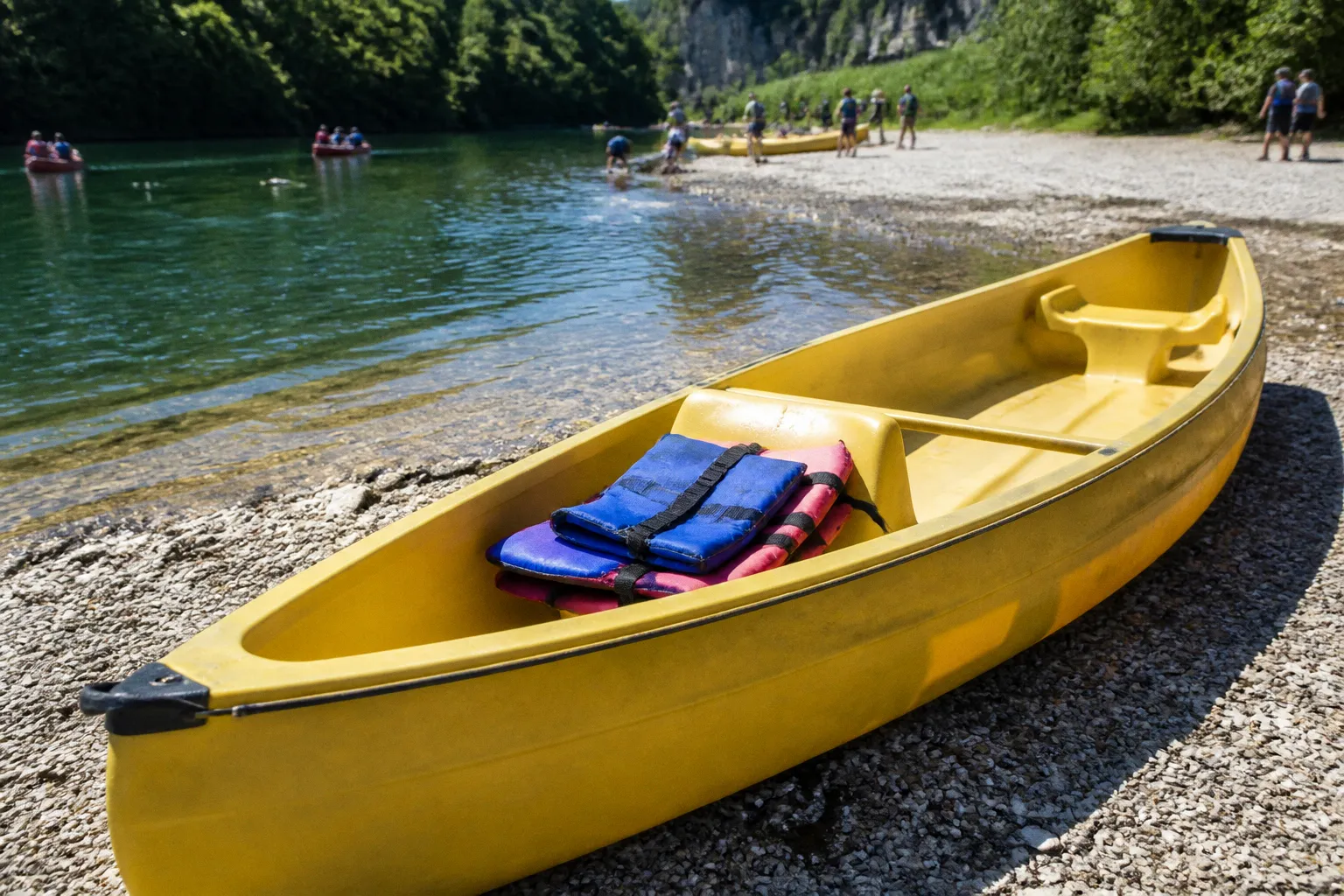
The Age Gate: What French Regulation Locks Down on the Dordogne
Before you book a rental, before you drive to a put-in at Vitrac or Argentat, you need the hard age gates, the swim threshold, and the flow rates that close the water entirely. This is the operational breakdown.
The baseline across the Dordogne basin is 6 years old. That is the national minimum for canoeing and kayaking on French rivers, and it applies across the full Class 1 corridor — Vitrac, Carsac, Beynac, Souillac, the entire accessible stretch in normal summer flow. It is a navigation regulation, not a suggestion from a rental shop.
Below six, the default answer from every licensed operator on the Dordogne is no. Most will not even sign the liability waiver for a younger child. Confirm the age with the operator before you commit a deposit.
The 5-Year-Old Window on Class 1 Water
There is a narrow exception, and only when three conditions align:
- The child is at least 5 years old (not younger — not "almost five").
- The water is Class 1 — calm current, no rapids, flat moving water typical of the lower Dordogne in summer low-flow.
- The rental operator explicitly permits it on that specific segment.
Some Dordogne rental companies do allow five-year-olds on carefully selected Class 1 routes — short, gentle stretches with quick bank access. But this is an operator-by-operator call. The default is six. Do not assume. Confirm at booking, and ideally in writing.
Five is not the floor. It is the edge of the floor. Under five, the answer is locked: no canoe, no kayak, no exceptions.
Children under 5 are categorically prohibited from canoeing on the Dordogne, regardless of parental supervision, calm conditions, or operator discretion. This line is hard.
The 7-Year Threshold: Moving Into Class 2
If your route crosses into Class 2 water — moderate current, small standing waves, light technical maneuvering — the child needs to be at least 7 years old. Certain upper-Dordogne segments and some tributaries hit Class 2 depending on flow. Confirm the class of your segment with the operator if your child is between 6 and 7, and walk away from any Class 2 plan if they are not.
The 25-Meter Swim Test: A Hard Line
French regulation is blunt on this point. Every paddler on the water — adult or child — must swim 25 meters unaided. Not 20. Not "comfortable in water." Twenty-five continuous meters, without a flotation aid, with the paddler able to submerge.
This requirement stacks on top of the life jacket. It does not replace it. The two are independent:
- The PFD keeps you at the surface if you go in.
- The 25-meter swim gets you back to the boat or the bank.
If your child cannot reliably clear 25 meters, they do not meet the regulatory minimum. No life jacket waives this. No adult companion waives this. The answer is to wait until next summer, build the swim capacity, then book.
The life jacket is your buoyancy. The 25-meter swim is your margin. You need both.
For many young children, this is the binding constraint — not the age, but the swim. A strong six-year-old who can clear 25 meters is more compliant than a weak seven-year-old who cannot. Pool-test before you commit to the booking.
Gear Loadout: What Every Paddler on the Water Must Wear
This is the equipment floor for any Dordogne canoe deployment, regardless of age:
- CE-certified personal flotation device (PFD) — mandatory for every person in the boat, no exceptions, no "we'll put it on at the first rapid." Worn, fastened, correctly sized, from launch to takeout.
- Child-rated PFD sizing — adult jackets ride up over a child's head and fail in the water. Confirm the operator stocks PFDs sized for your child's weight. If the jacket is visibly too large or the chest strap does not cinch at armpit level, flag it before launch.
- Helmet — required for Class 2 and above, and increasingly standard practice on Class 1 runs with younger children during high-flow weeks or on rocky stretches.
- Closed-toe footwear — Dordogne river banks are rocky, slippery, and uneven. Strapped sandals are the bare minimum. Old sneakers or proper water shoes are better. No flip-flops at launch or takeout.
- Sun and thermal layer — the valley runs hot in July and August, but spring and autumn water stays cold enough to trigger gasp-reflex cold shock. A lightweight UV long-sleeve or a thin neoprene layer cuts both sun exposure and cold-shock risk if a paddler goes in.
Most Dordogne rental operators include PFDs in the base price. Confirm at booking what is included and what you must bring yourself. This is a friction point that wastes launch-day time if left unresolved.
Adult Supervision on the Water
Children aged 5 to 12 must be accompanied or supervised by a responsible adult at all times on the water. For the standard family rental — two adults and two children in a four-person canoe — this is built into the boat configuration. For mixed groups or single-parent deployments, the operator will advise on the supervision ratio for your specific segment.
The adult's job is not to paddle well. It is to manage the boat, watch the children, read the current, and execute the swim-to-bank or self-rescue if anything goes wrong. If you are not a confident swimmer yourself, you are the weak link in the deployment — not the child's PFD. Reconsider the trip before you launch.
River Flow: The 80 and 150 m³/s Kill Switch
The Dordogne is not a controlled river. Its flow varies by season, rainfall, and upstream dam releases. Two specific thresholds trigger automatic navigation prohibition:
| Gauge | Flow rate | Effect |
|---|---|---|
| Downstream of Argentat-sur-Dordogne | Above 80 m³/s (or 100 m³/s for experienced paddlers in appropriate craft) | Navigation prohibited |
| Souillac gauge | Above 150 m³/s | Navigation prohibited |
These thresholds are not advisory. When the river crosses them, operators suspend launches and authorities can close the water. Spring snowmelt and autumn storm events are the most common triggers. July and August typically run well below these thresholds — but a wet spring can push flows up into late May or early June.
How to Check Flow Before You Travel
- The Vigicrues national flood-warning service publishes real-time Dordogne gauge data. Cross-reference the Argentat and Souillac stations against the thresholds above before you drive to the put-in.
- Most reputable Dordogne rental operators post flow status on their websites or confirm by phone the morning of your booking.
- If the operator cancels due to flow, that is the system working correctly. Do not look for a renegade rental that will launch you anyway. The thresholds exist for a reason.
Seasonal Windows for Family Canoeing
| Season | Months | Typical flow regime | Suitability for ages 5–8 |
|---|---|---|---|
| High season | July – August | Lowest flows, warmest water | Best window |
| Mid-season (shoulder) | April – June, September | Moderate to high flow, colder water | Ages 7–8 with prior experience; check flow weekly |
| Off-season | October – March | High flow, cold water, short daylight | Not recommended for young children |
For a family with a five- or six-year-old, July through August is the operating window. Outside that, you are fighting both flow and water temperature on the same day.
Multi-Day Deployments and Route Matching
If you are planning a multi-day canoe expedition — two nights, three nights, a longer traverse — the recommended minimum age rises to 8 years old. This is the threshold where outfitters draw the line for trips exceeding three days.
The reason is cumulative load. Multi-day deployments stack:
- Longer daily paddling distances, often 15–25 km per day.
- Multiple portages around locks, dams, and weirs.
- Overnight camps with cold mornings and variable weather.
- Fatigue accumulating across days, which degrades both decision-making and swim performance in children.
An eight-year-old can typically sustain the rhythm. A six-year-old often cannot, and the operational risk profile climbs sharply with each extra day on the water.
For the standard half-day or full-day single-segment rental — Vitrac to Beynac, Carsac-Aillac to Domme, Souillac to Pinsac — the 6-year minimum holds. Save multi-day builds for when the child is older and has already logged several day-runs.
| Segment type | Distance | Class | Flow-sensitivity | Typical operator minimum age |
|---|---|---|---|---|
| Short Class 1 (e.g. Vitrac → Beynac) | Short | Class 1 | Low | 5–6 (operator-dependent) |
| Medium Class 1 (e.g. Beynac → Saint-Cyprien) | Medium | Class 1 | Low–moderate | 6 |
| Class 1–2 corridors (Argentat area and similar) | Medium–long | Class 1–2 | Moderate | 7 |
| Multi-day full traverse | Long | Mixed | Variable | 8 |
This is the operational table. Match your child's age to the segment, not the other way around. If the most attractive segment is above your child's age threshold, pick a different one. The Dordogne has enough Class 1 options that you do not need to push.
Final Pre-Launch Gate Check
Before you push off from the put-in, run this list. Every item is a gate:
1. Child's age confirmed against the segment's operator policy and French regulation.
2. Child has swum 25 meters unaided in a pool within the last month.
3. PFD is child-rated, CE-certified, correctly fastened, snug — not riding up over the ears.
4. Closed-toe footwear on every paddler.
5. Sun protection and a thermal layer stowed in the boat.
6. Flow rate checked on Vigicrues — Argentat under 80 m³/s (or 100 for experienced craft), Souillac under 150 m³/s.
7. Operator has confirmed the segment is open and matches your child's age.
8. Adult in the boat is a confident swimmer who can execute a self-rescue.
9. Phone in a waterproof bag — but the bank is your safety net, not the network.
10. Takeout point confirmed with the operator, with an ETA window.
No child on the water under five. No paddler on the water without 25 meters of swim. No canoe on the water without a CE PFD. No launch when the river is above threshold.
These four lines are not advisory. They are the operational floor. Stay above them and you have a clean, compliant family deployment on one of the most navigable canoe corridors in France. Drop below any one of them and you are gambling with a child's safety on moving water — and French regulation, rental operators, and the river's own physics are all aligned against that bet.