Dordogne cycling routes: matching paths to your skill level
Summer heat and traffic are the two variables that can turn a Dordogne ride from straightforward to demanding.
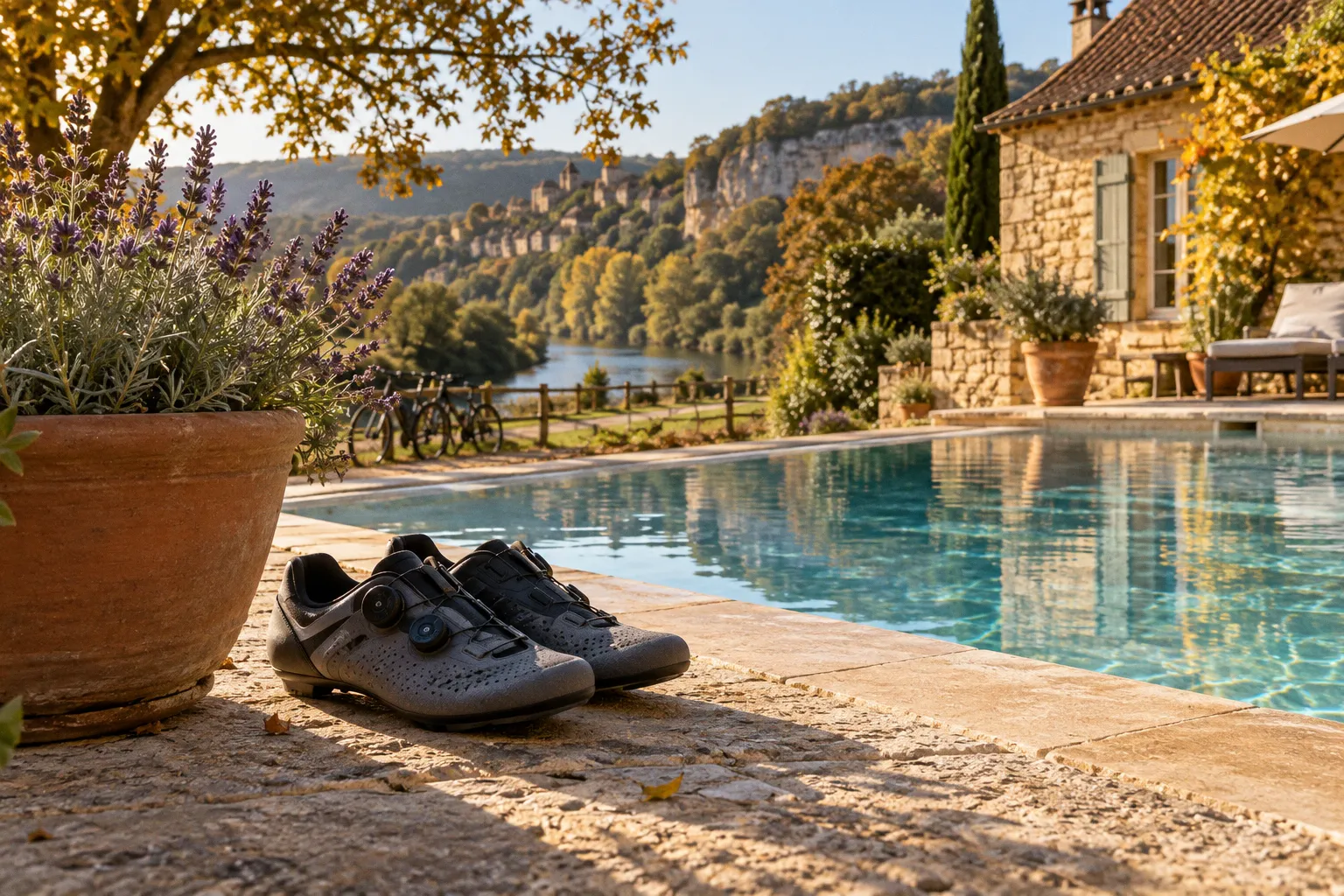
Families looking for a protected, manageable route should navigate to a designated Voie Verte; experienced riders can build a harder day or multi-day loop on the region’s rolling backroads, limestone plateaus and valley climbs. These are different ride environments, not interchangeable difficulty settings.
The key distinction in the choice of Dordogne cycling routes for families vs experienced riders is not simply distance. It is exposure: to motor traffic, gradients, heat and the effort required to get back to your starting point. Choose the route first, then set the day’s distance around the weakest rider and the conditions.
Start with the surface and traffic
Voies Vertes are the clearest family option. In the Dordogne Valley, these greenways are paved, car-free paths, often following river corridors or converted railway lines. That makes navigation simpler and removes the need to manage ordinary road traffic along the designated route. It does not mean every cycling path in the region is traffic-free: once you leave a greenway, you may be sharing narrow rural roads with motor vehicles.
For experienced riders, that change is part of the route’s character and its workload. Backroads offer access to hilltop villages and the plateaus above the valleys, but they can bring winding approaches and steep climbs. Do not treat a line on the map as a promise of easy progress. A short distance can demand more than a longer, flat ride.
| Route type | Best fit | Main terrain demand | Traffic picture |
|---|---|---|---|
| Designated Voie Verte | Families, newer riders, relaxed day rides | Mostly flat, paved path | Car-free on the greenway |
| Hilly rural backroads | Confident road cyclists | Repeated ascents and descents | Shared with motor traffic |
| Multi-day valley and plateau loop | Experienced riders prepared for sustained effort | Hilly terrain and changing elevations | Route-dependent; not wholly car-free |
For a family group, the safest default is to keep the route on the greenway rather than assume that a quiet-looking country lane is equivalent. For a stronger rider, the reverse applies: do not mistake the calm of the valley floor for the difficulty of the full loop if the route climbs onto the causses.
Match the route to the terrain you can ride all day, not the distance that looks manageable on a map.
Paved paths and railway corridors: Sarlat to Cazoulès
The Sarlat to Cazoulès greenway is a useful anchor for planning. It follows a disused railway line converted into a 35 km paved cycle path, passing through the Périgord countryside via Grolejac and Carsac-Aillac. Its railway origins explain the appeal: the route runs along a corridor built for gradual travel rather than a sequence of steep road climbs.
Thirty-five kilometres is the full route length, not a compulsory family target. Choose a section that fits the youngest or least experienced rider, and decide in advance where the group will turn around. On an out-and-back ride, the return leg still has to be completed; a headwind, tired legs or a late start can make that second half feel longer than expected.
The same route can serve different riders if they use it differently. Families can take a shorter stretch and keep the ride focused on steady, protected progress. A fitter cyclist can use more of the path as a base before adding a separate road section—but only after checking how the return connects and whether that added mileage introduces traffic or climbing.
The Voie Verte du Céou is another family-friendly option, starting from Castelnaud-la-Chapelle and following flat, protected valley paths. That makes it a strong fit when the priority is uncomplicated riding rather than a challenging ascent. Treat it as a valley route, not as evidence that all terrain around Castelnaud is flat: leaving the protected path can change the effort and traffic conditions quickly.
For a longer greenway itinerary, the Véloroute Voie Verte Vallée de l’Isle runs for 100 km along the Isle River from Périgueux towards the southwest, passing castles and historic villages. The full distance is a route framework for a longer journey, not a sensible one-day target for every party. The Périgueux section from Trélissac to Marsac is 23 km, giving riders a more contained option within the wider corridor.
When comparing the best cycling paths in the Dordogne Valley, separate three questions: how much of the route is protected, how much distance your group actually wants to ride, and where the planned ride ends. A greenway can be easy to follow and still become a poor choice if the day’s distance exceeds the group’s energy.
Beyond the valley floor: climbs, plateaus and road riding
The valley paths solve one kind of problem: they keep the ride relatively flat and away from cars. They do not represent the full Dordogne cycling terrain. Experienced riders looking for sustained effort can leave the river corridor for small, winding roads, steep limestone plateau climbs and routes linking villages above the valley.
That shift raises the physical demand and the navigation burden. Climbs are not just a matter of stronger legs. They shape the day’s timing, how much energy remains for the return, and how quickly riders need to respond to heat. Descents then require control and attention, particularly on winding roads. A route that looks attractive because it connects several places may be a poor choice if the group has not allowed for repeated elevation changes.
There is no single difficulty label that can accurately describe every rural road in the department. Exact gradients vary, and not every climb has a dependable number attached to it. Plan around the known terrain character—hilly backroads and steep plateau approaches—rather than relying on invented precision.
Road cycling and gravel riding also should not be treated as synonyms here. The confirmed route examples include paved greenways and hilly backroads; they do not establish a department-wide inventory or total mileage for unpaved singletrack. If your plan depends on gravel or mountain-bike trails, verify the surface and route conditions for the specific track before you commit. Do not assume that a path shown between two points is suitable for your bike or skill level.
For less experienced riders, climbs to plateau destinations such as Domme or Rocamadour are not casual extensions of a flat family ride. They call for proper fitness or e-bike assistance, plus a realistic plan for the descent and the return. If those ingredients are missing, stay on the valley floor and make the climb a separate objective.
Plan by season, heat and effort
The recommended cycling season in the Dordogne runs from May to October. September and October are particularly appealing for milder conditions and autumn foliage. July and August can bring hot temperatures, which changes the ride even when the route itself is straightforward.
On a hot day, the practical response is to reduce the load: start earlier, shorten the exposed sections and avoid treating a planned distance as a target that must be completed. Families should set the turnaround point before the group gets tired. Experienced riders should account for the extra cost of climbing in heat; a demanding ascent late in the day leaves less margin for delays and the ride back.
A useful route plan has a clear fallback. On a greenway, that may mean choosing a shorter out-and-back section. On a hilly loop, it means knowing whether the route can be shortened without committing the group to another climb or a long stretch on a busier road. If the answer is unclear, simplify the itinerary before setting off.
A pool at your gîte can make a useful recovery point after a ride, but it does not replace a sound route plan. Decide whether the cycling day is the main event or one part of a mixed active holiday. A family itinerary can alternate a short greenway ride with a quieter day; a strong cycling group may schedule its longest loop when temperatures are more manageable.
Multi-day loops: build the route around the hard day
Experienced cyclists can use a two-day road route starting from Souillac train station as a model for a more demanding itinerary. The route traverses the Lot and Dordogne valleys and the steep causses landscape, passing castles including Montal and Castelnau-Bretenoux. This is not a protected greenway circuit. It is a hilly road journey whose effort comes from the terrain and the repeated changes in elevation.
For a multi-day ride, do not stack the hardest climbs on the day when the group is already carrying its full gear loadout and learning the route. Set the first day’s distance conservatively, then position the more demanding section when the riders are prepared for it. Keep the route legible: clear start and finish points, a plan for shortening the day, and no assumption that every rural connection will be traffic-free.
The distinction between a family-friendly cycling route and a sporty itinerary is therefore operational. The family plan protects a steady pace and limits exposure. The experienced plan accepts climbing and shared roads, but needs stronger fitness, more active navigation and a deliberate approach to heat and fatigue.
Before rolling, confirm the route’s surface, its traffic status and the return plan. For greenway rides, stay on the designated path where protection matters. For road loops, check the climbs and distance between planned stopping points rather than extrapolating from the map’s straight-line distance.
Final gear and route check
Use this last check before leaving the gîte:
- Route: Confirm the start, finish and turnaround point. Make sure the planned distance suits the least experienced rider in the group.
- Surface: Identify whether the route is a paved Voie Verte, a rural road or an unpaved track. Do not assume all paths are car-free.
- Climbing: Flag any plateau ascent or repeated hill section. If the group lacks the fitness or e-bike support for it, select a valley route instead.
- Conditions: Check the forecast and account for summer heat. Shorten the ride or move the start earlier when conditions demand it.
- Return: Plan how everyone gets back. An out-and-back route doubles the distance between the start and turnaround; a loop can introduce unfamiliar roads.
- Loadout: Carry water, basic repair equipment and a way to navigate the chosen route. Keep the setup proportionate to the ride, but do not leave essentials behind.
Choose the protected valley path when the priority is controlled, family-paced riding. Choose the backroads and plateau climbs only when the riders, conditions and plan are ready for them. In the Dordogne, that decision is the real route grade.