Dordogne gites with heated pools: a booking roadmap
A heated pool in a Dordogne gîte is usually an outdoor pool held at roughly 26°C to 28°C between May and September. That temperature range is a target, not a guarantee.
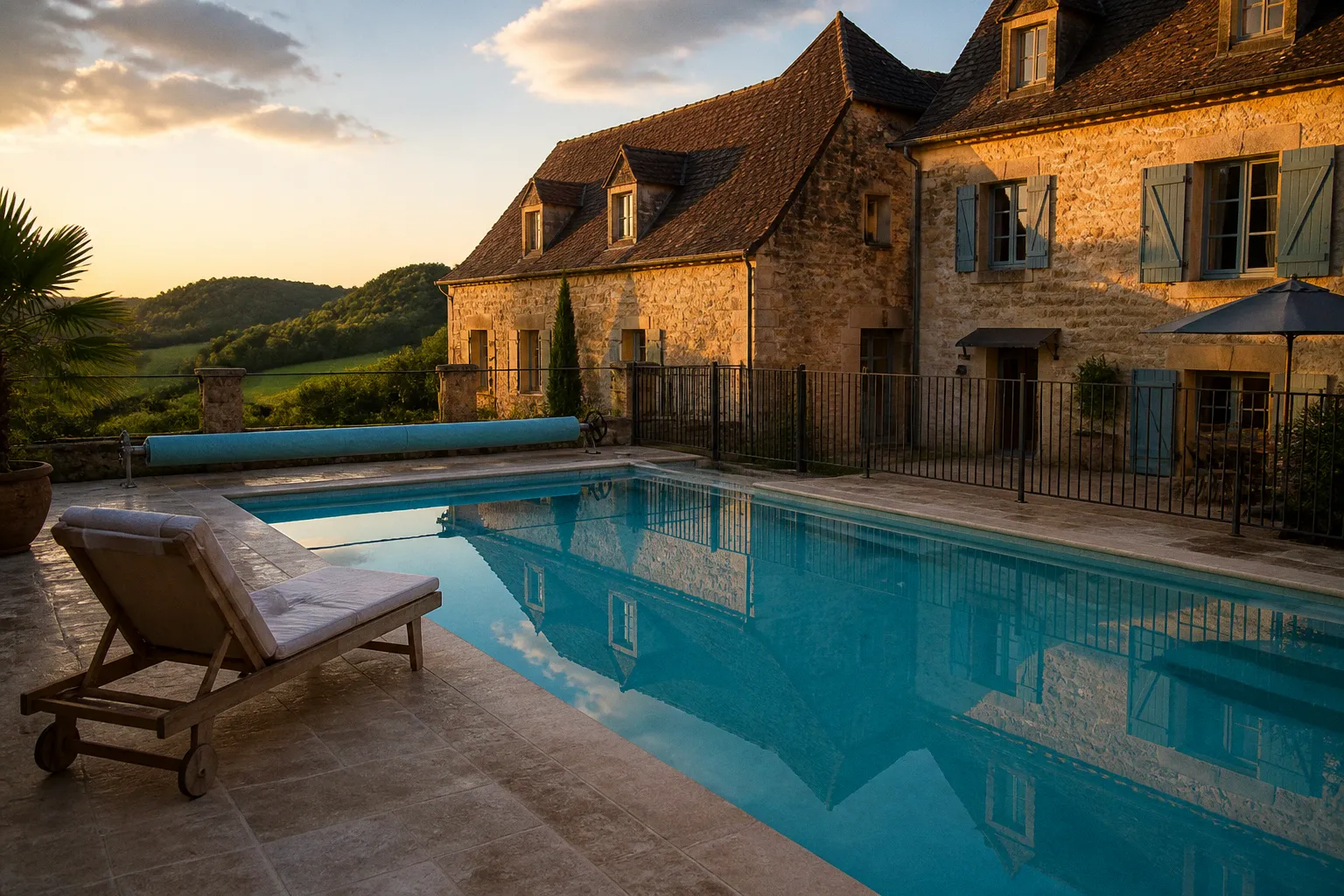
In September, the regional average is around 24°C by day and 16°C by evening, so the difference between air temperature and water temperature becomes commercially relevant. A listing that says “heated pool” without an operating period, setpoint, and charging policy is incomplete.
The main booking risk is not whether the water feels warm on arrival. It is the gap between the brochure and the operating contract. Since 1 January 2006, French rules have required fully or partially in-ground private pools, including pools at self-catering rental gîtes, to use at least one approved AFNOR safety system. Non-compliance can carry a fine of up to €45,000. A serious assessment therefore covers five separate items: season, temperature, safety, energy cost, and maintenance.
A heated pool is an engineered service, not a decorative amenity. The relevant specification is the one written into the booking.
1. Establish the seasonal window before comparing pools
The first question is not whether the pool is heated. It is whether it is available during the dates of the stay. Outdoor pool heating in the Périgord is generally operational from May to September, but the exact opening and closing dates are set by the property. September should be assessed as a shoulder-season booking, not as a continuation of July.
That distinction matters because the pool’s water temperature is affected by more than the nominal setting. Ambient temperature, overnight loss, wind, pool volume, the use of a cover, and the number of hours the heating system operates all affect the result. A target of 26°C to 28°C under normal seasonal conditions sounds precise, but it says little unless the host defines what happens on a cool September night.
| Period | Practical assessment | Information to obtain |
|---|---|---|
| May to June | Shoulder-season conditions; heating availability may be more limited than in peak summer | Exact opening date, operating hours, target temperature, and whether a cover is supplied |
| July to August | The most straightforward period for outdoor pool use, subject to the property’s own schedule | Daily operating window, weather-related shutdown policy, and maintenance access |
| September | Average daytime high near 24°C and evening low near 16°C; cooler nights change the value of active heating | Whether the system runs overnight, the closing date, and the expected maintained temperature |
A property should not be treated as having a year-round heated pool merely because the equipment is installed. Outdoor pools in Dordogne are exposed to the same seasonal loss as any comparable outdoor installation. Unless the owner provides a written winter operation policy, the sensible assumption is that heating ends with the outdoor season.
Use a short pre-booking sequence:
1. State the dates on which the pool would be used.
2. Ask for the first and last dates on which heating is normally available.
3. Ask for the target water temperature, not the phrase “comfortably heated”.
4. Confirm whether the system runs during the evening and after a cool night.
5. Ask whether the pool is supplied with a cover and whether guests are expected to deploy it.
6. Confirm what happens after a storm, equipment fault, or unusually cold period.
The dimensions and water volume are also useful. Pool volume is a better basis for comparison than a generic claim about efficiency. It affects thermal mass and the time required to recover temperature. A large pool can remain attractive without being an economical heated pool. The brochure may describe a generous swimming area; the auditor should ask how much water the system is expected to maintain.
2. Verify the French pool safety system
Pool safety requires a specific answer, not a general assurance that the pool is secure. Under the French rules that have applied since 1 January 2006, a fully or partially in-ground private pool at a self-catering rental gîte must have at least one of four approved AFNOR systems. The relevant standards are identifiable:
| French standard | Safety system |
|---|---|
| NF P 90-306 | Protective barrier |
| NF P 90-307 | Pool alarm |
| NF P 90-308 | Safety cover |
| NF P 90-309 | Pool shelter or enclosure |
The standard number is more useful than an adjective such as “protected” or “child-safe”. Ask which system is installed and request a current photograph or clear description before booking. The question is not whether the property has a fence somewhere near the pool. It is whether the stated system corresponds to the actual pool and installation.
The four standards should not be treated as four mandatory features. The legal framework requires at least one approved system. The practical question is whether the installed system is suitable for the property’s layout and whether it is described accurately. A cover may also help retain heat, but it should not be assumed to be the same thing as a safety cover. Heating and pool safety are separate specifications.
There is an important boundary to the rule. The confirmed French requirement applies to fully or partially in-ground pools. Above-ground and inflatable pools are not in the same mandatory category. That does not make them risk-free, and it does not remove the need to assess access, supervision, and equipment. It does mean that the €45,000 compliance figure should not be used as a claim about an above-ground or inflatable pool.
The host should be asked to identify the applicable standard, show the installation, and explain any access restrictions. If the property has an enclosure, the enclosure’s relationship to the pool and its operating condition are relevant. If it has an alarm, the guest should know whether the alarm is active, how it is reset, and what the property’s instructions are. If it has a safety cover, its specified use and, where relevant, load-bearing information are more informative than a photograph alone.
“Secure pool” is not a verifiable standard. NF P 90-306, NF P 90-307, NF P 90-308, or NF P 90-309 is a verifiable starting point.
The legal position should not be reduced to a warning directed at the guest. The host is responsible for presenting the property accurately, and the guest is entitled to assess the physical reality. If the pool is in-ground and the listing provides no standard number, that omission should be resolved before arrival. It is a booking issue, not a matter of visual judgement.
3. Separate the headline rate from the landed cost
Dordogne gîte prices vary substantially with property size and season. A small property in a low or shoulder period may be advertised below €1,000 per week. A larger luxury property in peak summer commonly falls between €2,000 and €7,000 per week. Across the market, the broader range is approximately €800 to €7,000 or more per week. These are comparison bands, not universal tariffs.
The quoted weekly rate is not the same as the total cost of having a private heated pool. Heating may be included in the base rate, supplied as a weekly supplement, or billed through electricity consumption. The research confirms that billing policies vary by property contract. There is no universal pool-heating surcharge that can be added to every listing.
| Published price level | What it may represent | Questions before booking |
|---|---|---|
| Below €1,000 per week | Smaller gîte, lower-demand dates, or a base rate without extras | Is the pool heated during my dates, and is heating included? |
| Approximately €2,000 to €7,000 per week | Larger property, peak-season demand, or a higher-specification rental | Is the premium for the property, the pool, or both? Is heat metered? |
| Any headline rate | A rate that may omit one or more mandatory or variable charges | What is the expected total after heating, electricity, local tax, and booking extras? |
A useful comparison is a single weekly total:
weekly total = base rent + heating charge + any metered electricity + applicable local charges + non-refundable extras
The formula is simple. The work is in obtaining the inputs. Ask whether the heating charge is a fixed supplement or a consumption charge. Ask whether the host reads a meter at arrival and departure. Ask whether the price changes if the pool is used less than expected. The answer may be reasonable, but it should be known before payment.
The local tourist tax is a separate point. Exact 2026 rates depend on the municipality or intercommunal authority, so a generic online figure should not be treated as current for every Dordogne booking. Obtain the amount from the property or local booking terms. It may be modest, but it belongs in the comparison rather than being silently excluded from it.
September can produce a lower headline rate than July. That does not establish value. A lower base rate accompanied by a heating charge, metered electricity, and a short operating season may be more expensive in use than a higher rate with heating included. The correct comparison is not “€1,400 versus €1,800”. It is the total delivered specification for those dates.
4. Compare heating systems by load, not marketing language
Most outdoor heated pools in Dordogne use a heat pump or a solar system. The description “solar” and the description “heat pump” do not provide enough information to compare them. The pool volume, target temperature, ambient conditions, operating hours, cover, and electricity arrangement determine the practical result.
A heat pump is an active system. Ask for the rated output rather than accepting a general claim of efficiency. BTU capacity is relevant when comparing equipment, but it is not a temperature guarantee. The useful questions are:
- What is the rated heat-pump output?
- Is the quoted output tied to a particular air temperature?
- What water temperature is the system expected to maintain?
- Is the pump operated continuously, on a timer, or on demand?
- Is electricity included, metered, or charged separately?
- Where is the equipment located relative to bedrooms, terraces, and access routes?
- What is the service response if the equipment stops working?
Equipment proximity is a practical matter. A unit near a bedroom may affect noise. A unit with difficult service access may be more disruptive to maintain. Neither issue makes a property unsuitable, but both belong in the assessment. Footfall, access, and maintenance route are part of the pool specification.
A solar system should be assessed on the same basis. Solar contribution varies with available sunlight, but a listing should not imply that solar heating means a maintained 26°C to 28°C at night. Ask whether the property has a separate backup system, what the target temperature is, and how the system behaves during cloudy periods. If the owner describes a combined installation, identify which component is responsible for maintaining the water after sunset.
Pool volume and thermal mass are the two measurements that prevent vague comparisons. A small pool and a large pool cannot be judged by the same thermostat setting. A system may be technically present while still being a poor match to the volume of water. The appropriate audit question is not “Is it heated?” but “Can this system maintain the stated temperature at this property, at this time of year, under the stated billing arrangement?”
A cover can alter heat retention and reduce avoidable heat loss, but it is not a substitute for a properly specified heater. Ask whether one is included, whether it is intended for routine use, and whether guests are expected to handle it. If the cover is not included, the heating cost may be higher than the listing suggests.
No guest should assume that heating is included because the property calls itself a luxury gîte. The same applies to a high weekly rate. A high price may purchase more space, a better location, or a larger pool. It does not automatically purchase a particular energy policy.
The meaningful heating specification is a maintained water temperature, an operating period, and a defined energy charge. “Efficient” is not a unit of measurement.
5. Assess water quality and maintenance logistics
Pool temperature is only one part of the physical condition. Water quality, access, and maintenance determine whether the pool is actually usable on a given day. A property can have a heat pump and a compliant safety device while still failing as a rental pool if maintenance is irregular or the pool is closed without notice.
France published a new decree on water sanitary safety in late 2025, with entry into force in 2026. It updates water-quality and drainage rules for collective and public aquatic facilities. Individual private residential pools remain outside the mandatory public sanitary control systems described by that framework. That distinction should not be interpreted as a waiver of practical hygiene standards. A private pool still requires routine testing, treatment, cleaning, and response to contamination or heavy rainfall.
The private-rental classification should be confirmed rather than assumed. Ask whether the pool is exclusively associated with the gîte, whether other properties or guests can access it, and who is permitted to use it. “Private” is sometimes used loosely. The physical layout and access route matter more than the listing label.
Before booking, request a concise maintenance summary covering:
1. Who tests and treats the water, and how often.
2. How the pool is cleaned and what happens after heavy rain.
3. Whether the pool is checked before the first swim of the day.
4. How an equipment fault or contamination event is reported.
5. Whether the pool can be closed temporarily for treatment or repair.
6. Whether guests are asked to follow any specific rules before entry.
7. Where the treatment products and service equipment are stored.
A high occupancy week creates a different maintenance load from a quiet shoulder-season stay. The pool area should have a workable access route for servicing without turning every inspection into a logistical operation. Proximity to the house, bedrooms, and service entrance is relevant to noise and maintenance. It is also relevant to whether a fault can be dealt with promptly.
September deserves particular attention. Average daytime temperatures can remain pleasant while evenings fall to around 16°C. Water maintained for daytime use may not be comfortable for an evening swim unless the system is running on an appropriate schedule. Ask whether the target temperature is maintained overnight, whether the pool closes earlier, and whether a cover is used after the last swim.
For 2026 arrivals, ask whether the host has made any operational changes in response to the new sanitary-safety decree. The answer need not be a legal interpretation. It should establish whether the host understands the current water-management requirements and has a practical maintenance process.
6. Use a written booking sequence
The safest booking decision follows the physical pool from the water to the contract. I would use the following sequence before paying a heated-pool premium:
1. Confirm the season. Obtain the first and last operating dates for the actual stay.
2. Confirm the temperature. Ask for a numerical setpoint and the hours during which it is maintained.
3. Confirm the pool category. Determine whether it is fully or partially in-ground. Do not apply the in-ground safety requirement to an above-ground or inflatable pool.
4. Confirm the safety system. Obtain the applicable NF P 90-306, NF P 90-307, NF P 90-308, or NF P 90-309 description.
5. Confirm the system type. Identify whether the property uses a heat pump, solar system, or another arrangement, and ask for rated BTU capacity where relevant.
6. Confirm the cost. Add heating, metered electricity, local charges, and other mandatory extras to the headline rate.
7. Confirm maintenance. Establish who manages water quality, cleaning, faults, and temporary closures.
8. Put the answers in writing. The booking confirmation should contain the operational promises rather than a restatement of the listing.
A property passes this review when the answer to each question is specific and consistent across the listing, the host’s message, and the contract. It fails when “heated” has no dates, “secure” has no standard, or the price excludes the energy required to deliver the advertised water temperature.
| Booking result | Assessment |
|---|---|
| Proceed | Heating dates, target temperature, safety system, total cost, and maintenance responsibility are all stated clearly |
| Resolve before payment | One of the above is missing, but the host provides a credible written answer and the contract reflects it |
| Do not pay the heated-pool premium | The pool is seasonal but described as year-round, the safety system is unidentified, or the heating charge is introduced only after arrival |
The correct value test is binary. A Dordogne gîte with a private heated pool justifies its premium when the pool is available for the intended use, maintained at the stated temperature, fitted with the appropriate safety system, and priced without hidden energy assumptions. If one of those conditions is unverified, the pool is not a reliable specification.
Choose the property that supplies measurements, operating dates, and charging terms. The brochure can be attractive. The physical pool still has to work.