Hidden fees in luxury Dordogne villa rentals
A Dordogne villa advertised at €4,500 for a week may not cost €4,500. The final amount can include tourist tax, end-of-stay cleaning, linen hire, pool heating, household heating, firewood, booking fees and a refundable security deposit.
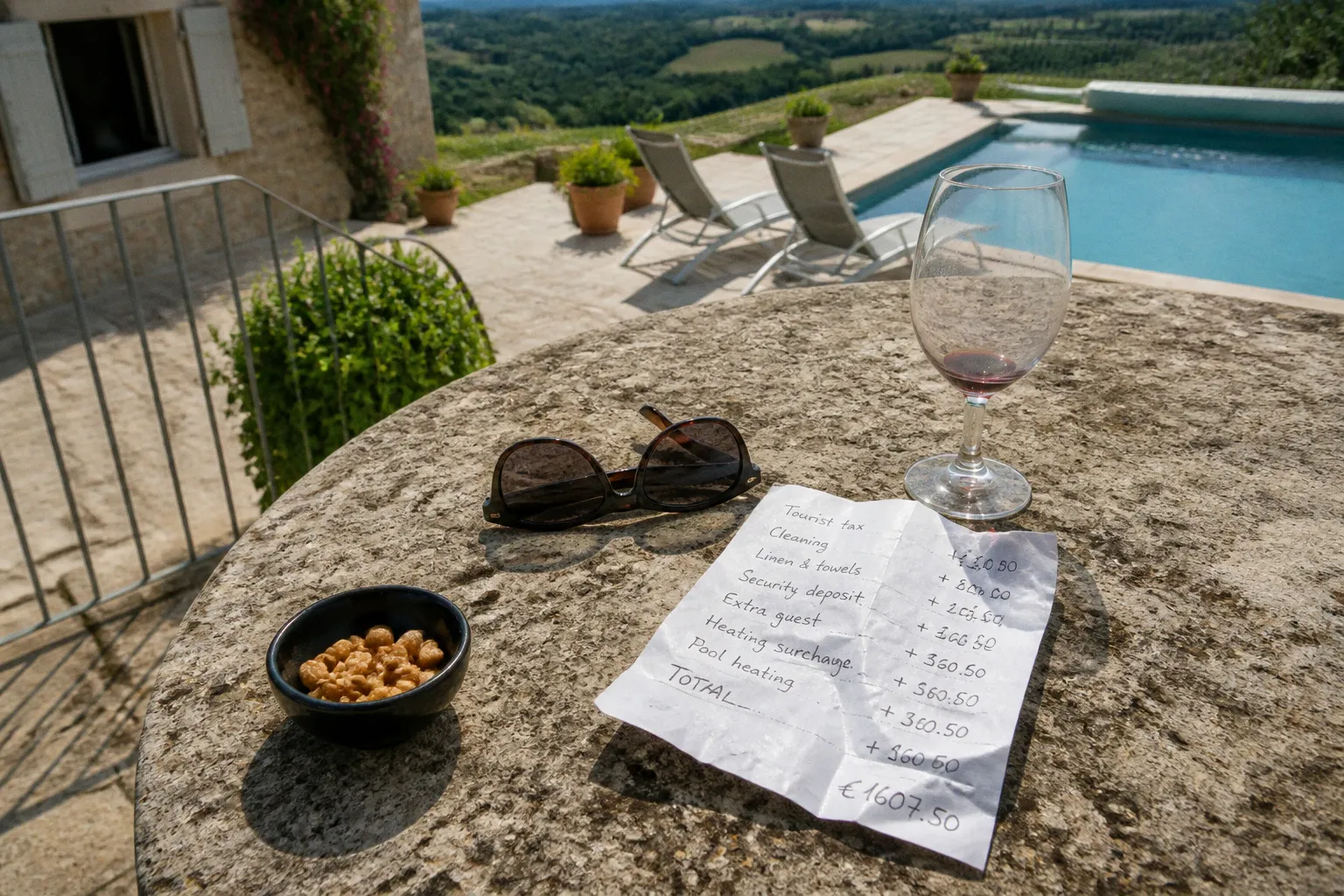
Some of these are legitimate operating costs. Others are simply excluded from the headline rate to keep the initial figure competitive.
The distinction matters. A luxury gîte with a private pool is not a hotel room with a single nightly tariff. It is a managed property with cleaning labour, utilities, local taxation, maintenance exposure and occupancy controls. The rental price is therefore only one component of the transaction unless the owner explicitly states that the rate is all-inclusive.
For anyone comparing a Dordogne villa rental, hidden costs are not a minor administrative detail. They determine the real value of the property.
The reality of modular pricing in French countryside rentals
French holiday homes are commonly priced in one of two ways.
The first is an all-inclusive model. The quoted rental rate incorporates cleaning, linen, standard utilities and sometimes pool heating. Tourist tax may still be charged separately because it is a local levy rather than an owner-controlled operating cost.
The second is modular pricing. The base rate covers the accommodation itself. Services and consumption-related items are added as separate lines, either during booking or shortly before arrival. This can produce a lower headline figure, but the comparison becomes less direct.
The problem is not modular pricing in itself. A transparent itemised quote is often more useful than a vague all-in figure. The problem occurs when the booking page presents the base rental rate prominently and places material charges in secondary text, general terms or a final payment screen.
A serious comparison requires the total payable amount for the specific dates, occupancy and property configuration. Not the weekly rate shown in a search result.
The following cost categories are the ones most likely to alter the financial assessment:
- Taxe de séjour: charged per adult aged 18 and over, per night, according to the property classification and commune.
- End-of-stay cleaning: often charged separately, with typical fees of €150 to €300 per stay.
- Bed linen and towels: sometimes supplied for a per-person fee, with €25 per person being one recorded example.
- Heating: may be included, capped, metered or charged as a seasonal supplement.
- Pool heating: particularly relevant outside the main summer period, when a private pool may require a dedicated heating charge.
- Firewood: fireplaces can carry a separate supply fee, such as €50 per week.
- Additional guests: exceeding the stated occupancy can trigger charges of around €16.50 or £10 per extra person per night, depending on the operator.
- Security deposit: commonly between €500 and €3,000, payable before or at arrival and potentially retained for damage or exceptional cleaning.
These are not all universal charges. Many professionally managed luxury villas include several of them. The point is to identify the pricing model before comparing properties.
The headline rate describes access to the property. It does not necessarily describe the cost of occupying it.
Mandatory local levies: understanding the taxe de séjour
The tourist tax is the easiest extra charge to overlook because it is both mandatory and relatively small in isolation. It is also calculated in a way that makes the total dependent on the composition and duration of the group.
In the Dordogne, the taxe de séjour is charged separately per adult aged 18 and over, per night. The amount depends on the accommodation classification and the rules of the relevant commune. Recorded rates range from approximately €1.10 to €3.63 per adult per night.
Children are treated differently under the applicable local rules, but the exact treatment should be confirmed in the booking documentation rather than assumed from a generic property description. Rates can vary between communes, and local councils may update their schedules.
The arithmetic is straightforward. For a seven-night stay with four adults, a rate of €3.63 would produce €101.64 in tourist tax. At €1.10, the equivalent would be €30.80. Neither amount changes the quality of the villa, but both change the final invoice.
This is why the phrase “tax included” requires precision. It may mean:
1. The rental rate includes the local tourist tax.
2. The tax is calculated and collected by the booking platform.
3. The tax is excluded from the advertised price but disclosed before payment.
4. The owner collects it separately on arrival.
Only the first option is genuinely included in the advertised accommodation price. The second and third may still be perfectly transparent, provided the amount is visible before the booking becomes binding.
The relevant questions are narrow and practical:
- Is the tourist tax included in the quoted total?
- Is it charged for every adult in the party?
- Is the calculation based on the full stay or only certain nights?
- Is the amount fixed at booking or subject to a later local-rate update?
- Who collects it: owner, agent or platform?
A property listed as a premium gîte should provide this information without requiring a long exchange of emails. If the tax is not included, it should appear as a separate line in the booking summary.
Classification and the advertised standard
The property’s classification can influence the tourist-tax rate, but the term “luxury” used in marketing material is not itself a tax category. A restored barn with polished concrete floors, a heated pool and designer furniture may be marketed as luxury accommodation without having a classification that maps neatly onto the guest’s expectations.
This creates a recurring mismatch between marketing language and administrative calculation. “Luxury villa” describes positioning. It does not establish the tax treatment.
The same principle applies to facilities. A private pool, air conditioning and high-specification kitchen may justify a higher rental price, but they do not automatically mean that ancillary costs are included. The financial assessment must be based on the contract and tariff, not on the visual quality of the property.
Operational add-ons: cleaning, linen and utilities
The largest routine surcharge is often end-of-stay cleaning. A typical separate cleaning fee falls between €150 and €300 per stay. The fee reflects labour, travel time, laundry coordination, inspection and preparation for the next arrival. In a rural property, the cost can be higher than guests expect because the house may be large, dispersed across several floors or fitted with multiple bathrooms and external areas.
The cleaning fee becomes more significant when comparing short stays. On a seven-night booking, a €250 charge is spread across the week. On a three-night booking, the same charge has a much greater effect on the effective nightly rate.
The fee also needs to be distinguished from the guest’s departure obligations. A contract may charge for standard end-of-stay cleaning while still requiring guests to remove rubbish, wash dishes, strip beds or leave the kitchen in a defined condition. Failure to meet those conditions can lead to additional deductions from the security deposit.
That is not necessarily unreasonable. The issue is whether the required standard is stated clearly and whether “excessive cleaning” is defined with enough practical detail to be understood.
Linen is a supply decision, not a luxury guarantee
Bed linen and towels may be included, supplied for a fixed charge or left to the guest. A per-person fee of €25 for linen and towel sets is within the range found in rental terms. The amount may apply once per stay, but the booking conditions should establish this rather than leaving the guest to infer it.
The specification matters more than the label. A premium rental should state whether the charge covers:
- One set of bed linen per guest.
- Bath towels and hand towels.
- Pool towels.
- Mid-stay towel changes.
- Replacement linen for stays longer than one week.
- Cot linen, if required.
A villa with a private pool can be materially less convenient if pool towels are excluded and guests are expected to transport bath towels outdoors. Conversely, a property that supplies a complete set of bed, bath and pool linen may offer better operational value even with a higher base rate.
The phrase “linen provided” is insufficient if it does not identify the quantity and replacement schedule.
Utilities and the thermal mass of old buildings
Dordogne properties frequently occupy converted barns, stone farmhouses and thick-walled rural buildings. Their thermal mass can moderate internal temperatures, but it does not eliminate heating or cooling demand. A heavy masonry envelope may absorb and release heat slowly; it still requires energy input when outdoor temperatures fall or when guests expect a stable indoor temperature.
That becomes relevant in spring, autumn and winter bookings. Utility treatment may include:
- Standard consumption included within the rental rate.
- A seasonal heating supplement.
- A fixed weekly charge.
- Metered electricity or oil usage.
- A consumption allowance with excess charged separately.
- Firewood billed by basket, load or week.
Exact energy caps and per-kilowatt-hour rates vary by property. They should not be assumed from regional averages.
Fireplaces create a similar issue. A traditional open fire is an architectural feature, not a free heating system. One rental arrangement may charge approximately €50 per week for firewood. Another may include a starter supply and charge for further deliveries. The difference is operational rather than aesthetic.
A guest evaluating an autumn stay should establish whether the quoted rate covers:
1. Space heating.
2. Hot water.
3. Electricity.
4. Air conditioning, if installed.
5. Firewood or pellets.
6. Pool heating.
7. Any consumption cap.
If the property has a large floor area, multiple wings or detached bedrooms, the heating arrangement is more consequential than the presence of a wood-burning stove in the main living room.
Pool heating is a capacity question
Pool heating is one of the most commonly misunderstood luxury gîte extras. A private pool does not mean a warm pool. Temperature depends on pool volume, cover quality, exposure, ambient conditions, heat-pump or boiler capacity and the hours during which the system is operated.
A pool advertised as heated may therefore mean several different things:
- Heating is included for a defined season.
- Heating is available as an optional extra.
- Heating is mandatory during cooler periods.
- Heating is available only if booked in advance.
- The system raises the temperature but cannot guarantee a fixed water temperature.
- The pool is naturally warmer in summer but has no active heating system.
The relevant technical questions are more useful than the adjective “heated”:
- What is the pool’s approximate surface area and volume?
- What system provides the heat?
- Is there a thermal cover?
- Is heating included in the rental rate?
- Is there a fixed weekly charge?
- Does the charge apply for the entire stay or only selected weeks?
- Is the system designed to extend the season or maintain a guaranteed temperature?
- Are there restrictions on operating hours?
A heat pump with insufficient BTU capacity for the pool volume may provide limited improvement during cool weather. A large pool exposed to wind will also lose heat more rapidly than a compact, sheltered pool, regardless of the brochure wording.
This is where a luxury gite pool heating fee should be assessed as an operational service. The question is not simply whether the charge exists. It is whether the equipment and conditions justify it.
Security deposits and occupancy clauses
A security deposit, or caution, is usually the largest amount paid that is not part of the rental price. Recorded deposits range from €500 to €3,000. The upper end is more likely to appear on large, high-value properties with extensive furnishings, external equipment, swimming-pool infrastructure or expensive kitchen and entertainment systems.
The deposit may be collected by card pre-authorisation, bank transfer or a platform process. The release period should be stated. So should the circumstances in which deductions can be made.
Typical grounds include:
- Damage to furniture, fixtures or appliances.
- Missing household items.
- Broken glassware or kitchen equipment.
- Pool or garden damage.
- Excessive cleaning.
- Unreported defects that become difficult to attribute.
- Occupancy above the contracted number.
- Unregistered visitors.
- Smoking where prohibited.
- Lost keys or remote controls.
A deposit is not automatically evidence of an unreasonable contract. It is a risk-allocation mechanism. The quality of the arrangement depends on the inspection procedure and the owner’s documentation.
A competent operator should identify the condition of the property at arrival and provide a method for reporting pre-existing defects. Guests should record problems promptly, particularly in kitchens, bathrooms, pool areas and outdoor furniture. The practical objective is not to create a photographic archive of every spoon. It is to establish a time-stamped record of material defects that could otherwise be attributed to the current stay.
Occupancy is a contractual limit
The stated occupancy is not merely a recommendation. It can determine insurance conditions, waste capacity, septic-system load, linen provision and wear on the property.
Extra guest charges can apply when the base occupancy is exceeded. Examples in rental terms include approximately €16.50 or £10 per additional person per night. The currency and amount depend on the operator. More restrictive agreements prohibit unregistered visitors entirely, including day visitors who do not sleep at the property.
This is particularly relevant to large family groups. A villa may have four bedrooms and advertise accommodation for eight guests, but the commercial terms may charge separately for a ninth guest even if a sofa bed is physically available. The practical capacity of the building and the contractual capacity are not always identical.
Look for the following distinctions:
| Occupancy term | Practical meaning | Financial consequence |
|---|---|---|
| Maximum occupancy | The highest permitted number of overnight guests | Exceeding it may breach the agreement and affect the deposit |
| Base occupancy | The number included in the advertised rate | Additional guests may be charged per night |
| Registered guests | People declared at booking or arrival | Unregistered visitors may be prohibited |
| Day visitors | Non-resident guests using the property during the day | May require prior permission or incur a charge |
| Infants and children | Often treated differently by the operator | Cot, linen and tourist-tax treatment may vary |
The most expensive mistake is not a small per-person supplement. It is assuming that a property’s physical sleeping arrangement overrides its contractual occupancy limit.
Evaluating all-inclusive against itemised rental quotes
An all-inclusive quote is not automatically better value. It is easier to compare, but the bundled price may conceal a higher operating margin. An itemised quote may be cheaper if guests do not require pool heating, additional linen or heavy winter heating.
The correct comparison is a normalised total based on identical assumptions.
For each property, calculate:
- Base rental rate.
- Tourist tax for the adult guests and number of nights.
- End-of-stay cleaning.
- Linen and towel charges.
- Pool heating.
- House heating or energy supplements.
- Firewood.
- Extra guest charges.
- Booking or payment fees.
- Security deposit, recorded separately because it is usually refundable.
The deposit should not be treated as a rental cost unless there is a deduction. It does, however, affect cash flow and the financial exposure of the booking.
A compact comparison can look like this:
| Cost component | All-inclusive model | Itemised model |
|---|---|---|
| Base accommodation | Higher headline rate | Lower headline rate may appear first |
| Cleaning | Usually incorporated | Often €150–€300 separately |
| Linen and towels | Generally included | May be charged per person, such as €25 |
| Tourist tax | May remain separate | Usually shown as a distinct levy |
| Pool heating | Included only if expressly stated | Often optional or seasonal |
| House heating | May be incorporated into the rate | May be capped, metered or added |
| Firewood | Sometimes supplied | Can be charged separately, including around €50 per week |
| Deposit | May still be required | May range from €500–€3,000 |
| Comparison quality | Easier at the booking stage | Requires a full cost calculation |
Booking direct versus using a platform
Booking Dordogne gites direct can remove some platform booking fees, but it does not remove the other operating costs. Tourist tax remains a local charge. Cleaning remains necessary. Pool heating still consumes energy. A direct booking may also present the terms less clearly than a major platform, particularly where the owner relies on a PDF contract or email exchange.
A direct booking can be financially attractive when:
- The owner provides a complete written total.
- Cancellation terms are explicit.
- The payment schedule is documented.
- The security deposit process is clear.
- Additional charges are itemised before payment.
- The property manager can answer technical questions about heating and pool operation.
A platform booking may provide a more standardised payment interface, but its headline price can still exclude local tax, optional services or property-specific charges. Neither route eliminates the need to read the tariff.
The useful distinction is not direct versus platform. It is disclosed versus undisclosed.
The wording that should trigger a second look
Certain phrases are operationally incomplete:
- “Utilities charged according to usage.”
- “Heating available on request.”
- “Pool heating offered at an additional cost.”
- “Cleaning fee payable locally.”
- “Linen can be provided.”
- “Extra guests by arrangement.”
- “Security deposit required.”
- “Price excludes local taxes.”
None of these statements is inherently unacceptable. Each simply requires a number, a method or a defined condition.
For instance, “pool heating available at an additional cost” should be followed by the weekly charge, booking deadline and operating limits. “Utilities according to usage” should identify the meter, tariff basis and whether there is a cap. “Cleaning payable locally” should state the amount and payment method.
Without that information, the booking price is provisional.
A practical reading of the rental agreement
The contract is where the property’s physical promises meet its financial mechanics. Read it in the same order that you would inspect the building: from the main accommodation to the services, then to the liabilities.
Start with the property description. Confirm the number of bedrooms, bathrooms, living areas and pool facilities. A detached annex may be described as part of the villa while being subject to a separate occupancy or linen arrangement. A pool may be private to the property but shared between buildings on the same estate.
Then move to the rate schedule. Separate fixed charges from conditional ones. A fixed cleaning fee is easier to budget than a utility charge whose final amount depends on consumption. Neither is necessarily cheaper, but the risk profile differs.
Finally, identify the events that can increase the invoice after arrival:
- Arrival outside the stated hours.
- Additional cleaning.
- Excessive energy consumption.
- Unauthorised occupancy.
- Use of a cot or extra bed.
- Pool heating requested after arrival.
- Firewood deliveries.
- Damage or missing inventory.
- Late departure.
A premium property should have a more controlled process, not a more opaque one. High-quality materials, restored stonework and custom furniture increase the replacement cost of damage. They do not justify vague deductions.
A fair rental agreement does not eliminate extra charges. It quantifies them before the guest commits.
What a genuinely strong quote looks like
A robust quotation should allow the guest to calculate the final payment without interpreting marketing language. It should show the dates, number of guests, base rent, mandatory taxes, fixed service charges, optional extras and deposit separately.
The strongest version will also distinguish between:
- Charges paid at booking.
- Charges paid before arrival.
- Charges paid locally.
- Refundable amounts.
- Charges dependent on actual consumption.
- Optional services that must be reserved in advance.
This format is especially important for shoulder-season stays. A villa may be competitively priced in April or October, but pool heating and household heating can alter the economics. The low-season base rate is not a complete bargain until the thermal requirements are understood.
For summer bookings, the main variables are usually cleaning, linen, tourist tax, deposit and additional occupancy. For cooler months, heating and pool operation become more important. For larger groups, occupancy clauses and linen charges deserve closer attention than small platform fees.
There is no universal best pricing model. A family that wants predictable expenditure may prefer an all-inclusive property. A couple booking a short stay may prefer an itemised rental where they avoid optional services. A group arriving with its own pool towels may not want to pay a mandatory linen package. A multigenerational party may accept a higher total if the pool is genuinely heated and the accommodation has sufficient thermal performance.
The correct decision comes from matching the tariff to the way the property will actually be used.
The final assessment
The real cost of a luxury Dordogne villa is the complete occupation cost, not the search-result price. Tourist tax is usually modest but mandatory. Cleaning can add €150–€300. Linen may be charged at around €25 per person. Pool heating and household heating can materially change the total outside the main summer period. A security deposit of €500–€3,000 may not be an expense, but it is a substantial temporary liability.
My verdict is binary.
If the owner or agent provides a full, date-specific total with every mandatory charge identified, modular pricing is acceptable. It may even be preferable.
If the headline rate is clear but cleaning, heating, pool operation, occupancy and deposit terms remain numerical blanks until after payment, the property is not yet comparable with a transparent alternative. Treat the quote as incomplete, regardless of how polished the villa appears.