Dordogne luxury villa booking: a step-by-step timeline
A Dordogne luxury villa booking is not a transaction to leave until the flights are purchased. For July and August, the workable planning window is usually six to ten months before arrival.
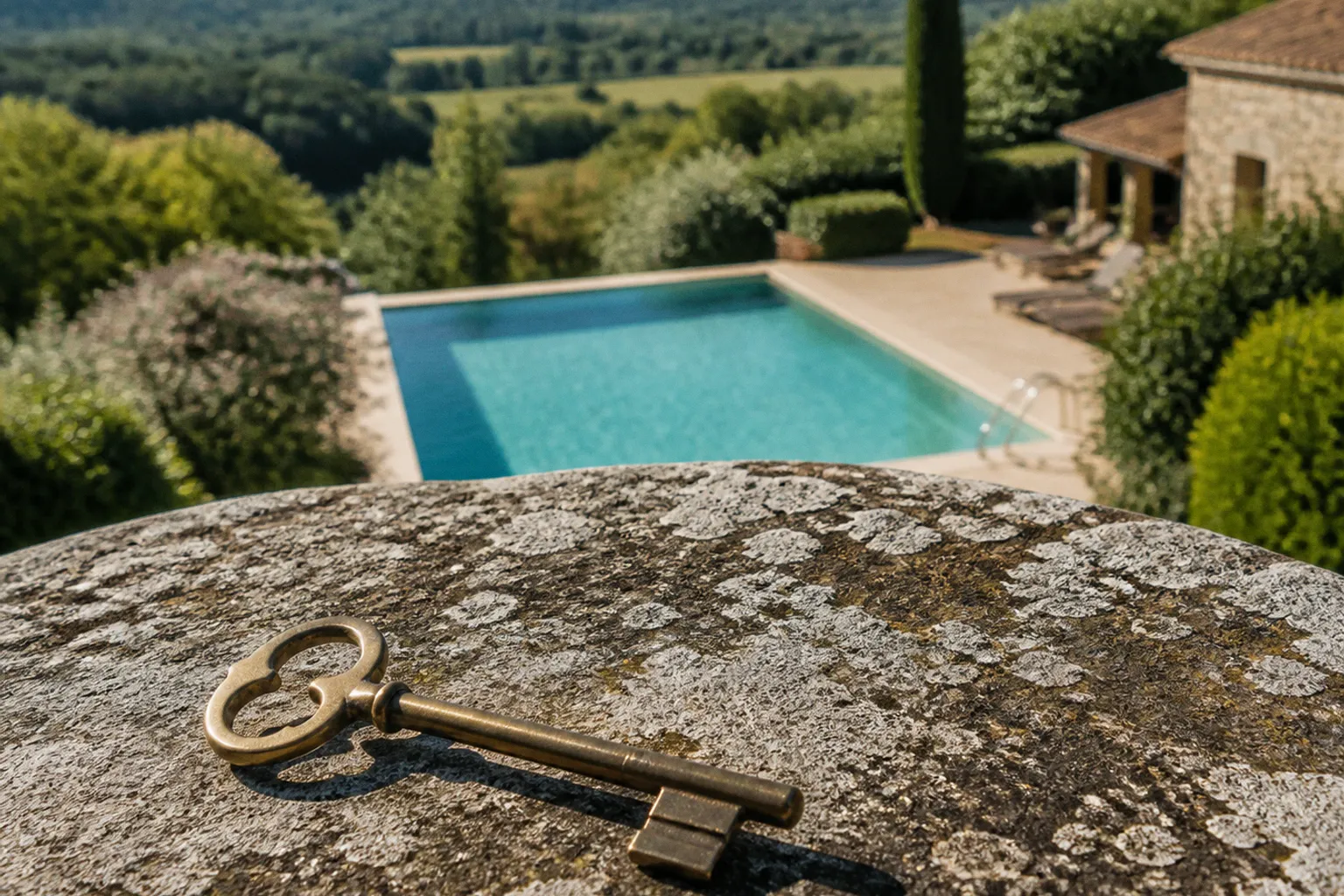
By then, the choice is still between properties rather than between whatever remains after the private-pool inventory has been filtered by dates, occupancy, and minimum-stay rules.
The financial structure is equally predictable. A booking made more than eight weeks before arrival commonly requires a 50% deposit, with the balance due eight weeks before arrival. Within that eight-week period, the full amount is generally payable immediately, including rental charges, cleaning fees, and tourist tax where applicable.
That gives the Dordogne luxury villa booking timeline a fixed backbone. The variable part is the property itself: access, sleeping configuration, pool specification, thermal performance, service logistics, and whether the advertised capacity is usable in practice.
Start with the season, not the property
The first decision is the month. The second is whether the required dates are fixed. Only then does property selection become efficient.
Peak summer in the Dordogne is July and August. These months carry the highest demand for private-pool villas and full estates, with many high-season properties requiring a minimum stay of seven nights, frequently on a Saturday-to-Saturday basis. The booking window of six to ten months is not a ceremonial recommendation. It is the period in which a family or group can still align dates, bedroom requirements, pool access, and location without making a material compromise.
For June and September, four to six months is a more practical lead time. Demand is usually less compressed than in July and August, but premium properties with a strong outdoor specification remain limited. A villa with a private pool, several properly sized bedrooms, a usable kitchen, and good proximity to markets or restaurants is not interchangeable with a larger house that merely has a swimming pool in the photographs.
Spring and autumn provide a longer selection window, often around three to five months. This does not mean that every property is available at short notice. It means that the pressure on the most desirable dates is lower, particularly when the group can travel outside school-holiday periods.
A useful planning sequence is:
1. Fix the arrival and departure dates.
If the group is travelling in July or August, assume that a seven-night stay may be the minimum practical unit. Do not build an itinerary around a Friday arrival until the rental conditions confirm that shorter or non-standard changeover dates are accepted.
2. Define the required sleeping capacity.
Count proper bedrooms, not the number of people mentioned in the headline capacity. A sofa bed in a living room is not equivalent to a separate bedroom for a multi-generational family or two couples travelling together.
3. Set the pool requirement.
Distinguish between a private pool, a shared pool, and a pool that is private only during certain periods. Also establish whether pool heating is available and whether it is included in the rate. The phrase “pool villa” is a category description, not a technical specification.
4. Check the location by driving time.
Dordogne distances are rarely judged accurately from a map. A property may appear close to a market town while access involves narrow lanes, bridge crossings, or a longer route than the straight-line distance suggests. Use proximity metrics based on actual driving time to the places the group will use.
5. Request the full cost before paying.
The rental fee may not be the complete figure. Cleaning, tourist tax, optional pool heating, security deposits, and other stated charges can alter the total. Exact tourist-tax rates vary by commune and property classification, so they should be confirmed for the specific address.
For a group with fixed school-holiday dates, this sequence should begin before browsing becomes enjoyable. Otherwise the search tends to proceed in reverse: attractive photographs are collected first, then rejected when the dates, occupancy, or payment terms fail.
In peak summer, the scarce asset is not a villa photograph. It is a compatible seven-night block with a private pool.
The six-to-ten-month window: what it actually secures
Booking six to ten months in advance does more than reserve a roof and a pool. It preserves the ability to reject properties that look luxurious but fail on physical or logistical grounds.
The highest-value checks concern the relationship between the property and the group:
- A six-bedroom estate may have only one adequately sized communal room.
- A stated capacity may depend on temporary beds or a converted annex.
- A private pool may sit beyond a gate or down a slope, which affects supervision of young children.
- A restored barn may retain substantial thermal mass and remain cool during the day, but that does not confirm the nighttime sleeping temperature or the presence of mechanical cooling.
- A large rural plot may provide privacy while increasing the distance to shops, restaurants, and emergency services.
- A visually impressive kitchen may have insufficient refrigeration, preparation surface, or seating for the advertised occupancy.
These are not defects by default. They are measurement questions. A luxury self-catering gite should be assessed as a working building, not as a still image.
Ask for a current floor plan where possible. Confirm which bedrooms are in the main house and which are in an annexe. Establish whether every bedroom has a permanent bed arrangement, usable storage, and a nearby bathroom. In older properties, the load-bearing structure and internal alterations may produce irregular room sizes and changes in floor level. That character can be acceptable. It becomes a problem when the booking description treats an awkward passageway or open mezzanine as a conventional bedroom.
The same applies to outdoor areas. A pool terrace may have excellent sun exposure but limited shade. A covered dining area may look substantial in photographs while accommodating fewer people than the indoor dining table. For a family villa holiday, footfall between kitchen, dining terrace, pool, and bathrooms is a practical design issue. Poor circulation creates friction every day, particularly when the property is occupied at full capacity.
A practical property audit before committing
The following questions produce more useful answers than general requests for reassurance:
- What is the exact bed configuration in each bedroom?
- Are any sleeping spaces located in an annexe or accessed externally?
- Is the pool entirely private to the booking party?
- What are the pool dimensions and opening dates?
- Is pool heating available, and is there a separate charge?
- Is air conditioning installed in bedrooms, communal areas, or neither?
- How many bathrooms are available, and how many include a shower suitable for daily use?
- Is the access road suitable for a normal rental car?
- Where are the nearest bakery, supermarket, market town, and restaurant?
- Which charges are payable at booking, eight weeks before arrival, or locally?
- What is the arrival procedure if the group reaches the property outside the stated check-in period?
The last question is often neglected. Rural rentals may have a fixed key handover process, a coded entry system, or a local manager who must coordinate arrivals. A late arrival is not automatically a crisis, but it is a logistical variable. A property with a long approach route and no nearby open shop should be treated differently from one within straightforward reach of a town.
Payment milestones: the booking is not fully paid when it is confirmed
The standard payment pattern is simple, but the timing has consequences.
For a stay more than eight weeks away, many luxury rental platforms and independent operators require:
- 50% deposit at the time of booking
- Remaining 50% balance due eight weeks before arrival
For a booking made within eight weeks of arrival, the usual requirement is 100% payment immediately. This commonly includes the rental fee, cleaning fee, and tourist tax, although the exact treatment depends on the operator and local arrangements.
The eight-week point should be entered into the travel plan as a hard financial milestone. It is not merely an administrative reminder. It is commonly connected to the cancellation terms, and the financial exposure changes materially once the balance has been paid. The exact refund position for cancellations inside that window is not universal across independent property owners. It must be read in the individual booking conditions rather than inferred from another villa.
A simple schedule helps:
| Booking stage | Typical payment position | Operational consequence |
|---|---|---|
| More than 8 weeks before arrival | 50% deposit | Dates are secured, but the booking is not fully paid |
| 8 weeks before arrival | Remaining 50% balance | Cancellation and financial exposure may change |
| Within 8 weeks of arrival | 100% immediately | Last-minute booking requires immediate funds and rapid document review |
| Arrival and stay | Any stated local charges or deposit requirements | Confirm method, timing, and release conditions in advance |
Do not compare properties on the weekly rental rate alone. A lower headline price can be offset by mandatory cleaning charges, tourist tax, or paid pool heating. Conversely, a higher rate may include services that would otherwise need to be arranged separately. The relevant figure is the full cost of occupying the property for the stated period.
This is especially relevant for premium French holiday homes where the property is marketed as an estate rather than a basic gite. The term “luxury” often reflects land, restoration quality, privacy, and furnishing rather than hotel-style service. Self-catering means that the group remains responsible for food, transport, daily housekeeping unless included, and the practical management of the house.
High-season constraints: seven nights, Saturday changeovers, limited flexibility
A common planning error is treating July and August as if every villa operates like a hotel. Many high-season rentals do not.
A seven-night minimum stay is common, and Saturday-to-Saturday changeovers frequently dominate the calendar. This affects more than the number of nights. It determines flight selection, car-hire duration, grocery planning, and the possibility of combining two properties.
If the group arrives on a different day, the available inventory may contract sharply. Some owners accept flexible arrivals outside the busiest weeks; others do not. That distinction should be established before an itinerary is built around a particular property.
The Saturday pattern also produces a predictable pressure point on roads and local services. It may be convenient for the rental operator because cleaning and inspection can be organised in a single weekly cycle. It is less convenient for travellers who want a short stay or a staged route through the region.
A property auditor assesses the changeover as part of the accommodation, not as an external inconvenience. Ask:
- What is the stated arrival and departure time?
- Is early arrival permitted if cleaning is complete?
- Is luggage storage available?
- Does the property require a final cleaning routine before departure?
- Are linens and towels supplied?
- Is a security deposit taken, and how is it returned?
- Is there a local contact for plumbing, electrical, pool, or heating issues?
These details become more consequential in a large restored barn or farmhouse. Multiple bathrooms, external shutters, pool equipment, septic systems, and outbuildings create more points of failure than a compact apartment. That does not make the property unsuitable. It means the management response should be part of the selection process.
The best time to ask these questions is before the deposit is paid. After confirmation, the available leverage is reduced to the contractual terms.
Budgeting by season: rate is a function of access, not just weather
The Dordogne rental market has a substantial seasonal spread. High-season weekly rates for full private villa estates can reach approximately €6,200 per week in July and August, while mid-season rates may be around €3,800 per week in May, June, and September. These are reference points, not universal tariffs. Property size, restoration standard, pool specification, location, and included services all alter the figure.
The comparison is useful because it shows what the shoulder season can buy. A June or September booking may reduce the weekly rate while retaining many of the features that attract travellers in July: outdoor dining, a private pool, access to villages and markets, and sufficient daylight for regional excursions. The trade-off is usually date flexibility and, depending on the property, less certainty about pool conditions or local operating schedules.
A budget should be divided into four separate lines:
1. Accommodation rate
The advertised weekly price for the property and dates.
2. Mandatory booking charges
Cleaning fees, tourist tax, and any other compulsory amounts stated in the terms.
3. Property-specific extras
Pool heating, additional linen, pet fees, firewood, or other optional services where applicable.
4. Use of the property
Food, transport, transfers, local activities, and any paid housekeeping or catering arranged independently.
This division prevents a common misreading. A villa can appear competitively priced while the group is still exposed to a significant final balance and additional charges. The payment schedule should be modelled against the full known cost, not the deposit alone.
There is also a capacity issue. If a property sleeps twelve but the group uses only eight bedrooms and has no need for the additional annex, the effective cost per usable bedroom may be less attractive than a smaller, better-configured house. Conversely, a larger property may provide the communal space, bathroom ratio, and privacy that make the stay function properly.
The correct comparison is therefore not “price per person” in isolation. It is value per usable configuration:
- proper sleeping spaces;
- bathroom access;
- indoor and outdoor communal capacity;
- pool privacy and usability;
- kitchen functionality;
- travel time to the group’s planned destinations;
- level of local support.
A luxury villa is expensive when its headline capacity is theoretical. It can be good value when the building absorbs a full group without forcing daily compromises.
When last-minute booking becomes a false economy
A late Dordogne villa booking can work in the shoulder or lower season, particularly when dates and property type are flexible. It is a poor strategy for a fixed July or August family holiday requiring a private pool, a specific bedroom count, and a Saturday-to-Saturday week.
The risk is not only that the best properties have gone. It is that the remaining options become difficult to compare properly. A group under time pressure may accept:
- a pool that is shared rather than private;
- an annexe arrangement that does not suit the occupants;
- a longer drive to essential services;
- a smaller kitchen or dining area;
- non-standard payment or cancellation conditions;
- a property with limited local support.
Within eight weeks of arrival, the entire booking cost is commonly due immediately. That compresses the time available for document review, travel planning, and resolving questions about access or equipment. A last-minute booking therefore requires a higher tolerance for uncertainty, not merely a willingness to pay.
The practical exception is a traveller with a narrow set of requirements and genuinely flexible dates. If the group can move by several weeks, accept a shorter stay outside peak season, or choose between a villa and a restored barn without insisting on a particular village, late availability may produce a workable result. The search must remain disciplined. A discount is not compensation for an unsuitable building.
A useful decision rule is binary:
- Book early when the dates are fixed, the group is large, a private pool is mandatory, or the property must meet specific accessibility and bedroom requirements.
- Consider waiting only when the dates, location, duration, and internal layout can all move without damaging the purpose of the trip.
The final booking sequence
Once a suitable property has survived the physical and financial review, the reservation process should be completed in a controlled order.
1. Reconcile the listing with the booking document
The contract or confirmation should match the advertised address, dates, occupancy, bed configuration, pool status, included equipment, and total charges. Marketing copy is not a substitute for booking terms.
2. Record every payment date
Enter the deposit date and the eight-week balance deadline in the travel calendar. Set a separate reminder for any requested guest information, security deposit, or arrival form.
3. Confirm the operational specification
Keep written confirmation of pool arrangements, heating or cooling, linen, towels, Wi-Fi, parking, and access procedure. A verbal assumption made during the search is weak evidence after the booking is confirmed.
4. Build the route around actual proximity
Measure driving times to the principal market town, food shops, restaurants, and planned excursions. Avoid treating the nearest named village as a complete service centre. Rural proximity is a logistical metric, not a decorative line on a brochure.
5. Plan the first six hours
The arrival period determines whether the property feels manageable or immediately inconvenient. Establish where food can be obtained, how keys are collected, what happens if the group is delayed, and whether the kitchen contains the equipment required for the first meal.
This is particularly relevant to self-catering. The property may be private and well furnished, but the group still needs to operate it. Refrigeration capacity, cookware, outdoor lighting, hot-water recovery, and waste arrangements matter more than a second set of decorative cushions.
Final verdict
The correct Dordogne luxury villa booking timeline is straightforward: six to ten months for July and August, four to six months for June and September, and a shorter window only when the traveller can accept reduced choice. The payment structure is equally clear: typically half at booking, half eight weeks before arrival, or the full amount immediately when booking inside that period.
Book early if the holiday depends on a private pool, a defined bedroom arrangement, a full week, or a particular standard of restoration and support. Waiting is defensible only when the dates and property specification are genuinely flexible.
The value verdict is binary. A premium Dordogne villa is worth the rate when its physical capacity, location, payment terms, and operating details match the group’s real requirements. If the luxury exists only in the photography, the booking is expensive regardless of the season.