Gite, barn, or villa: choosing your Dordogne rental
The first decision in planning a Dordogne holiday is often made before anyone looks at the swimming pool: how do you want the house to work when the market is full of peaches, the bakery run has…
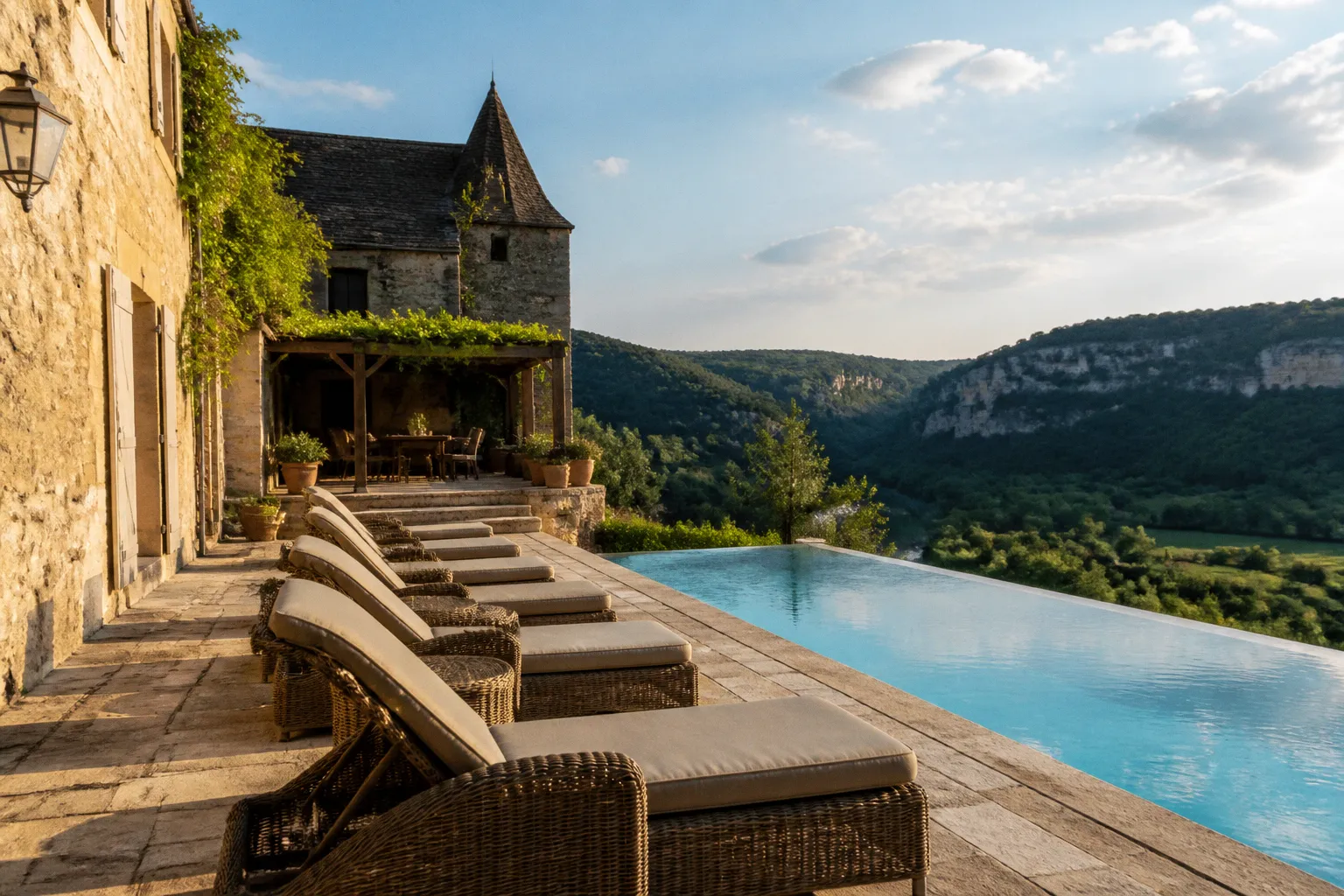
The first decision in planning a Dordogne holiday is often made before anyone looks at the swimming pool: how do you want the house to work when the market is full of peaches, the bakery run has already happened, and twelve people are deciding whether lunch belongs indoors or under the terrace awning?
A luxury gite vs villa rental in Dordogne is not simply a choice between an old building and a modern one. The words describe different histories and layouts, but they do not reliably tell you which property will feel more comfortable, more private, or better suited to your group. A restored farm annex may have a private heated pool, en-suite bedrooms and beautifully finished kitchens, while a villa may be less generous in character but easier for a large family to occupy.
The useful comparison is therefore practical: how the property was formed, how its rooms connect, what sort of outdoor life it supports, and whether its comforts match the way your party actually spends a day.
A gite is a history, not a level of luxury
The word gîte originally referred to a rural shelter or annex, often connected with a farm estate or country house. In the Dordogne, that history is still visible in many properties: a former stable converted into a kitchen and sitting room, an old maison d’amis standing just beyond the main farmhouse, or a stone outbuilding brought back into use as an independent holiday home.
In practical terms, a French gite is a furnished, self-catering property with its own entrance, kitchen facilities and living space. That independence is the important part. You are not fitting into a host’s breakfast schedule or sharing the main household; you have a base from which to organise your own meals, market trips and long afternoons by the pool.
The original agricultural purpose can create a particularly satisfying layout. Thick stone walls often keep bedrooms cooler during the first hot spell of summer. Exposed beams give the upper rooms their shape. A former barn may have a tall central volume that makes the living area feel generous even when the bedroom count is modest. But these advantages come with details that need reading carefully.
An old building may have:
- bedrooms arranged across more than one floor, which suits independent adults but can be less convenient with very young children;
- thick walls and smaller windows, helping with heat but reducing the amount of bright morning light;
- a separate pool terrace rather than a pool immediately outside the kitchen;
- a charming irregular staircase or split-level plan;
- an outdoor dining area that is perfectly placed for the evening but not necessarily beside the barbecue or kitchen door.
None of these features makes a gite better or worse. They tell you how to live in it.
A restored gite can be every bit as polished as a premium villa. The distinction is that its luxury often sits inside an inherited structure. You may find a carefully fitted kitchen tucked beneath old beams, modern bathrooms inserted into former utility rooms, and bedrooms whose proportions reflect the original farmstead rather than a contemporary floor plan.
The name of the property tells you where it came from; the floor plan tells you how your holiday will feel.
Restored barn, farmhouse, or villa: reading the building itself
A converted barn is usually the most recognisable form of rural restoration. In Dordogne, these properties often preserve the features that make the region’s architecture so distinctive: honey-coloured stone exteriors, exposed timber, terracotta floors and deep-set windows. The building may once have stored hay, sheltered animals or served as a working part of a larger farm.
That agricultural past can give a barn rental a strong sense of volume. High ceilings and broad rooms are common, with the former working space adapted for shared meals and evening gatherings. For a family or group of friends, this can be a real advantage. The kitchen, dining table and sitting room often become one connected social space rather than a series of separate formal rooms.
The trade-off is acoustic and visual rather than luxurious. Large open-plan rooms carry sound. A child waking early may be aware of the kitchen long before the rest of the party is ready for coffee. A group that enjoys cooking together will appreciate the openness; anyone seeking a quiet corner may need to choose a property with a second sitting room, a shaded terrace or a bedroom wing set away from the main living space.
A farmhouse rental can offer a different balance. Rather than one large converted volume, it may consist of several connected rooms or a main house with an adjoining annexe. This is helpful when a group wants to share a holiday without sharing every waking hour. Teenagers can have their own sitting area, grandparents can take a ground-floor bedroom, and early risers can make breakfast without turning the whole house into a morning assembly.
A villa, by comparison, usually suggests a property designed or substantially reorganised as a complete holiday home. The architecture may be traditional, contemporary or a mixture of both. The term itself does not guarantee a particular standard, just as gite does not limit a property to rustic accommodation. In the Dordogne, luxury villas commonly provide:
- larger bedroom suites with private or shared bathrooms;
- broad terraces designed for outdoor dining;
- private swimming pools, sometimes heated;
- sun loungers and dedicated poolside space;
- Wi-Fi and modern kitchen equipment;
- sleeping arrangements for anything from a couple to a group of 16.
The most useful question is not whether a building is called a barn or a villa. Ask whether its original structure has been allowed to support modern living, or whether the character has been preserved at the expense of practical circulation.
Space and scale: choosing for the group you actually have
Dordogne rentals range from intimate homes for two guests to large houses accommodating up to 16. Capacity, however, is only the first measure. A property can sleep eight people and still feel cramped if every bedroom depends on one bathroom, if the pool terrace has only six comfortable seats, or if the dining table is too small for the group’s preferred meal pattern.
This is where the difference between property types becomes useful.
| Property format | Usually suits | Strengths | Details to examine |
|---|---|---|---|
| Traditional or restored gite | Couples, smaller families, or groups who value character | Independent living, local architecture, often a strong connection to a farmstead or village setting | Staircases, bedroom separation, bathroom access and the distance between kitchen, terrace and pool |
| Converted barn | Families and social groups who cook and eat together | Generous shared rooms, high ceilings, exposed beams and a memorable sense of place | Acoustics, temperature in the high-ceilinged living area, privacy between bedrooms |
| Farmhouse or house with annexe | Mixed-age groups and friends travelling together | More than one living zone, flexible sleeping arrangements and useful separation | Whether the annexe has a full kitchen, how the buildings connect and which spaces are genuinely private |
| Luxury villa | Larger groups seeking easy circulation and contemporary comfort | En-suite bedrooms, spacious terraces, private pools and straightforward indoor-outdoor living | Pool heating, shade, air conditioning or cooling strategy, kitchen capacity and the number of proper dining seats |
For a family, the best Dordogne holiday homes are rarely the ones with the most dramatic photograph. They are the houses that remove small points of friction from the day.
Consider the harvest window of your holiday. In the hottest part of summer, everyone may spend more time outside than expected, but the house still needs a shaded place for lunch and a cool room for an afternoon nap. In early or late season, the balance changes: a heated pool, a comfortable sitting room and reliable indoor dining space become more valuable than an oversized sun terrace.
Sleeping arrangements also need a little more scrutiny than a headline capacity suggests. Eight guests might mean four equal double bedrooms, or it might mean two double rooms, one twin room and a bunk room. Those are not interchangeable arrangements for two families, a group of adults or a party with grandparents.
Before booking, look for the practical shape of the accommodation:
- Are the bedrooms grouped together or divided between floors and buildings?
- Does every guest have convenient access to a bathroom?
- Is there a ground-floor bedroom for anyone who prefers to avoid stairs?
- Can the kitchen store food for the full group without turning the refrigerator into a daily puzzle?
- Is the dining table large enough for one meal, or will people be eating in shifts?
- Does the pool area have shade as well as loungers?
- Can younger children reach the pool directly from the main terrace?
These are not minor domestic questions. They determine storage temperature, breakfast timing and whether the person preparing lunch can still keep an eye on the pool.
Private pools, terraces, and the real meaning of outdoor living
A private pool is one of the defining features of luxury self-catering gites in the Dordogne, but the word private deserves a practical reading. It should mean that the pool belongs exclusively to your rental, not that the water is necessarily heated, fenced, overlooked or directly beside the house.
Pool location changes the rhythm of a stay. A pool set below the house may offer a better view and more privacy, while one immediately outside the kitchen is easier for families with young children. A heated pool can extend the useful season, but it is worth confirming whether heating is included, available throughout the booking period, or offered at an additional cost. These details vary by property and should never be inferred from the word luxury alone.
The terrace is equally important. In the Dordogne, the main outdoor table is often the true centre of the house during summer. This is where bread is sliced, tomatoes are dressed, market cheese is brought out, and the day’s plans are negotiated over coffee. A terrace should therefore be judged by more than its view.
Look at:
- whether the table is shaded during the main lunch hours;
- whether the barbecue or cooking area is close enough to remain part of the gathering;
- whether there is lighting for late meals;
- whether the pool is visible from the dining area;
- whether there is a second outdoor corner for anyone who wants to read or retreat;
- whether the route from the kitchen is manageable when carrying hot dishes and bottles.
An elegant terrace with no shade can become unusable in the middle of the day. A smaller terrace with a deep canopy may yield far more pleasure because it works from breakfast through supper.
This is also where converted barns and villas can differ in character. A barn may open onto a stone courtyard, with walls that hold the evening warmth and provide shelter from the wind. A newer villa may offer a broad deck with uninterrupted views and easy access to the pool. The better choice depends on whether your group prefers enclosure and architectural character or open, uncomplicated circulation.
For anyone travelling with children, the pool’s relationship to the house matters more than its shape. A pool that can be seen from the kitchen and dining table makes supervision easier. A pool separated by a garden may be more peaceful for adults but requires a different arrangement of the day.
Traditional character and modern comfort do not have to compete
There is a persistent misconception that a traditional gite means accepting compromised bathrooms, awkward kitchens or furniture chosen for appearance rather than use. That may describe some poorly converted properties, but it is not a reliable definition of the category. A restored barn can retain stone walls and terracotta floors while providing modern plumbing, generous showers, efficient appliances and comfortable beds.
The question is how thoughtfully the old and new elements have been joined.
A well-converted property usually makes the original structure work harder rather than hiding it. Stone walls may contribute thermal mass. Timber beams may define the ceiling without lowering the usable height. A former stable door may become a glazed opening onto the terrace. At the same time, the kitchen should be sized for the number of people the house sleeps, and the bathrooms should reflect the actual capacity rather than the romantic history of the building.
For a self-catering holiday, kitchen specification is particularly revealing. A house that sleeps 12 but has a domestic refrigerator, limited work surface and a small oven may be visually beautiful but operationally frustrating. The issue is not whether the kitchen looks professional. It is whether it can handle a market shop, several courses, a large salad, breakfast supplies and the storage of leftovers without forcing the cook into constant rearrangement.
Pay attention to:
- refrigerator and freezer capacity;
- the number of cooking zones and oven size;
- dishwasher capacity;
- preparation space beside the hob;
- outdoor cooking facilities;
- the number and quality of glasses, plates and serving dishes;
- pantry storage for dry goods and wine;
- laundry facilities for longer stays.
This is the point at which practical luxury becomes visible. A beautiful butcher’s cut needs a cold place to rest; a dozen guests need enough plates to avoid running the dishwasher after every course; a family returning from the market needs somewhere to put fruit without bruising it under a stack of bread.
The same principle applies to bedrooms. Exposed stone and old beams create atmosphere, but a good mattress, sensible bedside lighting, proper storage and a bathroom that can be reached without crossing the communal living area create comfort. Luxury is not the removal of history. It is the careful addition of what daily life requires.
In a self-catering house, luxury is measured at the moment the provisions arrive: enough cold storage, enough work surface, enough shade, and nowhere for the day to become awkward.
French accommodation terms: gite, villa, and chambre d’hôte
The terminology around French accommodation can be confusing because several words are used in English listings as if they were interchangeable. They are not quite the same, although modern marketing often places them side by side.
A gîte is an independent furnished rental with its own entrance, living space and kitchen. It may sit within a village, on a farm estate or as a separate building in the grounds of a larger property. It is designed for self-catering, so guests organise their own breakfasts, meals and housekeeping according to the rental arrangement.
A villa is a broader property term. Its roots lie in the idea of a country retreat, but contemporary listings use it for many kinds of premium holiday homes. In the Dordogne, a villa might be a modern house with clean lines and generous glazing, a traditional stone home with a substantial renovation, or a private estate intended for a larger group.
A chambre d’hôte is different again. It is a bed-and-breakfast accommodation offering up to five guest bedrooms within the host’s private home, with breakfast included. It is not a self-catering rental, even when the setting is rural and the rooms are beautifully presented. Guests should expect a hosted arrangement rather than a private house with an independent kitchen and living area.
The distinction matters when comparing prices and availability. A gite or villa gives you control over the pantry, the meal schedule and the use of the property. A chambre d’hôte may provide local knowledge and breakfast, but it does not offer the same level of private domestic space.
When reading a listing, separate the label from the evidence. Look for:
1. Independent access. A true self-catering rental should have its own entrance and living arrangement rather than relying on shared household facilities.
2. Kitchen provision. Check whether it is a complete kitchen or simply a kitchenette intended for drinks and light snacks.
3. Pool ownership. Confirm whether the pool is private to your booking or shared with the owners or another rental.
4. Bedroom configuration. Capacity should be matched against bed types, bathroom access and the position of each room.
5. Outdoor space. A private garden, terrace and pool area can mean very different things depending on whether they are enclosed, overlooked or shared.
6. Seasonal operation. Pool heating, outdoor dining and certain facilities may be available only during particular periods.
7. Pricing structure. Weekly rates for luxury Dordogne villas can begin around €2,700 or more during peak periods, depending on size and classification, but property terminology alone does not establish the price. Season, pool facilities, finish, location and capacity all affect the final figure.
This is why a direct comparison between gite and villa prices can mislead. A small, highly finished gite may cost more than a larger but simpler villa in a different season. A converted barn with a private heated pool may sit firmly in the luxury bracket, while a property described as a villa may offer fewer services or less privacy.
Which format suits your Dordogne holiday?
The right rental is the one whose practical rhythm matches your group.
Choose a restored gite if you want architectural character, independent self-catering and a property with a strong connection to the surrounding rural landscape. This can be especially appealing for couples, smaller families and groups who enjoy a house with visible history and a more intimate scale.
Choose a converted barn if the shared parts of the holiday matter most: long lunches, cooking together, evening games and a generous room where everyone can gather. Check the bedroom layout and sound transfer before committing, particularly if the group contains both early risers and late-night cooks.
Choose a farmhouse with an annexe if you need flexibility. It is often the most forgiving arrangement for mixed-age families or friends travelling together, provided the separate spaces are genuinely usable and not simply an extra bedroom with no living area.
Choose a villa if you value contemporary circulation, en-suite facilities, broad terraces and a straightforward relationship between the house and pool. This is often the easiest format for larger groups, but the quality still depends on the details: shaded outdoor dining, a properly equipped kitchen and enough bathrooms for the advertised capacity.
For the best exclusive holiday lets in the Dordogne Valley, begin with your daily pattern rather than the property label. Decide whether lunch will usually be prepared at home, whether everyone needs to sit together, whether the pool will be used in the cooler shoulder months, and whether the party wants one shared house or several pockets of privacy.
Then read the listing as if you were preparing the first market shop. Where will the cheese go? Can the vegetables be washed and prepared without blocking the kitchen? Is there a cool, shaded place for bread and fruit? Can the whole group eat outside without balancing plates on laps?
That exercise usually reveals more than the photographs.
The practical choice
A gite, barn and villa can all provide an exceptional Dordogne stay. The differences lie less in a simple hierarchy of luxury than in the way each property carries its past into present-day living.
The strongest rental combines the right structure with the right habits: enough privacy for quiet mornings, enough shared space for generous meals, a kitchen that can handle the local yield, and an outdoor setting that works beyond the single hour shown in the brochure photograph.
My practical advice is to shortlist by capacity, bedroom arrangement, pool position and kitchen performance first, then use architectural character to make the final choice. When those fundamentals are right, the exposed beam, honey-coloured stone or contemporary terrace becomes what it should be: an enhancement to the holiday, not a substitute for comfort.