Shifting Travel Trends: Why Luxury Dordogne Gites Are the Smart Choice for 2026
A 79.1% occupancy rate in June is the clearest signal in Alliance France Tourisme’s summer 2026 report: France’s accommodation market is busy, but demand is no longer concentrated exclusively in the traditional coastal and high-season circuit.
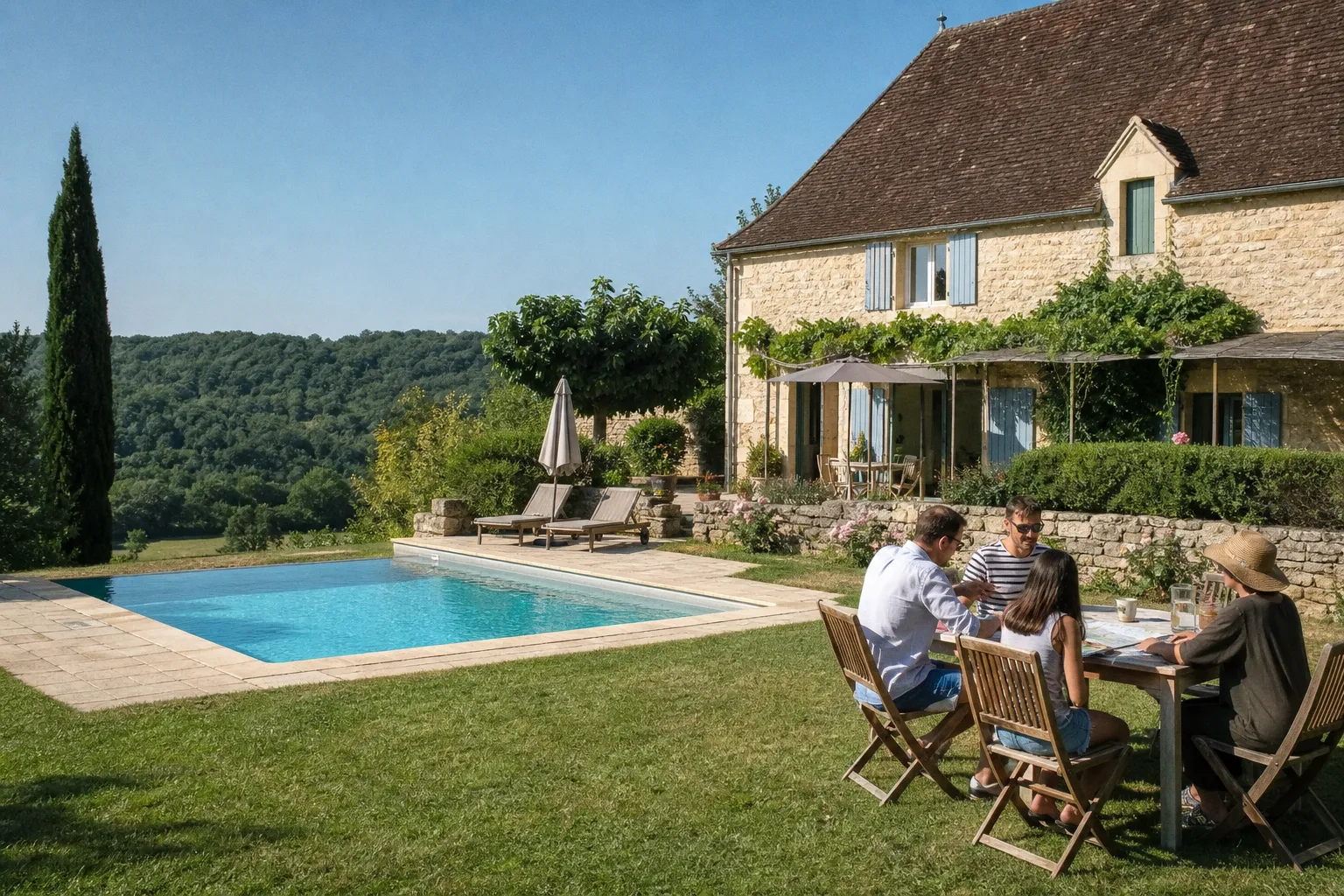
For travellers considering a luxury self-catering gîte in the Dordogne, the useful conclusion is narrower. France remains competitive and expensive at peak periods, while the report does not provide a specific Dordogne occupancy figure.
Demand is spreading beyond the standard summer map
Alliance France Tourisme reported that French hotel occupancy reached 79.1% in June, 1.3 percentage points above 2025. Revenue per available room rose by 3.7%. July followed the same direction, with occupancy up 0.9 points and RevPAR up 3.3%.
Those figures concern hotels, tourist residences and holiday villages rather than gîtes specifically. They nevertheless establish a broader operating environment for French accommodation: strong demand, continued price pressure in the upper market, and a season that is beginning to distribute itself differently.
The report identifies three forces behind that shift. Record heat redirected some demand towards the Channel coast and the mountains. Purchasing-power constraints encouraged some travellers to move trips into June and September. International demand continued to support the upmarket and luxury segments, where RevPAR increased by 4.4% in June and 5.1% in July.
For Dordogne visitors, the second and third points matter more than the headline national occupancy rate. A private pool, usable outdoor space and a self-catering arrangement may provide more control over total holiday spending than a hotel-based itinerary, but the evidence does not show that Dordogne gîtes are becoming cheaper. It shows that France’s higher-value accommodation market remains active.
August was strong, but not frictionless
The centre of the season was less uniform. Between 1 and 17 August, national occupancy stood at 72.5%, down 0.7 points on 2025, while RevPAR fell by 1.5%. The source attributes the softer performance partly to cancellations linked to the Gironde wildfire and partly to delayed last-minute bookings amid geopolitical tensions and historically high peak-season prices.
This is a logistical warning for anyone relying on late availability. High national demand does not guarantee a smooth last-minute market. The report describes a pause in August rather than a collapse, with levels still high in absolute terms. It also notes that all categories and regions were affected by the broader trend.
The regional winners were not limited to the usual southern destinations. Brittany recorded August occupancy growth of 1.6 points, with RevPAR 6.1% above 2025 and 19% above 2024. The Channel coast, from Le Havre to the Côte d’Opale, recorded the strongest growth among French coastlines in July, with occupancy up 4.5 points year on year and nearly 10 points over two years. Normandy gained 2.6 points during August.
The Côte d’Azur remained a high-demand benchmark, exceeding 90% occupancy at the height of summer. The Northern Alps also strengthened their position as a two-season destination, with June RevPAR up 22% compared with 2025.
None of these figures should be transferred directly to the Dordogne. They do, however, confirm that travellers are actively reassessing destination, timing and climate exposure rather than simply following the conventional July–August pattern.
What to check before choosing a Dordogne gîte
The report supports a practical booking sequence.
First, separate the property from the market narrative. National hotel data is not a substitute for confirmed availability, pricing or operating details at an individual gîte. Check the actual booking calendar, the cancellation terms and whether the pool is available for the full travel period.
Second, test the value of the shoulder season. Alliance France Tourisme specifically identifies June and September as periods benefiting from purchasing-power trade-offs. That does not prove a discount at a particular Dordogne property, but it makes those dates relevant when comparing total accommodation cost and flexibility.
Third, treat the luxury label as a pricing category, not a specification. The report shows continued growth in the upmarket and luxury segments. It does not define what those terms include. For a rural rental, the measurable points remain the same: pool access, sleeping capacity, kitchen provision, outdoor layout and the practical distance to the places on your route.
The wider European market is also strong. A late-August report cited by TTR Weekly said Europe captured one-third of global leisure travel spending in 2025, with France among the leading Southern European destinations. That supports the expectation of continued competition for desirable French stays, but it is not a forecast for any individual Dordogne village.
The verdict is binary: for a peak-summer gîte, assume competition and limited last-minute leverage; for June or September, investigate the numbers rather than assuming the brochure price is fixed.