Dordogne river kayaking: finding the perfect time of day
The Dordogne in July rewards an early decision about timing. By the middle of the day, the valley can feel hot, the busiest rental period is under way, and the limestone cliffs reflect light back across the water.
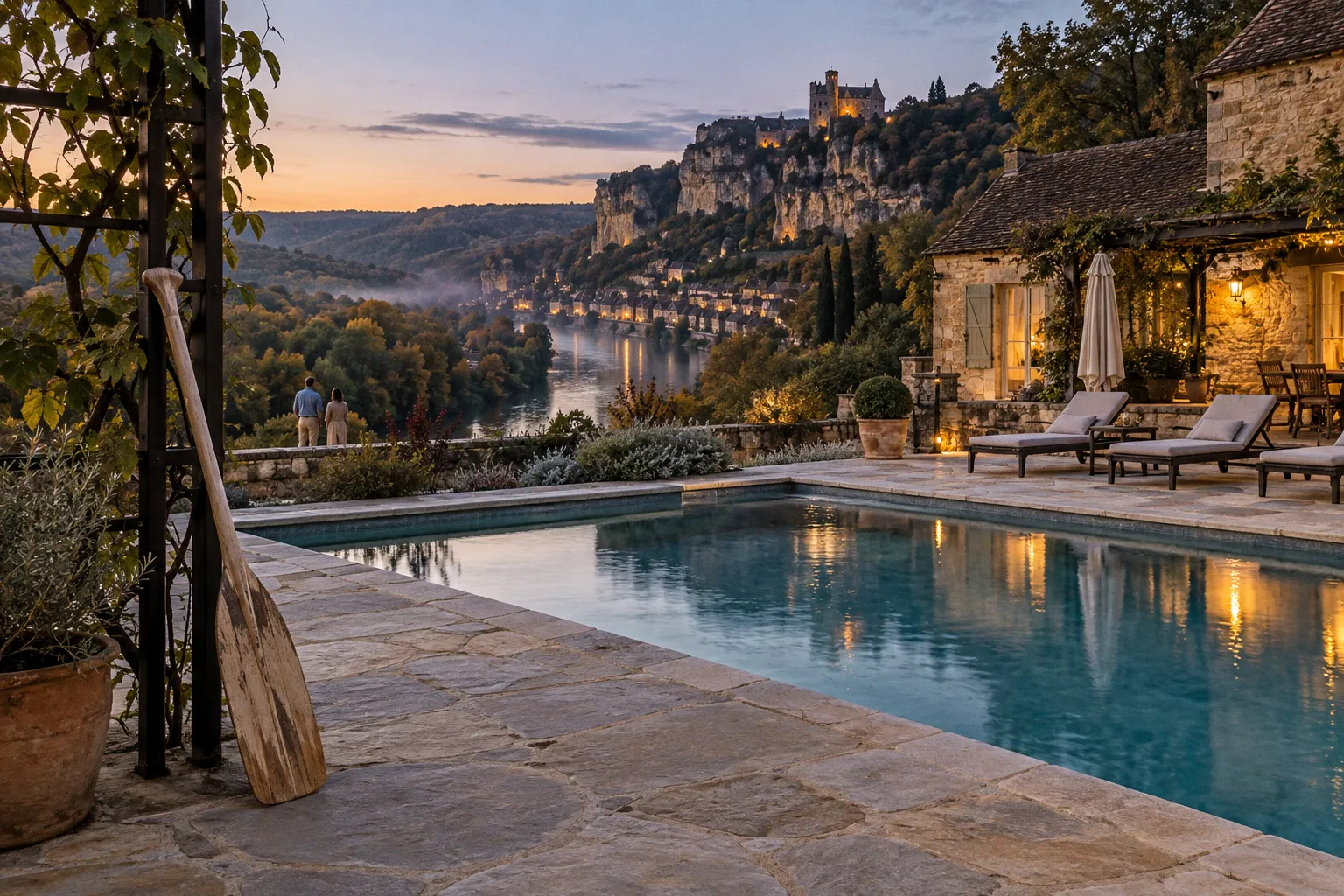
A route described as easy on a rental brochure can feel considerably less relaxed when you launch into the warmest and most crowded part of the afternoon.
Your start time is not the only decision that matters, but it shapes almost every other one: how much energy you have left for the second half of the route, how much space you find around the popular landing points, and whether the cliffs appear in hard glare or warm, readable light. Choose well and the Dordogne becomes an unhurried glide through one of the most attractive stretches of river in south-west France. Choose badly and heat, traffic and logistics begin competing for your attention.
On the Dordogne, the best time of day is the one that matches the experience you actually want from the river.
The Case for Early Morning Starts: Mist, Light, and Solitude
An early launch offers the clearest route to a quieter river. Before the main rental traffic builds, sheltered bends around Vitrac and Beynac may still hold a thin layer of mist, while the air is generally more comfortable than it will be later in the day. The first boats also have more room to choose their line around gravel bars, bends and landing areas without having to make constant adjustments for other groups.
There is an important practical qualification here. A standard rental base may not be open for a casual pre-9:00 AM departure. If you want to be on the river earlier than the operator’s normal launch schedule, arrange it privately in advance with the specific rental company. Do not assume that arriving at the door before opening time will produce a boat, shuttle or safety briefing.
That private arrangement can be worthwhile for photographers and experienced paddlers, but it should be treated as a special departure, not as the normal operating pattern. You need to confirm where the shuttle will collect you, which section is available, when the return vehicle leaves and whether the operator is comfortable with the water and weather forecast for that part of the day.
The morning light is one of the strongest arguments for going early. At a lower angle, it picks out the texture of the limestone and gives Château de Beynac, the cliffs near La Roque-Gageac and the valley’s wooded slopes more definition. Later, when the sun is high, the same scenery can lose contrast under a broad wash of white glare. The river may still be beautiful, but it becomes harder to photograph well, particularly from a moving kayak.
Morning is also helpful if your group includes people who are not used to paddling for several hours. Cooler conditions do not remove the physical work of a 14-kilometre route, but they can make it easier to maintain a steady rhythm. You are less likely to begin the day already overheated, and you have more flexibility to stop when someone needs a drink, a snack or a short break on the bank.
The river itself is not automatically faster in the morning. This is where a common assumption about Dordogne river water levels, morning versus afternoon, needs some care. Ordinary daily temperature changes do not create a reliable timetable for the water level on the section used by holiday rentals. Rainfall, upstream conditions and occasional managed releases matter more. Ask the rental base about the current flow on the day rather than choosing a launch time on the theory that morning water will always be higher or more favourable.
Wind can also influence the feel of the route. Valley weather is changeable, and a calm morning is possible without being guaranteed. If the forecast suggests wind later in the day, an early departure may provide a more settled paddle. If the morning is forecast to be breezy, however, do not treat the clock as a substitute for checking conditions. A quiet-looking river at the launch point can behave differently around an exposed bend or below a high cliff.
Who benefits most from an early start?
An early window is particularly well suited to:
- photographers who want softer contrast and fewer boats interrupting views;
- families who prefer to finish the main paddle before the hottest part of the day;
- paddlers planning a longer route or several stops;
- anyone who dislikes negotiating busy landing beaches;
- visitors who want to hear the river and birds rather than a constant exchange of shouted instructions between groups.
There is a trade-off. Morning departures can feel less flexible. Some cafés, village services and riverside stops may not yet be fully open, and a private early launch requires more advance coordination. For a relaxed holiday group, the first available standard departure may be a better choice than forcing an unusually early start.
Navigating the Midday Heat: Managing Peak Summer Traffic
The late-morning to mid-afternoon period is when the Dordogne usually feels most active. This is the main operating window for many rental groups, and popular stretches can become busy with canoes, kayaks, swimming stops and boats moving between launch and collection points. The issue is not simply the number of craft. It is the difference in experience and speed between them.
A confident paddler may be trying to hold a straight line through a bend while another group is drifting across it, stopping to take photographs or deciding where to land. On a broad section of river this is manageable. Near a shallow gravel shelf, a narrow channel or a busy beach, small delays accumulate quickly. The result is not necessarily dangerous, but it can turn a scenic route into a sequence of avoidable manoeuvres.
The heat adds another layer. There is no need to attach a dramatic formula to reflected sunlight to understand the problem: water, pale stone and limited shade can make the middle of the day feel more exposed than the temperature alone suggests. Shoulders, forearms, knees and the backs of hands are particularly easy to overlook when you are sitting low in a boat. Apply sun protection before launching, cover up where practical, and keep drinking throughout the route rather than waiting for thirst.
If midday is the only slot available, make the route easier on yourself rather than pretending the conditions do not matter.
Stay alert to the distinction between the main flow and the edge of the river. The centre may carry you along efficiently, but it is also where traffic and wakes tend to concentrate. Near the margins, the water can be shallower and slower, with more opportunities to find shade or pause. Do not hug the bank blindly: avoid submerged branches, private landing areas and awkward shallows, and follow the operator’s briefing about the safest line for that section.
Choose stopping points before fatigue makes every decision feel urgent. A short break in shade can be more useful than trying to maintain an ambitious pace and then arriving at the next landing exhausted. If someone becomes dizzy, unusually confused, nauseated or severely cramped, stop paddling and get them out of the sun. Contact the operator or emergency services if the symptoms do not settle promptly. A route can be shortened; heat illness should not be negotiated with.
Midday is not forbidden. It simply leaves less room for poor hydration, weak sun protection or an over-ambitious route.
Traffic is also a reason to look beyond the most obvious itinerary. A section with the same headline landmarks may feel entirely different when approached at a quieter hour or with a shorter planned distance. Speak to the rental base about the expected traffic for the specific launch point, not just the river in general. Conditions around Vitrac, Beynac and La Roque-Gageac can vary according to the day’s bookings, local events and the weather.
Golden Hour Paddling: Why Late Afternoon Wins for Scenery
Late afternoon is often the best compromise between comfortable temperatures, accessible rental logistics and attractive light. As the sun moves lower, the glare softens and the limestone begins to show colour and relief again. The cliffs around Beynac and Castelnaud can take on a warmer tone, while the wooded slopes and village façades become easier to distinguish from the bright surface of the river.
This is the window for people who want the Dordogne as a landscape rather than as an athletic challenge. A slower pace leaves more time to look up at the château, drift past a cliff face or stop briefly without feeling that the whole route is falling behind schedule. It can also suit photographers who find morning departure logistically difficult but still want something more considered than overhead midday light.
The phrase “golden hour” should not be treated as a fixed appointment. The timing changes with the season, the weather, the orientation of the valley and the section you choose. In July, sunset in the Dordogne is much later than the early-evening timetable often imagined by visitors. At 7:00 PM there can still be strong daylight, and the river may remain comfortably bright well beyond that point. The exact quality of the light depends on where the sun is in relation to the valley and whether clouds are filtering it.
That later daylight does not mean you should plan carelessly. Rental collections operate to a schedule, and a final landing point in deepening shade may be less straightforward to find than it looked on the map. Confirm the latest return time, allow for pauses and leave a margin for a tired paddler or a slower group. The relevant deadline is the operator’s collection arrangement, not simply sunset.
Late afternoon wind can be either an advantage or a nuisance. Local breezes may ease as the day cools, but there is no universal rule that the river becomes perfectly calm at sunset or changes from choppy to glass-like within a set number of minutes. Wind can persist after the light has turned golden, and a sheltered bend can be calm while an open reach remains rippled. Check the forecast and read the water as you go.
A late launch also requires honest thinking about the group. If younger paddlers are likely to tire after several hours, the improved light may not compensate for a return that arrives when everyone is hungry and less attentive. For adults who can maintain a steady pace, or for a shorter scenic section, the later window can be excellent. For a mixed group, ask the operator which route leaves the least demanding final stretch.
The best light for photography on the Dordogne River
Photographers should separate three different aims:
- Mist and quiet surfaces: early morning offers the best chance, especially after a cooler night and in sheltered bends.
- Readable detail on the limestone: morning or late afternoon is usually preferable to the high-contrast middle of the day.
- Warm colour on the cliffs: the later part of the afternoon, subject to the valley’s orientation and cloud cover, is the stronger choice.
A phone is enough for memorable images, but protect it properly. A dry bag should be genuinely sealed, not merely zipped into a soft pouch that can open when the kayak shifts. Keep the camera accessible without placing it where a sudden wake can send it overboard. The most successful river photographs often come from a brief pause near the bank rather than from trying to shoot while correcting the boat’s direction.
Logistics and Timing: Planning Your 3–4 Hour Excursion
A three- to four-hour excursion is not three to four hours from the moment you arrive at the water. The real schedule includes registration, equipment fitting, the safety briefing, the transfer to the launch point and the paddle itself. Add time for swimming, photographs, snacks, minor delays and the final collection. A route that looks modest on a map can occupy much of the day once those pieces are included.
The operator’s timetable is therefore part of the route. Ask:
- What time must you check in?
- How long is the transfer to the launch point?
- Is the stated distance measured to the collection beach or to a choice of landing points?
- What happens if the group is late?
- Which sections are suitable for children and first-time paddlers?
- Is the route changed when water levels, weather or traffic make the planned section unsuitable?
Do not build a private itinerary around an assumed 7:30 AM arrival or a late-evening collection. If you want a departure outside the normal schedule, obtain a prior private arrangement from the operator and confirm it in writing. The same applies to any request for a non-standard launch point or an early shuttle.
For a half-day route of around 14 kilometres, the distance is only one part of the calculation. A group that paddles continuously may move quickly, while a family stopping to swim and eat will cover the same water over a much longer period. Current conditions, boat type and the experience of the slowest paddler all matter. It is usually better to finish with time and energy in reserve than to choose a longer route because it appears more impressive on the booking page.
Longer itineraries can extend across much of the day and may cover a wider distance depending on the operator and the current flow. They demand more than physical endurance. You need enough food, water, sun protection and patience for the final section, when a small inconvenience feels larger than it did at the launch beach.
Families should be particularly cautious with age and duration. Standard rental routes commonly have a minimum age in the region of five or six, depending on the operator and the section of river. A child below that range should not be assumed to qualify simply because the water looks calm. Participation below the operator’s stated minimum would require a specific private arrangement on an appropriate, calmer stretch, with the operator confirming that it is permitted and suitable. It is not a normal extension of the standard family booking.
Time-of-day comparison at a glance
| Window | What usually works well | What requires attention | Best suited to |
|---|---|---|---|
| Early morning | Quieter water, softer light, cooler start | Standard rentals may not launch before their normal opening time; earlier departure needs prior arrangement | Photography, families, longer routes, solitude |
| Late morning to mid-afternoon | Easiest fit with standard holiday schedules | More traffic, stronger sun, busier landing points and greater need for breaks | Groups with limited availability |
| Late afternoon | Warmer light, often a more relaxed scenic pace, potentially less traffic later in the window | Collection times, tired children, changing wind and the need to preserve daylight | Scenery, photography, shorter or well-paced routes |
Water levels should be discussed with the rental base rather than inferred from the time of day. The Dordogne is influenced by rainfall, seasonal conditions and upstream management, and a route can feel different from one day to the next. A higher flow may alter the pace; a lower level can expose shallows and make certain lines less convenient. The operator will know which section is appropriate for the day’s conditions.
This is also why a weather app is not enough. Look at the forecast for wind, thunderstorms and heat, but ask locally about the river. A storm upstream may matter even if the sky above your accommodation is clear. If the operator changes the launch section or advises postponing, that is useful local information, not an inconvenience to be argued away.
Safety and Regulations: Essential Requirements for Every Paddler
The operator’s briefing is not administrative filler. It is where you learn the relevant landing points, the expected route, what to do if the group becomes separated and how the rental company wants a capsize handled. Listen even if you have paddled elsewhere. A familiar boat does not make an unfamiliar river familiar.
Every participant should be able to swim and remain calm in moving water. Rental companies may refuse a booking where a participant cannot meet their swimming requirement, and the exact conditions can vary by operator and route. Ask before paying if there is any doubt, particularly when booking for children or for someone who is not confident in open water.
Wear the provided life jacket correctly throughout the trip. It should be fitted to the person wearing it, secured as instructed and comfortable enough that nobody is tempted to remove it during a stop. If you bring your own buoyancy aid, confirm in advance that the operator accepts it and that it meets the relevant requirements.
The usual minimum age for standard rental sections is around five to six years, but the operator and the river section determine the actual rule. Children below that age require a specific private arrangement, if one is available at all, on a calmer and suitable stretch. Do not place a younger child in a standard boat simply because another family has done so. The limiting factor is not only the child’s ability to sit still; it is their response to cold water, sudden movement, sun and fatigue over several hours.
Alcohol and paddling are a poor combination. Do not drink before launching, and do not treat a riverside picnic as an invitation to continue once your judgement or coordination is affected. The river does not become safer because the next landing beach is close.
If a kayak overturns, follow the briefing given by the operator. In many situations, staying with the boat makes you more visible and gives you something to hold while moving toward the bank. If the current is carrying you, floating on your back with your feet downstream can help protect your head from obstacles. Do not fight the current unnecessarily, and do not attempt a risky recovery for a paddle or loose item. The correct response depends on the section, the water conditions and the instructions provided at check-in.
What to carry before pushing off
A sensible loadout is uncomplicated:
- a correctly fitted life jacket for every paddler;
- a sealed dry bag for phones, keys, documents and medication;
- enough drinking water for the planned duration, with more for hot weather;
- sun cream applied before launch and clothing that covers vulnerable shoulders;
- a hat that will stay on when the boat moves;
- secure footwear that can get wet and will not fall off easily;
- food or snacks if the route includes a long interval between landing points;
- a whistle or other signalling device if supplied or recommended by the operator.
Keep the boat tidy. Loose phones, shoes and bottles become hazards during a capsize and are easily lost in the current. A paddle should be checked for obvious damage and adjusted to a comfortable position before departure. If a grip, seat, footrest or buckle feels loose, report it at the launch point. There is no benefit in diagnosing equipment once you are several kilometres downstream.
Final Word: Pick the Window, Then Pick the Route
The usual planning mistake is to choose a route first and then accept whatever departure time remains. Reverse that order. Decide whether the day is mainly about quiet water, warm light, a manageable family outing or covering more distance. Then choose the section that fits the available window and the ability of the group.
For most visitors, the best time of day for Dordogne river kayaking is either early morning or late afternoon. Early morning gives you cooler air, fewer boats and the cleanest chance of mist and soft light, but a pre-9:00 departure must be arranged privately rather than assumed. Late afternoon offers the strongest scenery and a slower atmosphere, provided you respect the operator’s collection time and leave enough margin for stops.
Midday remains workable when the schedule leaves no alternative. Shorten the ambition, protect yourself from the sun, drink regularly and expect more traffic. Ask the rental base about the day’s water conditions, the likely crowding and the most suitable section. That small conversation is often more valuable than another hour spent comparing route descriptions.
The Dordogne is generous with scenery but not with careless planning. Treat launch time, water conditions, weather and group ability as one decision, and the river will usually give you the experience you came for.