Dordogne river kayak rental vs canoe hire: choosing your craft
Two craft. One river. Plenty of ways to choose badly.
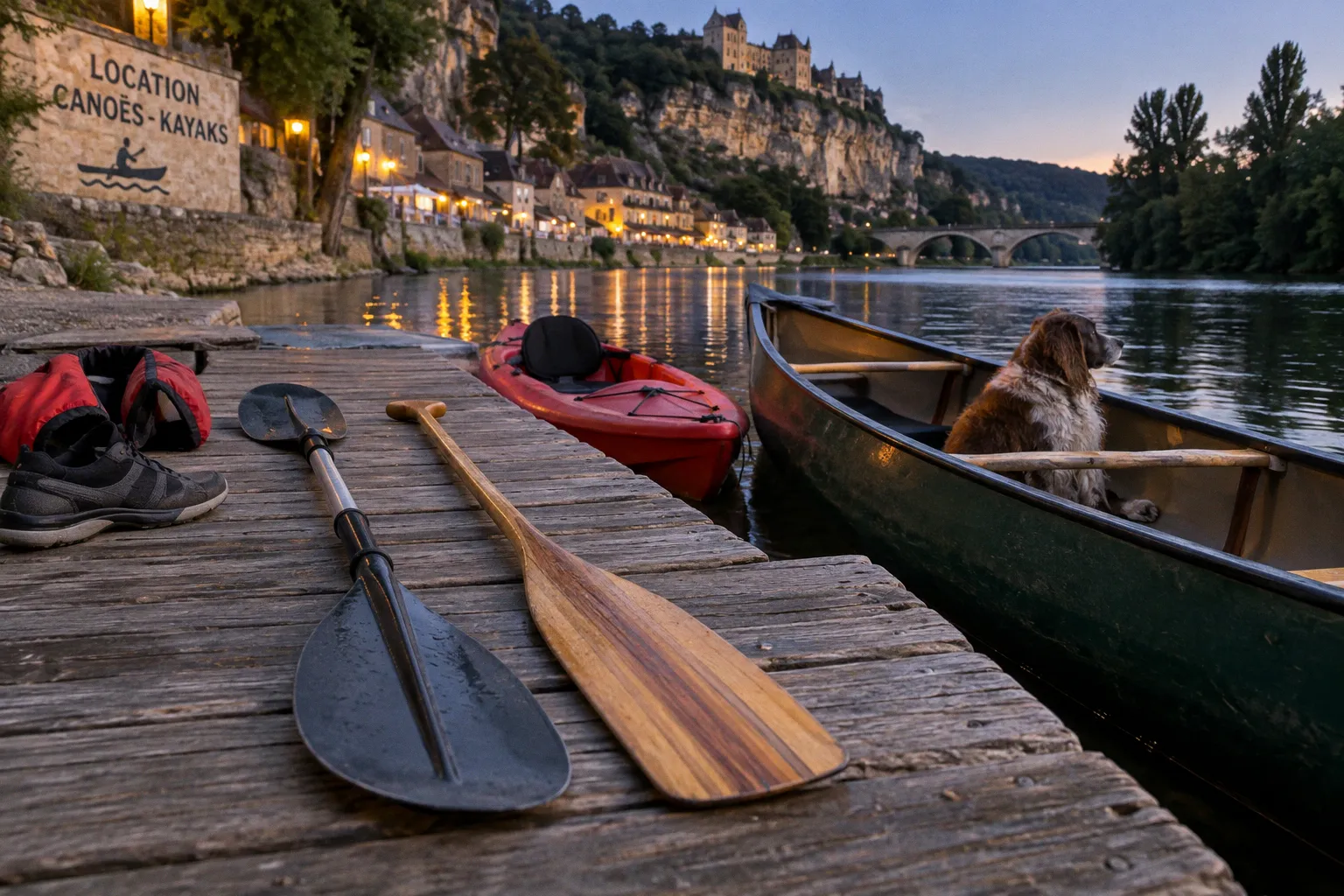
At a Dordogne rental base, the decision often looks simpler than it is. The kayak appears quicker and more athletic; the canoe offers space, stability and the familiar shape of a traditional river boat. Most people choose by instinct — the kayak because it looks faster, the canoe because it is “the classic”. Neither instinct is entirely wrong. Both can undermine a day on the water if the choice ignores what you are carrying, who is in the group, how far you plan to travel and how confidently you can respond when the current stops behaving like flat water.
The Dordogne is not a whitewater playground, but it is not a swimming pool either. Low gravel bars, shallow riffles, awkward landings, cross-currents and tired paddlers create most of the practical difficulty. The right boat is the one that leaves you with enough control and energy to deal with those details.
Design and Handling: Understanding the Craft
The open Canadian canoe and the sit-on-top kayak are designed around different priorities. They may sit side by side on the same beach, but they ask different things of the people inside them.
An open Canadian canoe — often a broad recreational model in a rental fleet — has an open hull, raised seats or thwarts and space between the paddlers for dry bags, coolers and other equipment. It is propelled with a single-bladed paddle. The stern paddler normally provides much of the steering, while the bow paddler helps with direction and obstacle avoidance. A canoe can also be paddled solo, although a loaded solo canoe takes more deliberate weight placement and correction than a tandem boat.
The open deck is the canoe’s central advantage. A child can sit where the adult can see and reach them. A dog can lie on a towel in the middle of the boat. A day bag does not need to be forced into a small hatch. You can shift position, redistribute weight and deal with a wet picnic without turning the boat into a luggage puzzle.
That openness has costs. Everyone is exposed to spray and sun, and there is no enclosed cockpit to keep the lower body dry. A canoe also rewards cooperation. Two paddlers who use their strokes at different times can make a wide boat wander; two paddlers who communicate clearly can turn it into a remarkably efficient platform. On a long day, the kneeling or perched position may also be less comfortable for people accustomed to a kayak seat.
A sit-on-top rental kayak has a different layout. The paddler sits on a molded seat on top of the hull, with legs open to the air and feet supported by molded footrests or footwells. There is no enclosed cockpit to climb into and no narrow spray-skirted opening around the waist. This is one reason sit-on-tops are common in warm-weather rental fleets: they are straightforward to board, easy to leave after a swim and less intimidating for beginners than a sit-inside kayak.
A single sit-on-top normally has a molded seating position, a backrest and a pair of foot supports. A tandem model has two such seating positions, sometimes with a small molded area or recess between them. The child is not normally sealed into a separate cockpit or isolated behind a bulkhead. That open arrangement makes communication easy, but it does not mean the child can move freely without affecting the boat. Everyone still needs to stay seated, keep their weight low and avoid sudden sideways movements.
Many rental sit-on-tops are self-bailing. Scupper holes allow water on the deck to drain as the boat moves, so a splashy landing does not leave the paddler sitting in a bathtub. Self-bailing describes drainage. It does not mean the kayak will automatically turn upright after a capsize, and it does not remove the need to know how to recover.
The operational difference is simple:
- A kayak is a compact sport platform for one or two paddlers, with efficient forward strokes and limited loose-load capacity.
- A canoe is an open transport platform, better suited to families, dogs, bulky equipment and flexible weight distribution.
- Neither craft is automatically safer in every situation. Safety depends on loading, weather, water level, paddler ability and the group’s recovery plan.
A canoe is not a kayak with extra room. It is a load-bearing platform dressed as a boat, and the load has to be managed.
Stability and Capacity for Families and Pets
Stability is not one single quality. A boat can feel stable while you are sitting still and become much less forgiving when somebody reaches for a camera, climbs over a bag or turns sideways in a current.
A broad rental canoe usually feels reassuring at the launch. Its width and open shape make it easy to settle into, and the adult in the stern has a clear view of the boat. That does not make it impossible to capsize. Standing up, leaning over the side or allowing heavy bags to slide can raise the centre of gravity and reduce the margin that the hull provides.
The sit-on-top kayak offers a different kind of confidence. The seating position is low and the molded seat keeps the paddler in a defined place. There is no cockpit rim to catch a knee or make a wet exit feel complicated. For many beginners, that simplicity is valuable. The boat can still tip if a paddler leans aggressively, if a tandem crew moves in opposite directions or if a wave catches the side. A sit-on-top is accessible; it is not self-righting.
For a parent travelling with one child who meets the operator’s minimum age and swimming requirements, a canoe is often the easier family platform. The adult can keep the child in sight and within reach, while the open hull leaves room for a small dry bag, drinks and spare layers. The child still needs to remain seated and wear a properly fitted buoyancy aid. The adult should not treat the open space as permission for the child to change places while the boat is moving.
A tandem sit-on-top can work well for an adult and an older child, particularly on a shorter outing. The child sits in a molded position in front of or behind the adult, depending on the design, rather than in a separate enclosed compartment. That makes conversation and instruction easy. It also means the child’s movements are transmitted directly through the shared hull. The adult has to set the rhythm, keep the kayak straight and prevent the common instinct to brace by reaching out over the side.
For two adults, the decision becomes more balanced. The kayak usually accelerates more readily and responds quickly to alternating strokes. The canoe provides more space and may be more comfortable if the pair are carrying lunch, clothing and equipment for a full day. The best river craft for Dordogne families is therefore not always the most stable-looking one. It is the one the group can keep organised.
Children and non-swimmers
Minimum ages and swimming requirements are set by the operator, the route and the conditions. Many bases will not accept very young children or non-swimmers, even when the river looks calm from the bank. A life jacket is essential, but it does not turn a non-swimmer into a capable passenger, and a parent’s arm is not a substitute for a secure seating position.
Before booking, ask four direct questions:
- What is the minimum age for this particular route and craft?
- Must every participant be able to swim?
- Is an adult required to paddle in the same craft as a child?
- What happens if water levels or weather make the planned section unsuitable?
The answers matter more than a generic description on a booking page. A quiet family section and a longer descent with several gravel-bar landings do not place the same demands on a group.
Dogs, luggage and the problem of loose weight
The canoe is normally the practical choice for a dog because the animal has a stable, open area to lie down. Whether a dog is accepted at all is an operator policy, not something to assume from the boat’s shape. Ask before arrival.
A dog should be kept low and central, never balanced on the bow and never encouraged to move from side to side while the canoe is underway. A towel helps with wet fur and slippery seats. A collapsible bowl is more useful than a large bottle that can roll under a thwart.
The question of a harness and leash requires care. A leash attached to a dog in moving water can become an entanglement hazard. A harness may also snag on fittings or branches during a capsize. Many operators therefore specify that the dog travels loose in the canoe, with the leash used only on land. Follow the rental base’s instructions rather than improvising a restraint system on the bank.
A dog does not belong in a standard sit-on-top kayak unless the operator has specifically approved that arrangement and the craft has a safe, suitable area. The small molded recesses on some tandem kayaks are not a secure animal compartment. A large or nervous dog can shift the boat’s balance quickly, interfere with the paddler’s stroke and complicate a recovery.
For multi-day trips, the canoe’s open capacity is even more valuable. Dry bags can be placed low and distributed around the centre of the hull. A kayak’s hatches protect equipment from spray, but the openings are limited and the available volume is often less useful than its headline capacity suggests. Sleeping gear may fit; bulky cooking equipment, food and spare clothing become a packing exercise.
Maneuverability and Performance on Class II Water
The Dordogne’s commercially paddled sections are generally associated with calm water and straightforward rapids rather than technical whitewater. Some stretches can reach Class II conditions: clear routes, moderate waves, small obstacles and defined current features. The classification is useful, but it is not a personal skill rating. A rapid that is manageable for an experienced paddler may feel serious to a beginner in a loaded boat.
The same section can change character with water level. At low water, a rapid may become a slow, scraping passage through exposed stones. At a higher level, the current can move faster around gravel bars and the eddies can become more noticeable. Wind, cold, fatigue and an unfamiliar tandem partner all alter the difficulty. This is why kayaking versus canoeing on the Dordogne river cannot be settled by saying that one craft is simply “better in rapids”.
A sit-on-top kayak responds quickly to a double-bladed paddle. Short corrective strokes can keep the bow aligned, and a paddler can accelerate before a riffle or adjust position around a shallow patch. The low seating position can also feel secure when the boat is moving through small waves.
That responsiveness is useful only when the paddler can use it. A beginner may overcorrect, paddle on one side too long or turn broadside to the current. In a tandem kayak, the rear paddler generally controls the rhythm and much of the steering, while the front paddler contributes power. If both people make independent corrections, the kayak may yaw rather than travel cleanly.
The canoe turns differently. The bow and stern paddlers can combine forward, sweep, draw and stopping strokes to move the hull around its centre. A tandem canoe can cross a current or make a controlled angle toward a landing with less frantic activity than a novice might expect. It also tracks well when loaded correctly.
The disadvantage appears when the crew is not coordinated. A canoe has more hull to move, and a solo paddler may need to switch sides, kneel or use specific corrective strokes to keep the boat on line. Poorly placed luggage can make the bow or stern sit too low, causing the boat to catch water or respond sluggishly.
There is no honest universal threshold such as a fixed number of hours after which Class II becomes easy. Experience on flat water does not automatically prepare somebody for a current pushing the stern sideways. A competent paddler may be comfortable on a particular Class II section after suitable instruction and a careful briefing; another paddler may need a gentler route, an experienced partner or a guide.
Before committing to a rapid, use the options available to you:
1. Read the water from the bank when the route allows it.
2. Look for the main current, submerged stones, overhanging branches and a sensible landing area.
3. Keep the boat facing generally downstream rather than allowing it to turn broadside.
4. In a tandem craft, agree who is steering and what simple commands mean before entering moving water.
5. If the line is unclear or the group is tired, get out and walk the boat around the obstacle when that is permitted.
A paddler who has only used a kayak on still water should not assume that the Dordogne’s Class II sections will be trivial. Equally, a cautious first-timer should not conclude that a canoe or kayak is unsuitable simply because the river has a formal classification. The relevant question is whether the craft, route and group match the conditions on that day.
Class II is a description of the water, not a promise about how easy it will feel from the seat.
Essential Safety Protocols and Age Requirements
The basic safety rules apply to both craft, but the recovery method differs.
A properly fitted buoyancy aid is non-negotiable. It should be fastened before the boat leaves the beach, with the straps adjusted so it cannot ride up over the wearer’s head. Children need the correct size, not an adult jacket tightened as far as it will go. A whistle attached to the buoyancy aid is useful if the group becomes separated or somebody needs attention above the noise of moving water.
Closed-toe footwear is practical for the Dordogne. Put-ins and take-outs may involve slippery stones, shallow water and uneven riverbeds. Bare feet and loose sandals offer little protection if you need to walk the boat or steady yourself at the bank. Water shoes, old trainers or suitable neoprene footwear are better choices.
Sun protection is equally easy to underestimate. A paddler can feel cool while moving and still spend hours exposed to reflected light from the river. A hat, sunglasses with a retaining strap, drinking water and regular sunscreen application belong in the day’s plan, not at the bottom of a dry bag that cannot be reached.
What happens in a kayak capsize
A sit-on-top kayak is easier to leave than a sit-inside kayak, but recovery still requires action. If the boat capsizes, it may remain upside down. Its self-bailing design will drain water once the kayak is upright and moving, but the drainage holes do not rotate the hull by themselves.
The paddler must first move clear of the overturned boat, keep hold of the kayak or paddle where possible and assess the immediate hazard. In shallow, gentle water, the paddler may be able to turn the kayak upright, empty or stabilise it as instructed by the rental operator, and climb back on from the side or stern. In faster water, near rocks or among other boats, the priority is to avoid entanglement and move with the craft toward a safe bank or calm eddy.
Remounting a sit-on-top takes practice. It is not difficult for everyone, but it is not automatic either. Cold water, heavy clothing, fatigue and panic make a simple movement harder. Ask for a recovery briefing before departure, especially if nobody in the group has practised climbing back onto the type of kayak being rented.
A canoe that fills with water can become heavy and unstable. The correct response depends on the location, the equipment supplied and the operator’s instructions. Do not assume that a flooded canoe can be paddled normally. In many situations, reaching the bank and stabilising the boat is safer than trying to continue across the river.
The group’s weakest paddler sets the margin
The strongest paddler does not remove the needs of a child, nervous passenger or tired partner. Keep the group together, avoid racing between bends and establish a meeting point before launching. On a longer descent, regular pauses are not wasted time: they allow paddlers to drink, check dry bags and notice early signs of cold or exhaustion.
Operators may impose age, swimming and route restrictions that seem conservative from the beach. Those restrictions reflect the craft, the section and the available rescue access. They can also change with weather and water levels. Treat the briefing as operational information rather than a formality attached to the waiver.
Logistics for Multi-Day Descents and Gear Storage
The Dordogne is usually experienced in sections rather than as one continuous expedition. That makes shuttle planning as important as boat choice. A route can look modest on a map and still become a long day once you include launching, breaks, swimming stops, portages and the time needed to deal with a difficult landing.
For a multi-day descent, clarify the rental arrangement before departure:
- Is the craft available for the full period, or must it be returned each evening?
- Are overnight stops permitted at the planned banks or campsites?
- Does the operator provide dry storage, paddles, buoyancy aids and spare equipment?
- How will the vehicle and paddlers be reunited at the take-out?
- What is the procedure if water levels or weather make a section unsuitable?
A daily distance that feels relaxed on paper can become ambitious when the group includes children, inexperienced paddlers or a dog. Build the route around the slowest member and the places where you can safely land. The river’s current may help with forward progress, but it does not remove the need to paddle, steer and carry the boat around shallow sections.
Packing a kayak
Kayak storage is protected but constrained. Hatches are useful for clothing, sleeping bags and compact food, provided everything is packed in properly closed dry bags. The opening may be narrower than the available internal space, so a bulky tent or rigid cooking kit can be impossible to load even when the total volume seems adequate.
Keep frequently needed items accessible and secure. A phone, map, medication, snacks and an extra layer should not be buried under the entire expedition load. Heavy equipment belongs low and as near the middle of the boat as the design allows. Too much weight at the bow or stern affects tracking and can make the kayak harder to control in current.
A tandem kayak may offer more storage than a single, but shared volume is not the same as flexible volume. Two paddlers need to agree what must stay dry and how the weight will be divided before the first launch. A badly packed tandem can be slower and less predictable than a well-packed single.
Packing a canoe
The canoe is generous by comparison, but generous space encourages careless loading. Place heavy bags low, keep them central and distribute the weight fore and aft. Do not stack equipment so high that it raises the boat’s centre of gravity. Secure dry bags so they cannot slide under the seats or float away after a capsize, while leaving enough flexibility to unload at a landing.
A cooler, food box or dog should not all end up on one side. The boat may still float, but it will sit unevenly and take water more readily. Check the trim whenever the group has eaten, removed a wet bag or moved equipment for the night.
The open hull is also exposed to rain and spray. Dry bags should be closed correctly, not merely rolled once. Anything essential to navigation, communication or warmth should have a backup plan. A canoe can carry more than a kayak, but it does not protect loose items by magic.
Shuttle and weather decisions
Confirm the shuttle with the rental base before launching. Know the put-in, the take-out and the points where the group can leave the river if the day needs to end early. Save the operator’s number and keep the phone protected but reachable.
Weather matters even when the river is calm. Strong sun changes the amount of water the group needs; wind can make an open canoe tiring to control; a storm can turn a pleasant landing into a poor place to remain. If conditions deteriorate, the sensible decision is usually to shorten the day rather than prove that the original plan was possible.
Choosing the Craft at the Rental Base
A quick decision can be made by asking what the boat must carry and what the paddlers must be able to do.
| Situation | More suitable starting point | Why |
|---|---|---|
| Solo adult wanting a compact, responsive boat | Sit-on-top kayak | Efficient double-bladed paddling and simple boarding |
| Two adults on a day trip with little luggage | Tandem kayak or canoe | Kayak for responsiveness; canoe for space and relaxed trim |
| Adult with a child | Canoe or approved tandem kayak | Better visibility and easier communication when loaded correctly |
| Family carrying picnic gear and spare clothing | Canoe | Open space and easier weight distribution |
| Dog accompanying the group | Operator-approved canoe | Low, open area is more practical than a molded kayak seat |
| Multi-day trip with bulky equipment | Canoe, subject to operator arrangements | More flexible capacity and easier access to the load |
| Novice group facing moving water | The craft matched to the briefing and route | Skill, conditions and recovery ability matter more than labels |
The best river craft for Dordogne families is often the canoe, but not because a canoe cannot capsize. It gives families more room to manage people and equipment, and it allows the adult to see what is happening. A sit-on-top kayak is often the sharper choice for a confident adult pair or a solo paddler who values quick corrections and a low, open seating position.
Do not choose the kayak because somebody promises it will be faster. Do not choose the canoe because it looks indestructible. Ask how the boat behaves when it is loaded, who will steer, what happens if somebody falls in and which sections the operator considers appropriate for your group.
The Dordogne rewards modest decisions. Keep the weight low, keep the group together, read the water before entering it and leave enough energy for the final landing. A kayak and a canoe can both deliver an excellent descent. The right choice is the one that makes the river’s small complications manageable rather than turning every one of them into a test.