Dordogne River Swimming: Safe Spots and Current Caveats
The Dordogne is inviting precisely because it does not look industrial. Pull up beside a bend, hear the gravel under the tyres, and the river opens out below in a sheet of green that seems to have been filtered.
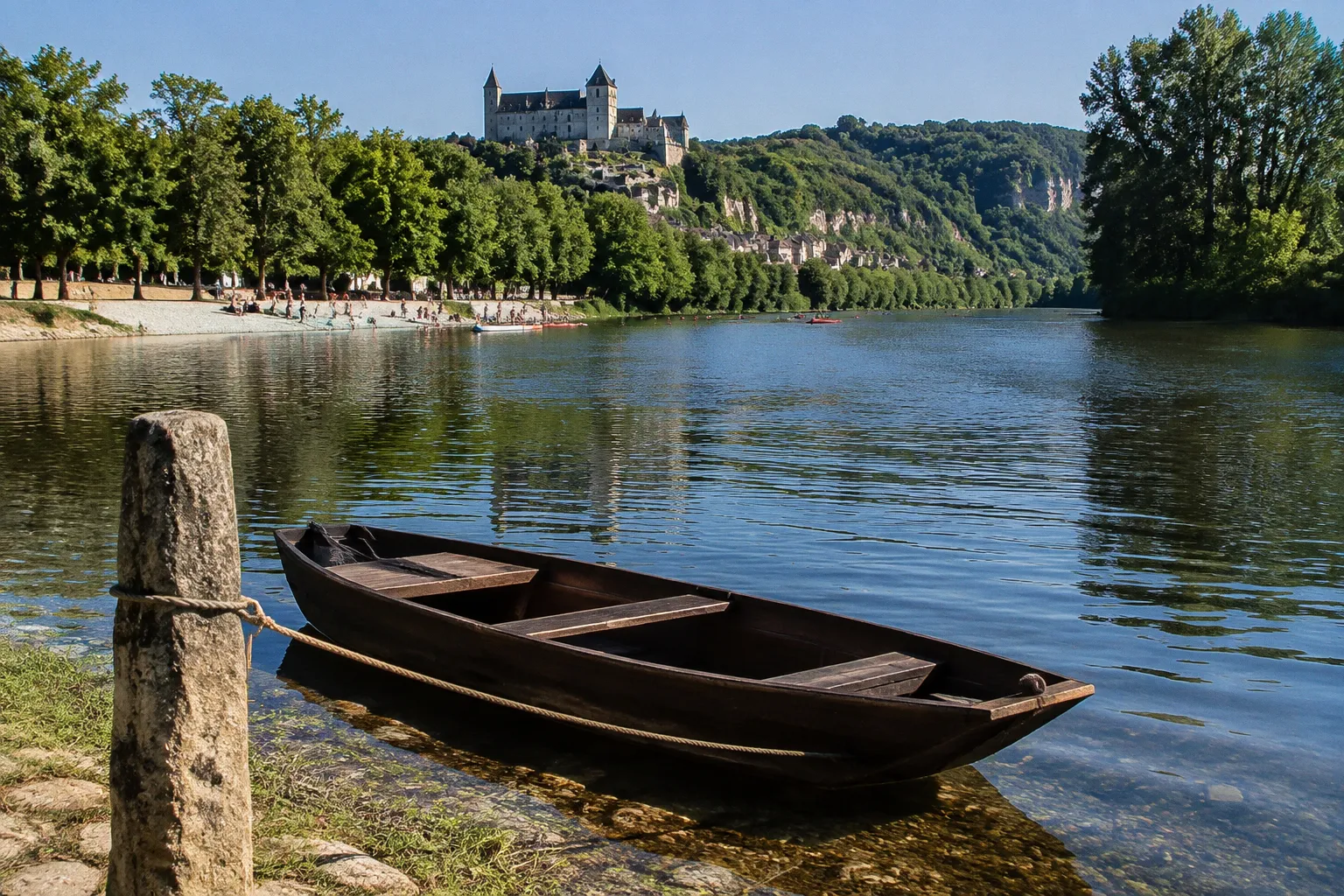
The banks are wooded, the cliffs are warm with limestone, and in summer the shallows can look almost motionless.
That appearance is useful only up to a point. The Dordogne runs through a protected and closely watched catchment, but it remains a working river with a current, upstream hydroelectric infrastructure and a late-summer biological risk that can change the decision on the bank. Swimming in the Dordogne River is safe in designated waypoints when local supervision and conditions are in place. It can also be perfectly manageable at a quiet wild bend for a capable swimmer. It becomes a different proposition when the current is unfamiliar, the exit is unclear or nobody has checked the latest local information.
The practical question is not simply is it safe to swim in the Dordogne River? It is: which stretch, under which conditions, and with what margin for error?
The UNESCO Biosphere River Basin: What the Designation Does — and Does Not — Mean
The Dordogne’s reputation begins with the catchment rather than with any single beach. Its UNESCO Biosphere recognition reflects the wider river basin: geology, habitats, agricultural and wooded landscapes, settlements and the relationship between the river and the communities along it. That status is an important marker of environmental value. It is not a bathing-water certificate, a lifeguard service or a guarantee that every bend is suitable for swimming on every day of the season.
For visitors, the distinction matters. A river can be ecologically valuable and visually clean while still having a strong cross-current, a slippery ledge or a sudden change in depth. The water may be clear enough to see the stones below while the flow remains powerful enough to move an inexperienced swimmer away from the bank.
In calm summer conditions, many stretches offer exactly what people come to the Dordogne for: accessible shallows, pebble margins, warm-looking water and long views through the valley. Around the more open sections, it is often possible to read the river from the bank before entering. You can see where the water slows, where the main channel darkens and where a gravel shelf gives way to deeper water.
That visual clarity should be treated as information, not reassurance. The river is not a static landscape. Water level, flow and debris can change, and the conditions at one village do not necessarily describe those several kilometres upstream or downstream.
UNESCO recognition tells you that the river landscape matters. It does not tell you that the next bend is a swimming pool.
The most reliable way to enjoy the Dordogne is to separate two ideas that are often collapsed into one:
- Environmental quality concerns the condition and value of the catchment.
- Swimming safety concerns the immediate combination of depth, current, access, supervision, weather, water-quality alerts and the abilities of the people entering.
A beautiful, well-managed river can still be the wrong place for a tired child, a nervous swimmer or an adult planning to cross the channel without first identifying the way back.
The designation is therefore best understood as context. It helps explain why the valley is managed and valued as a connected landscape rather than as a collection of attractive picnic spots. It does not replace the local judgement required at the water’s edge. A protected river still needs to be approached as a river.
Supervised River Beaches: Where Lifeguards Monitor the Waters from July to August
If your group includes children, non-swimmers or people who are not used to moving water, a supervised river beach gives you the strongest available safety margin. Along the Dordogne, a number of established bathing areas operate with lifeguard coverage during the main summer period, generally from July through August and during posted daytime hours. The exact dates and hours can vary, so use the information displayed at the beach or provided locally rather than assuming that a familiar seasonal timetable is still in force.
The main recognised and popular swimming waypoints include:
- Vitrac Port — around seven kilometres from Sarlat and one of the better-known staffed beaches in the Sarlat corridor.
- Plage de Caudon — a marked, family-oriented river beach.
- Limeuil beach — near the confluence of the Dordogne and Vézère, and a practical option for visitors staying on the southern side of the valley.
- Plage du Bac de Sors in Alles-sur-Dordogne — an established bathing point with access to the river.
- Creysse — another known Dordogne swimming location.
- Plage du Pont de Vicq in Le Buisson-de-Cadouin — a designated point used by visitors looking for an organised place to enter the water.
These are not interchangeable. A beach can be supervised while conditions, depth and access remain specific to that location. A lifeguard’s presence reduces the risk of delayed assistance; it does not remove the need to follow local instructions or keep children within the area being monitored.
On arrival, look for the practical information before anyone changes into swimwear:
1. Find the bathing boundary. Do not assume that every attractive section beside the beach is part of the supervised zone.
2. Check the posted opening period and hours. Supervision outside the main summer season should never be assumed.
3. Look for the day’s restrictions or warnings. These may relate to water quality, river conditions, weather or temporary closure.
4. Ask the lifeguard about the current section. A local answer is more useful than a general description of the Dordogne several villages away.
5. Keep children inside the area being watched. The presence of a lifeguard on the beach does not extend supervision to a distant bend or an improvised jumping point.
A designated river beach is particularly valuable for mixed-ability groups because it simplifies several decisions at once. There is usually a clearer entry point, more predictable access from the bank, people nearby who know the site, and an established response if someone gets into difficulty. That is a meaningful difference from a beautiful but isolated strip of pebbles beneath a cliff.
A river beach is not the same as a swimming pool
The label “designated” can create a false sense of uniformity. A river beach may have a marked bathing area, but the bottom can still be uneven. Pebbles move, the bank can be slippery and the boundary between shallow water and the main channel may be closer than it appears. Children who are confident in a pool may react differently when the bottom shifts beneath their feet or when the water pushes sideways.
Stay within the marked area and use the entry point intended for bathers. Do not turn mooring areas, canoe routes, boat-launch points or the edges of bridges into alternative swimming zones. River traffic adds a separate hazard: a swimmer may be difficult for a boat operator to see, while a swimmer concentrating on the current may not hear or notice a vessel approaching.
Jumping from bridges, cliffs, tree roots or other raised points is a particularly poor shortcut to excitement. Water depth can change, submerged rocks may be invisible and the landing zone may not be clear of boats or other swimmers. A familiar local spot is not proof that the same jump is safe on the day you arrive.
What changes outside the supervised season
The beaches do not necessarily become inaccessible when lifeguard coverage ends. They may still be used in favourable conditions, but the safety net is gone. There may be no monitored bathing zone, no lifeguard post and no one on duty to assess the water for that day.
Late May and early June can feel warm on land while the river remains cold. In September, the air can still be pleasant even though supervision has ended and daylight is shortening. Treat the calendar as part of the risk assessment. If there is no lifeguard present, the responsibility for judging the water, managing children and choosing an exit rests entirely with your group.
For a holiday group, this is where accommodation advice becomes useful. A gîte owner or local host may know whether a nearby beach is currently staffed, whether access has changed or whether residents are avoiding a particular section. That local knowledge is valuable, but it should complement — not replace — posted notices, official warnings and the judgement of a lifeguard when one is present.
Wild Swimming Spots in the Dordogne Valley: The Attractive Bends Are Unsupervised
The natural river bends around Carsac and La Roque-Gageac are among the places that make the Dordogne valley so compelling. Cliffs drop towards the water, trees shade the margins and pebble shelves create pockets where the flow appears to relax. These are the scenes people remember. They are also the places where swimmers can overestimate how much control they have.
A wild swimming spot is not a designated bathing area simply because other people have entered the water there. There may be no lifeguard tower, marked boundary, first-aid post or maintained route out of the river. Access can be awkward, the bank can be steep, and the easiest-looking entry point may not be the easiest place to leave.
For a competent adult swimmer, an unsupervised bend can be reasonable when the conditions are calm and the plan is conservative. That means:
- Walk in rather than dive. The depth can change quickly, and submerged stones are not always visible from the surface.
- Spend time on the bank reading the flow before entering. Watch how the surface moves around rocks, narrowing banks and the outside of bends.
- Stay close enough to the shore to leave without crossing the main current.
- Identify the exit point before entering, including what happens if the intended route becomes awkward.
- Avoid swimming alone, particularly at isolated bends or beneath steep cliff lines.
- Keep children and weak swimmers at supervised beaches rather than treating a quiet-looking wild spot as an informal family pool.
- Do not rely on mobile coverage. Signal can be unreliable under the cliffs around La Roque-Gageac and in other enclosed sections of the valley.
The key distinction is not bravery. It is recovery. At a managed beach, a swimmer who feels cold or disorientated can usually move towards a visible, accessible bank. At a wild bend, the bank may be high, slippery or blocked by vegetation. A current that feels mild at waist depth can become much more difficult to resist once your feet leave the bottom.
The outside of the bend deserves respect
River bends are deceptive. The inside of a bend often collects gravel and creates a shallower margin. The outside can be deeper and faster, with water pushed towards the bank. It may look like the most dramatic place to swim because the cliff and darker water create the strongest visual contrast. It is often the least forgiving place to enter.
The same caution applies to narrow channels between islands, rocks or banks. Water accelerates when it is forced through a smaller space. A swimmer can drift into the faster thread without intending to cross the river. If you cannot describe where the current will take you and where you will get out, you have not yet chosen a safe entry point.
A useful test is to watch floating leaves or small pieces of natural debris from the bank. They can reveal the direction and speed of the surface flow, although they cannot tell you everything about what is happening below it. Look for rotating patches, converging lines on the surface and water that appears to pull away from the bank. These are reasons to choose a shallower margin or abandon that entry point altogether.
Do not confuse a broad river with a forgiving river. Width can make the surface look slow while the deeper central flow remains strong. Nor should a line of swimmers be read as a safety assessment. People may be using the water briefly, entering at a different point or taking risks that are unsuitable for your group.
Navigating Hidden Hazards: Dam Releases and Sudden Current Shifts
The Dordogne is influenced by an upstream network of hydroelectric facilities. Water released from that system can alter conditions downstream. The important fact for a swimmer is not a particular timetable — there is no dependable public rule that lets visitors predict every release by the hour — but the possibility that depth and current may change after conditions looked stable earlier in the day.
A release may not announce itself in a way that is obvious to someone standing on a beach. The river can become less forgiving without offering a dramatic visual signal at the exact moment a swimmer is deciding whether to enter. Conditions upstream, the distance from the release point and the shape of the river all affect what reaches a particular stretch.
This is why several attractive-sounding diagnostics should be discarded. An audible turbine or generator hum is not a reliable way to establish that a dam is operating or that a release is moving towards your location. Likewise, muddy or discoloured water after a dry spell does not prove that a recent release has passed through. Discolouration can have more than one cause, and swimmers should not use it as a timetable in disguise.
The correct response is less theatrical and more useful: check current local information, pay attention to official alerts and follow instructions from the supervised beach or the commune. If you cannot establish that conditions are suitable, do not enter the water merely because the surface looks similar to yesterday.
| What you observe or learn | What it means for your decision | Safer response |
|---|---|---|
| A local warning, closure notice or instruction from lifeguards | The people responsible for the site have identified a current concern | Do not swim until the restriction is lifted or local advice changes |
| Water level or flow is visibly different from the conditions you expected | The river is not behaving as planned, whatever the cause | Leave the water, move away from the channel and reassess using local information |
| The current is stronger than it appeared from the bank | Surface appearance has underestimated the force of the flow | Do not continue into deeper water or attempt a crossing |
| Debris is moving quickly through the channel | Objects in the river indicate active movement and can also create a collision hazard | Stay out of the main flow and choose a different activity if the condition persists |
| The water is cloudy or visibility is poor | Submerged rocks, drop-offs and other hazards are harder to read | Avoid entering until you can verify that the location is suitable |
| The timing or effect of upstream operations is unknown | You cannot safely build a precise swim plan around an assumed schedule | Check current local conditions and official alerts before entering |
A change in water level is a reason to stop and reassess. It is not, by itself, proof of a particular upstream event. The same principle applies to surface debris and water colour: they are reasons to be cautious, not dependable evidence of exactly what has happened upstream.
Do not try to decode the river from one sound, one colour or one hour on the clock. If the current is unfamiliar, treat that uncertainty as the warning.
Why the “morning is safest” rule is not a rule
It is tempting to build a visit around an assumed quiet period: swim early, before the day’s operations have begun, then leave the river by lunch. That may sound practical, but it invents a regularity that visitors cannot rely on. Release timing is not something a swimmer should infer from a generic morning-versus-afternoon pattern.
If you are staying in a holiday gîte, ask the owner or local host where residents currently swim and whether any warnings or restrictions are in force. At a supervised beach, ask the lifeguard before entering and again if conditions change. Use official local information rather than an assumed daily window. A morning visit may be convenient, cooler and less crowded; it is not automatically safer because the clock says so.
The same caution applies after heavy rain or a period of changing weather. Rain upstream may affect a stretch that still looks calm where you are standing. Run-off can also reduce visibility and bring branches or other debris into the channel. You do not need to identify the precise cause of every change before deciding not to swim. Uncertainty is enough.
Managing Environmental Risks: Cyanobacteria and Water Quality
Flow is not the only reason to pause. During hot, settled periods in late summer, benthic cyanobacteria — often described as blue-green algae — can colonise stones and river margins. Local health authorities may issue advisories when these organisms are detected or when conditions warrant caution.
The risk is especially relevant in slow-moving or stagnant margins, where material can collect on submerged stones. Dark green, brownish or slimy mats and surface scum are reasons to keep out of that section. Do not handle the material, and do not allow dogs to drink from the river. If an official advisory is in force, follow it even if the water looks clear at the particular place where you are standing.
Possible effects can include skin irritation and gastrointestinal illness. Dogs are particularly vulnerable to contaminated water, and suspected exposure requires prompt veterinary advice. The sensible approach is not to diagnose a bloom from appearance alone. Visual signs can prompt you to stop, but the official notice is the information that should govern your decision.
Before a late-summer swim:
- Check the latest local health or bathing-water information, including ARS bulletins where relevant.
- Look at the information posted at the beach or access point.
- Avoid stagnant side pools, concentrated surface scum and visible mats on submerged stones.
- Shower after swimming if facilities are available, especially if the water has been in contact with irritated or broken skin.
- Keep dogs away from the river if an advisory is active or if suspicious material is visible.
- Do not drink untreated river water, regardless of how clear it appears.
- If a swimmer develops an unusual rash, stomach symptoms or other concerns after exposure, seek medical advice and mention the river contact.
A flowing section is not automatically risk-free, and a clear section is not automatically confirmed safe. Conditions can vary along the river and from one day to the next. When there is no reliable current information, a different plan — a supervised pool, a walk beside the river or a canoe-free afternoon on shore — is the sensible choice rather than a disappointing one.
Cyanobacteria also reinforces the importance of thinking locally. A notice may apply to a particular bathing area or stretch, not to every kilometre of the Dordogne. Conversely, the absence of a notice at one location should not be treated as a guarantee for an isolated bend elsewhere. Read the sign for the place you are using and ask if anything has changed.
Essential Safety Protocols for Wild Swimming in Unsupervised River Bends
Wild swimming in the Dordogne is not a single activity with a single level of risk. A short wade beside a broad gravel margin is different from swimming out into the channel, and both are different again from attempting a crossing. The safest plan is the one that limits the number of things that can go wrong at once.
Before entering an unsupervised stretch, make the decision in this order:
1. Assess the people first. A strong pool swimmer may still be inexperienced in moving water. Account for children, fatigue, cold, anxiety, alcohol and anyone who may panic if they lose contact with the bottom.
2. Read the whole access route. Check how you will get down to the river, where you will enter and whether the bank remains usable if you need to leave quickly.
3. Watch the water for several minutes. Look at the main flow, eddies, floating debris and the way water moves around the bend. Do not judge only the small pocket where you intend to step in.
4. Choose the exit before the entry. An exit should be reachable without crossing the strongest current. If the bank is lined with reeds, private fencing, rocks or a steep drop, it is not a practical emergency exit.
5. Keep the first contact conservative. Wade only as far as you can remain stable and turn back easily. There is no obligation to progress from wading to swimming.
6. Stay together and visible. Do not allow the strongest swimmer to disappear around the bend or encourage weaker swimmers to follow farther than planned.
7. Leave at the first sign of deterioration. Cold, fatigue, rising water, worsening visibility, nearby debris or a change in the current are all sufficient reasons to stop.
Life jackets, flotation and river equipment
Inflatable toys and casual pool floats are not safety equipment in a river. They can catch the current, separate a child from an adult or give a false impression of control. Children should be supervised at arm’s length in moving water, not watched from a towel several metres away.
For activities involving a canoe, paddleboard or other craft, use the equipment and buoyancy aid appropriate to that activity. A life jacket does not make a strong current harmless, and it does not remove the need to understand the route, landing points and local restrictions. Swimmers should also keep clear of craft launching or passing through the area.
If someone is swept away, do not enter the main current in an improvised rescue unless you are trained and equipped to do so. Shout for help, alert the lifeguard if there is one and call the emergency services when necessary. Throwing a reachable flotation aid may be safer than following the person into the flow. The priority is to prevent a second casualty.
When to stay out
There are situations in which the answer to is it safe to swim in the Dordogne River? should simply be no, at least for that place and that moment:
- The bathing area is closed or an official warning is displayed.
- The current is visibly stronger than expected or the water level is changing.
- Debris is moving through the swimming area.
- You cannot identify a safe way out.
- The water is too cloudy to judge the bottom and depth.
- Cyanobacteria, scum or suspicious mats are visible, particularly in a slow margin.
- Someone in the group is tired, cold, unwell or under the influence of alcohol.
- A child or weak swimmer would need to leave the supervised zone.
- The weather is deteriorating or there is a risk of sudden conditions changing upstream.
- You are relying on a rumour, an old social-media post or yesterday’s conditions rather than current local information.
This is not an argument against wild swimming. It is an argument against pretending that all wild swimming spots in the Dordogne Valley are equivalent. The appeal of an unsupervised bend lies in its quietness and setting; those same qualities mean that help, information and easy access may be limited.
Choosing the Dordogne’s Safer Swimming Spots
For most visitors, the best balance is straightforward: use a designated river beach when the group is mixed, when children are involved or when nobody knows the river well. Arrive during the posted supervised period, read the local information and stay within the monitored zone. That is not the less adventurous version of the Dordogne. It is often the most relaxed one.
Experienced swimmers may reasonably prefer a quieter bend, but the standard should be higher, not lower, simply because there is no lifeguard present. Check the current situation, inspect the entry and exit, keep away from the main channel and accept that the correct decision may be to stay on the bank.
The river is safe in places and conditions that make it safe — not because its water looks clear, its valley is protected or other visitors are already swimming. The strongest habit is also the simplest: choose the location first, check the conditions on the day, and leave a generous margin for changing water, uncertain footing and human error.
That margin is what turns a beautiful afternoon beside the Dordogne into a good memory rather than a story about how quickly a calm-looking river can change.