Dordogne river swimming spots or public beaches: which to choose
A Dordogne river swimming decision starts with one hard variable: control. At a managed public beach, you have marked access, facilities and, at selected sites in July and August, trained lifeguards.
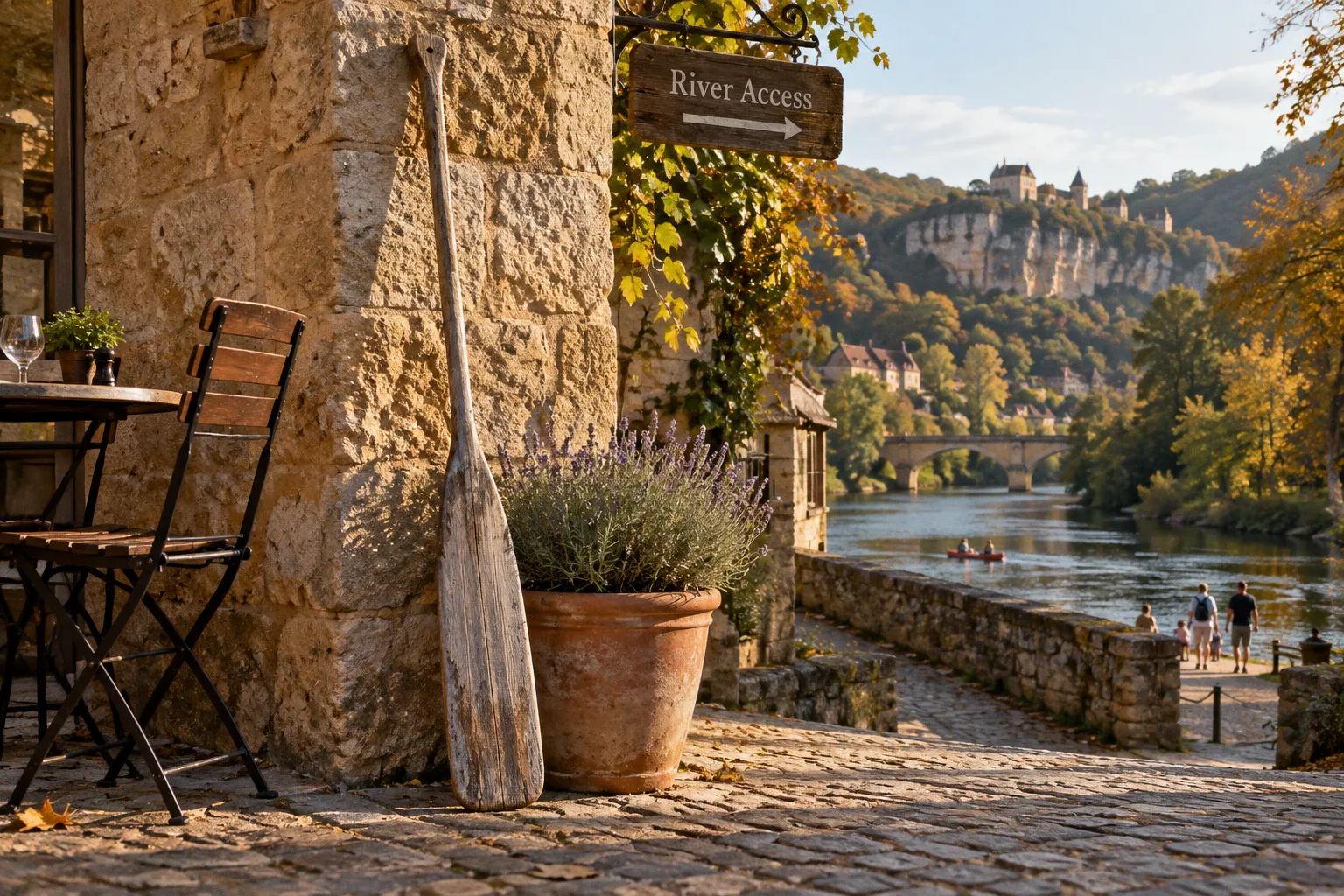
At a wild swimming cove, you have fewer people, less infrastructure and no rescue team if the current flow changes.
That is the operational difference between the two options. The river basin has UNESCO World Biosphere Reserve status and is consistently regarded among France’s cleanest river systems, but clean water does not remove physical risk. Heavy rain, sudden depth changes, upstream dam releases and local cyanobacteria warnings can alter the situation quickly. Choose the location for the conditions on the day, not for a photograph saved six months earlier.
Managed river beaches: the controlled entry point
The official public river beaches, known locally as plages fluviales, are the strongest choice when the priority is a predictable deployment. They are designed around access rather than isolation. Expect a defined shoreline, easier entry, more visible activity and basic visitor facilities. At selected sites, trained lifeguards operate during the main summer season, typically in July and August.
Vitrac Port is one of the most practical reference points. It sits roughly 7 kilometres from Sarlat, around a 12-minute drive, which makes it easy to combine a swim with a market visit, lunch or a route through the surrounding valley. During peak summer, lifeguard supervision is typically scheduled from about 10:00 to 19:00. Treat those hours as a safety window, not as a guarantee that every part of the river is controlled.
Other supervised public options include Plage du Coux and Plage du Pont de Vicq at Le Buisson-de-Cadouin. These sites suit travellers who need a clearer operating picture:
- Families with children who require shallow water and a visible shoreline.
- Swimmers who do not know the local river and want staff nearby.
- Groups carrying cool boxes, towels, inflatables and a heavier gear loadout.
- Travellers planning a longer stop with access to facilities rather than a short water entry.
- Anyone who wants to abort quickly if weather or current conditions deteriorate.
The key advantage is not comfort. It is reduced uncertainty. You can identify the access point, establish where the supervised zone begins and ends, and set a straightforward regrouping waypoint. That matters when several people are swimming at different speeds or when children are moving between the bank and the water.
Why public access still demands discipline
A lifeguarded beach is not an enclosed pool. The river remains a moving body of water with variable depth and current flow. The supervised zone has limits, and conditions can shift outside it. Do not assume that a lifeguard’s presence turns every nearby bank, rock shelf or deeper channel into an approved swimming area.
The best public beaches for families are those where the entry profile is easy to read. Plage de Limeuil is a useful example: it lies at the confluence of the Dordogne and Vézère rivers, below one of France’s listed Most Beautiful Villages, and offers very shallow water near the edge before the river deepens farther out. That gives adults a clearer progression from bank to deeper water, but it still requires an active depth check before children move away from shore.
Use the first minutes on site to establish four points:
1. Entry route: identify the easiest path into and out of the water. Loose stones, mud and submerged ledges can slow an emergency exit.
2. Depth transition: locate where shallow water gives way to deeper water. Do not rely on visual estimates alone.
3. Supervision boundary: confirm the area covered by lifeguards and the operating times displayed locally.
4. Regrouping waypoint: choose one visible point on the bank where the group returns after every swim.
This is not over-planning. It is how you prevent a relaxed river stop from turning into a search operation.
A supervised beach reduces uncertainty; it does not eliminate the river’s force.
Wild swimming in the Dordogne Valley: solitude with no recovery margin
Wild swimming Dordogne Valley locations appeal because they remove the crowd and the infrastructure. Pebble banks, cliff-side coves and quiet bends can offer a more private water stop than an official beach. Plage du Bac de Sors in Alles-sur-Dordogne and coves near the Cingle de Trémolat are examples of the type of setting travellers seek.
The operating condition is non-negotiable: these locations are unstaffed. There is no lifeguard supervision, no controlled rescue zone and no guarantee of a prepared entry. Swimming is entirely at the bather’s own risk.
That changes the route plan. A wild spot is not simply a public beach with fewer people. It has a different risk profile from the moment you leave the vehicle or main path. Access may involve uneven ground, loose stones, steep banks or a difficult return route after the swim. A swimmer who feels strong entering the water may be dealing with fatigue, cold, current and a slippery exit when it is time to climb out.
Before committing to a wild spot, assess:
- Whether the bank provides a stable launch and recovery point.
- Whether you can see the riverbed through the entry section.
- Whether the current is moving faster than expected.
- Whether there is a clear route back to the road or accommodation.
- Whether mobile coverage and access for assistance are uncertain.
- Whether the group has enough experience to manage without a lifeguard.
- Whether recent rain has altered the river level or current flow.
Do not enter from a cliff edge, a blind bend or a bank where the exit route disappears below the waterline. Do not jump into water simply because locals or other visitors have done so. A river can conceal rocks, sudden depth shifts and submerged obstructions. The visible surface gives you only part of the route data.
The correct use of a wild swimming spot
Wild swimming works best as a short, controlled operation. Arrive with a clear turnaround time and a defined exit plan. Keep the swim close to the bank unless you have verified the conditions and the group has the skill to manage moving water. The person who enters first should not be the only strong swimmer in the group. Maintain visual contact. Keep children within immediate reach rather than relying on shouted instructions across the water.
Do not bring unnecessary complexity into a wild access point. Inflatable toys, bulky paddle equipment and heavy cool boxes increase the gear loadout and make a difficult bank harder to navigate. The objective is a safe water entry and a clean return, not a full beach installation.
If the river is carrying extra flow after rain, abandon the plan. There will be another day. The Dordogne valley offers enough alternatives that there is no tactical reason to force a marginal location.
Water quality: clean river, changing conditions
The Dordogne River basin’s UNESCO biosphere status is an important environmental marker, and the river system is consistently rated among the cleanest in France. It is not a permanent clearance signal for every bend and every day.
Dordogne river water quality can vary by location and timing. Heavy rainfall can affect the river’s behaviour and water conditions. Localised cyanobacteria blooms may also be monitored by the Regional Health Agency, or ARS. The relevant question is not whether the river has a strong environmental reputation. The relevant question is whether the specific bathing site is currently suitable.
Official bathing sites are covered by France’s water-quality monitoring system. The French Ministry of Health publishes test results on an interactive map, with ratings that run from excellent, marked in blue, through to prohibited, marked in pink. Use the current site information when available. Do not substitute an old review, a social media photograph or a generic statement about the Dordogne for a current status check.
A practical water-quality scan should cover:
- The official rating for the precise bathing location.
- Any local closure notice or prohibition.
- Recent heavy rain, which can change both water movement and clarity.
- Any cyanobacteria warning communicated by local authorities or the ARS.
- Whether the location is an official bathing site or an unstaffed wild bank with less formal infrastructure.
The distinction between public and wild access matters here. A managed beach gives you a defined site to investigate. A wild cove may have no clear sign, no posted update and no staff member to confirm current conditions. That does not automatically make it unsafe, but it increases the burden on the visitor.
“Cleanest river system” is an environmental reputation. It is not a personal risk assessment for today’s swim.
Current flow, rain and seasonal timing
River swimming is controlled by water movement first and temperature second. Summer air temperatures in the Dordogne frequently exceed 30°C to 35°C, which creates strong demand for a swim but can also encourage poor decisions. Heat pushes people toward the water. It does not make a fast current manageable.
Late June to early September is generally the warm-water period for an unhurried river swim, with July and August forming the main supervised season at designated beaches. These dates help with planning, but they do not override the daily conditions.
Three variables require attention before entry.
Heavy rain
Rain upstream can change the river after the local sky has cleared. The result may be higher water, stronger current flow, poorer visibility and more difficult exits. Do not judge the river solely from the weather at your accommodation. Check the recent conditions across the catchment and inspect the water before committing.
If the current is visibly pushing debris, accelerating around bends or making the shallow edge unstable, move to a managed site or cancel the swim. A fast-moving river is not a stronger version of a calm one. It is a different operating environment.
Upstream dam releases
Sudden depth shifts can follow hydroelectric dam operations upstream. Exact daily release schedules are not established here, so do not plan around an assumed timetable. Treat unfamiliar changes in water level or current speed as a stop signal. If the river appears to be rising or the shoreline is changing while you are on site, clear the water and move away from the edge.
Local biological warnings
Cyanobacteria can be monitored locally by the ARS. If a warning is active, follow the local restriction. Do not enter because the water looks clear from the bank. Do not let a previous visit override a current notice.
Public beach or wild cove: make the decision by mission
The right choice depends on the group and the objective. There is no universal winner in the comparison between Dordogne river swimming spots and public beaches.
| Decision factor | Managed public beach | Wild swimming spot |
|---|---|---|
| Lifeguard presence | Available at selected sites, typically in July and August | No lifeguard supervision |
| Access | More defined and easier to organise | May involve uneven banks, stones or a difficult exit |
| Family use | Stronger option where shallow entry and visible zones are available | Suitable only when adults can maintain close control |
| Facilities | More likely to provide visitor amenities | Minimal or absent |
| Privacy | Lower, especially in peak summer | Higher, but conditions are less predictable |
| Water assessment | Easier to identify the official bathing site and local notices | Greater responsibility on the swimmer |
| Response to changing flow | Staff and a defined site may help with decisions | No on-site professional support |
| Gear loadout | Can support a longer stop with more equipment | Keep equipment light and mobile |
| Best operating window | July and August for supervised sites | Only when current conditions, access and exit are clear |
Choose a public beach when:
1. Children are the primary swimmers. Use the shallowest, most visible entry available and keep the group within the supervised zone where one exists.
2. The group has mixed ability. Strong swimmers, cautious swimmers and non-swimmers are easier to manage from a defined shoreline.
3. You need a low-friction stop. Public dordogne river beach access reduces the navigation problem and gives you a more straightforward return to the vehicle.
4. The weather or river is unsettled. Choose infrastructure when the margin is narrowing.
5. You are new to the valley. Start with a managed site before considering a remote bank.
Choose a wild spot only when:
1. Every swimmer understands the absence of supervision.
2. The entry and exit are visible, stable and within the group’s ability.
3. The current is calm and there are no signs of a recent water-level change.
4. You have checked local water information rather than relying on reputation.
5. You can carry a light loadout and leave immediately if the conditions change.
For families searching for the best river spots for families Dordogne travellers can use, the public beach option is usually the more robust starting point. A wild cove may be quieter, but quiet does not equal controlled. The adults must supply the control through positioning, supervision and a strict exit decision.
A route-planner’s operating plan for the day
Build the swim into the wider route rather than treating it as an isolated attraction. A morning departure gives you more flexibility if the first site is crowded or the current is unsuitable. Keep a second waypoint available: another official beach, a pool at your accommodation or a dry-land activity in the valley.
A workable sequence is:
1. Check conditions before departure. Review current bathing information, weather and any local notices.
2. Select the site according to the group. Default to a supervised public beach for children, mixed ability or uncertain weather.
3. Arrive and perform a bank inspection. Watch the current, assess the entry and identify the exit.
4. Set the boundaries. Tell every swimmer where they may go and where the regrouping waypoint is located.
5. Enter in stages. Do not allow the entire group to scatter into the water at once.
6. Abort early if the river changes. Rising water, stronger flow, debris or a health warning ends the operation.
7. Recover on land. Dry off, rehydrate and confirm that every member of the group is accounted for before moving on.
The pool at a luxury self-catering gite can be the correct fallback, not the consolation prize. It removes current flow, uncertain depth transitions and river access problems. Use it when the river is running hard, when a warning is active or when the group needs a controlled recovery session after cycling or hiking.
Final position: control the margin
For most visitors, managed public beaches are the correct first choice. Vitrac Port, Plage du Coux, Plage du Pont de Vicq and the shallow-edge access at Limeuil offer a clearer operating framework, particularly during the July and August supervision period. They are not risk-free, but they reduce the number of unknowns.
Wild swimming Dordogne Valley locations are viable for experienced, self-sufficient swimmers who can read the bank, assess the current and accept full responsibility for the decision. Their advantage is seclusion. Their cost is the loss of support.
Make the choice before you unload the towels. Public beach for control, family access and lower friction. Wild cove for solitude only when the water, access and exit all hold. If one of those variables fails, navigate to the next waypoint.
Mandatory swim gear check
- Water-quality status checked for the specific site.
- Weather and recent rainfall reviewed.
- Current flow inspected from the bank before entry.
- Stable entry and exit route identified.
- Supervision hours confirmed at a managed beach.
- Children assigned to an adult within immediate reach.
- Light, mobile gear loadout for wild access.
- Drinking water, sun protection and dry clothing packed.
- Phone secured and emergency access route understood.
- Fallback waypoint selected: another public beach, a pool or a dry-land route.
- Final headcount completed before leaving the water.