Outdoor Adventures: what to check before you decide
The Dordogne rewards active travel, but the river, roads, and trails do not adjust to your holiday timetable.
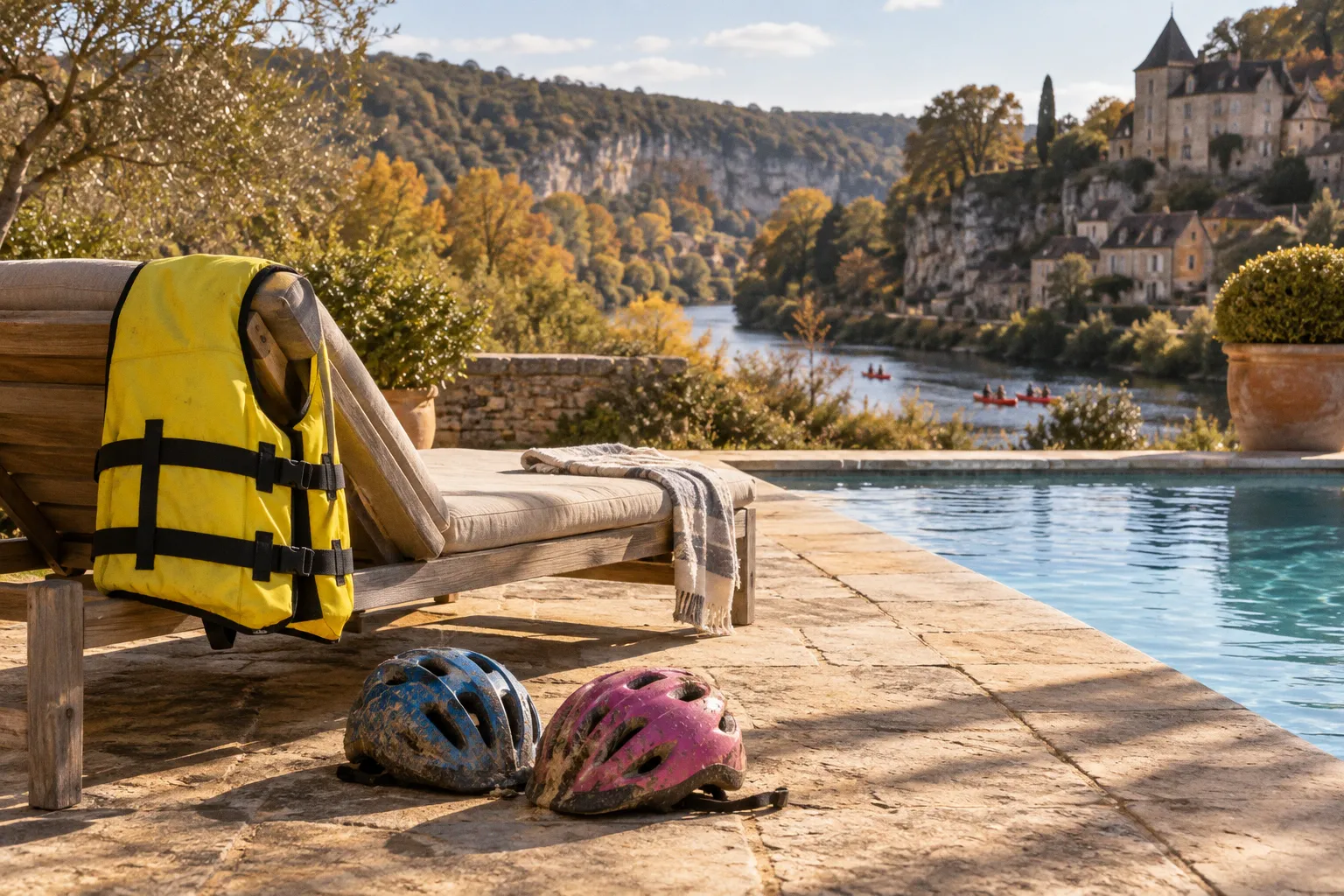
A warm afternoon can still leave you exposed to fast current flow, poor visibility, a badly equipped bicycle, or a trail that demands more ascent than your group expected.
Before you book a canoe descent, load the bikes, or set out from your gîte on foot, lock down the essentials: legal requirements, weather, water conditions, route difficulty, equipment, and return logistics. The right preparation keeps the day moving. The wrong assumption turns a straightforward outing into a recovery operation.
Navigating River Regulations: Canoeing and Kayaking Safety
The Dordogne is accessible, but it is not risk-free. River activity starts with a physical requirement that cannot be negotiated: every participant must be able to swim 25 metres unaided and dive. This applies before the first paddle stroke, before the launch, and before anyone boards a canoe or kayak.
Children under six are prohibited from canoeing without a state-certified instructor under French national safety regulations. On certain class 1 waters, the threshold may be five, but do not build your holiday plan around an exception. If a child is below the relevant age or cannot swim to the required standard, choose a supervised alternative on land or remain at the pool.
An approved buoyancy aid is mandatory while canoeing on the Dordogne. Wear it correctly and keep it fastened for the entire descent. River police conduct checks, and non-compliance can lead to fines. A buoyancy aid left loose on the bow is not protection; it is misplaced gear.
Establish the river brief before launch
Your operator should provide the operational details for the selected stretch. Get those details before you commit your group:
- Launch point and take-out point, with the exact meeting procedure.
- Estimated paddling time under current conditions, not only the brochure timing.
- Shuttle arrangements and the final return location.
- Any age, swimming, or supervision restrictions applying to your group.
- Current weather guidance and any temporary access limitations.
- Required clothing, footwear, dry storage, and phone protection.
Do not confuse a low technical rating with low consequence. A gentle river section can still create problems if someone falls in, loses a paddle, becomes separated from the group, or reaches the bank far from the planned exit. Maintain visual contact. Keep children between capable adults. Treat every landing, transfer, and awkward bank exit as a friction point.
The river does not care whether you are on holiday. Wear the buoyancy aid, confirm the exit point, and keep the group together.
Current flow, weather, and water temperature
Rain upstream can change the river’s behaviour even when conditions around your gîte look settled. Heat brings a different risk profile: dehydration, sun exposure, and fatigue can reduce paddling control long before the route is complete.
Check the forecast immediately before departure. Do not rely on a weather screenshot saved the previous evening. Confirm whether storms, strong wind, or heavy rainfall could affect the planned section. If the operator changes the route, accept the adjustment. Route discipline is part of safety.
Pack a compact river loadout:
- Approved buoyancy aid supplied or confirmed by the operator.
- Secure footwear that stays on in water and grips wet surfaces.
- Water in a container that will not sink if dropped.
- High-protection sun cream, hat, and a light layer.
- Dry bag for keys, medication, phone, and essential documents.
- Spare clothing sealed against spray and accidental immersion.
- Small snack for groups with children or longer sections.
Do not take loose valuables into the canoe. Do not attach a phone where it can be lost on the first capsize. Do not assume a swimming costume is adequate clothing for a full day on moving water.
Wild camping and riverbank conduct
Wild camping, or bivouac, along the Dordogne is generally permitted for overnight stays when environmental regulations are respected. That permission is narrow in practice. It does not mean every bank, beach, woodland edge, or private field is available for occupation.
Open fires are strictly prohibited. Carry a compact stove only where its use is lawful and safe, and confirm local restrictions before relying on it. Never improvise a fire ring on the riverbank. Pack out every item, including food packaging, damaged cordage, and disposable equipment.
A responsible overnight river plan also needs a defined exit strategy. Know how you will leave if the weather changes, a member of the group becomes unwell, or the route is no longer suitable. A bivouac is not a substitute for navigation.
Cycling in the Dordogne: Legal Requirements and Equipment Standards
Cycling the Dordogne valley can shift quickly from easy cruising to exposed road riding, sharp gradients, narrow lanes, and poor sightlines. The legal equipment requirements are straightforward. The route planning is where most holiday groups lose momentum.
A bicycle ridden on French public roads must have:
- Two working brakes.
- A bell audible from at least 50 metres.
- Front and rear position lights.
- Front, rear, pedal, and wheel reflectors.
Check these items before departure, not after the first descent. A bell that barely functions, a rear light with a flat battery, or a brake lever with excessive travel is not a minor inconvenience when traffic approaches on a narrow road.
Children under 12 must wear a bicycle helmet whether they are riding or travelling as a passenger. An accompanying adult who allows a child under 12 to ride without a helmet can receive a fixed fine of €135. Adults are not generally required by French law to wear a helmet, but that does not make a helmet optional from a route-planning perspective. On descents, uneven surfaces, and mixed-traffic roads, head protection belongs in the loadout.
Select the route by elevation, not by distance
A short route can carry more physical demand than a longer one if it includes repeated climbs, exposed descents, or technical surfaces. Use the profile, not just the kilometre count. Ask where the decisive ascent occurs, where water is available, and whether the route returns to the gîte or requires a vehicle shuttle.
Build the day around the least experienced rider. That means:
1. Identify the longest continuous climb and its gradient profile.
2. Confirm whether the route uses public roads, cycle paths, gravel, or mixed terrain.
3. Mark villages or service points where the group can stop.
4. Set a turnaround time before fatigue affects judgement.
5. Reserve daylight for the final navigation stage.
6. Keep a recovery option available if a rider cannot complete the route.
Do not send a family group onto a demanding valley loop because the map makes it look compact. Once the temperature rises and the return leg becomes uphill, the route has changed in practical terms.
Visibility rules and night riding
Cyclists in France must wear a certified high-visibility reflective vest outside built-up areas at night or in conditions of poor visibility. Fines for failing to do so range from €22 to €75. Carry the vest even if you expect to finish before sunset. Delays happen. A puncture, wrong turn, or slow climb can push the final kilometres into low light.
Front and rear lights must be working before you leave. Reflectors do not replace lights in every situation, and a phone torch is not a cycling lighting system. If the weather closes in, the group should already have the equipment needed to remain visible.
Use the same discipline on cycle paths and minor roads. Signal clearly, hold a predictable line, and avoid spreading across the carriageway. France’s rural roads can appear empty until a vehicle arrives at speed around a bend.
| Activity | Non-negotiable preparation | Main route friction | Return decision |
|---|---|---|---|
| Canoeing or kayaking | 25-metre unaided swim ability, diving ability, approved buoyancy aid | Current flow, immersion, difficult exits | Follow the operator’s take-out plan; do not extend the descent casually |
| Road cycling | Two brakes, bell, lights, reflectors, suitable helmet for children under 12 | Ascents, traffic, poor visibility, heat | Turn around before fatigue compromises braking and navigation |
| Hiking | Route profile, water, footwear, weather check, offline navigation | Heat, exposed sections, wrong turns, delayed return | Use a fixed turnaround time and keep daylight in reserve |
| Poolside recovery | Hydration, shade, supervision of children | Heat exposure and overconfidence after activity | Treat recovery as part of the itinerary, not an afterthought |
Alcohol Limits and Road Safety for Active Travellers
A long lunch is part of the Dordogne experience. It is not a reason to ignore road safety. The legal alcohol limit for cyclists in France is between 0.25 and 0.40 mg/L of exhaled air, and violations can attract a €135 fine.
The practical instruction is simpler than the legal threshold: do not cycle after drinking. Alcohol reduces reaction speed, balance, hazard recognition, and braking control. Those effects become more serious on a descent, on loose gravel, or when the route runs through a village with limited visibility.
Plan the food and drink stop at the end of the riding stage, not in the middle of it. If the group wants a long meal with wine, arrange transport back to the gîte. Do not treat an e-bike as a loophole. Motor assistance can increase speed and reduce the margin for a poor decision.
The same principle applies after canoeing. Paddling back from a riverside lunch still involves moving water, balance, transfers, and equipment handling. Keep the activity window and the celebration window separate.
Preparing for the Trails: Essential Safety Checks for Hikers
The Dordogne region has more than 9,000 kilometres of marked hiking trails. That scale creates choice, but it also creates a navigation problem: a marked trail is not automatically an easy trail, a shaded trail, or a short trail.
Assess the route against the group’s actual capacity. A trail that suits experienced walkers may be the wrong deployment for young children, older travellers, or anyone recovering from an injury. Check the total distance, elevation gain, surface, shade, water availability, and likely return time. If those details are unclear, select a shorter route with multiple exit points.
Build a route card before leaving the gîte
Write down the operational details, even for a day walk:
- Starting point and parking or access restrictions.
- Route name, marking colour, and map reference.
- Total distance and major ascent sections.
- Forecast temperature, storm risk, and expected visibility.
- Water sources and planned hydration capacity.
- Emergency contact method and mobile coverage assumptions.
- A turnaround time that leaves daylight for the return.
- The location of the nearest road or settlement.
Download the route for offline use. Keep one paper map or a clear route reference in the group. A navigation app is useful, but it is not a complete plan if the battery fails or the signal drops.
Stay on marked paths where possible. Shortcuts across private land, steep banks, or untracked woodland can create access conflicts and navigation errors. Gates must be left as found. Dogs should remain under control. Do not approach livestock, especially where a herd blocks the path.
Heat is the primary variable
The most underestimated hiking hazard in southwest France is often not distance but heat. Start early. Use shaded sections strategically. Reduce pace before fatigue becomes visible. Children may appear energetic until they suddenly cannot continue; build in water and food stops before that point.
Wear footwear with grip and a secure heel. Smooth trainers are a poor choice on damp soil, loose stone, or steep descents. A walking pole can improve stability on uneven ground and reduce load on knees during the return descent.
Carry more water than the route description implies if there is no confirmed refill point. Do not count on a café or village shop being open when you reach it. Rural opening hours are part of the route risk.
Weather escalation and route abandonment
If thunder, heavy rain, or strong wind moves in, stop treating the route as a fixed objective. Leave exposed ridges, open fields, and wooded areas where falling branches may become a concern. Find a safer position and reassess the return.
A route abandoned early is a successful route decision. The failure is continuing because the group has already invested time, driven to the trailhead, or announced the plan at breakfast.
This is where a well-chosen gîte gives you an advantage. The Dordogne holiday does not depend on completing every outdoor objective. If the weather closes the hiking window, switch to a poolside recovery block, a shorter local walk, or a food-led village route. Preserve energy for the next day instead of forcing a poor final hour.
The best itinerary has an exit route. Set the turnaround time before the weather, fatigue, or group pressure sets it for you.
The Gîte Base: Recovery Is Part of the Route Plan
A luxury self-catering gîte with a pool is not only an overnight address. Used correctly, it becomes your operating base: secure equipment storage, controlled recovery, reliable meals, and a place to reset after exposure to heat, current, or elevation.
Use the arrival day to establish the logistics:
- Where wet river equipment can dry without damaging interiors.
- Where bicycles can be stored and recharged securely.
- Whether the pool area provides shade and safe supervision.
- Which local roads offer a short test ride before a full route.
- Where you can refill water and assemble food for the next outing.
- How quickly you can reach medical or transport support if needed.
Do not schedule a demanding canoe descent immediately after a late arrival, a long drive, or poor sleep. Do not place a major ascent on the day after an exhausting ride. Outdoor activity is cumulative. The route planner must manage the next day as aggressively as the current one.
Poolside leisure is useful recovery, but it is not a complete substitute for hydration, food, sleep, and muscle recovery. Cold water may feel restorative; it does not erase heat stress. Children need supervision around the pool, particularly after a day on the river when fatigue is already high.
Final gear check before deployment
Run this check before leaving the property. No exceptions.
River loadout
- Swimming ability confirmed for every canoe or kayak participant.
- Age and supervision requirements confirmed for children.
- Approved buoyancy aid fitted and fastened.
- Secure water footwear packed.
- Water, sun protection, dry bag, and spare layer loaded.
- Launch and take-out points understood by the group.
- Weather and current guidance checked on the day.
- No open-fire plan; all waste returns with you.
Cycling loadout
- Two brakes tested.
- Bell audible from at least 50 metres.
- Front and rear lights working.
- Front, rear, pedal, and wheel reflectors present.
- Certified helmets fitted for every child under 12.
- High-visibility vest packed for each rider.
- Water, repair essentials, phone, and route map secured.
- No alcohol before or during the ride.
- Turnaround time and recovery plan agreed.
Hiking loadout
- Route downloaded or mapped offline.
- Distance and ascent understood.
- Footwear checked for grip and fit.
- Water capacity exceeds the minimum expected demand.
- Food, sun protection, and light weather layer packed.
- Mobile battery protected; emergency contact plan clear.
- Weather checked immediately before departure.
- Turnaround time fixed before the first kilometre.
- Every member of the group knows the exit plan.
The Dordogne offers canoeing, cycling, hiking, golf, river days, and controlled recovery beside the pool. The objective is not to collect the most activities. It is to navigate each one with enough margin to remain safe, legal, and capable for the next departure.
Choose the route. Check the conditions. Load the correct gear. Keep the exit visible. Then move.