Périgord dinner route: from market to gite kitchen
A workable Dordogne market-to-table dinner route depends on one fact that brochures routinely omit: most of the serious food buying is finished by early afternoon.
The main markets in Sarlat, Périgueux, and Bergerac generally run on Wednesday and Saturday mornings, roughly from 8:00 AM to 1:00 PM. Arrive late and the issue is not atmosphere. It is stock, temperature, and transport.
The practical sequence is simple. Buy the main ingredients before the heat builds, keep chilled products under control, select a Bergerac wine that matches the fat and salt of the meal, and return to a gite with a kitchen capable of handling more than a decorative breakfast. This is the Périgord dinner route in operational terms: market, cold storage, preparation surface, heat source, table.
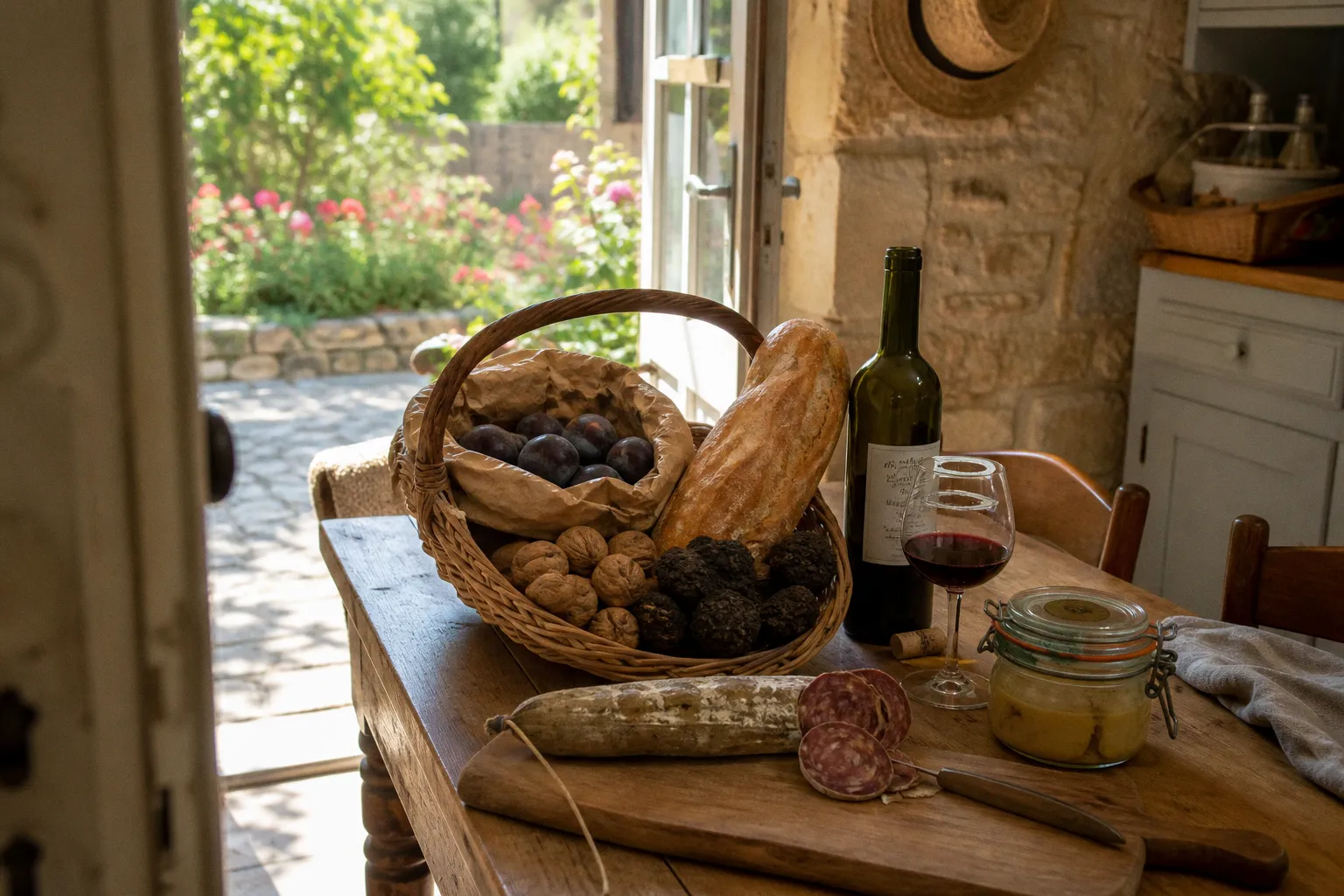
The region gives you four reliable culinary pillars: duck, foie gras, black truffles, and Périgord walnuts. Add Cabécou cheese, seasonal vegetables, bread, and a bottle from the Bergerac appellations. The result is not difficult to cook. It is difficult to source and sequence correctly.
A market-to-table dinner is won before the pan is heated. The failure point is usually procurement, not technique.
The morning market ritual: buy by route, not by postcard
Sarlat-la-Canéda is the obvious starting point for visitors staying in the eastern Dordogne. Its traditional food market occupies the medieval city centre on Wednesdays and Saturdays, broadly between 8:00 AM and 1:00 PM. The product mix is predictable in the useful sense: local vegetables, walnut oil, duck products, cheeses, bread, preserves, and prepared regional foods.
The mistake is treating Sarlat market as a single-purpose attraction. It is not merely a place to buy foie gras. It is a consolidation point for a dinner that requires several product categories, each with different handling requirements.
A functional buying order looks like this:
1. Buy ambient products first. Walnut oil, bread, preserves, dried goods, and sealed jars can go into the basket immediately. They do not create a cold-chain problem.
2. Select vegetables next. Choose produce that can tolerate the drive back to the property. Salad leaves and soft berries require more care than onions, courgettes, beans, or firm tomatoes.
3. Purchase cheese and duck products after that. Ask for products to remain wrapped and shaded. A soft cheese should not sit in a hot car while you continue browsing.
4. Buy foie gras or other highly perishable items last. The €25–€45 range is a typical market cost for a quality whole raw lobe of foie gras at the Sarlat Saturday market, but weight, producer, season, and preparation affect the final price.
5. Finish with wine only if transport conditions are stable. Bottles are not fragile in the same way as foie gras, but they are easily left in a vehicle that becomes an oven.
This is also why a gite’s proximity to the market has practical value. A property within a short drive of Sarlat is not automatically superior, but a 15-minute return journey gives you more control than a long rural transfer with fresh duck, cheese, and butter in the boot. Proximity metrics matter more than a vague claim that the house is “near local amenities.”
Sarlat, Périgueux, or Bergerac?
The correct market depends on the location of the gite and the intended menu. Driving across the Dordogne for a single ingredient is usually poor logistics unless the market itself is part of the day’s route.
| Market | Main food-market days | Useful for | Operational limitation |
|---|---|---|---|
| Sarlat-la-Canéda | Wednesday and Saturday mornings | Duck products, walnut oil, cheeses, vegetables, regional specialities | Medieval-centre access and parking require planning |
| Périgueux | Wednesday and Saturday mornings | Farm produce, bread, seasonal foods, winter fat markets | The specialist winter market is seasonal rather than year-round |
| Bergerac | Wednesday and Saturday around the central squares | Farm produce, wine-country provisions, access to Bergerac appellations | The wine and food route works best when the stay is already in the western Dordogne |
| Bergerac, Marché Bio de la Madeleine | Friday morning | Organic produce and a narrower, produce-led shop | Smaller scope than the principal town-centre market |
Périgueux’s fresh markets operate around Place du Coderc and Place de la Clautre on Wednesday and Saturday mornings. From November to March, the town also has specialist winter fat markets, or marchés au gras, at Place Saint-Louis. That seasonal distinction matters. A traveller arriving in July should not build a menu around a winter market format that is not operating.
Bergerac’s principal open-air farmers’ market operates on Wednesdays and Saturdays around Place Gambetta and Place Louis de la Bardonnie. The Friday morning Marché Bio de la Madeleine offers a different buying profile, with a stronger emphasis on organic produce. It is useful when the dinner is vegetable-led and the wine selection is handled separately.
The market towns are not interchangeable. Sarlat is strong for the classic eastern Périgord basket. Périgueux gives access to a more central urban market structure and the winter fat-market tradition. Bergerac is the logical base for combining fresh produce with a wine route through the local appellations.
The Dordogne food market shopping list: build the plate around fat, acid, and texture
Périgord cooking is often reduced to duck and foie gras. That is incomplete. The usable structure of the cuisine is a balance between rich animal fat, bitter or green elements, acidity, starch, and a controlled amount of sweetness. Without that balance, the dinner becomes a sequence of heavy products rather than a meal.
For a market-to-table dinner, the shopping list should be assembled by function.
The primary protein
Duck is the most flexible purchase. Confit offers preserved, already-seasoned meat that can be crisped and served with potatoes or beans. Magret requires more immediate cooking and benefits from a hot, dry pan and careful rendering of the skin. These are different operational products, not interchangeable labels.
Confit is forgiving when the gite kitchen is mediocre. It does not require the same level of timing or heat control as a raw magret. The main requirement is enough surface area to crisp the skin without steaming the meat. A small frying pan with poor thermal recovery will produce soft skin and uneven browning.
Magret is less tolerant of improvisation. The pan needs to remain hot enough to render the fat progressively, but not so aggressive that the skin burns before the meat warms through. A reliable extractor or at least a window is useful. Duck fat produces smoke and odour. In an open-plan kitchen, this is not a minor detail.
Foie gras belongs to a different part of the meal. A whole raw lobe is a specialist purchase requiring cold storage and a clear plan. If the kitchen has limited refrigerator space, buying a raw lobe late in the market visit is sensible only if the return journey is short and the product can be chilled immediately. A prepared terrine or sealed portion is less demanding.
The supporting ingredients
The four pillars of Périgord gastronomy are duck, foie gras, black truffles, and Noix du Périgord. They do not all need to appear in one dinner. That would be expensive, rich, and structurally repetitive.
Walnuts are the easiest pillar to use. They bring texture to a salad, body to a sauce, and a bitter finish that works against duck fat. Walnut oil should be treated as a finishing ingredient rather than a high-heat cooking medium. Its aroma is the point. Use it in a vinaigrette or over warm vegetables after cooking.
Cabécou provides a smaller, more manageable cheese course. The cheese should not be buried under excessive garnish. Serve it with bread, walnuts, or a restrained leaf salad. The objective is contrast after the main dish, not another layer of richness.
Black truffles are seasonal and more difficult to procure consistently. Exact vendor schedules and week-to-week pricing vary, particularly during the winter period. Do not construct the entire route around finding a fresh truffle unless the market or producer has been confirmed in advance. A truffle-based dish can be excellent. It is not a dependable last-minute shopping assumption.
Vegetables are not filler. They control the meal’s thermal and textural balance. Green beans, leafy salads, firm tomatoes, onions, and seasonal roots can absorb vinaigrette, carry duck juices, and reduce the need for a heavy sauce. Buy what is sound and local on the day rather than forcing a fixed recipe onto a market that does not stock it.
The minimum viable basket
For two to four people, a practical basket might include:
- duck confit or magret as the principal protein;
- a small quantity of foie gras only if there is adequate refrigeration and a defined serving plan;
- potatoes or another suitable starch for duck fat;
- a bitter or green salad component;
- Périgord walnuts and walnut oil;
- Cabécou or another local goat cheese;
- bread from a bakery stall;
- one dry or sweet Bergerac wine selected for the actual menu;
- fruit or a light dessert component to prevent the meal ending on another dense course.
This is not a recipe. It is a load plan. The quantities should follow the number of diners and the capacity of the kitchen, not the number of attractive stalls.
Marchés des Producteurs de Pays: when provenance is part of the specification
The official Marchés des Producteurs de Pays operate under a charter requiring that products sold come directly and exclusively from local farmers and artisans. That gives the label practical value. It does not mean every market stall in the Dordogne has the same status, and it does not eliminate the need to understand the product.
The distinction is between provenance and quality. A product can be local and still vary in freshness, preparation, seasoning, fat content, or maturity. The charter improves traceability. It does not turn a market purchase into a guaranteed recipe.
For a dinner in a French holiday home, direct producer markets are useful because they shorten the supply chain between purchase and cooking. You can often buy products that are less standardized than supermarket equivalents: irregular vegetables, farm eggs, stronger cheeses, different cuts of duck, and preserves with a more pronounced regional character.
The gite kitchen then becomes the second half of the supply chain. This is where many properties underperform.
A serious cooking inspection should cover the following:
- Hob output: A two-ring induction hob may be adequate for breakfast but restrictive for duck, potatoes, sauce, and vegetables at the same time. Gas burners can offer strong heat but require stable grates and usable extraction.
- Oven capacity: Check whether the oven is full-size and whether its temperature control is credible. A small oven changes the menu more than an attractive photograph suggests.
- Refrigerator volume: A compact under-counter unit may not hold wine, raw foie gras, cheese, butter, vegetables, and leftovers without stacking or temperature abuse.
- Worktop length: A kitchen can have expensive cabinetry and still lack a continuous preparation surface. Footfall around a small island is not a substitute for usable counter space.
- Cookware: One heavy frying pan is more valuable than a drawer of thin non-stick utensils. Duck skin needs stable contact with the cooking surface.
- Ventilation: Extractor capacity matters when rendering duck fat. A recirculating hood with a saturated filter has limited authority over smoke and odour.
- Tableware: A dinner involving foie gras, duck, cheese, and wine requires proper plates, sharp knives, serving dishes, and glasses that do not collapse the wine into a small tumbler.
In a gite kitchen, the limiting factor is usually not the recipe. It is the weakest piece of equipment between the refrigerator and the table.
The same logic applies to outdoor kitchens and barbecue areas. A grill may be advertised as a feature, but its useful capacity depends on grate area, heat distribution, fuel access, and cleaning condition. A broad thermal mass improves recovery after food is added. A thin, unstable grate does not.
Seasonal shifts: winter fat markets and summer night markets
The Dordogne food calendar changes materially across the year. The market route that works in August is not the route that works in January.
From November to March, Périgueux’s specialist marché au gras offers a winter-focused market format associated with duck and goose products. This is the period when preserved fats, raw preparations, and winter food traditions become more visible in the supply chain. Cold weather also simplifies transport. Fresh products remain easier to control between stall and kitchen, although a refrigerator is still required on arrival.
Winter menus can be more concentrated. Confit, potatoes, walnuts, robust greens, and a structured red from Pécharmant form a coherent sequence. The meal needs acid and restraint, but it does not need to imitate summer produce.
Summer creates a different problem: heat, opening hours, and volume. July and August bring evening gourmet night markets, or marchés nocturnes gourmands, in many parts of the region. These are useful for eating prepared food in a communal setting. They are not a direct substitute for the morning market if the objective is to cook in the gite.
Morning remains the procurement window for the principal food markets. Evening markets are better treated as an additional meal or a source of ideas, not as a reliable replacement for buying raw ingredients.
A summer market-to-table dinner should reduce the amount of heat generated inside the property. A large magret cooked in a poorly ventilated open-plan kitchen can raise the internal temperature quickly. Use a simple cold starter, a short hot main course, and a dessert that requires no oven. A terrace is useful only if its table, lighting, shade, and access to the kitchen are functional. A photograph of outdoor seating does not establish any of those conditions.
The seasonal planning can be reduced to three operating rules:
1. Winter permits heavier cooking but demands a defined preservation plan. Confit and foie gras are practical, but refrigeration and sealed storage still govern the sequence.
2. Summer favours short cooking times and market-fresh produce. Buy early, return directly, and avoid leaving chilled food in a parked vehicle.
3. Truffle-led dinners require prior confirmation. Fresh black truffles are not a stable, year-round market assumption, and exact availability varies by season and vendor.
Pairing the market haul with Bergerac appellations
Bergerac is a distinct wine region, not part of the Bordeaux AOC designation. The two regions are geographically close—Bergerac is approximately 120 kilometres from Bordeaux—but their appellations and wine identities should not be collapsed into one category.
The useful Bergerac appellations for a Périgord dinner are differentiated by structure and sweetness:
- Pécharmant: structured red wines suited to duck, confit, and dishes with browned or roasted flavours.
- Monbazillac: sweet white wines that can work with foie gras, provided the sweetness is balanced by acidity and the portion is controlled.
- Saussignac: sweet white wines with a similar dessert-wine role, often considered when the menu requires a richer white pairing.
- Rosette: refined white wines suited to lighter starters, cheese, or dishes where a red would dominate.
The error is selecting the bottle by regional prestige rather than by the plate. Foie gras does not automatically require the most powerful sweet wine available. A large, intensely sweet pour can make the first course exhausting. The serving temperature, glass size, and portion are part of the pairing.
For duck confit or magret, Pécharmant is the most direct red-wine route. The wine should have sufficient structure to stand against fat but should not turn the meal into a contest between tannin and salt. Potatoes cooked in duck fat intensify the need for freshness in the wine and acidity in the food.
Rosette is useful where a dry or more restrained white is required. It can support a vegetable starter, goat cheese, or a lighter preparation of poultry. Monbazillac and Saussignac belong more naturally with foie gras or dessert, but the sequence matters. If the meal already contains a sweet preserve with the foie gras, the wine should not make the combination cloying.
A straightforward pairing table is more reliable than general advice:
| Market ingredient or dish | Bergerac direction | Why it works |
|---|---|---|
| Duck confit with potatoes | Pécharmant red | The structured red can carry the salt, browning, and fat |
| Magret with a restrained sauce | Pécharmant or another dry local red | The wine supports roasted flavour without requiring a sweet pairing |
| Foie gras with minimal garnish | Monbazillac or Saussignac | Sweetness and acidity provide contrast to the liver’s richness |
| Goat cheese, walnuts, and salad | Rosette or a fresh local white | The white keeps the course lighter and preserves the walnut and cheese profile |
| Summer vegetables with bread and fresh cheese | Rosette or another dry white | The pairing does not overpower produce or vinaigrette |
The wine route can be separate from the food-market route. Bergerac’s market days are Wednesday and Saturday, while the Marché Bio de la Madeleine operates on Friday mornings. If the gite is located close to Bergerac, a Friday organic-produce shop followed by a winery visit can produce a more coherent day than a long detour to Sarlat.
Wine storage in the gite should also be inspected. A cellar photograph is not proof of stable temperature. For a short stay, the practical requirement is a refrigerator with enough room to cool white or sweet wine without displacing fresh food. Red wine should not be served at the temperature of a heated July sitting room. The term room temperature has no useful meaning when the room is hot.
Transforming local produce into a classic gite kitchen dinner
The final meal should be designed around the property’s actual equipment. This is where cooking in a French holiday home differs from cooking in a private kitchen. You do not know the thermal behaviour of the hob, the sharpness of the knives, the size of the oven, or the availability of basic utensils until arrival.
A reliable sequence uses one demanding hot component and several low-risk supporting elements.
Course one: foie gras or a lighter market starter
If buying foie gras, keep the portion restrained. A whole raw lobe is not a casual ingredient. It requires preparation, correct chilling, and enough time to set if made into a terrine. A gite kitchen without a reliable oven, suitable dish, or sufficient refrigerator space is a poor environment for ambitious foie gras preparation.
A prepared product is easier to manage. Serve it with good bread and an acidic or lightly bitter accompaniment rather than a pile of sweet preserves. The point is to make the foie gras legible, not to bury it under sugar.
If the kitchen is uncertain, use walnuts, goat cheese, market leaves, and bread as the opening course. This still expresses local ingredients for a Périgord dinner and reduces the risk of spending the first hour of the evening managing temperature.
Course two: duck with a controlled starch
Confit is the safer gite option. It can be reheated and crisped with limited preparation, assuming the pan or oven has enough capacity. Potatoes are the conventional partner because they absorb duck fat and provide a stable base. They should not be cooked in an overcrowded pan. Overcrowding reduces surface temperature and produces pale, soft potatoes.
Magret gives a more precise result when the equipment is sound. The skin should be rendered gradually, and the cooked meat should have time to rest before slicing. A blunt knife damages the presentation and releases more juice onto the board. This is a small detail, but the final plate exposes poor equipment quickly.
Add a green component or salad with enough acidity to reset the palate. Walnut oil is potent. Use it as part of a dressing rather than allowing it to dominate the entire plate. A meal constructed from duck fat, walnut oil, foie gras, and sweet wine can become technically regional but sensorially monotonous.
Course three: cheese before the finish
Cabécou can be served as a small cheese course with bread and walnuts. It does not require elaborate treatment. If the main wine is a structured red, the cheese can remain simple. If the meal moves to Rosette, a fresh white, or a sweet Bergerac wine, the cheese should not be so strong or salty that the wine loses definition.
The kitchen’s dishwasher capacity matters here. A dinner with separate starter, main, cheese, and dessert courses produces more plates, glasses, boards, and utensils than many rental owners expect. A property that sleeps eight but provides six dinner plates is not fully specified for eight-person dining. This is a capacity failure, not a styling issue.
The cooking sequence
A practical sequence for a market dinner is:
1. Return from the market and stabilise the food. Refrigerate foie gras, cheese, butter, and raw meat immediately. Keep bread and produce separate from chilled items.
2. Clear the worktop. Remove decorative appliances and identify the one continuous preparation surface. If there is no surface, create one before cooking begins.
3. Prepare cold elements first. Wash and dry salad leaves, portion cheese, open preserves, and make any dressing that benefits from resting.
4. Set the wine temperature. Do not wait until the first course is on the table. A warm sweet white is unbalanced; an over-chilled red is compressed and unexpressive.
5. Cook the starch before the duck if the hob is limited. Potatoes can be held briefly. Duck skin cannot be repaired after it has softened.
6. Render and finish the duck. Keep the pan available for resting or sauce work only if the cookware is large enough to avoid crowding.
7. Plate by contrast. Fat needs acid, rich meat needs green vegetables, and a dense main course needs a restrained finish.
8. Store leftovers immediately. Rural drives, warm kitchens, and open containers are a poor combination for perishable food.
This approach is deliberately conservative. The gite is a temporary production environment, not a restaurant pass. A menu that relies on four burners, two ovens, a food processor, a blender, and a large refrigerator belongs in a different property category.
Route planning from the gite
The best dinner route is usually regional rather than ambitious. Choose one market, one wine area, and one return journey that leaves enough time to cook without rushing.
For a gite in the Sarlat area, the obvious plan is a Wednesday or Saturday morning market, an early return, and a dinner based on duck, walnuts, cheese, and a suitable bottle purchased locally. If the property is in the Bergerac area, combine the town market with a Bergerac appellation tasting rather than adding a long transfer to Sarlat.
Périgueux works well for travellers staying centrally and visiting between November and March, when the winter fat-market format is available. It is less rational to promise a fat-market experience outside that season.
The route should also account for parking and unloading. A market may be within a few kilometres of the gite as the crow flies but much farther by road. Medieval town centres add one-way systems, pedestrian restrictions, and a final walking leg. A buyer carrying glass bottles and chilled food should not be forced into an extended footfall route because the property description ignored vehicle access.
A useful property assessment includes:
- actual driving time to the nearest serious food market, not just the village name;
- parking distance from the accommodation entrance;
- refrigerator volume and whether shelves can be removed;
- oven and hob capacity;
- terrace distance from the kitchen;
- shade and evening lighting at the outdoor table;
- availability of proper wine glasses;
- dishwasher size and cycle speed;
- waste storage for packaging, bones, fat, and bottles.
These details determine whether the market-to-table idea functions as advertised. A gite can be attractive, private, and well located, yet still be unsuitable for cooking a regional dinner.
The final assessment
A Périgord dinner route is not a performance of rusticity. It is a controlled movement of ingredients through a rural property with uneven infrastructure. The markets supply the raw material. Bergerac supplies the wine framework. The gite kitchen either preserves the quality or erodes it.
Choose Sarlat for an eastern Périgord market basket, Périgueux for central produce and seasonal winter fat-market access, and Bergerac when food buying and wine tasting need to occupy the same route. Shop in the morning. Treat the 8:00 AM to 1:00 PM window as operational, not decorative. Buy foie gras and fresh duck last. Keep the menu narrow enough for the equipment available.
The binary verdict is clear: if the gite has credible refrigeration, usable worktop, stable cooking heat, and short market access, the Dordogne market-to-table dinner route is excellent value; if it has only attractive rural styling, the same dinner becomes an avoidable logistics exercise.