Dordogne dining: Michelin stars vs farm-to-table
When friends ask me where to eat in the Dordogne, they usually frame the question as a choice: spend one evening at a legendary Michelin table, or pocket that same budget for a week of casual ferme-auberge lunches.
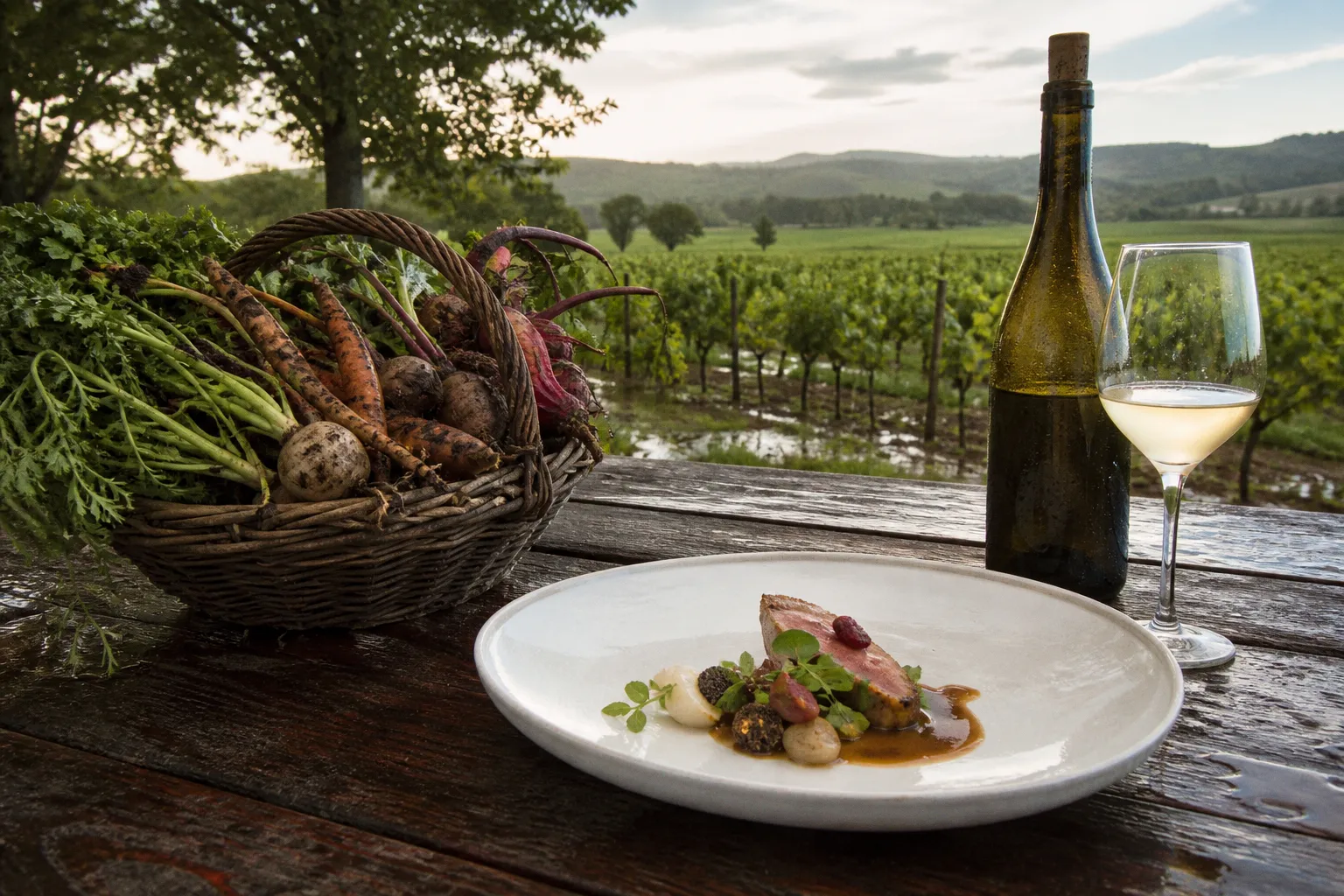
Dordogne Dining: Michelin Stars vs. Authentic Farm Inns
I have been cooking, hosting, and shepherding visitors between kitchen gardens, truffle markets, and tasting rooms across the Périgord long enough to know that framing misses the point. The real question is not which experience is "better" or more "authentic." Both the starred chef and the farm family are reading from the same harvest calendar — they just happen to plate it very differently.
The seven Michelin-starred tables and the family-run fermes-auberges are not opposites. They are two different translations of the same Dordogne terroir.
The Art of Refinement: Inside the Dordogne's Seven Michelin-Starred Tables
The current Dordogne Périgord Tourisme guide lists seven restaurants holding Michelin stars — and if you picture a starred meal as something only found in a slate-grey gastronomic temple, you are in for a pleasant surprise. Most of these tables sit inside converted abbeys, country châteaux, and small village hotels where the dining room opens onto a terrace overlooking a river or a vineyard.
Take Le 1862 at Hôtel Les Glycines in Les Eyzies, where chef Pascal Lombard earned the restaurant its first star in April 2022. The setting is a nineteenth-century manor house shaded by lime trees, and the menu treats Périgord staples — duck, walnut, black truffle — with the kind of patient technique you would expect from a much bigger city kitchen. A few valleys east, Didier Casaguana runs Les Fresques at Château des Vigiers near Monestier, building his seasonal tasting menu around local lamb, freshwater fish from the Dordogne river, and whatever the estate's own kitchen garden is yielding that week.
The remaining starred tables — La Tour des Vents in Monbazillac with its sweeping Bergerac vineyard views, Le Moulin de l'Abbaye in Brantôme set along the river, L'Essentiel in Périgueux for those nights you want to stay in the prefecture, Le Petit Léon tucked into the Vézère valley, and La Meynardie in Salignac-Eyvigues — each bring a different angle on the same regional larder. What unites them is restraint. You will rarely find a dish on a Dordogne Michelin menu whose ingredients have travelled further than an hour's drive, and that proximity is part of the point. A starred meal here is not a break from the region. It is the region, held up to a finer lens.
A Dordogne Michelin meal is not an escape from the countryside. It is the countryside, re-read at a finer register.
Roots of the Périgord: The Enduring Legacy of the Ferme-Auberge
A ferme-auberge is not a restaurant with a farm photo on the wall. It is a working agricultural estate that opens its table to visitors a few days a week — usually by reservation, often for a single sitting at lunch, occasionally on a set evening. The menu is whatever the family has raised, butchered, picked, or preserved that week, served family-style around a long communal table or in a converted outbuilding. You eat what is set in front of you, and you eat it when it is at its peak.
La Ferme du Brusquand in Marquay, which has been welcoming guests since 1905, is a fair example of how the tradition still functions. The day's plate typically leans on duck — semi-cooked foie gras pulled from storage at the right temperature the morning of service, confit prepared across the butcher's cuts that take longest to render, a cassoulet in cooler months — alongside the Sarlat-style potatoes (the crisp-fried golden kind, named for the town that perfected them). If you arrive at 5 PM, you can join the farm tour first, watch the daily cycle of feeding and yard work, then sit down to a meal that tastes like the next two hours of walking through the same property.
Not every ferme-auberge follows that script. Ferme Auberge du Séchoir in Beleymas operates from a converted tobacco-drying shed and runs a plant-based, organically grown menu — the kitchen works almost entirely with what is harvested on-site that morning, and main courses sit between roughly €14 and €28. Auberge Les Truffières, a more traditional table near the truffle groves, asks around €40 in cash for a fixed meal built around the season's black diamonds. The point is that "farm-to-table" in the Dordogne is not a single restaurant format. It is a spectrum that runs from family duck plates to organic vegetable tasting menus, all under the same ferme-auberge label, and it rewards visitors who treat the lunch hour as a moving target rather than a fixed reservation.
The farm plate arrives when the harvest allows it, not when the reservation system asks for it. Plan your appetite, not your schedule.
Shared Ingredients, Different Philosophies: How Chefs and Farmers Interpret Local Produce
Here is the part that surprises most visitors: a starred tasting menu and a ferme-auberge lunch in October will both lean heavily on black truffle, cèpe, and the year's last walnuts. The supply chain is shorter than you might think — many of the chefs source from the same brokers and smallholders who supply the fermes-auberges directly. What changes is the philosophy of the plate.
A Michelin kitchen tends to compress and concentrate. A Périgord truffle becomes a thin shaving over a slow-cooked egg yolk, a butter emulsion, a single perfect raviolo. The goal is to extract the maximum aromatic yield from a small portion. At a ferme-auberge, the same truffle might be folded generously into a frittata the size of a dinner plate, scrambled through eggs by the spoonful, or shaved thickly over a warm slab of goat's cheese. The yield is generous rather than concentrated — more truffle per bite, less architecture around it.
The same divergence shows up with duck. In a starred room, a magret might arrive pink, carved at the table, with a sauce built from reduced jus and a single cherry reduction. At La Ferme du Brusquand or a similar family table, you are likely to see the whole bird honored across the butcher's cuts — confit leg, a pan-seared breast, a slice of foie gras torchon at the start, the fat rendered into the potatoes you are already eating. Neither approach is more authentic than the other. Both are valid interpretations of what a harvest window offers, and both reward different kinds of hunger on different days of the same trip.
The same black truffle will travel less than thirty kilometres from forest to plate, whether you eat it under a chandelier or at a farmhouse table.
From €14 Organic Sheds to €40 Farm Feasts: Navigating the Price and Experience Spectrum
The hardest part of planning a Dordogne food trip is not finding good tables — it is sequencing them so each experience lands properly. A Michelin dinner at full tasting-menu pricing can easily outpace a week of ferme-auberge lunches combined, but the per-meal economics are misleading. You need to factor in reservation windows, dress expectations, travel time from rural gîtes, and how much of your evening a meal will actually consume.
Here is the practical comparison I walk my friends through when they ask which way to lean:
| Dimension | Michelin-starred table | Ferme-auberge |
|---|---|---|
| Reservation lead time | 2–6 weeks in summer; same-week possible in shoulder season | Often 1–3 days; some accept walk-ins for the single lunch sitting |
| Menu structure | Multi-course tasting or à la carte; dietary needs flagged in advance | Single fixed menu, served family-style at a set hour |
| Price per person (drinks aside) | Highest tier in the region; full tasting menus generally sit at the upper end of regional dining | Roughly €14–€28 at organic plant-based tables (Ferme Auberge du Séchoir); around €40 cash at traditional duck-and-truffle tables (Auberge Les Truffières) |
| Setting | Converted abbey, château, or boutique village hotel | Working farm, often with pre-dinner tour (e.g. 5 PM at La Ferme du Brusquand) |
| What to wear | Smart-casual minimum; some rooms prefer a jacket | Whatever you have been gardening in that day |
| Time commitment | Allow 2.5–3 hours from seating to final digestif | Usually 1.5 hours; you eat what is set |
| Best paired with | A pre-dinner drive through the vineyards and a post-dinner walk in the village | A long afternoon outing, market visit, or truffle-hunt morning |
A few practical notes that do not fit neatly in a table. The ferme-auberge tradition in the Dordogne is heavily weighted toward cash, especially at the older family tables, so check before you drive out and arrive with notes the kitchen cannot always accept. Starred rooms tend to take cards without question. Hours matter more than dress code: ferme-auberge kitchens often close between lunch service and the next morning, so arriving at 2:30 PM hungry is a common first-timer error. Finally, if a member of your party keeps a strict diet — vegetarian, gluten-free, no game — call the ferme-auberge directly. Menus are fixed by what the family raised that week, and substitutions are not always possible, but the organic sheds like Le Séchoir have built their whole concept around that kind of flexibility.
Curating Your Culinary Itinerary: Balancing Haute Cuisine with Rural Authenticity
The mistake I see most often is visitors trying to do too much of either thing. Three Michelin dinners in a week leaves you overfed and under-inspired; seven consecutive ferme-auberge lunches in a row starts to feel like a single long meal. The Dordogne rewards a rhythm — and that rhythm is built around what the season is actually giving you at the market stalls that morning.
For a week-long stay, I usually suggest anchoring one or two evenings at a starred table for the nights you want to linger. Pair them with market mornings in Sarlat, Le Bugue, or Issigeac, where you stock the gîte with cheese, bread, walnuts, and a bottle of Bergerac for a quiet lunch on the terrace. Reserve ferme-auberge lunches for the days you have planned an active outing — a truffle-hunt morning in the Sainte-Alvère market, a canoe descent of the Vézère, or a vineyard walk through the Monbazillac slopes — so the appetite builds honestly and the drive home feels earned. If you are visiting in autumn, lean hard into the truffle-and-duck combination; in summer, push toward the lighter organic tables and river-fish menus; in spring, the asparagus and strawberry harvest windows open briefly, and a good ferme-auberge will let you taste them at their actual peak.
One last piece of practical advice, the kind I wish someone had given me on my very first Dordogne trip: book your Michelin table before you book your gîte, not the other way around. The seven starred rooms in the department are spread across a fairly large geography, and the one you want will determine the easiest base for the week. Everything else — the market mornings, the ferme-auberge lunches, the long afternoons by the pool — arranges itself naturally around that single anchor evening.
Book the starred dinner first. Let the rest of your Dordogne week arrange itself around it.