Perigord Truffle Markets: A Visitor Preparation Checklist
The window is narrow. From late November through early March, the controlled truffle markets of the Périgord open on fixed days at fixed hours, and every kilogram of Tuber melanosporum that reaches a…
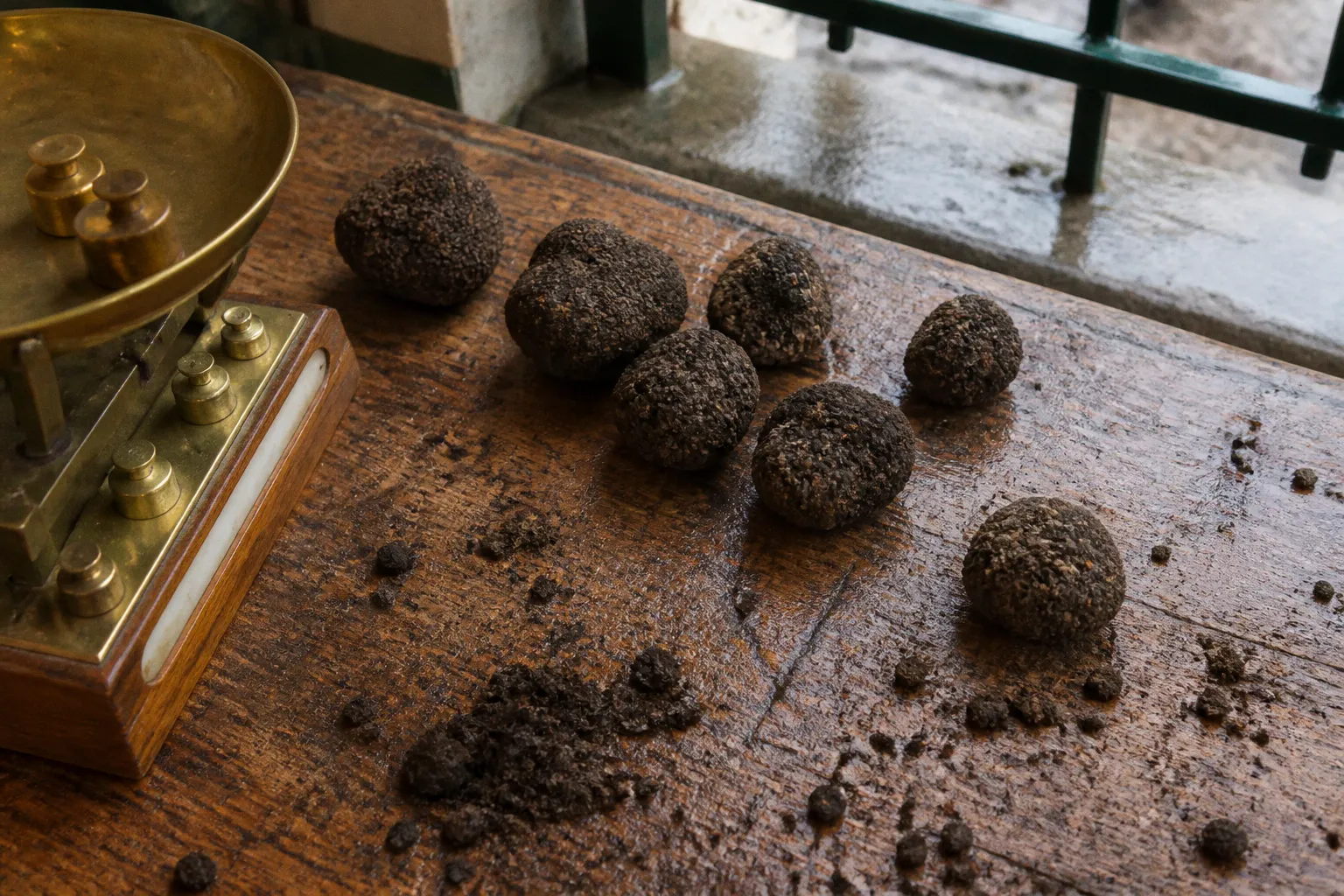
The window is narrow. From late November through early March, the controlled truffle markets of the Périgord open on fixed days at fixed hours, and every kilogram of Tuber melanosporum that reaches a buyer has already passed under the eye of an approved controller from the Périgord Federation of Truffle-Harvesters. Miss the schedule, misunderstand the grading station, or arrive without a plan for storage, and you may leave with the wrong product, the wrong quantity, or nothing at all.
This is not a farmers’ market where visitors wander between heaps, bargain over appearances, and make a decision at leisure. It is a controlled buying environment. The truffle has been inspected, graded, weighed, and cleared before the transaction reaches you. Your task is narrower, but it still requires preparation: arrive on the right day, understand the categories, recognise what the grading means, and know how to protect the tuber once it leaves the table.
The route below covers the principal controlled markets across the region, the distinctions that separate a sound mature truffle from an immature or frost-damaged reject, and the handling required to get that truffle from the market table to your plate without losing the volatile aromatics that justify the price.
The Anatomy of a Controlled Truffle Market
A Périgord truffle market is not a generic stall selling whatever has been dug that morning. It is a graded transaction zone. The Federation dispatches an approved controller to every official session, and that controller works from an inspection station with responsibility for weighing, classifying, and approving the truffles before they are sold.
Buyers do not browse an unclassified pile and try to diagnose quality with a quick sniff. The truffles have already been sorted into three broad outcomes: Category 1, Category 2, or reject. The visitor’s role is to understand the classification, compare the quality with the intended use, and decide whether the lot justifies the price.
That changes the rhythm of the visit. You arrive at the published opening time, locate the controller’s table or station, identify the lots available for purchase, and confirm the grading before completing the transaction. There is no meaningful back-room negotiation over whether a damaged truffle should count as prime quality. The official inspection has already established that point.
The useful questions are practical:
- Is the market genuinely controlled, rather than simply described as a truffle market?
- Which category is being offered?
- Is the lot intended for immediate cooking, a meal later in the week, or transport home?
- Does the quantity match the way you plan to use it?
- Can you store it correctly as soon as you leave?
A visitor cooking a single meal does not necessarily need the largest or most cosmetically perfect tuber. Category 2 can be a sensible choice when the interior is sound and the external flaw is minor. A buyer looking for a presentation truffle, or planning to shave it directly over several dishes, may prefer Category 1. The point is not to pursue the highest grade automatically. It is to understand what you are paying for.
A controlled market strips the guesswork out of buying. The grade is on the table before you reach for your wallet.
Twelve controlled markets operate across the Périgord during the winter season. Not every town holds a market on every day, and the seasonal timetable is part of the system rather than an administrative detail. A visitor who arrives in the wrong commune on the wrong morning can be perfectly prepared for truffle buying and still go home empty-handed.
The controlled format also protects the reputation of the region. A truffle market is valuable precisely because the buyer does not have to rely on a seller’s description alone. Weight, condition, maturity, and sale status are brought into the open. That does not remove every decision from the visitor, but it gives the decision a reliable starting point.
Decoding Quality: Understanding Official Grading Standards
The grading system is three-tiered in execution, even if the buying decision often feels binary: acceptable or not acceptable. A controller assesses weight, maturity, colour, and structural integrity. The visible appearance matters, but the interior is decisive. A truffle can look impressive from the outside and still fail to deliver the maturity and aroma expected of a black Périgord truffle.
| Parameter | Category 1 | Category 2 | Rejected |
|---|---|---|---|
| Minimum weight | 10 grams or more | Under 10 grams, or above that threshold with surface flaws | Any weight |
| Exterior | Uniform dark colour, firm and intact | Slightly misshapen or showing light surface blemishes | Cracked, soft, frost-damaged, or showing insect damage |
| Interior | Fully matured black flesh with a pronounced pale-vein marbling | Sound interior with minor irregularities | Overall pale or whitish immature interior, or flesh compromised by damage |
| Sale status | Cleared for retail and wholesale | Cleared for retail at a lower price band | Withdrawn from sale |
Category 1 is the prime grade. The truffle weighs at least ten grams, has no significant visible defect, and reveals dense black flesh with a developed network of pale veins when cut. Those pale or white veins are not evidence of immaturity: they are a characteristic part of a mature Tuber melanosporum. What matters is the dark flesh around them, the strength and definition of the marbling, and the overall condition of the interior.
Category 2 is not automatically a poor culinary choice. The differences may be size, shape, or surface appearance rather than a fundamental failure of flavour. A smaller specimen, or one with a cosmetic imperfection, can still perform well when grated into butter, folded through warm pasta, or used to perfume eggs. The lower price band reflects the classification, but it does not mean that the truffle has no value in the kitchen.
The distinction becomes important when the imperfection is not merely cosmetic. A soft patch, deep crack, insect damage, or evidence of frost affects the condition of the flesh and the truffle’s ability to retain its aroma. The controlled grading is designed to remove that uncertainty before sale.
Reading the interior
Maturity is most clearly revealed when the truffle is cut. A mature black truffle has dark flesh and a network of pale veins that creates the characteristic marbled appearance. The contrast should look developed and substantial. An immature truffle tends towards an overall pale or whitish interior, with less convincing structure and a weaker aromatic profile.
That distinction is worth making carefully. Pale veins within dark, well-developed flesh are normal and desirable. A generally pale or whitish interior is a different matter: it indicates that the truffle has not reached the maturity expected for the product being sold as a black Périgord truffle. The problem is not the presence of light lines. It is the lack of mature dark flesh across the interior.
This is why the exterior alone is a poor guide. Dirt can disguise colour, and shape says little about maturity. A knobbly truffle is not necessarily inferior; a smooth, attractive one is not necessarily ready. The interior and the official grade carry more weight than a quick visual impression.
Frost damage is a separate problem. Exposure to sub-zero temperatures can compromise the cellular structure of the truffle, reducing aromatic quality and accelerating deterioration. A truffle affected by frost may feel soft or show damage that becomes more apparent after cutting. It is not a bargain version of Category 1. It is a different quality proposition and, within the controlled system, should be withdrawn from sale.
An immature truffle is also not something that will improve after purchase. Unlike fruit that can continue ripening away from the plant, a truffle harvested before full maturity will not develop the same complete aroma simply because it is stored for several days. Buying an overall pale interior in the hope that time will correct it is false economy.
Choosing a black truffle for the kitchen
The best specimen depends on the intended service. Before you join the queue, decide whether the truffle is going to be:
- Shaved directly over eggs, potatoes, rice, or pasta, where appearance and immediate aroma matter.
- Infused into butter or cream, where a slightly irregular shape is less important.
- Divided across several meals, which makes storage quality and intact skin especially valuable.
- Transported home, where a firm, undamaged truffle will tolerate the journey better than a soft or cracked one.
Do not confuse size with intensity. A larger truffle is not automatically more aromatic, and a small Category 2 truffle is not automatically weak. The grade, maturity, firmness, and condition together provide a better basis for the decision. If the purchase is for one meal in a gîte, a sound smaller truffle may be more sensible than a large specimen that will sit unused in the refrigerator.
There is also a difference between buying for a dish and buying for display. A truffle that will be shaved at the table benefits from a firm exterior and a shape that is easy to hold and slice. One destined for a sauce, butter, or stuffing can tolerate a less regular outline, provided the flesh is sound. The market’s classification gives you the information; the menu determines how much of the cosmetic premium is worth paying.
Strategic Timing: Market Schedules from Sarlat to Sainte-Alvère
The Périgord truffle season generally runs from late November or early December through mid-February or early March, depending on the harvest and the weather. Individual markets then operate on their own fixed days and hours. This is the part of the visit most likely to go wrong. A traveller can plan a weekend around a town, arrive expecting a market, and discover that the relevant session took place several days earlier.
The practical rule is simple: verify the current schedule before setting out, then build the day around the opening time rather than treating the market as an optional stop. Market calendars can change slightly from one season to the next, and an old accommodation guide or archived travel article is not a sufficient authority for a time-sensitive journey.
Sarlat-la-Canéda
The retail market operates on Saturday mornings from 8:30 a.m. on Rue Fénelon, in the medieval centre of the town. It is the most visitor-friendly session and usually attracts several growers presenting graded lots under the controlled inspection protocol.
Arriving at opening time matters. The first hour offers the strongest choice, particularly for Category 1 specimens. Later arrivals may still find truffles, but the selection can be narrower and the most desirable lots may already have changed hands. A visitor who wants to compare several grades should not plan to arrive just before the market closes.
Sarlat also has a wholesale bulk market on Wednesday afternoons under the arcades of the town hall on Place de la Liberté. This session is oriented towards professional buyers purchasing larger quantities. It should not be treated as a normal visitor market: access and purchasing arrangements may be restricted, so travellers should confirm the current position with the market organiser or local tourist office before planning around it.
For a first visit, the Saturday retail session is the straightforward choice. The Wednesday wholesale market belongs to a more trade-oriented part of the system, with larger lots and a different rhythm. A visitor who has not confirmed access should not assume that turning up will provide the same buying opportunity as the Saturday session.
Sainte-Alvère
The controlled market at Sainte-Alvère takes place on Monday mornings at 10:00 a.m. inside the covered market hall. The session runs from late November through late February.
Sainte-Alvère is positioned roughly between Sarlat and Périgueux, making it a practical waypoint for visitors staying in gîtes across the central Périgord. Its Monday schedule is useful for travellers who have spent the weekend in Sarlat or who are moving between the Dordogne valley and Périgueux. It is also the source of one of the easiest planning mistakes: arriving on a Saturday because that is the day associated with many other regional markets.
The hall’s covered setting makes the buying process feel orderly, but the same preparation still applies. Be there before the session begins, know whether you want a single truffle or a larger lot, and have a storage plan ready before you buy. If you are staying some distance away, allow time for parking and the final walk to the hall. The market itself may be brief; the journey is not necessarily so.
Périgueux
The Périgueux market follows the same Federation-controlled protocol as the other regional markets, with seasonal hours published through the Office de Tourisme Intercommunal du Grand Périgueux. Visitors using Périgueux as a base should confirm the current session schedule before driving out.
The calendar can shift slightly from one year to the next in response to harvest conditions. That does not mean the market system is unpredictable; it means that a schedule found in an old accommodation guide is not enough. Check the current information close to the date of travel, especially if the market is the main reason for a particular day’s itinerary.
Périgueux is also a useful base for combining a market visit with other food-focused stops. The city’s position makes it possible to approach the northern and central parts of the Périgord without committing every day to the longer drive towards Sarlat. That can be more comfortable for visitors who want the market to be part of a wider gastronomic day rather than an isolated early-morning expedition.
Sorges-et-Ligueux-en-Périgord
Sorges-et-Ligueux-en-Périgord lies northeast of Périgueux, not south of the city. The commune is associated with the late-January “Truffes en Folie” festival and holds controlled market sessions during the peak winter window.
Visitors combining a market run with the festival should plan around the final week of January, while still confirming the precise programme and market hours before travelling. The event is a useful way to place the market within the wider culture of the region: growers, demonstrations, food, and local identity come together rather than being separated into a single transaction.
Its location northeast of Périgueux also makes it a different kind of stop from Sainte-Alvère. It works naturally for visitors travelling from Périgueux towards the northern Périgord, whereas Sainte-Alvère is more convenient for a route between the central region and Sarlat.
Building a route
For visitors planning a multi-day sweep across several markets, a realistic outline may include Sarlat on Saturday morning, Sainte-Alvère on Monday morning, and Périgueux mid-week if the current schedule aligns. The Wednesday wholesale session at Sarlat should be treated as an optional, access-dependent addition rather than a guaranteed visitor stop.
That route is not a competition to collect markets. Each additional stop introduces another drive, another early start, and another quantity of truffle to store. The sensible approach is to choose the session that fits the meal plan and accommodation rather than treating the market calendar as a checklist to complete at any cost.
The season is fixed, the days are fixed, the hours are fixed. Build your itinerary around the calendar — do not expect the calendar to flex around you.
Post-Market Care: Preserving Your Truffle Investment
A fresh Périgord truffle begins losing aromatic intensity once it leaves the controlled station. The purchase is only the first half of the operation. Storage determines whether the truffle reaches the plate with its aroma intact or becomes an expensive, increasingly dull object in the back of the refrigerator.
The basic protocol is straightforward. Wrap the truffle in a dry paper towel, place it inside a sealed glass jar, and store the jar in the refrigerator. Do not freeze it. Frost is precisely the kind of damage the controlled market is designed to exclude, and freezing a fresh truffle at home compromises its texture and aromatic character.
Change the paper towel every day. The towel absorbs moisture released by the truffle, but once it becomes damp it no longer protects the product. A saturated towel can accelerate deterioration and encourage mould. The sealed jar contains the aroma and reduces the risk that the truffle will absorb odours from cheese, onions, cooked food, or anything else occupying the refrigerator.
A whole, intact truffle kept under this protocol holds its aromatic peak for roughly four to five days. That is a short window, but it is long enough for a visitor staying in a self-catering gîte to plan several carefully chosen dishes. The important point is to make the plan before buying. Do not purchase a large quantity and assume that storage will preserve it indefinitely.
Once the surface is broken by slicing or shaving, the exposed flesh begins to oxidise and the useful window becomes shorter. Shave the truffle at the moment of service rather than preparing it hours in advance. The aroma is volatile; it belongs in the warm dish, not on a cutting board while the rest of dinner is being organised.
Dosage without waste
Dosage is where visitors often overestimate what they need. Local culinary guidance places approximately 30 grams of fresh truffle across three distinct dishes: shaved over scrambled eggs, folded into pasta, or infused into a butter or cream preparation. The exact distribution depends on the dish and the strength of the truffle, but the principle is consistent: a little well-handled truffle can carry several meals.
Eggs are particularly useful because they absorb aroma during storage. If you intend to serve truffled eggs, place the intact truffle with the eggs in a sealed container for a period before cooking. Keep the truffle dry and separate from the eggs themselves. The result is not a substitute for fresh shaving at the table, but it makes sensible use of the same purchase.
Warmth matters. Truffle should generally meet a warm dish rather than prolonged high heat. Excessive cooking can flatten the aroma that made the ingredient worth buying. Fold shavings through a finished sauce, place them over the dish just before serving, or let the residual heat release the fragrance without boiling it away.
A visitor in a gîte should also think about equipment. A small sharp knife is adequate, but a truffle slicer makes it easier to produce thin, even shavings. More importantly, plan dishes that do not compete with the ingredient. Eggs, potatoes, pasta, rice, butter, and cream provide a quiet base. A heavily spiced recipe can overwhelm the truffle before anyone has a chance to appreciate it.
Beyond the Purchase: Immersive Truffle Festivals and Traditions
A controlled market is the most direct way to buy, but it is not the whole truffle culture of the Périgord. The winter calendar includes festivals, demonstrations, tastings, and events that place the tuber in its agricultural and culinary setting. These gatherings are useful for visitors who want to understand why the market is so formal and why maturity, grading, and timing matter.
The late-January “Truffes en Folie” festival at Sorges-et-Ligueux-en-Périgord is one example. It connects the market with demonstrations, local food, and the traditions surrounding cultivation and harvesting. The festival atmosphere is more expansive than the brief commercial exchange at a market stall, but the same principles remain visible: provenance matters, the harvest is seasonal, and the quality of the finished ingredient begins long before it reaches the kitchen.
Other events may include cooking demonstrations or opportunities to see how truffles are prepared for service. These are not simply entertainment for visitors. They show the practical relationship between the raw product and the dishes that suit it. A truffle is not improved by complexity for its own sake. It is usually treated with restraint, allowing the aroma to sit against a neutral or gently flavoured base.
What to observe at a festival
A festival can also sharpen your understanding of the market system. Watch how growers handle the truffles, how the product is presented, and how explanations distinguish a mature black truffle from an immature one. Notice that pale veins are discussed as part of mature marbling, while an overall pale or whitish interior indicates a different problem.
It is worth asking about the current programme before travelling. Festival dates and detailed schedules are seasonal, and demonstrations may be concentrated into a particular part of the day. The event should be planned with the same care as the market itself. A visitor who arrives late may still enjoy the food and atmosphere but miss the part that explains the agricultural and commercial process.
The wider tradition also helps correct a common misconception: truffle buying is not primarily a treasure hunt for the most dramatic-looking specimen. It is a matter of season, maturity, condition, and use. The best purchase is the one that reaches the plate at the right moment and in the right dish.
Making the market visit work
The essential preparation is modest, but it has to be done in the right order.
1. Confirm the market date and opening time. Use current local information rather than relying on a previous year’s itinerary. Pay particular attention to the difference between retail and wholesale sessions.
2. Choose the market that fits your route. Sarlat, Sainte-Alvère, Périgueux, and Sorges-et-Ligueux-en-Périgord serve different travel patterns. The nearest market is not always the most convenient if the day does not match your stay.
3. Decide how you will use the truffle. A single meal, several meals, transport home, and a festival tasting call for different quantities and different priorities.
4. Understand the interior grading. Mature black flesh with pale marbling is the expected pattern. An overall pale or whitish interior indicates immaturity; it should not be confused with the normal pale veins of a mature truffle.
5. Buy only what you can store and use promptly. A sealed glass jar, dry paper towel, and refrigerator should be ready before the purchase, not improvised afterwards.
6. Keep the cooking simple. The truffle’s aroma is the point. Use warm, mild dishes and shave or fold the truffle into the food at the last practical moment.
The market does most of the quality control, but it does not plan your holiday, your route, or your dinner. That remains the visitor’s responsibility. Arrive on the correct day, understand what the grade is telling you, and buy for the meal you will actually cook. In the Périgord, the best truffle experience is rarely the result of rushing after the most expensive specimen. It comes from matching a sound mature truffle to the right moment.