Sainte-Alvère vs Sarlat: two Périgord truffle routes
The difference between the Sainte-Alvère and Sarlat truffle markets is not simply a matter of choosing a Monday or a Saturday.
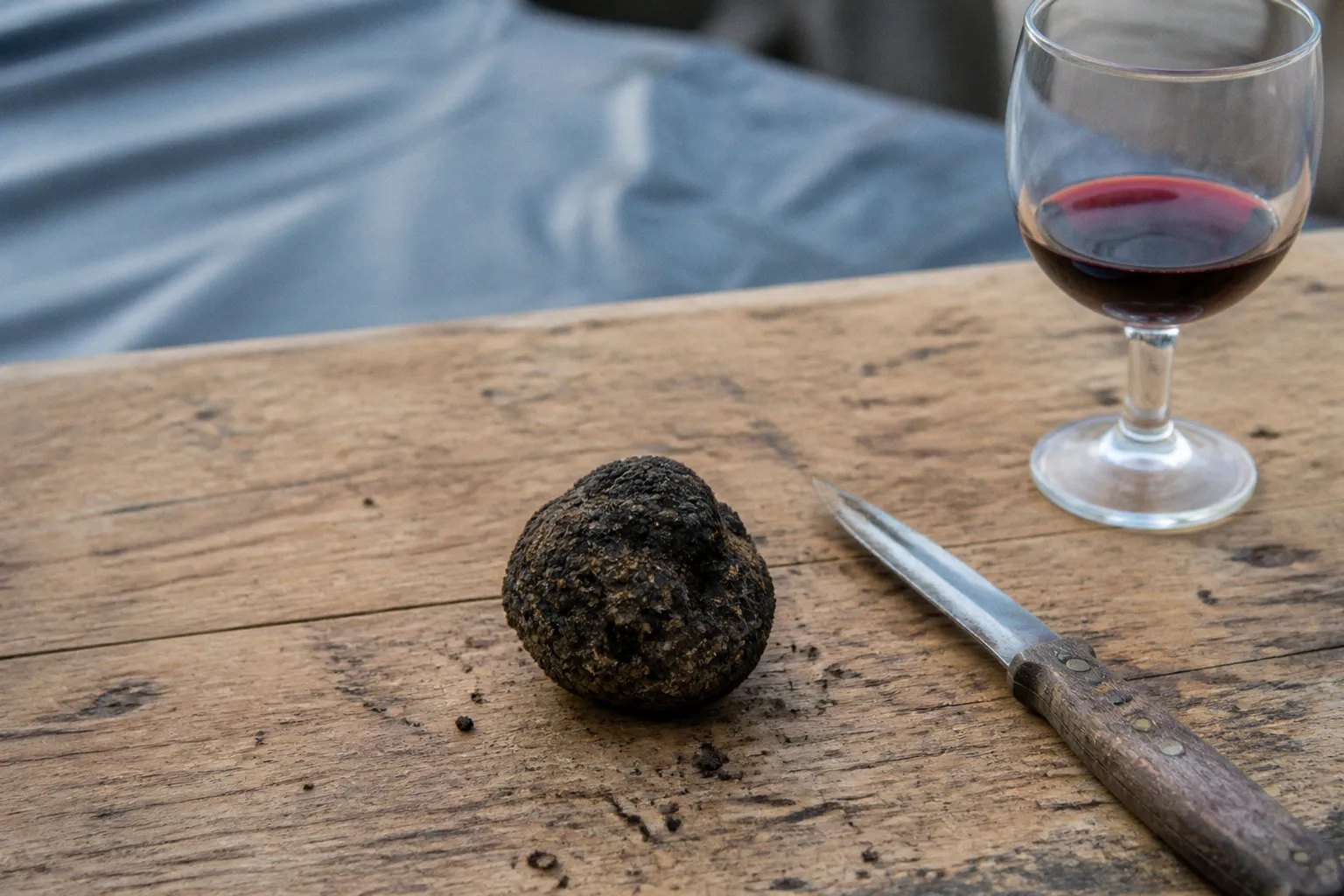
It is a choice between two ways of entering the Périgord black truffle trade: one brisk, regulated, and focused on the quality of the tuber; the other more festive, accessible, and woven into a wider day in one of Dordogne's most visited towns.
That distinction matters when you are planning a winter food journey. At Sainte-Alvère, the market begins at exactly 10:00 a.m., and much of the business is completed within half an hour. In Sarlat-la-Canéda, the retail market runs through the morning, with stalls, visitors, demonstrations, and the possibility of combining truffle shopping with a full town visit. Neither experience is automatically better. They answer different pantry plans.
If you want to understand how official inspection shapes the buying process, Sainte-Alvère is the sharper route. If you want atmosphere, choice, and a more leisurely introduction to buying truffles in Dordogne, Sarlat is easier to fold into a weekend.
The Sainte-Alvère standard: precision and official inspection
Sainte-Alvère's winter truffle market is built around control. It operates on Monday mornings at 10:00 a.m. from late November through late February, and every Périgord black truffle sold through the regulated market is inspected, weighed, and categorized by official controllers before it reaches the public sale.
That timing is not decorative. The market is designed for a rapid exchange between sellers and buyers, rather than a long browsing session. Doors open at the stated hour, and the majority of transactions are completed within roughly 30 minutes. Arriving late does not necessarily mean that you will find nothing, but it does mean that you have missed the principal rhythm of the market.
The market's great advantage is that quality is not left entirely to the eye of a visitor who may be unfamiliar with fresh truffles. Official sorting gives the buyer a clearer framework. The truffles have been assessed before sale, rather than simply placed on a table with a handwritten price and a hopeful description.
This does not make every specimen identical, nor does it remove the natural variation of a harvest. Black truffles are agricultural products, and weather, soil, maturity, scent, size, and the condition of the season all influence what arrives at market. But the Sainte-Alvère system gives the transaction a firm starting point.
What the inspection changes for a buyer
A truffle is not judged by size alone. A large specimen may be impressive to look at, but a smaller, well-matured truffle with a strong aroma can be more useful in the kitchen. The interior, known as the gleba, also matters: when cut, a mature black truffle should show the characteristic veining associated with its development.
At Sainte-Alvère, official inspection is intended to sort and categorize the product before public sale. For a visitor, this reduces some of the uncertainty that can make Dordogne truffle shopping intimidating. You are not expected to behave like a wholesale buyer, but you should still pay attention to the category, the weight, and the final price before the transaction is completed.
The practical sequence is straightforward:
1. Arrive before 10:00 a.m. The market opens at a precise time rather than gradually gathering throughout the morning.
2. Watch the first transactions. The pace can be quick, and observing for a few minutes helps you understand how sellers present the harvest.
3. Ask about weight and category. These are more useful questions than simply asking whether a truffle is fresh.
4. Buy only what you can use promptly. The aroma is the point of the purchase, and it will not improve through unnecessary storage.
5. Have a kitchen plan before you buy. A truffle bought without eggs, butter, potatoes, rice, or another mild base often becomes an expensive ornament rather than an ingredient.
Sainte-Alvère is the market to choose when you want the truffle itself to remain the centre of the morning: inspected, categorized, bought, and carried home without fuss.
There is also a cultural lesson in the market's speed. Local agricultural markets often work according to harvest windows rather than visitor convenience. The product has arrived at a particular moment, buyers know what they are looking for, and the transaction moves accordingly. A visitor who expects a tasting-room atmosphere may find Sainte-Alvère abrupt; a visitor who appreciates a clear process will usually find it reassuring.
Sarlat-la-Canéda: a festive hub for truffle enthusiasts
Sarlat offers a different version of the Périgord truffle experience. Its winter retail market takes place on Saturday mornings from 8:30 a.m. to 12:00 p.m., along Rue Fénelon and Place de la Liberté, generally from mid-November to early March.
The longer opening window changes the character of the visit. You have time to arrive early, look at the produce, walk through the historic centre, return to the market, and continue the day with lunch or another stop in the region. The market is more visibly oriented towards visitors, which makes it approachable for anyone encountering the black truffle trade for the first time.
Sarlat also has a wholesale truffle market on Wednesday afternoons beneath the arcades of the town hall on Place de la Liberté, overseen by the Société Nationale des Marchés. That is a separate setting from the Saturday retail market. A visitor looking for the public-facing experience should plan around Saturday morning; someone interested in seeing the market from a more commercial angle may find the Wednesday event more revealing, although the rhythm and audience are different.
The town's annual Fête de la Truffe adds another layer. Held over a full weekend in mid-January, the festival includes culinary demonstrations, truffle dog demonstrations, and appearances by Michelin-starred chefs. For travellers who want more than a purchase, it provides a concentrated introduction to the ingredient: how it is found, handled, cooked, and presented.
The festival weekend for the 2026 season was scheduled for 17–18 January 2026, an event that has already taken place by late August. For anyone planning the next edition, the festival typically falls in mid-January each year; the precise dates should be confirmed through the Sarlat tourist office or official town listings before booking travel and accommodation around it. Treat the festival as a particularly busy period rather than assuming it represents an ordinary Saturday market. Demonstrations and public interest change the atmosphere, and accommodation, restaurant tables, and parking can become more difficult to arrange.
Why Sarlat suits a first truffle visit
Sarlat is forgiving of an imperfect plan. The retail market runs for several hours, so you are not dependent on reaching one precise opening bell. You can combine it with a broader culinary itinerary, perhaps beginning with the market and continuing to a local restaurant, a food shop, or a drive through the surrounding Périgord countryside.
That flexibility is valuable for guests staying in a Dordogne gîte, particularly when the morning involves children, a long breakfast, or a market-day kitchen plan that includes more than truffles. Sarlat makes it easier to treat the market as one stop in a day rather than the entire purpose of the outing.
The trade-off is that the visitor experience can feel busier and less concentrated. There are more people browsing, photographing, asking questions, and moving between stalls. The atmosphere is part of the appeal, but it can make close comparison more difficult than at a tightly controlled specialist market.
Sarlat is not a guarantee that every truffle on display has passed through the same official inspection system used at Sainte-Alvère. Controlled sorting is a specific feature of designated markets, and buyers should not assume that all market stalls across Dordogne operate under identical procedures. Ask how the truffles have been graded, where appropriate, and whether the price is given by weight.
Sainte-Alvère vs Sarlat truffle markets: the practical comparison
The simplest way to decide is to match the market to the kind of day you want. Sainte-Alvère offers a focused purchase with strong official oversight. Sarlat offers a longer, more public-facing morning with room for discovery and other activities.
| Parameter | Sainte-Alvère | Sarlat-la-Canéda |
|---|---|---|
| Main public market | Monday morning | Saturday morning |
| Opening time | 10:00 a.m. sharp | 8:30 a.m. |
| Closing pattern | Transactions move rapidly, with most completed within about 30 minutes | Retail market continues until 12:00 p.m. |
| Market character | Regulated, brisk, quality-focused | Festive, visitor-friendly, integrated into a historic town |
| Inspection | Official controllers inspect, weigh, and categorize each Périgord black truffle before public sale | Do not assume every stall follows Sainte-Alvère's inspection process |
| Best for | A purposeful purchase and a closer look at market discipline | A first introduction, a broader day out, or a festival visit |
| Additional event | The market itself is the main attraction | January Fête de la Truffe, plus a Wednesday wholesale market |
| Planning pressure | High: arrive for the exact opening | Lower: the retail window gives more flexibility |
| Ideal pantry plan | Buy, return home, and cook promptly | Browse, learn, shop, and build a wider meal around the visit |
The table gives the outline, but the important difference is less visible: Sainte-Alvère asks you to adapt to the market, while Sarlat adapts more readily to the visitor.
Which route is better for buying truffles in Dordogne?
Choose Sainte-Alvère if:
- You are travelling specifically to see a regulated Périgord black truffle market.
- You value official inspection and categorization as part of the buying decision.
- You can be in place before 10:00 a.m. on a Monday.
- You already know how you will use the truffle once you return to your kitchen.
- You prefer a short, concentrated market experience to a busy public festival.
Choose Sarlat if:
- This is your first time buying or seeing fresh black truffles.
- You want to combine the market with restaurants, food shops, and a town visit.
- You need a wider morning window rather than a single opening moment.
- You enjoy culinary demonstrations and public events.
- You are visiting in mid-January and would like the fuller Fête de la Truffe experience.
A serious truffle enthusiast may reasonably visit both. Sainte-Alvère explains the discipline of the trade; Sarlat shows how that trade becomes part of the region's public culinary identity.
Seasonal timing: the black truffle calendar in Périgord
The first mistake in planning a truffle route is assuming that Périgord black truffles are a year-round product. They are not. The winter black truffle, Tuber melanosporum, belongs to a limited harvest season that runs from late November into late February or early March, depending on the market calendar and local conditions.
For the winter 2025–26 season, the listed market dates run from 24 November 2025 to 23 February 2026. Sarlat's retail season is generally described as extending from mid-November to early March, while Sainte-Alvère's regulated Monday market is associated with the late-November-to-late-February window.
These dates should be read as a planning framework, not a promise that every week will offer the same yield. Truffle harvests respond to weather and ground conditions. The volume coming to market can change, and prices fluctuate with the harvest rather than following a stable supermarket-style tariff. Exact prices for a future week cannot be sensibly promised in advance.
There is also a separate summer truffle season. Tuber aestivum, often called the summer or Saint-Jean truffle, is harvested between mid-June and mid-July. Its season and culinary profile are not interchangeable with the winter Périgord black truffle. If your aim is the deeply aromatic winter ingredient associated with these markets, plan for the colder months.
How early should you travel?
For Sainte-Alvère, the answer is simple: build the day around the 10:00 a.m. opening. A late arrival undermines the point of choosing a market whose main business happens quickly.
For Sarlat, arriving close to the start of the retail market gives you the best chance to browse before the morning becomes crowded, while still allowing more flexibility than Sainte-Alvère. The 8:30 a.m. opening also suits a longer food itinerary: market first, then coffee or breakfast, followed by a drive or lunch elsewhere in the valley.
The mid-January festival is a special case. The programme may include demonstrations and dog work, with trained truffle dogs able to detect scent at depths of around 30 centimetres. That detail is not merely a spectacle. It explains why truffle hunting is difficult to reduce to a simple walk through an oak grove: the product is concealed, the harvest window is narrow, and the quality of the final truffle depends on what happens after it is found.
From market to kitchen: selecting and storing your find
A fresh truffle should have a job waiting for it. The best home use is rarely a complicated recipe with a crowded list of ingredients. Truffle aroma is easily lost behind chilli, strong herbs, heavy sauces, or a powerful butcher's cut. Eggs, butter, cream, potatoes, rice, and fresh pasta are useful precisely because they provide a mild background.
Local chefs often note that around 30 grams of black truffle can be sufficient to flavour up to three dishes. That is a useful kitchen proportion, particularly for a holiday gîte where you may want one truffle to carry several meals rather than use it all at once. The exact yield depends on maturity, the strength of the truffle, and how generously it is distributed, but the principle is sound: a modest quantity can have a broad effect when paired with the right base.
Storage temperature and timing
The truffle should be handled as a fresh, aromatic ingredient, not as a dry pantry good. Keep it cool and use it promptly. A sealed container can help protect the aroma, but moisture is the enemy of a clean storage routine, so the truffle should not be left sitting in condensation.
If you are staying in a gîte, make the kitchen equipment part of the plan before purchasing. You need a reliable refrigerator, a clean container, a sharp knife or truffle slicer, and ingredients that will not compete with the aroma. A storage temperature that is too warm shortens the useful window; a container that traps excess moisture can damage the surface.
The practical order is:
1. Buy near the day you intend to cook. This keeps the harvest-to-plate window short.
2. Handle the truffle gently. Brush away visible soil rather than soaking it in water.
3. Use a mild dish as the first test. Warm eggs or buttered potatoes will tell you more about the aroma than a heavily seasoned stew.
4. Slice thinly when serving over a warm base. Heat releases fragrance, but excessive cooking can flatten it.
5. Divide the quantity deliberately. If you have approximately 30 grams, plan two or three modest uses rather than one oversized dish.
6. Keep strong flavours at a distance. Garlic, smoked meat, hot spices, and highly seasoned sauces can overwhelm a delicate truffle.
This is where the two markets converge. Whether the truffle came through Sainte-Alvère's official process or was bought during Sarlat's Saturday market, the kitchen will judge the purchase by the same things: maturity, aroma, storage, and timing.
The most convincing truffle meal is often the least complicated one, because it leaves enough room for the harvest to speak.
A simple gîte menu
For a practical Dordogne stay, plan a small sequence rather than one elaborate dinner. Begin with eggs or a soft omelette, where the aroma can be noticed clearly. The next meal might use thin slices over warm potatoes, rice, or fresh pasta finished with a little butter. A third use — risotto, a creamy sauce for poultry, or shaved truffle over a salad of bitter leaves — rounds out the truffle without exhausting it. The same 30 grams, used across three meals, gives each dish a distinct note rather than letting one plate carry the full weight of the ingredient.
If the truffle is larger than expected, consider freezing part of it. Frozen truffle loses some of its aromatic lift, but it still has its place in an omelette or a butter sauce long after the fresh window has closed. Slice before freezing, separate the pieces with parchment, and use them quickly once thawed.
A note on authenticity and price
Périgord truffles are not inexpensive. The market price reflects the labour of harvest, the limited season, and the irreplaceable role of trained dogs in finding the tuber. There is no honest shortcut. A truffle offered at a fraction of the going market price, or trimmed to a suspiciously uniform shape, deserves the same caution a buyer would apply to any luxury agricultural product whose origin is unclear.
If a vendor cannot answer basic questions about the harvest, the weight, or the grading, treat that silence as information. The regulated markets exist precisely because the trade has spent decades establishing the kind of trust that protects both the producer and the visitor. A buyer who arrives informed — knowing the season, the schedule, the difference between a wholesale and a retail morning, and the typical use of a 30-gram truffle — is far better placed to judge the purchase than one who relies on atmosphere alone.
Two routes, one ingredient
The honest summary is that Sainte-Alvère and Sarlat serve different parts of the same journey. A traveller who wants to see how the official side of the truffle trade works, and to buy on the morning the market is designed for, will be satisfied with Sainte-Alvère. A traveller who wants the broader Périgord Saturday, with a town, a market, a festival option, and the leisure to browse and learn, will be happier in Sarlat. Neither market replaces the other; each one explains the Périgord black truffle from a different angle.
For guests based in a luxury self-catering gîte between the two towns, the practical advice is straightforward. Decide first whether the trip is about the truffle itself or about a fuller Périgord day. Plan the season carefully, build the menu before the visit, and treat both markets with the same respect for what an honest harvest, sold by weight and graded before sale, can still bring to a winter table.