Dordogne group rentals: single large villa vs multiple gites
The first question for a large Dordogne holiday is not whether the house has a heated pool, a handsome stone fireplace, or enough bedrooms.
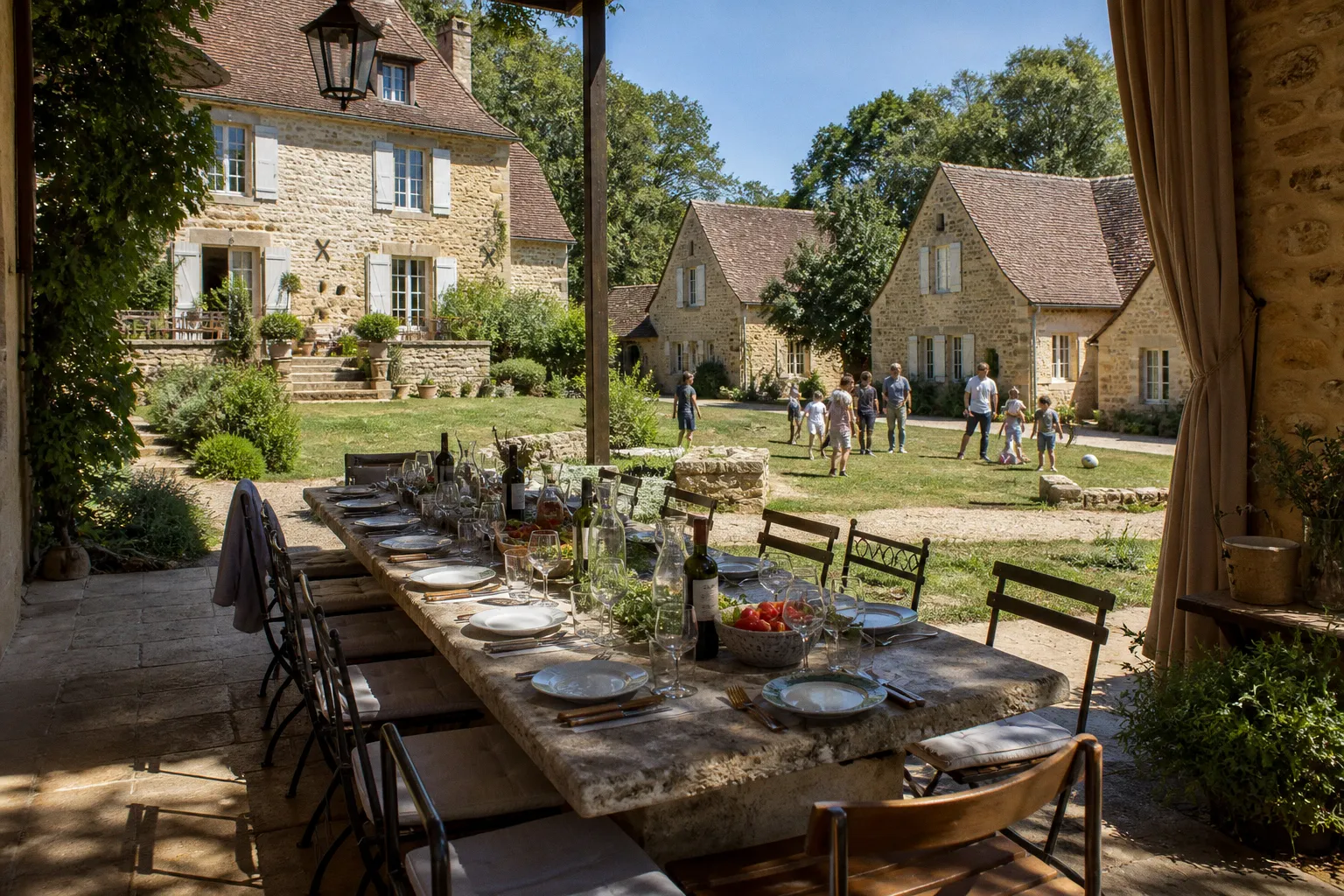
It is simpler, and rather more revealing: where will everyone eat breakfast when three families wake at different times, the children are already asking about the pool, and the person responsible for lunch is trying to store a week’s worth of market produce at the right storage temperature?
That is the practical dividing line between a single large villa and a collection of independent gîtes on one estate. Both can work beautifully for a multi-family holiday, but they produce very different daily rhythms. A restored manor or château keeps the group together under one roof, while a multi-gîte domaine gives each household its own kitchen, sitting room and retreat space, with shared grounds and amenities beyond the front door.
For anyone comparing a large family villa vs multiple gites in Dordogne, the best choice depends less on the headline bedroom count than on how your group actually lives: who cooks, who goes to bed early, who needs quiet, and whether shared meals are the heart of the holiday or simply one pleasant part of it.
The real difference is the shape of the day
A single large villa is designed around togetherness. The kitchen, dining room, terrace and pool usually become communal territory, and people naturally cross paths throughout the day. Someone starts coffee, another brings back bread, children drift between the games room and the garden, and dinner becomes a group occasion almost by default.
That flow is often exactly what a reunion needs. If the purpose of the trip is to celebrate a birthday, mark an anniversary or gather relatives who do not see one another often, a large house makes the group feel like one household. There is less need to message everyone about where lunch is happening because lunch is happening in the same place for everybody.
Multiple gîtes create a different arrangement. Each family or couple has a base with its own kitchen and living area, so breakfast can happen according to individual schedules. One household may head into Bergerac early for the market while another remains by the pool. Grandparents can take an afternoon nap without the entire house adjusting its volume. Teenagers can make pasta at a later hour without taking over the main kitchen.
The shared element remains important. On a well-planned estate, the gîtes may sit around common grounds with a pool, pétanque court, lawns and games areas. If the whole domaine is booked exclusively, the group still has a shared holiday setting; it simply has more than one front door.
The question is not whether your group loves one another. It is whether everyone needs the same breakfast time, noise level and butcher’s cut of the day.
This is why a multi-gîte estate can be particularly successful for extended families and groups of friends travelling together but not functioning as one household. Privacy is not a sign of distance. In a week-long rental, it is often what allows people to remain generous with one another.
What changes when everyone sleeps under one roof?
Large holiday homes in the Dordogne can accommodate roughly 18 to 38 guests across nine to twelve bedrooms, depending on the property. That sounds straightforward on paper, but capacity figures rarely explain the most important practical details.
A house may sleep 24 people yet have a dining table intended for 16. It may have generous bedrooms but only one main sitting room. It may offer several bathrooms but one narrow kitchen passage where everyone gathers at the moment the food is ready. These are not minor inconveniences when you are planning a roast, serving children, and trying to keep a delicate market tart away from the warmest part of the kitchen.
When assessing a single large villa, look beyond the number of beds and ask:
- Can the dining room seat the full group comfortably, rather than in shifts?
- Is there enough refrigerator space for a week of food, drinks and breakfast supplies?
- Does the kitchen have more than one useful preparation surface?
- Are there quieter sitting areas for guests who do not want to remain at the main table?
- Can the outdoor terrace accommodate the entire group for lunch?
- Are bedrooms distributed so that early risers and late sleepers are not all above the same living space?
- Is the pool visible from the main living areas, particularly if younger children are travelling?
A successful large villa does not need to feel like a hotel. It does need to absorb the pressure points of group life. Two ovens may matter more than a decorative range cooker. Several smaller refrigerators may be more useful than one handsome but crowded appliance. A second outdoor table can be the difference between a relaxed lunch and a procession of plates held on laps.
When the single villa has the advantage
Choose one large house when the group’s priorities are strongly communal:
1. Shared meals are central to the holiday. A single dining room and terrace make it easier to cook, serve and clear without dividing the group into separate households.
2. The trip has a clear social purpose. Celebrations and reunions often benefit from one central base where everyone gathers naturally.
3. There are many children who need easy supervision. A single house can make pool time, mealtimes and evening routines simpler, provided the layout is genuinely suitable.
4. The group wants one kitchen team. If two or three confident cooks are handling most meals, one well-equipped kitchen may be preferable to coordinating several.
5. You want the least complicated booking structure. One property, one arrival process and one set of house arrangements can make the administration lighter.
The drawback is that every household shares the same storage temperature, meal rhythm and ambient noise. In a house full of adults, this may be part of the fun. With babies, teenagers, elderly relatives and several different sleep patterns, it requires more generosity and more planning.
Multiple gîtes: privacy without losing the estate
Booking multiple gîtes together works best when the accommodation has been designed as a coherent estate rather than simply being a cluster of unrelated cottages. The distance between units matters, as does the position of the pool, the arrangement of parking, and whether there is a convincing communal hub.
A group may use one of the larger gîtes as the centre of activity, particularly if it has a dining room and a terrace large enough to seat everyone. The other gîtes then operate as private sleeping and breakfast spaces, while the main house becomes the place for evening meals, shared games and the second bottle of local wine that nobody intended to open.
This arrangement brings a different kind of flexibility. A family can keep yoghurt, fruit and children’s snacks in its own kitchen. Guests who prefer a quiet lunch can prepare something separately. If the weather turns, people have more than one indoor room in which to spread out. That extra capacity becomes especially valuable during the shoulder seasons, when a pool may be less useful on some days and the house itself has to carry more of the holiday.
There are, however, two points that need careful attention.
First, privacy depends on the booking arrangement. A gîte complex does not automatically mean exclusive use. If other guests remain on the estate, the pool and grounds may be shared beyond your group. Ask whether the entire domaine is reserved privately, and clarify which facilities belong solely to your booking.
Second, separation creates logistics. Somebody must decide where breakfast is happening. Guests need clear instructions about towels, bins, pool use and the evening meeting point. Children may forget which kitchen contains their own cereal. None of this is difficult, but a multi-gîte holiday rewards a little organisation before arrival.
| Practical consideration | One large villa | Multiple gîtes on one estate |
|---|---|---|
| Daily social flow | Everyone crosses paths naturally | Guests choose when to join the group |
| Kitchens | One main kitchen, potentially under pressure | Several kitchens with more household autonomy |
| Group meals | Simple if the dining area is large enough | Best when one gîte can act as a central hub |
| Quiet time | More difficult to protect | Built into the layout of the booking |
| Pool and grounds | Usually shared by everyone in the house | Shared across the estate; exclusivity must be confirmed |
| Children and supervision | Easier to keep the group in one visual field | More freedom, but more movement between units |
| Arrival and administration | One property and one set of arrangements | Several units, keys, layouts and instructions |
| Best suited to | Reunions, celebrations, highly social groups | Multi-family holidays with different routines |
French safety rules become part of the booking conversation
There is a regulatory distinction that matters when choosing large group accommodation in France. A self-catering holiday property accommodating more than 15 guests is legally classified as an ERP, or Établissement Recevant du Public. This brings heightened safety requirements, including measures such as fire doors, emergency exit signs and automatic emergency lighting.
That threshold should not be treated as a reason to avoid a large villa. It is a reason to ask better questions and to understand what type of property you are booking. A substantial château, manor or large holiday home that welcomes more than 15 guests must operate within the relevant safety framework. The responsibility is not for guests to interpret the regulations themselves, but the accommodation should be able to explain how the property is arranged and what safety provisions apply.
This is also one reason why several independent gîtes can appeal to large groups. The accommodation is divided into separate units rather than placing the full party in one single dwelling. That does not remove the need for responsible operation or make safety obligations disappear, particularly where shared facilities are concerned, but it changes the physical and administrative structure of the stay.
For the organiser, the useful questions are practical:
- How many guests can sleep in each unit?
- Is the advertised capacity the same as the number of proper beds?
- Are there clear exits and suitable access routes?
- Is the pool secured in a way that suits the ages of the children travelling?
- Are any bedrooms reached through another bedroom or by steep stairs?
- Does the property provide a written arrival and emergency procedure?
A property that answers these questions plainly is easier to manage. Evasion is more revealing than a limitation.
The pantry test: how each arrangement handles food
Self-catering is one of the pleasures of staying in the Dordogne, but a large group turns food into a small supply chain. Market purchases arrive in uneven quantities. Bread is best bought frequently rather than stored for a week. Soft fruit has a short harvest window. Cheese needs sensible storage. A large butcher’s cut may require room in the refrigerator before it ever reaches the oven.
One villa gives the cook a single command centre, which is useful when the group has agreed on a shared menu. It also creates a single point of pressure. If fifteen or twenty people are expecting dinner, the refrigerator fills quickly and the kitchen becomes a workplace as much as a domestic room.
Multiple gîtes divide the storage and preparation load. Families can manage their own breakfasts and lunches, while the central meal requires a more deliberate plan. You might assign one kitchen to salads and cold dishes, another to desserts, and the largest gîte to the main course. This is practical only if the kitchens are properly equipped and close enough for food to move between them without becoming an expedition.
The best approach is to decide before arrival which meals are genuinely communal. A holiday does not need seven large group dinners to feel shared. Often, two or three planned meals provide the social anchor, while the remaining breakfasts and lunches can follow the weather, excursions and appetites of the day.
For a large group, a simple food plan might include:
- A first-night supper that requires little cooking after arrival.
- One market-led lunch built around produce that will not keep for long.
- A shared dinner using the largest kitchen and dining area.
- Flexible breakfasts, with each household managing its own early or late start.
- A final meal that uses up opened ingredients and avoids unnecessary shopping.
This is where the layout of the property matters more than the label “luxury”. A beautiful kitchen with limited worktop space may yield less comfort than a plain, well-equipped one with room for several people to prepare food without collision.
Price: compare the whole arrangement, not the bedroom count
Prices for large self-catering properties in the Dordogne vary considerably with capacity, location, facilities and luxury level. Mid-to-large farmhouses and châteaux can fall broadly within the region of £1,000–£7,000 per week, while ultra-exclusive private châteaux can rise beyond €14,000–€19,000 per week during peak periods.
These figures are useful as orientation, not as a verdict on which arrangement costs less. There is no dependable rule that one large villa will always be cheaper than several gîtes. A 12-bedroom property with extensive grounds and a private pool belongs to a different pricing tier from three modest units sharing a swimming pool, even if both arrangements sleep a similar number of people.
The price per guest can also hide different forms of value. One villa may include a larger kitchen, a single dining room and easier administration. Multiple gîtes may offer more bathrooms, more refrigerators and better privacy, but require the group to coordinate several spaces. If the entire estate is booked exclusively, the cost reflects not only sleeping capacity but the use of the grounds and the loss of availability for other bookings.
When comparing dordogne estate rentals for large groups, set the two options beside one another using the same assumptions:
- Total sleeping capacity, excluding sofa beds unless the group is comfortable using them.
- Number of proper bathrooms and toilets.
- Private or shared use of the pool.
- Kitchen equipment and refrigerator capacity.
- Heating or pool costs, if charged separately.
- Cleaning arrangements and required departure tasks.
- Distance between accommodation units.
- Whether the whole estate is exclusive to your party.
- The cost of transporting guests between units if the layout is spread out.
The cheapest headline rate can become less attractive when the group needs additional restaurant meals because the kitchen is too small, or when the organiser spends the week solving avoidable layout problems. Equally, an expensive château can be poor value if everyone ends up eating in two sittings because the dining room was never designed for its stated capacity.
Luxury for a large group is not only polished stone and a private pool. It is enough cold storage, enough seats, and somewhere quiet to put the person who has been cooking.
A central hub makes the multi-gîte model work
The central hub is the practical hinge of a successful multi-gîte booking. Without one, the estate can feel like a collection of separate holidays. With one, it can provide the rare combination of independence and shared purpose.
The largest gîte is often the natural hub if it has:
- A dining room large enough for the complete group.
- An outdoor terrace with shade and seating.
- A kitchen capable of handling the agreed communal meals.
- A living area suitable for rainy-day gatherings.
- Convenient access to the pool and main grounds.
- Enough circulation space that guests are not standing in the kitchen doorway.
The hub does not need to host every activity. It simply needs to answer the recurring question of where the group meets. Morning coffee may happen in separate kitchens, but the evening aperitif can be on one terrace. Children can play outside while adults prepare food. Guests can retreat to their own gîte when the meal is finished instead of remaining in the main house until everyone is ready for bed.
This arrangement is particularly effective for a multi family villa rental in France because it respects the fact that families often have different operating systems. One household plans every excursion; another prefers to see what the morning brings. One has a toddler asleep by eight; another has teenagers who are only becoming sociable at ten. The estate gives them room to remain part of the same holiday without forcing the same timetable.
Which should you book?
A single large villa is usually the stronger choice when the group wants one shared household, one kitchen, one dining table and a high level of daily interaction. It suits celebrations, reunions and groups who genuinely enjoy spending most of their time together. The property must, however, have the infrastructure to support that capacity: generous communal rooms, practical kitchen equipment and a layout that does not turn every meal into a queue.
Multiple gîtes are usually better when the group includes several families, mixed generations or guests with different sleep and activity patterns. They provide the flexibility of separate kitchens and living rooms while retaining the pleasure of shared grounds, a pool and planned communal meals. Their success depends on confirming exclusive use, understanding the estate layout and identifying a convincing central hub before you book.
For large holiday homes in Dordogne with a private pool, the final decision should therefore begin with your group’s daily habits rather than its idealised holiday image. Count the cooks, not just the guests. Think about the first breakfast, the wet-weather afternoon, the storage temperature of the food you will buy, and the quiet space available after dinner.
Then choose the arrangement that gives those ordinary moments enough room. The best group rental is not the one that looks most impressive at the booking stage; it is the one whose practical yield remains generous on the sixth morning, when everyone knows where the coffee is, the children have found the pool towels, and dinner can begin without moving half the house.