Dordogne Dining Paths: Finding the Right Fit for Your Group
The best Dordogne dining plan is rarely a choice between cooking every meal in your gîte and booking a restaurant every night.
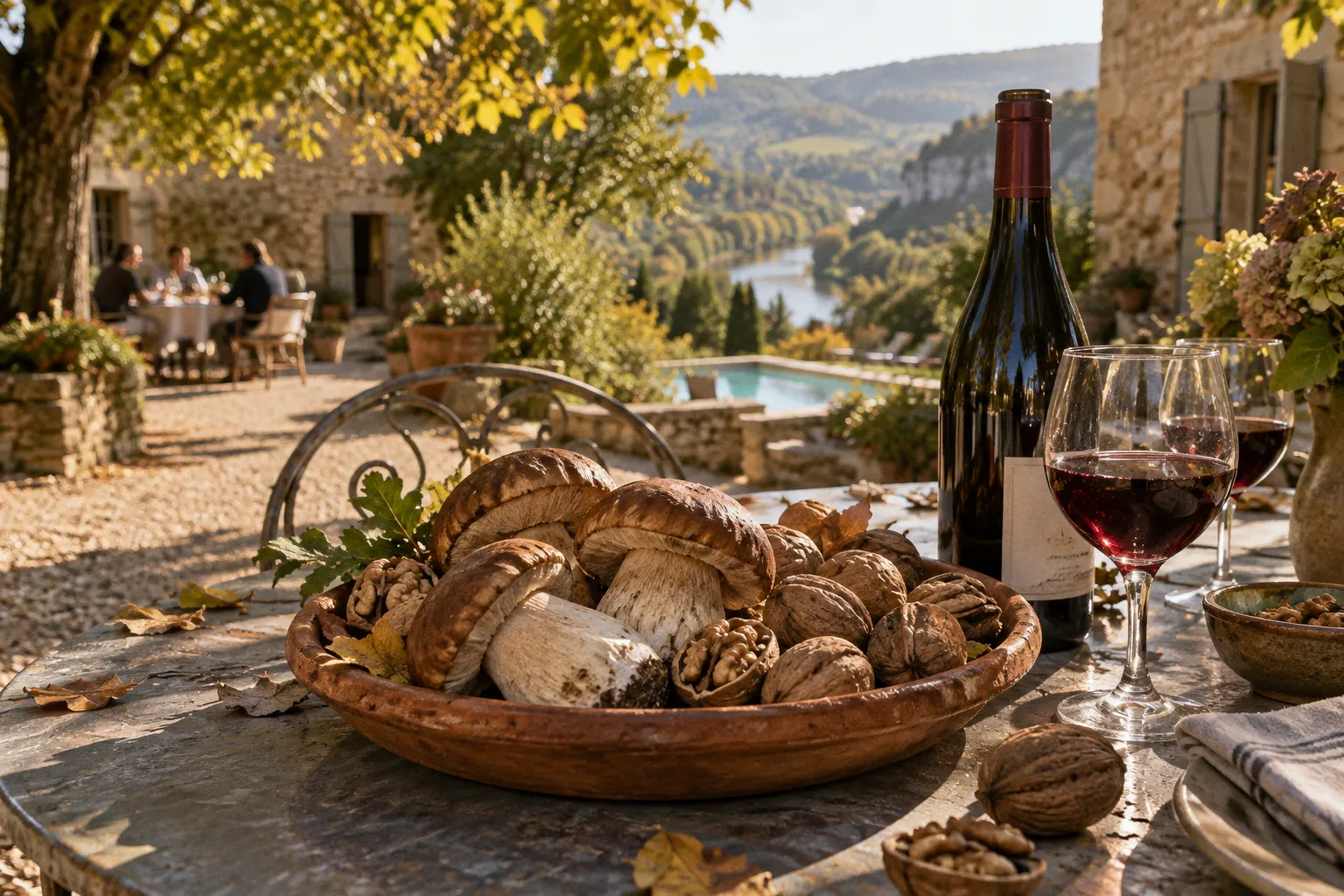
For a group, the more useful question is practical: which meals deserve a market basket, which are better delivered to the house, and when is it worth arranging a tasting menu or wine tour before the week fills up?
Dordogne dining options for travelers work particularly well when you combine several formats. A delivered arrival platter can settle everyone in after the drive, a market morning can supply the ingredients for a long lunch by the pool, and one carefully chosen evening at a table d’hôte can give the group a proper taste of Périgord without turning the whole holiday into a timetable.
The yield is in the balance. You want enough local food to feel the character of the region, but enough flexibility for different appetites, children, late swims, and the simple reality that a group of eight does not move through the day like a couple travelling with one small bag.
The art of in-gîte dining: from arrival platters to private chefs
Arrival day has its own harvest window, although the harvest is usually of patience rather than produce. After a long journey, the person who has driven is not necessarily keen to navigate a village supermarket, decode a French cheese counter, and produce dinner before the children become unmanageable. This is where gîte catering earns its place.
Local meal services can arrange delivered breakfast baskets, aperitif platters, and arrival dinners using regional ingredients. A breakfast basket is around €12 per adult and €8 per child. That may include the familiar country combination of bread, pastries, preserves, fruit, and dairy products, although the exact contents depend on the provider and the season. The useful point is not only the food itself; it is the storage temperature and timing. A basket that arrives ready for the first morning means you can unpack slowly rather than begin the holiday with a supply run.
A local aperitif platter costs around €35 and generally serves two to three people. This is the right scale for a first evening when nobody is yet ready for a formal meal: sliced charcuterie, cheese, bread, olives, seasonal vegetables, and perhaps a few regional additions. It can sit on the terrace while the group settles into the house, with no expectation that everyone will eat at the same time.
An arrival dinner platter, around €50 for two people, may feature dishes such as duck parmentier. This is more substantial than a grazing board and much less demanding than cooking a complete meal from scratch. It also gives you an immediate introduction to the local butcher’s cut and the region’s habit of making rich meat dishes feel homely rather than ceremonial.
When delivered food is the sensible choice
Gîte catering is especially useful for:
- arrival evenings, when travel times are uncertain and restaurant reservations create unnecessary pressure;
- families with young children who eat earlier than the local dinner service;
- mixed-age groups in which some guests want a full meal while others prefer bread, cheese, and fruit;
- pool days, when nobody wants to leave the house just as the afternoon heat softens;
- the first morning, before anyone has worked out which market is open and where to park.
The local etiquette matters here. Dordogne restaurants generally serve lunch from 12:00 to 14:00 and dinner from 19:30 to 21:00 or 21:30. An early dinner before 19:00 is not the normal rhythm. A delivered meal gives you the freedom to eat at 18:00, 20:00, or in several sittings without asking a kitchen to bend its service around your holiday.
The most successful group meal is often the one that respects the house’s rhythm: arrival food first, ambitious dining later.
Private chefs and table d’hôte menus
A private chef hire in a Dordogne gîte sits at the more structured end of in-house dining. It is not simply restaurant food transported to a holiday rental. A good private chef or table d’hôte arrangement usually takes account of the kitchen, the group’s preferences, the season, and the amount of service expected.
For groups of four or more, private table d’hôte and group tasting menus may be arranged as five- to seven-course meals, typically ranging from €85 to €145 per person. These menus are suited to a celebration or to the one evening when the group wants to stay at the property but still experience a composed regional meal. The practical advantage is that no one has to nominate a driver, find the village after dark, or hurry through an aperitif because the kitchen is closing.
The less obvious advantage is pacing. In a restaurant, a large group can be spread across a dining room and served according to the kitchen’s standard sequence. At a gîte, the chef can often explain the ingredients, adjust a course for a vegetarian guest, and place the meal around the group’s actual evening. That is where a local meal becomes more than a menu of foie gras and duck: the context, timing, and preparation are part of the experience.
A three-course menu may begin around €40, while the longer tasting format rises substantially. That difference is not only a matter of quantity. It reflects preparation, staffing, multiple courses, and the work involved in bringing a restaurant-style service to a private property. For a group, calculate the full evening rather than comparing the headline figure with a casual bistro meal. Wine, transport, table service, and the value of keeping everyone at home all change the equation.
| Dining format | Typical cost | Best suited to | Practical consideration |
|---|---|---|---|
| Delivered breakfast basket | About €12 per adult; €8 per child | First morning or a slow pool day | Confirm delivery time and refrigeration space |
| Aperitif platter | About €35 for 2–3 people | Arrival drinks, light supper, pre-dinner grazing | Add bread, fruit, and a simple salad for a fuller meal |
| Arrival dinner platter | About €50 for 2 people | First evening after a long journey | Order ahead and check reheating instructions |
| Three-course local menu | From about €40 per person | A relaxed group dinner | Ask what is included and whether children’s portions are possible |
| Private table d’hôte tasting menu | About €85–€145 per person | Celebration or special regional meal | Book early and discuss dietary needs before the menu is fixed |
| Guided wine tour | About €59 half-day; €99 full-day | Groups wanting structure and several tastings | Confirm transport, cellar visits, and the number of appellations |
Ferme auberge, village restaurant, or Michelin dining?
The phrase “eating out in Dordogne” covers several very different experiences. A ferme auberge may focus on produce from the farm or nearby suppliers, while a village restaurant might offer a short menu built around local duck, mushrooms, trout, and walnuts. At the other end, Michelin-starred restaurants in the wider Aquitaine region bring more formal service, careful presentation, and a higher level of advance planning.
The choice is not a ranking. It is a question of what your group wants the meal to do.
A ferme auberge is often a strong fit when the point is to understand how the landscape becomes food. The cooking may be direct and generous, with the menu shaped by what is available rather than by a large catalogue of alternatives. That can mean duck when duck is the right local yield, cèpes when the season allows, or a walnut-based dessert because Noix du Périgord is part of the region’s agricultural identity.
A Michelin restaurant gives a different kind of precision. It may be the right choice for a significant birthday, a smaller group within a larger party, or travellers who want one highly composed meal. It is less forgiving of last-minute changes, late arrivals, and children who decide that the carefully prepared course is not for them. If you are comparing a ferme auberge versus Michelin in Dordogne, compare the occasion and the appetite, not only the price.
What changes between the formats?
- Menu flexibility: A village kitchen may offer a small number of choices; a tasting menu usually follows a set sequence.
- Pacing: A formal meal can take several hours, while a ferme auberge may feel more straightforward and communal.
- Advance planning: Michelin-level dining and private chefs tend to require earlier booking, especially in the main summer months.
- Group size: A farmhouse restaurant may feel natural for a larger party, whereas a fine-dining room can be more difficult to coordinate.
- Dietary requests: Vegetarian food is increasingly available, but it should be requested in advance rather than assumed on arrival.
- Transport: A remote farm inn may need a designated driver or pre-arranged taxi, particularly if the meal includes a wine pairing.
The common misconception is that regional food is automatically rustic, inexpensive, and interchangeable. It is not. A dish based on duck confit, foie gras, truffle, or cèpes carries different labour and seasonal constraints from a green salad. The same ingredient can appear in a simple market lunch, an auberge menu, or an elaborate tasting course, with a different preparation and a different price at each stage.
Navigating the seven terroirs: Bergerac and Duras wine tours
Wine planning becomes much easier once you stop treating Bergerac as a single style. The Bergerac and Duras region contains seven distinct wine terroirs: Bergerac, Monbazillac, Saussignac, Montravel, Rosette, Pécharmant, and Côte de Duras. They do not all offer the same balance of red, dry white, and sweet wine, so the best route depends on what your group actually enjoys drinking.
Bergerac provides a broad entry point, while Pécharmant is often attractive to visitors looking for structured reds. Monbazillac is known for sweet white wines, and the wider set of appellations makes it possible to build a tasting day with more variation than a simple red-wine itinerary. This is one reason a Bergerac wine tour can work well for a mixed group: there are different styles to explore, rather than one narrow tasting brief.
Quai Cyrano in Bergerac is a useful central hub, particularly when you want an introduction to the region before visiting individual producers. From June to September, winemakers are more likely to be present there, which can make the visit more conversational and useful for travellers who do not already know the appellations.
Organised tours offer a straightforward way to manage the day. A half-day AOP Bergerac and Pécharmant tour can cost around €59 per person, while a full-day itinerary covering several appellations may be around €99 per person. These are practical benchmarks rather than universal prices; inclusions vary, and you should check whether tastings, transport, lunch, and cellar visits are included.
Choosing a half-day or full-day route
A half-day tour is usually enough when wine is one part of a wider day in the Dordogne. You might combine it with a market, a riverside lunch, or a visit to Bergerac itself. It suits groups that include some casual drinkers, children, or guests who do not want to spend the entire day moving between cellars.
A full-day multi-appellation tour is better when the group is genuinely interested in wine. It allows more time for the difference between terroirs to become clear, and it removes the pressure of fitting several tastings into a narrow afternoon. The drawback is that a full wine day can be tiring in warm weather, particularly for people who imagine wine tasting as a gentle succession of glasses rather than a day requiring food, water, and sensible pacing.
For your group, decide in this order:
1. Choose the wine interest level. Is the group curious about appellations and production, or does it mainly want one pleasant tasting with lunch?
2. Choose the transport arrangement. A driver who is not drinking, a guided vehicle, or a private transfer is essential if the itinerary involves several estates.
3. Choose the number of stops. More cellars do not necessarily produce a better day. A few well-spaced visits allow time to listen and taste properly.
4. Build in food. Bread and a tasting room’s small accompaniments are not a substitute for lunch, especially in summer.
5. Protect the following evening. After a full tour, a simple gîte supper may be more welcome than another reservation.
Wine also has a storage temperature problem once you return to the house. Do not assume that every bottle should be chilled in the same way. Keep the selection manageable, use the gîte’s refrigerator sensibly, and ask the producer how a bottle is best served if you are buying something unfamiliar. A bottle of sweet Monbazillac, a dry white, and a red from Pécharmant do not all want identical treatment.
Mastering the clock: traditional Périgord service hours
Restaurant opening times are one of the easiest details to overlook and one of the quickest ways to derail a group evening. In Dordogne, lunch is generally served from 12:00 to 14:00, with dinner beginning around 19:30 and often ending its seating window between 21:00 and 21:30. An early dinner before 19:00 is unusual, especially outside the busier summer period.
This is not a minor cultural curiosity. It affects every part of your itinerary.
A morning market visit can run longer than expected because the group is buying cheese, fruit, bread, and a few ingredients for the gîte. A château or cave visit may finish later than planned. Children may need food before the restaurant opens. Older relatives may prefer not to drive through unfamiliar lanes after dark. A good dining plan accommodates those realities rather than pretending that every day will run to the minute.
Three ways to work with the local rhythm
Eat lunch as the main meal. If your group is happy with a substantial midday meal, make the most of the 12:00–14:00 service and keep the evening simple. This works particularly well after a market visit or a wine tour, when you are already near a village restaurant.
Keep an arrival supper at the gîte. A platter, omelette, salad, bread, and local cheese can carry the first evening without anyone waiting for a table. This is also the easiest arrangement for a late arrival.
Reserve dinner for the evenings that deserve it. Rather than booking every night, choose one or two meals where the timing and journey are part of the plan. On other evenings, prepare a market dinner at home or use a delivered meal.
The practical detail is to communicate the service hours to the whole group before the holiday. Guests arriving from countries where dinner begins at 17:30 or 18:00 may otherwise assume that a village kitchen will adapt. It usually will not, and this is not a failing. The kitchen has its own working rhythm, staff, preparation schedule, and local clientele.
When travelling with children, order an aperitif platter or prepare a small first course at the gîte before leaving. Bread, fruit, yoghurt, or a simple walnut and goat cheese salad can take the pressure off the restaurant meal without spoiling appetites. A little preparation is kinder than expecting a tired child to appreciate a seven-course menu at the exact moment the kitchen is ready to begin service.
Beyond the duck: seasonal specialties and regional vegetarian staples
Duck and goose are central to Périgord cooking, but they are not the entire story. Regional menus also draw on black truffles, walnuts, cèpes, freshwater trout, goat cheese, and the produce available through the local market calendar. The useful question is not whether a dish sounds traditionally Dordogne; it is whether the ingredient is in a good harvest window when you are visiting.
Périgord black truffles are a winter interest, with the annual Sarlat Truffle Festival held in mid-January. The first weekend in March brings Sarlat Fest’Oie, the Goose Festival, which offers a more focused encounter with the region’s goose traditions. These dates can make a difference if your group is planning specifically around truffles or goose, but they should not be treated as the only time to eat well. Markets and restaurant menus continue to work with the broader regional pantry throughout the year.
Cèpes are similarly seasonal. When they are available, they may appear in omelettes, sauces, or as an accompaniment rather than as an unlimited menu staple. Walnuts are more dependable as a regional thread, appearing in salads, cakes, oils, and desserts. Freshwater trout can provide a lighter alternative to the richer duck and foie gras dishes.
Planning for vegetarian guests
Vegetarian options are increasingly common, but the strongest meals are usually arranged in advance. A restaurant may offer a walnut and goat cheese salad, a cèpe omelette, seasonal vegetables, or a dish built around eggs and mushrooms. These are not consolation plates, but they do depend on the kitchen knowing that a vegetarian guest is coming.
For a group staying in a gîte, the market is often the easiest place to build a satisfying vegetarian meal. Look for:
- goat cheese and fresh bread for a simple lunch;
- walnuts, salad leaves, tomatoes, and local vegetables for a composed market salad;
- eggs for omelettes with cèpes when they are in season;
- fruit, preserves, and yoghurt for breakfast or a light supper;
- vegetables that can be roasted or grilled while the main meat dish is prepared separately.
This is where a little pantry planning pays off. French country cooking often depends on a few good ingredients handled at the right moment, not on a long list of specialist products. Keep the storage temperature in mind, particularly for cheese, eggs, and prepared salads, and buy quantities that match your group’s actual appetite. A market basket that is too ambitious becomes waste by the third day.
Strategic planning for group gastronomy
The most comfortable Dordogne food itinerary usually contains three layers: food that is ready when you arrive, food you choose in the market, and one or two meals that require a proper reservation. Trying to make every meal an event creates fatigue and leaves no room for the unexpected village café, roadside produce stall, or bottle of wine that becomes the centre of an evening.
A simple planning model is:
- First evening: delivered arrival dinner or aperitif platter.
- First full morning: breakfast basket, followed by a market visit.
- Market day: lunch at the gîte using bread, cheese, vegetables, fruit, and a regional speciality.
- One restaurant lunch: take advantage of the 12:00–14:00 service window.
- One private or table d’hôte dinner: book a five- to seven-course menu if the group wants a special occasion.
- One wine day: choose a half-day or full-day Bergerac and Duras itinerary according to the group’s interest.
- Remaining evenings: alternate simple gîte cooking with a village restaurant, rather than reserving every night.
This approach also distributes the cost more naturally. A €50 arrival platter for two is not competing with a €145 tasting menu for one; they solve different problems. The platter protects arrival day, while the tasting menu is an experience. A €59 half-day wine tour may be enough for a group that wants an introduction, whereas the €99 full-day option can make sense for people who have travelled specifically to explore the appellations.
A useful way to divide the budget
For a group of adults, decide which meals belong to each of these categories:
1. Convenience: food ordered in advance because it removes work.
2. Discovery: markets, farm inns, village restaurants, and local producers.
3. Celebration: a private chef, table d’hôte, or Michelin-level meal.
4. Independence: simple cooking at the gîte, using ingredients chosen by the group.
5. Orientation: a guided wine tour that helps make sense of Bergerac, Monbazillac, Pécharmant, and the surrounding terroirs.
The categories can overlap, but they prevent every meal from being judged by the same measure. A family-style platter can be excellent convenience and good regional food without pretending to be a formal tasting menu. A market lunch can be modest in cost while still being one of the most memorable meals of the week. A Michelin restaurant may be technically impressive but unsuitable for a group that wants to eat early and return to the pool.
The route that usually works best
For most groups, the strongest Dordogne dining path is not the most elaborate one. Start with food at the gîte, when travel has made everyone practical rather than adventurous. Use the local market to shape one or two meals yourself. Book a restaurant lunch around the region’s service hours, then choose either a private table d’hôte dinner or a carefully selected evening restaurant for the occasion that matters most.
Add a Bergerac and Duras wine tour if the group wants help navigating the seven terroirs, and keep the itinerary spacious enough for the region’s slower meal rhythm. The purpose is not to collect every local speciality in a single week. It is to understand why a breakfast basket, a walnut salad, a Pécharmant tasting, and a duck parmentier each belong to a different part of the holiday.
My practical advice is to make the first and last meals easy, reserve the centre of the stay for your most ambitious booking, and leave at least one market day completely open. That small amount of breathing room gives your group the best yield: more local food, less logistical strain, and enough time to let Dordogne dining unfold at its proper pace.