Dordogne food markets: avoiding tourist traps and hidden markups
The best local food markets in Dordogne are not necessarily the largest, prettiest, or busiest.
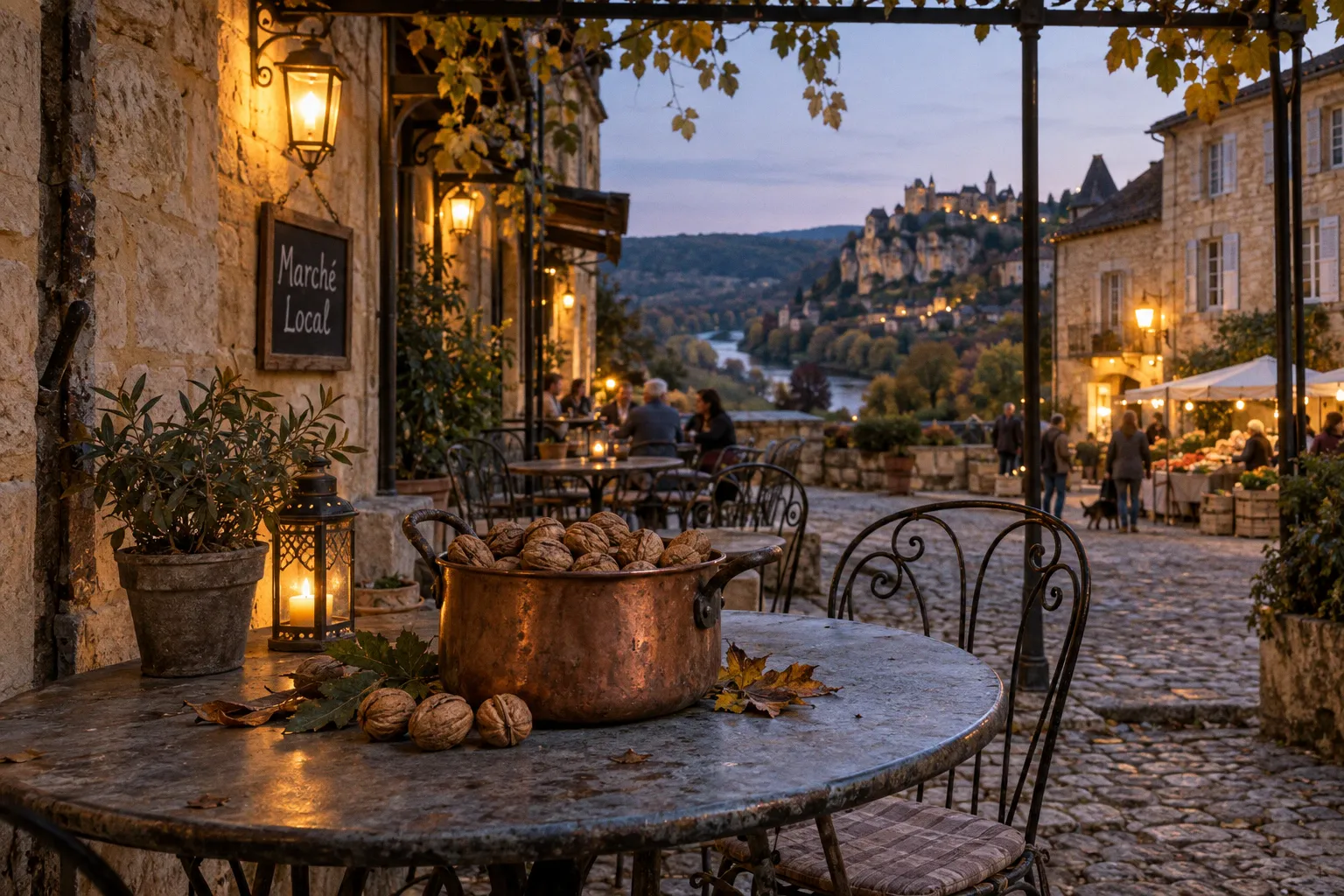
In high summer, a famous market may offer an excellent basket of peaches, bread, cheese, or walnuts — but it may also place local growers beside resellers carrying goods from much farther away. The stalls look equally French, the displays are equally generous, and the difference is rarely explained in English.
That is the practical difficulty behind finding the best farmers markets in Dordogne. You are not simply choosing between one market and another; you are learning to read the market itself: its certification, its timing, the seasonality of what is being sold, and whether the person behind the table can tell you where the product came from.
For a genuinely authentic Périgord market experience, start with one question: is this a direct producer market, or a general town market where producers and professional resellers operate side by side?
The producer’s promise: what the Marchés des Producteurs label means
The most useful sign for visitors is the official Marchés des Producteurs de Pays branding. This is not just a decorative phrase suggesting rusticity. The label operates under a strict charter and guarantees that the goods sold come exclusively and directly from local farm producers or artisans.
That distinction matters because “local market” can mean several different things in everyday French usage. A market may be held in a small village, surrounded by walnut orchards and stone farmhouses, while some of its stalls are still supplied through wholesale channels. A local setting does not automatically make every product locally grown.
The producer-market label gives you a much firmer starting point. Across the regional network, there are 387 producer markets operating across 42 sites. These markets are designed around direct sales, so the person selling the tomatoes, duck products, preserves, bread, or seasonal fruit should be connected to the production rather than simply distributing goods bought elsewhere.
That does not mean every labelled market will contain every Dordogne speciality. A producer market follows the agricultural calendar, not the expectations of a holiday brochure. If you arrive wanting fresh black truffles in July, the problem is not the market. It is the season.
How to read a stall before buying
Even outside the official network, a few practical observations will help you separate a farm stall from a reseller display:
- Look for a narrow, seasonal range. A grower may have several varieties of one fruit, a small selection of vegetables, or products made from one farm’s raw materials. A stall carrying the same perfect range every month deserves more questions.
- Ask where the product was grown or made. A producer should be able to answer naturally, often with the name of a village, farm, or nearby area. You do not need to conduct an interrogation; a simple question about origin is enough.
- Notice whether the stock follows the season. Dordogne has an abundant food culture, but it does not produce everything at once. The harvest window remains the most honest label.
- Check how prepared products are described. Foie gras, pâtés, preserves, and walnut products can be excellent, but the wording should make clear whether they were made by the stallholder, by a named local artisan, or sourced from elsewhere.
- Compare the rhythm of the stall. Direct producers often talk about what is ready now, what will come later, and what has already finished. Resellers tend to present a more fixed catalogue.
The purpose is not to reject every non-producer stall. Some resellers offer good food and useful regional products. The point is to know what you are paying for. A souvenir-style jar or boxed speciality may be convenient, but it should not be confused with a direct farm purchase simply because it is displayed under a market awning.
In Dordogne, the shortest route to a fair purchase is usually not the lowest-looking price; it is knowing who produced the food and whether the season agrees with the label.
Sarlat: two markets, two very different shopping plans
Sarlat is one of the easiest places to misunderstand because its market life is spread across several locations and formats. Visitors often arrive expecting one single event, then find a traditional open-air market, a covered market in a former church, craft stalls, prepared foods, and seasonal specialist trading all competing for attention.
The town’s main traditional market takes place on Place de la Liberté on Wednesday mornings from 8:30 a.m. to 1:00 p.m. It also runs on Saturdays from 8:30 a.m. to 6:00 p.m., although food sales finish at 1:00 p.m. That last detail changes the day completely. If your purpose is to buy ingredients for lunch at your gîte, Saturday afternoon is too late for the food section even though the broader market remains open.
The covered market, housed inside the converted Église Sainte-Marie, operates daily from 8:30 a.m. to 2:00 p.m. between April 1 and October 31. It is useful when the weather turns, when you need a more concentrated food stop, or when your schedule does not coincide with the open-air market. It is not, however, a guarantee that every product inside has come directly from a nearby farm.
The covered setting can create an assumption of authenticity. The building is historic, the displays are attractive, and the atmosphere feels deeply rooted in Sarlat. But architecture is not a supply-chain certificate. Ask the same questions you would ask outside.
The specialist truffle market
Sarlat’s certified black truffle market is a separate event from the general food and craft stalls. It takes place on Saturday mornings from mid-November to early March, at Rue Fénelon near the Tourist Office.
This is the market to seek out if your journey is built around the Périgord winter black truffle, not a summer market stall displaying truffle-flavoured products. Fresh Tuber melanosporum belongs to the cold-season calendar, with the official market season running from late autumn into early spring.
That seasonal boundary is one of the simplest ways to avoid confusion. In summer, you may find preserved truffles, truffle condiments, prepared products, or dishes made with truffle-based ingredients. You should not assume that a fresh Périgord black truffle has appeared at a general summer food market merely because the word “truffle” is printed on a label.
For a winter visit, plan the morning carefully. The specialist market is not an optional corner of the Saturday market; it is a distinct destination with its own location and seasonal opening. For a summer visit, shift your attention towards produce that is genuinely in its harvest window: fruit, vegetables, herbs, bread, cheeses, walnuts and prepared regional foods.
The summer gourmet market: communal tables, careful buying
The Dordogne’s summer evening gourmet markets, often called Marchés Gourmands, are among the easiest places to eat well without committing to a formal restaurant. Villages such as Aubas on Wednesdays and Bouzic on Tuesdays in July and August host evenings where visitors assemble a meal from local farm stalls and eat at communal tables.
This format is social and practical. You can choose a portion of meat, add vegetables or bread, find a local dessert, and settle in with a glass of wine. It is particularly convenient for guests staying in a self-catering gîte because it allows you to enjoy a cooked regional meal without buying a full basket of ingredients or managing storage temperature in a hot holiday kitchen.
But the same relaxed atmosphere can make price comparisons difficult. You are not shopping in a quiet morning market; you are buying into an evening event where cooking, seating, music, and convenience are part of the experience. The fairest comparison is not necessarily with the price of raw ingredients from a farm stall. It is closer to comparing a prepared local meal with eating out.
The practical distinction is this:
| What you are buying | What to expect | How to judge value |
|---|---|---|
| Raw produce from a direct stall | Seasonal ingredients to take away | Ask about origin and harvest timing |
| Cooked meat or a prepared plate | A ready-to-eat meal at a communal event | Consider portion, preparation, and the event setting |
| Jarred or packaged speciality | Convenient regional food for later | Read the producer information rather than relying on the town name |
| Wine by the glass or bottle | A social part of the evening market | Ask whether it is from the local area and what style it is |
| Truffle-flavoured products in summer | A preserved or prepared speciality | Do not confuse it with fresh winter black truffle |
A summer gourmet market is not automatically a tourist trap. Nor is it automatically a bargain. Its value lies in the combination of local food and a village evening, while its limitations are the fixed event pricing and the difficulty of comparing every item with a farm-gate purchase.
If you want to keep the cost under control, arrive with a simple plan. Decide whether you are buying a full meal, a few ingredients, or something to take back to the gîte. Without that distinction, it is easy to buy a little from every stall and end up with an expensive collection of attractive portions.
Timing is part of the market experience
The dordogne market day schedule is not merely logistical information. It determines what you will find, how much choice remains, and whether you are shopping among local residents or in the busiest visitor period.
The early start is especially useful in larger towns. On a Saturday morning in Sarlat, arriving earlier gives you more space to look at produce and ask questions before the food section closes at 1:00 p.m. It also makes the practical business of carrying a basket, choosing delicate fruit, and getting back to your car or accommodation less stressful.
Do not assume, however, that late arrival will produce automatic discounts. A market is not a supermarket clearance aisle. Some traders may reduce fragile goods towards the end of trading, but there is no general rule, and the most sought-after items may have already gone.
For a quieter and more focused visit, compact village markets can be preferable. Markets such as Domme on Thursday mornings, with around 30 to 40 stalls, are easier to read than a large summer market where several categories of seller overlap. Smaller does not always mean more authentic, but it can give you more time to speak to stallholders and understand what is actually being offered.
Two useful market days for planning a wider food itinerary are:
- Sunday morning in Issigeac, known for its medieval food market atmosphere.
- Thursday in Eymet, when the traditional market gives you another opportunity to shop beyond the busiest Sarlat schedule.
- Wednesday and Saturday in Bergerac, useful if your route takes you towards the wine country and the Dordogne valley’s western side.
- Wednesday and Saturday in Sarlat, with the Saturday food section ending at 1:00 p.m.
- Tuesday and Wednesday summer evenings in selected villages, where Marchés Gourmands create a different, meal-oriented market experience.
Market days can change seasonally or locally, so treat the schedule as a route-planning framework rather than a promise that every stall will be present at exactly the same level throughout the year. Weather, harvest yield, and the time of year all affect the market more than a visitor may expect.
Seasonal realities: truffles, foie gras, walnuts and the pantry
The quickest way to overpay in Dordogne is to demand a product outside its natural season and then accept the first attractive substitute. The more useful approach is to decide what the land is offering during your stay.
Black truffles
Fresh Périgord black truffles are a winter product. The certified Sarlat market runs from mid-November to early March, and that is the period to plan around if fresh truffle is central to your visit.
Outside that window, look carefully at the form of the product. A preserved truffle, sauce, seasoning, or prepared speciality may still be worthwhile, but it is not the same purchase. Read the label, ask whether the truffle is fresh or preserved, and avoid paying a premium for an implication that the product cannot honestly make.
Foie gras and duck products
Foie gras is deeply associated with Périgord, but the category includes several different products: whole foie gras, prepared foie gras, pâtés, terrines, confits, and other duck-based specialities. Their quality and price depend on the cut, the preparation, the producer, and the storage requirements.
A stallholder should be able to explain whether an item is ready to eat, needs refrigeration, or is intended for longer storage. This matters particularly when you are staying in a gîte and driving between villages in warm weather. A beautifully packaged product is not a substitute for sensible storage temperature.
If you are buying for a meal, ask what quantity suits the number of people you are feeding. A butcher’s cut or prepared portion can be more practical than a large celebratory format, especially when you have already bought bread, cheese, salad, fruit, and wine.
Walnuts and walnut products
Walnuts are one of the region’s dependable signatures, appearing as fresh nuts, oils, cakes, biscuits, and preserved products. Here again, origin matters. A market stall may sell a local speciality that uses regional tradition without every ingredient having been grown nearby.
If the distinction matters to you, ask whether the walnuts were grown by the producer or sourced from another local supplier. There is nothing wrong with either arrangement, but the answer tells you what kind of purchase you are making.
Fruit and vegetables
Fresh produce is where seasonality becomes easiest to see. A direct grower’s stall may look less abundant than a reseller’s display, but the smaller selection can tell you more about the current harvest window. Buy what looks plentiful, fragrant, and appropriately timed rather than chasing a specific ingredient because it appeared in a travel article.
This is also where a gîte kitchen gives you an advantage. You can buy a modest quantity, store it correctly, and build a simple meal around what is good that day. A few ripe tomatoes, bread, cheese, herbs, and a bottle of Bergerac wine may give you a better evening than a basket of expensive specialities chosen without a plan.
How to avoid overpriced food in France without losing the pleasure
The phrase “tourist trap” can make every visitor suspicious of anything popular, which is just as unhelpful as trusting every rustic sign. Dordogne markets serve locals, second-home owners, restaurant kitchens, day visitors, and international travellers. A busy stall is not proof of overcharging; a quiet stall is not proof of superior quality.
A more reliable method is to separate three questions:
1. Is the product local?
Look for the producer, the place of origin, and the relevant certification.
2. Is it in season?
Compare the product with the local harvest window. Fresh winter truffle and summer truffle-flavoured products should not be treated as the same thing.
3. Is the format right for my purpose?
A prepared dish at a summer gourmet market may be fair value as an evening meal, even if it costs more than buying raw ingredients. A packaged souvenir may be useful, but it should be priced and judged as a convenience purchase.
When a stall does not answer these questions clearly, you do not need to make a scene or assume a food market scam. Simply buy less, move on, and use the next stall as a comparison. Markets reward patience. The first table is rarely the only table selling bread, fruit, cheese, or preserved goods.
For a broader food itinerary, it can also help to pair a market with a producer visit or a wine tasting rather than trying to purchase every speciality in one morning. Bergerac’s wine country, the villages around Sarlat, and the smaller market towns each offer a different balance of produce, prepared food, and local atmosphere. The best route is usually the one that leaves room for the season to make the decision.
A practical market plan for your gîte stay
If you are staying in a self-catering property, use the market as part of your kitchen planning rather than as a shopping expedition without an endpoint.
Before leaving, check:
- which market is operating that day;
- whether you need raw ingredients or a ready-to-eat meal;
- how long the food will travel before refrigeration;
- whether your accommodation has the storage space and cooking equipment you need;
- whether a specialist product, such as fresh truffle, is actually in season;
- how much you can use before the next market or restaurant meal.
At the market, buy one or two ingredients that are clearly at their peak, then build around them. If the peaches are fragrant, the tomatoes are abundant, or the walnut products are being made by a producer you can identify, let those ingredients guide the meal. Do not spend the morning trying to recreate an idealised Périgord feast from a list.
The most dependable signs of an honest purchase are modest: a clear origin, a product that fits the season, a stallholder who can explain the food, and a quantity that makes sense for your table.
The route to an authentic Périgord market
Avoiding local food markets Dordogne tourist traps is less about finding a secret market untouched by visitors and more about knowing how each market works. Choose an official Marchés des Producteurs de Pays event when direct farm purchasing is your priority. In Sarlat, distinguish the general market, the covered market, and the separate winter truffle market. Treat a Marché Gourmand as a prepared-food experience rather than assuming every plate will cost the same as ingredients bought from a farm stall.
Most of all, let the season set the menu. Fresh black truffle belongs to the cold months; summer markets offer their own generous yield; and products such as foie gras, walnuts, preserves, and regional wines require a little attention to origin and storage rather than automatic trust.
Your final practical tip is simple: arrive with a question, not a shopping list. Ask who made it, where it came from, and whether it is ready for your table today. In Dordogne, those three answers will usually lead you towards the food worth carrying home.