Dordogne luxury gites: a pre-booking checklist
A pool with no fence. A €600 hold on a credit card you didn't budget for. A tourist tax the listing buried in fine print. These are the friction points that ambush travelers who treat a Dordogne luxury gîte booking like any other vacation rental.
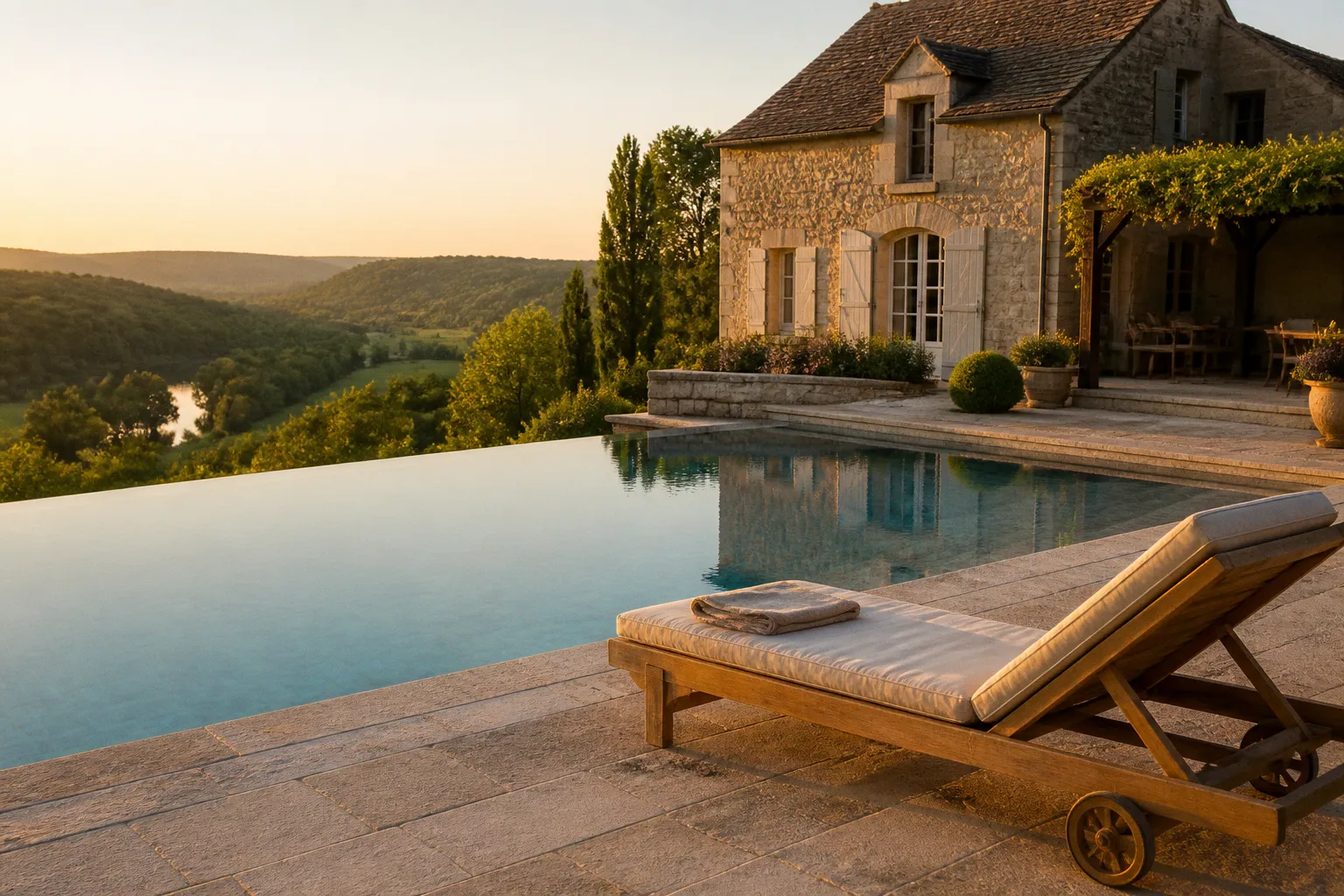
The Périgord countryside is generous — golden stone, walnut groves, river valleys — but the booking layer beneath those country estates carries its own specific compliance and financial terrain. Navigate it sloppy, and the first 48 hours of your stay become a reactive scramble instead of a controlled arrival.
This briefing breaks down the five operational checks you complete before you transfer a single euro to a property manager. Pool security, deposit structure, tourist tax exposure, arrival timing, and amenity inclusions — each is a waypoint where unprepared travelers lose money or time. Run through them in order, and you deploy into the Dordogne with your logistics locked.
A luxury gîte booking is not a transaction; it's a contract with terrain. Confirm the rules before the terrain confirms them for you.
Pool security: the first compliance gate
Every private swimming pool attached to a French holiday rental falls under national safety regulations. The requirement is non-negotiable: the property must feature at least one certified safety device drawn from a short menu — a locked barrier, an alarm, a safety cover, or an approved shelter. This is not a marketing claim. It is a legal baseline, and the owner's documentation should reflect it before you sign anything.
When you vet a listing, ask the manager directly which safety system is installed. A self-catering property advertising itself as family-grade but lacking any documented barrier or alarm is a red flag worth walking away from. Pool-related incidents on rural rentals are rare but severe, and insurance coverage can collapse if the property fails the regulatory baseline. Request a photo of the safety installation during your pre-booking exchange — a timestamped image showing the barrier, alarm sensor, or cover in working order. If the host hesitates or deflects, escalate or exit.
The second pool variable is heating. Luxury estates often market heated pools as a premium feature, but the operational temperature varies wildly between properties. Some heat to a comfortable 24–26°C shoulder-season standard; others barely break 20°C. If the listing uses the word "heated" without a figure, push for one in writing. A pool advertised at 22°C in May is materially different from one running at 26°C, and the difference is what makes early-morning or late-evening swims possible. Confirm before you book — not after you've watched fog rise off a too-cold surface.
Deposit structure and financial terms
The security deposit is the second terrain hazard. Dordogne luxury gîtes typically hold between €200 and €600 as a breakages or damage deposit, with larger group properties skewing toward the upper end. This is not the same as a booking deposit, and conflating them is a common error.
A booking deposit is the percentage of the total rental fee paid in advance to secure the dates — many luxury estates in the region require 50% upfront, with the balance due 60 to 90 days before arrival. A security deposit is a refundable hold, usually taken via pre-authorization on a credit card on arrival day, released after the exit inventory (typically within 7–14 days post-departure, depending on the property manager). These are separate line items, and your confirmation email should itemize both.
Before committing, verify:
- The deposit amount in writing, not as a range but as a figure tied to your specific property and week.
- The payment method accepted for the hold (most luxury rentals require a credit card, not debit, and refuse cash holds).
- The release timeline and any conditions that extend it — a contested cleaning bill, for instance, can delay the refund indefinitely.
- Whether any prior damage deductions have been issued on the property in recent seasons. A pattern is a signal.
| Financial element | Typical Dordogne luxury gîte terms | What to confirm pre-booking |
|---|---|---|
| Booking deposit | 30%–50% of total rental | Exact percentage and payment deadline |
| Balance payment | 60–90 days before arrival | Trigger date and accepted payment rails |
| Security deposit hold | €200–€600 (group size dependent) | Card pre-auth vs. cash hold, release window |
| Tourist tax (taxe de séjour) | Calculated per guest per night, on-site | Municipality rate and collection method |
| End-of-stay cleaning | Often mandatory, sometimes optional | Fixed fee vs. optional self-clean credit |
| Linen and towel sets | Frequently included at luxury tier | Confirm or quote per-set supplement |
The booking deposit secures the date. The security deposit secures the property. Treat them as separate operations.
The taxe de séjour and the local levy layer
The taxe de séjour is a local tourist tax levied by the municipality, not by the property owner. It is calculated per guest per night, and the rate varies across communes in the Dordogne — star-rated properties in Sarlat, Domme, or Saint-Cyprien carry different rates than smaller villages. Crucially, this levy is almost never baked into the advertised nightly rate. It is collected on-site, in cash or by separate card transaction, and appears as a line item at check-in.
Travelers who budget against the listing price without factoring this in arrive short. A two-week stay for a family of four at a four-star-rated gîte in a mid-tier commune can add €140–€280 to the bill, depending on the municipal rate. That is not a rounding error; it is a meaningful line item, and the only legitimate way to plan for it is to ask the property manager for the specific commune's current rate and multiply it against your guest count and nights on site.
Some luxury estates absorb the tax into the rental total and handle remittance to the commune themselves. This is the cleaner arrangement — ask if it applies to your booking. If the answer is no, request a written estimate of the total tax due before arrival so you can stage the cash or card accordingly.
Arrival logistics: the timing and transport problem
Standard check-in across most Dordogne self-catering luxury rentals runs between 3:00 PM and 7:00 PM. This window exists because rural property managers often run multiple properties and need daylight to prep between turnovers. Arrivals outside that window — early flights, late evening drives from Paris or Bordeaux — typically require advance notice and frequently carry a surcharge.
If your travel path pushes you toward a late arrival, confirm three things before booking:
1. Whether the property offers a self-check-in option (key box, smart lock, or secure code pickup from a local partner).
2. Whether a late-arrival fee applies and how it is structured — flat rate, hourly increment, or capped at a fixed ceiling.
3. Who is on call if you hit a roadblock: a dead key safe battery, a missing access code, a wrong gate code. The contact protocol matters more than the arrival hour itself.
The second logistics variable is transport. Dordogne luxury gîtes are deliberately rural — that's the product — and the road network reflects it. Supermarkets, weekly village markets, restaurants, and the region's historic sights (Lascaux, the Dordogne river castles, the medieval bastides) are dispersed across secondary roads that public transit does not meaningfully service. A rental car or private transfer is not optional. Confirm parking capacity at the property (gravel courtyard, secure gate, covered bay for one vehicle, open lot for multiple) before you arrive, especially if you're traveling with a larger group or a classic vehicle that needs covered storage.
Rural luxury means rural logistics. Drive the arrival window, drive the transport plan, drive the parking confirmation — all three, before you sign.
Amenity inclusions: the surprise-cost layer
This is where the most avoidable damage happens. Luxury Dordogne listings often advertise a generous amenity tier — Wi-Fi, linen, towels, end-of-stay cleaning, pool heating, garden maintenance — but the boundary between included and supplementary varies by property. The trap is assuming the premium tier is universal. It isn't.
Before you transfer the booking deposit, request the property's specific inclusions list. Clarify:
- Wi-Fi — speed tier and data cap. "High-speed" in a rural setting may mean 20 Mbps shared across the property, which is fine for email and browsing but collapses under multiple video calls or 4K streaming.
- Linen and towels — included at most luxury estates, but some quote a per-set supplement or exclude pool towels. If you're planning heavy pool use, ask about pool-specific towel provisioning.
- End-of-stay cleaning — sometimes mandatory (a fixed fee, non-negotiable), sometimes optional (with a credit if you leave the property in a stipulated condition). Confirm which model applies. A €150 cleaning fee on a €3,000 booking is a 5% surcharge worth knowing in advance.
- Pool heating — covered earlier, but it reappears here as an amenity inclusion. Is it included in the base rate or billed as an optional add-on (typically €150–€300 per week)?
- Firewood, electricity caps, air conditioning — shoulder and peak season terms differ. A property that includes firewood in October may exclude it in July. A/C is increasingly standard but not universal; confirm.
- Welcome packs, mid-stay cleans, concierge services — these are the actual luxury markers. If they appear in the listing text, confirm they are included rather than quoted on request.
A clean inclusions conversation saves a hundred small negotiations on-site. The property manager who answers these specifics clearly before booking is the property manager who runs a tight operation. The one who deflects is the one who will hand you a bill on departure day.
Pre-deployment checklist
Run this list before you click confirm on any Dordogne luxury gîte reservation. Every item is a verification you can complete in a single email or phone call. None requires you to commit funds before you have answers.
1. Pool safety system documented in writing, with a timestamped photo of the installation.
2. Pool heating temperature confirmed in °C, included or quoted as a line item.
3. Security deposit amount, payment method (card pre-auth preferred), and release timeline confirmed.
4. Booking deposit percentage and balance payment deadline in the confirmation email.
5. Taxe de séjour — ask whether it is included in the rental total or collected on-site, and request an estimate.
6. Check-in window confirmed, with a late-arrival protocol if your travel timing falls outside it.
7. Parking capacity and vehicle coverage confirmed for your party size.
8. Wi-Fi speed tier and data policy in writing.
9. Linen, towels, and pool towels — all confirmed as included or quoted.
10. End-of-stay cleaning — mandatory or optional, with the fee or credit amount.
11. A/C, firewood, and any seasonal amenity toggles confirmed.
12. Direct contact protocol for arrival-day issues — phone number, response window, backup contact.
If the property manager clears twelve out of twelve, you deploy. If they hesitate on three or more, the terrain is signaling something — move to the next listing. The Dordogne has no shortage of quality estates, and the operation that answers these questions cleanly is the one that will run your arrival without friction. Lock the logistics now, and the only thing left to navigate is which river valley to drive toward first.