Dordogne villa settings: secluded hills vs village life
The right Dordogne villa location can shape an entire holiday more than the number of bedrooms, the finish of the kitchen, or even the size of the pool.
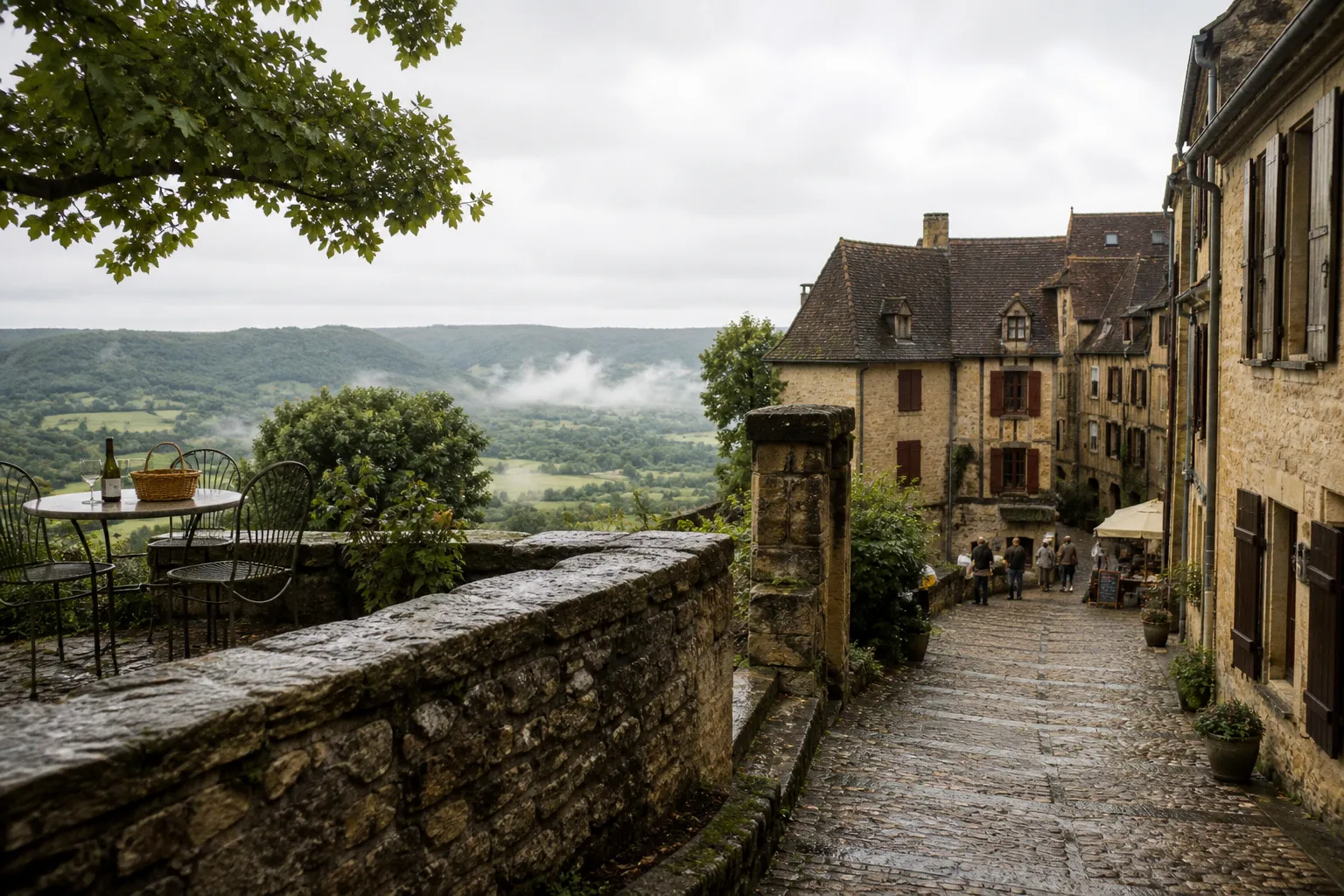
A secluded hillside gîte gives you quiet mornings, long views and the freedom to let children spill into the garden without crossing a road. A village-proximate rental gives you the more practical pleasures: fresh bread without starting the car, a market reached on foot and the possibility of an unplanned supper after a day beside the river.
The question is not simply whether you prefer countryside or village life. It is whether your household is happiest organising each outing around the car, or whether you want some of the day’s essentials to sit within walking distance. That distinction matters particularly in the Périgord Noir, where a property can feel wonderfully remote while still being only 20 minutes from Sarlat-la-Canéda—or appear close to a village on a map but require a steep walk, a dark lane or a drive for almost everything after breakfast.
The allure of seclusion: privacy, views and a proper outdoor life
A genuinely secluded holiday home rental in the Dordogne earns its distance from the nearest village through what it gives back. The setting may include a private garden, woodland edges, open pasture or a hillside outlook that changes noticeably from breakfast to supper. There is room for a long lunch to remain on the terrace, for pool towels to dry in the sun, and for the household to settle into its own rhythm rather than follow the timetable of a busy town.
For families, the yield is often space rather than silence alone. A private pool and generous grounds make it easier to divide the day naturally: an early swim, a slow lunch, a drive to a château or prehistoric site, then another hour outdoors before dinner. Teenagers can have a little distance without being entirely out of sight, while younger children have more room to play than they would in a compact village house.
That privacy also changes how you use the kitchen. At a premium self-catering property, the best meals are not necessarily elaborate. They might be tomatoes from the market, a local cheese, peaches eaten over the sink and a butcher’s cut cooked outside before the air cools. In a secluded setting, you are more likely to shop once, unpack properly and make the villa your base for the evening. The practical question becomes storage temperature, fridge capacity and whether the terrace has enough shade—not which restaurant still has a table at eight o’clock.
This is where a little pantry planning makes the difference. If you are arriving late, do not assume the nearest shop will be open or that the property sits close enough to collect supplies on foot. Bring or arrange a first-night provision of water, breakfast basics and something that can be cooked without a second outing. The Dordogne rewards a well-stocked kitchen, but only if you have thought about the first harvest window of the holiday: what needs using immediately, what can wait, and what will survive a warm car journey.
What secluded villas do particularly well
- Outdoor privacy: private gardens and pools are easier to enjoy without the visual traffic of a village lane or neighbouring terraces.
- Large family spaces: children can move between pool, lawn and shaded areas while adults prepare lunch or read nearby.
- Landscape: hillside and woodland settings often provide wider views and a stronger sense of being in rural France.
- Evening flexibility: you can eat early, late or in several stages without fitting around restaurant service.
- A slower domestic rhythm: one substantial food shop can support several days of lunches, suppers and picnic baskets.
The trade-off is that every convenience has a journey attached to it. A secluded property may be perfectly comfortable with modern facilities, including upgraded internet, but the bakery, pharmacy and evening restaurant are not made closer by a good Wi-Fi connection. If someone has forgotten milk, the solution is usually a car key rather than a quick walk.
Seclusion works best when you treat the villa as part of the holiday, not merely as a bed between excursions.
Village proximity: the practical pleasure of being able to walk
The appeal of luxury gîtes within walking distance of a village in the Dordogne is often described as atmosphere, but the daily advantage is more basic and more valuable: reduced logistics. A morning bakery run takes minutes rather than planning. Children can choose a pastry while one adult collects coffee. A market visit can happen before the day’s main excursion, and a bottle of wine does not have to be fitted into the boot beside beach bags and swimming equipment.
This is especially useful for mixed-age groups. Grandparents may prefer not to spend every evening driving. Older children may enjoy a little independence in a village square. One person can return to the rental while others stay for a drink. These small freedoms accumulate over a week, particularly when the household is balancing different energy levels and appetites.
Sarlat-la-Canéda is the major practical hub in the Périgord Noir, attracting more than one million visitors each year to its medieval centre. That popularity brings a strong supply of markets, food shops, restaurants and cultural interest, but it also means that “near Sarlat” does not automatically mean “walkable to Sarlat”. A rural gîte within a 20-minute drive can offer quiet woodland views and a private garden while remaining well placed for the town’s markets and surrounding attractions. That is a different proposition from staying in the historic centre or in a village connected to it on foot.
Village life also needs to be read seasonally. In high summer, a village may feel full of life through the evening. Outside the main travel period, opening hours can narrow considerably. A property inside a village does not guarantee a restaurant every night, and a hilltop location such as Domme can offer remarkable views and historic character while still requiring a drive for groceries and presenting limited dining choices once day-trippers have gone.
The useful distinction is between village access and village activity:
| What the location offers | Secluded countryside villa | Village-proximate rental |
|---|---|---|
| Morning bread | Usually requires a drive | Often possible on foot, subject to exact distance and opening hours |
| Market access | Planned outing by car | Easier to combine with a short walk or local journey |
| Evening meal | Cook privately or drive | More options nearby, but seasonal opening must be checked |
| Outdoor privacy | Usually strongest | May be more limited, depending on garden and neighbours |
| Children’s independence | Mostly within the property grounds | Greater scope for village walks and small errands |
| Landscape | Woodland, fields and long views | Historic buildings, lanes and village atmosphere |
| Holiday logistics | Shopping is concentrated and planned | Small, frequent top-up trips are more realistic |
A village rental is therefore not automatically the more sociable choice, nor is a country villa automatically difficult. The difference lies in how much of your routine can happen without starting the engine.
The 20-minute radius: a useful middle ground around Sarlat
For many travellers, the best Dordogne villa location is neither an isolated farmhouse far from services nor a house in the centre of a busy destination. It is a well-equipped countryside property within roughly 20 minutes of Sarlat. This radius can preserve the quiet, generous character of a rural rental while keeping major markets, restaurants and attractions within a manageable drive.
The value of the 20-minute strategy is not the number itself. It is the balance behind it. A short drive is usually practical for a full market shop, a museum visit or dinner in town, but the property can still feel removed from tourist traffic when you return. You may have a private pool, woodland views and enough outdoor space for the household to spread out, without committing every day to a long excursion before finding bread or provisions.
For families, this arrangement often removes the most tiring form of travel: repeated, low-value journeys. You can choose one morning for the market, one afternoon for the river and one evening for a restaurant, then spend the remaining hours at the property. The drive becomes part of a planned outing rather than the price of every small necessity.
A 20-minute radius can also be more useful than a famous village name when comparing listings. Two rentals may both be advertised as near Domme or Sarlat, yet their practical experience can differ because of road layout, elevation and the final approach. The map may show a short distance, but a winding route changes how readily you will make it for a forgotten ingredient or an after-dinner dessert.
Read the location in practical layers
When comparing properties, I would separate the location into five questions:
1. What is genuinely walkable?
Look for the actual route to the bakery, market or village centre rather than a broad statement such as “close to amenities”. A distance that looks modest on a map may include a steep climb, an unlit lane or a road without a comfortable footpath.
2. What will you need the car for?
A rural setting can work beautifully if you are happy to drive for the main shop and excursions. It becomes less convenient when someone expects to walk for breakfast, an evening drink or a forgotten bottle of cooking oil.
3. How does the setting serve the property itself?
Consider whether the garden, pool and terrace are the reason you chose the villa. If so, a few extra minutes in the car may be a fair exchange for privacy and outdoor space.
4. What happens after the attractions close?
A historic village may be lively during the day but quiet at night. That can be peaceful and appealing, but it is not the same as having a reliable evening dining scene.
5. How will the household divide?
The best area to stay in the Dordogne for families is often the one that allows different people to do different things: swim, read, walk, shop or visit a market without making one person responsible for every transfer.
This way of reading a location is more dependable than choosing by the most attractive photograph. A panoramic view is valuable, but so is the answer to the late-arrival question: where will breakfast come from tomorrow morning?
Seasonal rhythms: markets, evening dining and tourist footfall
The Dordogne changes character across the year, and the same location can feel like two different holidays depending on when you visit. During the busier months, Sarlat and the best-known villages offer strong access to markets, cafés and cultural sites, but popular areas also carry more visitor traffic. A village rental may give you an easy start to the morning while placing you close to the busiest routes later in the day.
A secluded villa gives you a natural retreat from that movement. You can visit a market early, return for lunch and spend the afternoon beside the pool while the roads and town centres are at their fullest. This is not an argument against staying in a village; it is a reminder that proximity and quiet rarely arrive in equal measure.
The shoulder seasons bring a different calculation. There may be more space at attractions and a gentler pace in the lanes, but fewer restaurants operating each evening. In the cooler months, the interior of the property matters more: a well-equipped kitchen, comfortable living space and reliable heating can outweigh the convenience of a village terrace. If you are planning around local produce, November to March is the black truffle season, but that does not mean every village offers a daily truffle market or that every restaurant is open throughout the period. The local calendar must be read alongside the property’s exact location.
The major prehistoric sites across the Dordogne commonly charge entry fees of around €10–€15 per adult. For a family or group visiting several sites, that makes planning useful: combine a paid attraction with a market, picnic stop or riverside walk rather than treating every outing as a separate journey. A countryside villa with a private pool can then absorb the gaps in the itinerary, allowing the holiday to breathe between scheduled visits.
A simple rhythm for each setting
If you choose a secluded villa:
- Make the main food shop early in the stay and plan storage around fresh meat, cheese and produce.
- Reserve restaurant meals before driving into a popular town, particularly in the high season.
- Keep one flexible day for the property itself; the pool and garden are part of the accommodation’s value.
- Check the route back after dark if you expect to dine out, especially where lanes are narrow or hilly.
If you choose a village-proximate rental:
- Confirm whether the bakery, market and restaurants operate during your travel dates.
- Establish whether the walk is comfortable for the least mobile member of the group.
- Expect more foot traffic and evening noise in a central or historic setting.
- Use the local access for small, frequent purchases, but do not assume every household errand is covered year-round.
A village gives you access; a countryside villa gives you reserve. The better choice depends on which resource your holiday group is more likely to spend.
Quality standards and the details that decide comfort
Once the broad location is right, the next question is whether the property delivers the standard implied by words such as luxury gîte, restored barn or premium holiday home. In France, recognised quality labels can provide a useful layer of reassurance. Clévacances uses a one-to-five-key scale, while Gîtes de France uses one-to-five ears of corn. Both carry out compliance checks at least every three years.
These labels are not a substitute for reading the description carefully, but they help establish that a property has been assessed against a defined framework. The remaining work is more domestic and more revealing. A luxury self-catering stay succeeds through the accumulation of small provisions: enough fridge space for a market haul, outdoor shade at the time you actually eat lunch, comfortable seating for the whole group, and a pool arrangement that suits the ages and confidence levels of everyone using it.
For a secluded villa, ask how the setting affects arrival and daily movement. For a village rental, ask how the setting affects privacy and unloading. In both cases, the practical details should be understood before you book:
- Is the pool private to your accommodation, and is its position visible from neighbouring properties?
- Does the kitchen have a fridge and freezer capacity suited to self-catering for the full group?
- Is there a shaded dining area, not merely an attractive sunny terrace?
- Are bedrooms arranged so that early risers and late sleepers can coexist?
- Is the route from parking to the house straightforward with luggage and groceries?
- Does the property’s description distinguish between a village being nearby and being walkable?
- Are restaurants and shops confirmed for your dates rather than assumed from summer photographs?
- If the home is on a hillside, will the terrain affect grandparents, toddlers or anyone carrying supplies?
The storage question deserves particular attention. Local markets encourage generous buying—soft fruit, ripe tomatoes, fresh cheese, pâté, a butcher’s cut for the grill—but a full basket is only a pleasure if the kitchen can receive it. A beautiful farmhouse rental with a small refrigerator will impose a different shopping rhythm from a modern villa designed for extended family stays. This is where the practical reading of a listing protects the holiday better than a long list of decorative features.
Which Dordogne villa location suits your holiday?
A secluded hillside property is the stronger choice when the accommodation is central to the experience. Choose it if you want private outdoor space, long lunches, woodland views and the freedom to spend unstructured days at home. It is particularly well suited to families who enjoy cooking, swimming and gathering together without needing an evening programme every night.
A village-proximate rental is more useful when access is part of the pleasure. Choose it if morning bakery runs, local markets and spontaneous drinks matter, or if different members of the group need some independence from the car. It can be a better fit for travellers who prefer a lively base and shorter, more frequent outings rather than one substantial drive each day.
The middle ground—a rural luxury gîte within about 20 minutes of Sarlat—is often the most adaptable option. It offers enough distance for quiet and privacy, while keeping the Périgord Noir’s main attractions, food shops and market life within reach. The important qualification is that the property must be judged by its actual route, not by a place name used in the headline.
Before booking, write down the three routines your group will repeat most often. Perhaps they are breakfast, pool time and dinner; perhaps they are market visits, archaeological sites and evening walks. Then choose the setting that makes those routines easy rather than merely picturesque. If you select the countryside, arrange the first food shop and one simple supper in advance. If you select a village, confirm the opening calendar and walkability for your dates.
That is the practical distinction between a beautiful Dordogne address and the right Dordogne villa location: the right one continues to work when someone wants bread before coffee, when the market is busy, when the restaurant is closed, or when the best plan for the afternoon is simply to stay beside the pool.