Exposed Oak Beams: Soda Blasting vs Hand Sanding
The first time you peel back the plaster in a Dordogne longère and uncover the oak beams beneath, there is a rush of excitement — followed quickly by the practical question of what on earth to do with them.
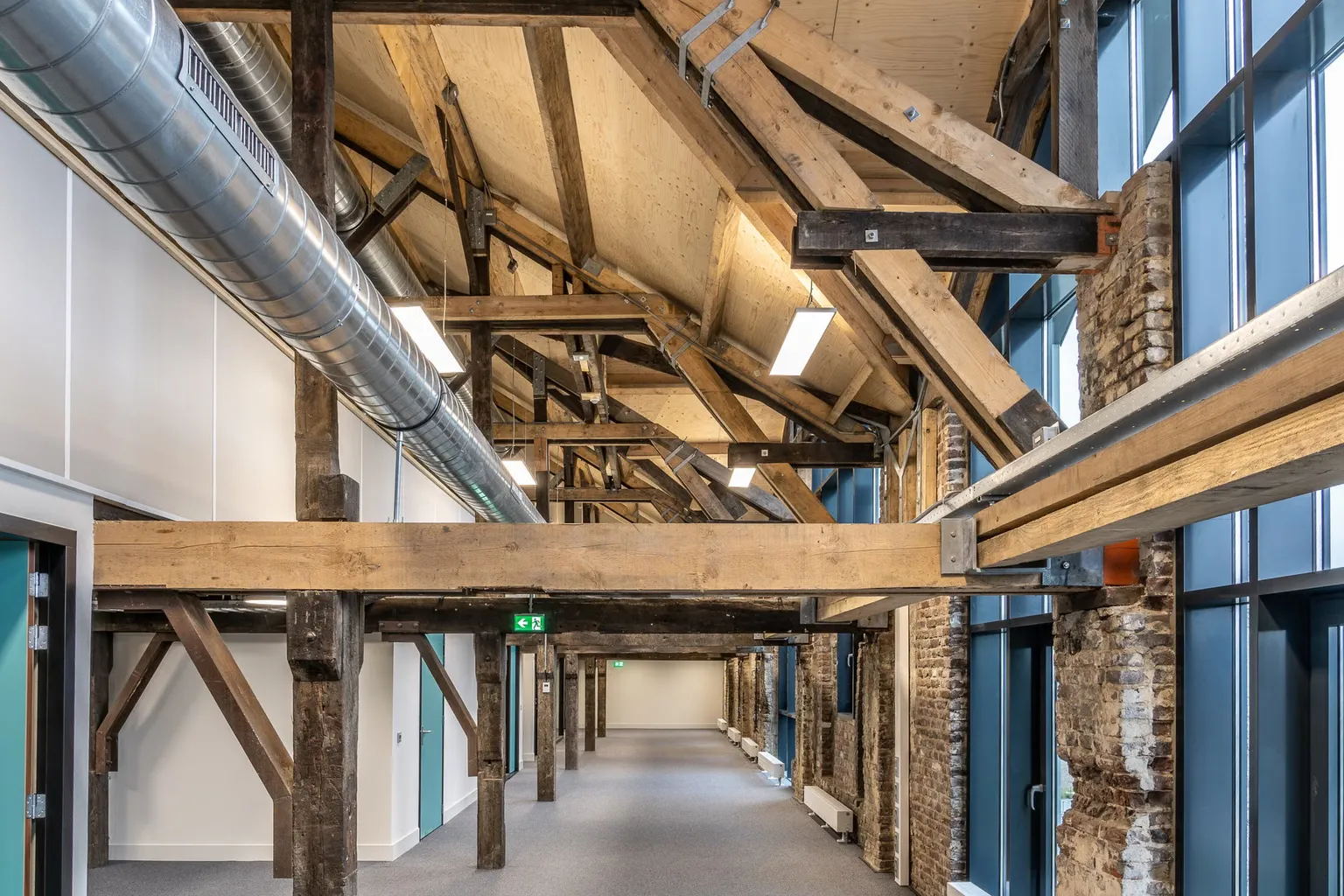
The timbers are often centuries old, blackened by generations of hearth smoke and lamp soot, marked with hand-hewn grooves that no orbital sander was ever designed to follow, and pitted with old woodworm flight holes. You want them clean, you want the character intact, and you want to finish the restoration before the next heating season arrives. Two methods come up in nearly every conversation with local artisans: soda blasting and hand sanding. They look like competing answers, but they actually solve different problems.
The Mechanics of Preservation: Soda Bicarbonate vs Manual Abrasion
To choose sensibly, it helps to understand what each method is physically doing to the wood beneath your hands.
Soda blasting propels soft sodium bicarbonate particles at the timber through a low-pressure nozzle, typically operated around 80 PSI when working on wood surfaces. The bicarbonate carries a Mohs hardness of roughly 2.4 — softer than oak itself, harder than the soot, smoke residue, and old waxes you are actually trying to remove. On impact the particle fractures and releases a small burst of energy that lifts the contaminant layer off the wood surface without cutting into the cellular structure beneath. There is no significant heat buildup at the contact point, which matters more than people realise when working with old oak that has already spent two centuries drying in place.
Hand sanding does something fundamentally different. Whether the tool is a sanding block, a random orbital, or a detail sander fitted with a profiled pad, the abrasive paper physically removes a thin layer of wood along with whatever sits on top of it. You are shaving the beam clean rather than lifting the dirt off it. That works beautifully on a flat, modern softwood surface. On a hand-hewn oak beam that has known six different faces since the reign of Louis XIV, the result is less predictable — the sander finds the high points first and leaves the recesses untouched.
The "why" behind local craftspeople preferring one approach over the other usually comes down to how much original wood they are willing to lose. Oak that has survived since the 1600s has already been stressed by warping, insect activity, and seasonal movement. Every pass of sandpaper takes a century's worth of patina with it.
Navigating Structural Integrity and Surface Texture
Old oak beams were rarely cut by machines. They were pit-sawn or hewn with broad axes, leaving surfaces that ripple, dip, and curve in ways no planed timber ever does. That texture is precisely what gives a restored Dordogne farmhouse its character, and it is the first casualty of an aggressive sanding approach.
A soda-blasted beam keeps its adze marks, its tool grooves, its gentle undulations. The media follows every contour because it behaves almost like a fluid stream rather than a flat abrasive pad. The resulting surface reads as authentically aged rather than uniformly scrubbed — there is no risk of producing the "newly cleaned" look that immediately dates a restoration to the wrong decade.
Hand sanding can preserve the texture if you work carefully with coarse grits and follow the grain by eye, but it requires a patience most renovators simply do not have at the end of a long project. There is also a thermal consideration worth flagging. Sustained friction from power sanding on dense oak generates real heat at the contact point. Over a long session on a single beam, that localised warming can dry out the surface fibres unevenly and encourage fine checking — the small surface cracks that develop as wood loses moisture too quickly in one spot. Soda blasting sidesteps the issue entirely, because the bicarbonate particles fracture before they can transfer meaningful heat to the substrate.
The hidden cost of hand sanding old oak isn't labour — it's the layer of original wood that disappears with every pass.
Health Hazards and Environmental Containment in Historic Interiors
This is the section most renovation blogs skip, and it is the one that should make anyone working on a French farmhouse beam pause before picking up a sander.
Oak dust is classified as a carcinogenic substance. Sawing, planing, and especially sanding oak releases fine particulate matter that lingers in the lungs long after the tool is switched off. In a closed interior — the typical situation when you are restoring a ceiling beam in a room still being lived in — that dust coats curtains, bedding, kitchen surfaces, and ductwork for weeks. If you are running a gîte, or restoring a property you intend to let, the contamination footprint of a sanding job is a real operational concern, not a theoretical one.
Proper protection during sanding calls for an FFP3-rated respiratory mask and dust extraction equipment rated at Class M or Class H when working indoors. Even with that kit, you are still managing a dust cloud rather than containing it at source.
Enclosed soda-blasting systems are a different proposition. Because the blasting happens inside a sealed cabinet or under carefully sealed plastic containment sheeting around the work area, particulate capture rates reach up to 99% of the material mobilised. The waste collects in the system rather than drifting through the house. For a property that has already been partly restored — with original tomettes, finished lime plaster, or a newly fitted kitchen nearby — this containment difference matters enormously. It is not a marketing claim; it is the basic physics of a closed system versus an open one.
If the rest of the house is already finished, the dust a method produces is as important as the finish it leaves behind.
Reaching the Impossible: Cleaning Crevices and Woodworm Galleries
There is a moment during most beam restorations when the geometry simply decides for you. Hand-hewn oak is full of tight crevices, adze marks the shape of fingernails, peg holes from original joints, and old woodworm flight holes that tunnel deep into the heartwood. No sanding pad — no matter how cleverly profiled — can reach inside a flight hole a few millimetres across. The dust and compacted frass simply stay where they are.
Low-pressure media blasting, using fine recycled glass media in the 100–200 mesh range, behaves almost like a liquid. It flows into every cavity, follows every groove, and cleans surfaces that simply cannot be reached by abrasion. The same physics that allows it to clean a deeply textured beam without damaging the high points also allows it to enter woodworm galleries and lift out the compacted material inside them.
This is not a marginal benefit. If you are restoring a beam that has had woodworm in the past — and in the Dordogne, that is most of them — the difference between a beam that has been surface-cleaned and one that has been cleaned into the galleries is visible from the floor below. The former looks tidy but reveals its history the moment raking light hits it at an angle. The latter reads as honest, cared-for timber that someone has actually looked after.
Hand sanding does have a role. For localised touch-ups, for finishing a small repair patch to match a larger area, or for easing a sharp edge someone is about to brush against, a sanding block in hand is exactly the right tool. The mistake is treating it as the whole job.
Operational Realities for French Farmhouse Renovations
Choosing between the two methods in practice is rarely a binary decision. It is about matching the tool to the section of beam, the stage of the restoration, and the conditions on site. Most decisions in a Dordogne renovation come down to a handful of practical parameters, and beam cleaning is no exception — what the method does to crevices, how much dust ends up in the rest of the house, how the original surface texture is affected, and how long the setup actually takes.
| Parameter | Soda Blasting | Hand Sanding |
|---|---|---|
| Surface finish | Follows contours, preserves adze marks and tool grooves | Flattens high points, can smooth original texture |
| Crevice cleaning | Reaches into woodworm flight holes and narrow recesses | Limited to surface area the pad can physically touch |
| Heat on the wood | None — particles fracture before transferring heat | Sustained friction can dry and check dense oak |
| Dust at the worksite | Up to 99% contained in a closed system | Open cloud, requires FFP3 mask and Class M/H extraction |
| Setup time | Longer — sealing, containment sheeting, specialist kit | Shorter — basic dust sheets, hand tools, immediate start |
| Best suited to | Full historic beams, textured surfaces, finished interiors | Flat sections, repair patches, small finishing tasks |
| Speed on hand-hewn oak | Faster per square metre on irregular timber | Slower, labour-intensive, easy to underestimate |
For most full-beam restorations in a Dordogne farmhouse where the original oak is genuinely historic, the local specialists tend to reach for blasting first and reserve sanding for finish work. That said, every property is different, and the only way to settle the question for your own beams is a small test patch in an inconspicuous corner, ideally with both methods tried side by side before committing to the whole ceiling.
Whichever route you take, seal the cleaned oak with a breathable finish rather than a film-forming varnish — a traditional beeswax and turpentine mix, a lime wax, or a hard wax oil will let the timber continue to move with the seasons, which is exactly what has kept it standing for the last four hundred years.