French country garden planning: a pre-design checklist
Most gardens billed as "French country" never make it past the cartography phase. The owner sketches a vague rectangle, plants three lavender shrubs by the front wall, throws in a galvanized bucket, and calls the job done within a weekend.
By August the lavender is leggy, the bucket is rusted through, and the rectangle reads as an empty yard rather than a place to be. The mission fails because there was no pre-design briefing — only a quick stroll around the perimeter, a half-loaded wheelbarrow, and an optimistic calendar.
Before the first seed goes in, before a single terracotta pot is ordered, before the gravel supplier is called, the Dordogne gardener needs to run the same kind of terrain evaluation a deployment planner runs before crossing open country: where is the sun, where does the water sit, what is the soil actually doing, and how does the human traffic flow through the space. Read this briefing once. Walk the site twice. Then commit to the route.
A French country garden is not a softer copy of Versailles. It is engineered informality — geometry under the surface, looseness on top.
Mission Profile: What "Country" Actually Means
Two distinct disciplines sit under the French gardening umbrella, and confusing them is the first failure point. Jardin à la Française — formal French — is the Versailles register: rigid symmetry, clipped parterres, axial sightlines built to govern large estates. It is theatre. Jardin de curé, the country garden, is the opposite temperament: an irregular footprint where vegetables, herbs, fruit trees, flowers, and gravel paths intermingle without apology. The country style is what the smallholder and the parish priest actually ran for centuries before royal gardeners redesigned the country at scale.
A 1994 French government survey found that roughly 23 percent of the fruit and vegetables consumed in France were home-grown in exactly this kind of kitchen garden — the potager. That figure tells you something important about the country garden's purpose: it is not a viewing platform. It is a working surface that happens to be beautiful. Plan accordingly. If your site cannot produce a meaningful cut of food alongside the flowers, you are building a small Versailles, not a country garden, and the brief needs to be rewritten.
The country brief respects asymmetry, but it does not respect chaos. There is structural geometry hiding underneath the relaxed planting — a gravel axis here, a clipped boxwood edge there, a stone path that always returns the eye to the house. Looseness without bones produces a meadow. Bones without looseness produces a tax office courtyard. The target is both, simultaneously.
Site Survey: Read the Terrain Before You Commit
The Dordogne presents a specific operational environment. Soils here trend toward clay-limestone, drain variably, bake hard in July and August after a wet spring. Sun exposure shifts dramatically across even a small plot due to the stone walls and mature oak canopy that almost always surround a country property. Map the following before any other step.
Sun path. Track the sun across the full day, not just the moment you fall in love with the garden. Anything labelled "sun-loving" in the nursery — lavender, rosemary, most Mediterranean herbs, roses for reliable bloom — needs a minimum of six hours of direct exposure. Anything less and you are recruiting shade-tolerant performers — hostas, hydrangeas, certain hardy geraniums — and the palette changes with it.
Water behaviour. Watch where the rain pools after a storm. Standing water that lingers past 24 hours rules out most Mediterranean selections and points you toward bog-tolerant material or a drainage intervention: gravel sub-base, French drain, raised bed. Do not plant rosemary into a low clay pocket and hope.
Slope and footfall. Identify the natural circulation routes — where the kitchen door opens, where the bins go, where the dog runs. The path network follows those flows, it does not fight them. A gravel axis laid perpendicular to the daily route will be ignored by feet and worn bald by weather into a useless strip.
Existing structure. Mature trees, walls, wells, stone outbuildings, large roots — these are waypoints the mission must route around. A 60-year-old walnut casts deep shade and exudes juglone, which kills a long list of ornamentals. Either commit to a shade-tolerant, juglone-resistant palette beneath it, or design around the root zone entirely.
| Survey Element | What You Log | Threshold That Forces a Plan Change |
|---|---|---|
| Sun hours per zone | Direct exposure from dawn to dusk | Under 6 hours → shift to shade-tolerant palette |
| Drainage | Where water stands after rain | Standing > 24h → drainage work or raised bed |
| Existing trees | Species, canopy spread, root zone | Walnut or other juglone producers → restricted plant list |
| Foot traffic | Daily routes from door to door | Paths follow routes, never cross them |
| Soil texture | Squeeze test: clay, loam, sandy | Clay-dominant → grit amendment before any planting |
Structural Loadout: The Hardscape Goes In First
A common misreading of the style treats hardscape as decoration to be added after the planting "softens" the space. Reverse that. In the Dordogne country brief, the bones go in first because the bones are what survives drought, a long July absence, and the gardener's mid-summer slowdown. Planting is the second wave.
Five hardscape elements do most of the heavy lifting:
- Gravel paths. Not bark, not the bright pre-bagged supermarket stuff, not concrete pavers in soldier rows. Local limestone gravel, laid 8–10 cm deep over landscape fabric, edged in reclaimed stone or low boxwood. The path cracks pleasantly with age, drains itself, and grounds the garden in country vocabulary.
- Weathered natural stone. Reclaimed tuffeau, sandstone, or local limestone for steps, edging, low walls. New stone reads wrong in this setting. Source from a local démolition yard or a stone-cutter's leftover pile. The patina is part of the work.
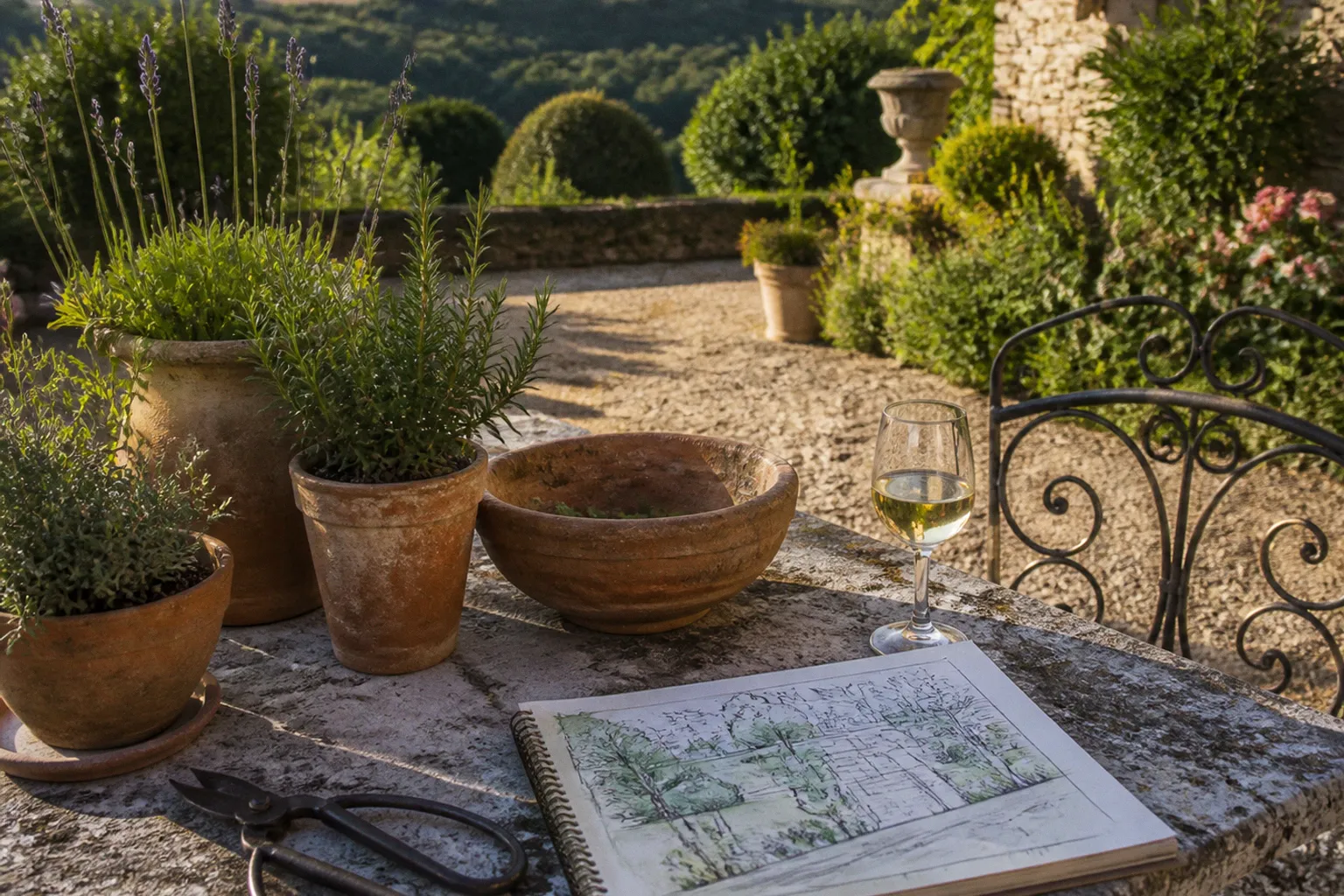
- Terracotta pots. Anduze, Biot, or plain unglazed earthenware, sized generously. Anything plastic signals a holiday let. Pots are the unit of flexibility: they let you move the focal point through the season and patch a failed planting overnight.
- Wrought iron. Trellises, plant supports, a gate, a bench frame, the obligatory tuteur for climbing roses. Black or very dark grey only. Powder-coat if rust bothers you; otherwise accept the oxidation — the country garden does not fear patina.
- Stone or marble furniture. One piece, placed with intent: a small bistro table, a sundial, a stone bench. Not a matched set. One anchor object gives the eye somewhere to rest.
The Potager Waypoint
The traditional French kitchen garden — the potager or jardin de curé — is the country brief's signature structure and the element that most reliably separates a country garden from a generic cottage planting. Plan it early because it sits inside the geometric frame and decides the path layout.
A working potager intermingles four categories in the same square metres: vegetables, soft fruit, culinary herbs, and cutting flowers. The interplanting is the discipline — it disrupts pest monocultures, supports pollinators, and gives the eye something to read every week of the year. A typical 25-square-metre plot can carry tomatoes, courgettes, a fig or small fruit cordons, a strip of thyme and rosemary, a clump of chives, and a row of zinnias or dahlias for cutting, without crowding.
Three structural rules hold:
1. Path access from all sides. A bed wider than 1.5 m stops being reachable from the edges. Break large plots into smaller rectangles separated by 60–80 cm gravel paths.
2. Rotation by quarter. Divide the plot into four zones and rotate heavy feeders (tomato, courgette, brassica) through them year on year. Soil exhaustion and disease pressure drop sharply.
3. Edge the working space. Boxwood, lavender, or a low stone wall. The country brief always shows the boundary of the potager — never leaves it as bare soil against open lawn.
If a full potager is too much maintenance, do not abandon the principle — compress it. A 4-square-metre herb and cutting-flower bed against the kitchen wall, edged in boxwood, delivers most of the visual and culinary return for a fraction of the work. The brief is to feed the kitchen and the eye; the square metre count is a variable, not a target.
Plant Palette: Selections That Earn Their Slot
The country palette has its own discipline. It favours structural evergreens, drought-tolerant Mediterranean material, and flowering shrubs that hit hard in their season without becoming labour. The default list, in order of structural priority:
- Boxwood (Buxus sempervirens). Low edging, parterre framing, topiary punctuation. Slow-growing, accepts formal shearing, anchors the geometry. Where boxwood blight pressure runs high, prefer 'Faulkner' or B. microphylla cultivars.
- Lavender (Lavandula angustifolia). 'Hidcote' or 'Munstead' for low hedges; L. × intermedia for mass plantings. Full sun, sharp drainage, no summer irrigation once established. Plan to renew stands every 8–10 years as plants go woody.
- Rosemary. Same sun and drainage rules as lavender. One large specimen near the kitchen door outperforms any herb garden for daily cut use.
- Roses. Old garden roses and modern shrub roses — David Austin types, Rosa 'Mutabilis', gallicas — rather than hybrid teas. They accept informal training against walls and tolerate a dry Dordogne summer once established.
- Hydrangeas. Reserved for shadier zones and north-facing walls. Hydrangea macrophylla performs reliably in the Périgord's slightly acidic pockets; flower colour reflects soil pH.
- Sage, santolina, perovskia, nepeta, Geranium 'Rozanne'. The labour-efficient flowering understorey. Cut back hard in late winter; they regrow fast in spring.
Colour discipline matters. The country palette is sage green, soft blue, lavender, peach, off-white, and the occasional light pink. Hot reds and saturated oranges break the register and read as Mediterranean holiday planting, not French country. When the brief calls for warmth, reach for peach and terracotta tones, not chrome-yellow zinnias.
Soil Prep and Pre-Planting Gear Loadout
Skip soil prep and every later step is built on sand. In the Dordogne the clay-limestone base compacts easily, sheds water when dry, and soaks slowly when wet. Two interventions do most of the work.
Test first. A basic soil pH and texture test — many French garden centres offer this, or send a sample to a regional lab — gives you actual numbers before you commit. Skip it and you will have planted acid-lovers into alkaline ground, or amended the wrong direction by feel. Local soil pH and microclimate numbers vary sharply across even a single property, which is why the test is non-negotiable on any plot above a few hundred square metres.
Amend by texture, not by recipe. Heavy clay wants coarse river grit and well-rotted compost forked into the top 20–30 cm, plus gypsum if the clay is severe. Sandy pockets want compost and organic matter for water retention. Peat against Dordogne clay holds water against roots and accelerates rot — leave it out.
Mulch once, mulch properly. A 5–7 cm top-dressing of leaf mould or fine bark on bare beds after planting suppresses weeds, carries the garden through July, and feeds soil life. Refresh annually. The country garden looks after itself once the mulch habit is locked in.
Before the contractor arrives or the first weekend dig starts, lay out the field kit. This is the loadout check.
- Survey kit: notebook, phone for sun-path photos at two-hour intervals, 10 m tape, soil test kit or lab address.
- Hardscape sources: local gravel supplier, stone yard, terracotta potter (Anduze, Vallauris, or regional equivalent), blacksmith for wrought iron.
- Plants: structural evergreens ordered nine months ahead for the best size and price; perennials sourced from a regional nursery, not a hypermarket.
- Soil amendments: coarse river grit, well-rotted manure or compost, gypsum (if clay), mulch material.
- Tools: sharp spade, border fork, half-moon edger, wheelbarrow, plate compactor for the path sub-base, hose with a fine rose.
Walk the site twice before you order anything. The second walk costs you an hour and saves you a season.
The country garden is not a weekend project. It is a two-to-three-season build: a spring for hardscape and soil prep, a first summer for structural planting, the following spring for the understorey and potager finish. The Dordogne rewards patience and punishes enthusiasm. Plan the bones, source the local material, watch the site through a full weather cycle, and the loose country planting will start to feel inevitable — like the garden was already there, waiting for the path to be laid.