Exposed stone vs lime plaster for French barn walls
The first warm spell after winter is often when an old French barn reveals the truth about its walls. A patch of damp appears behind a cupboard, salt begins to bloom through a hard render, or a previously sound-looking joint starts shedding grit.
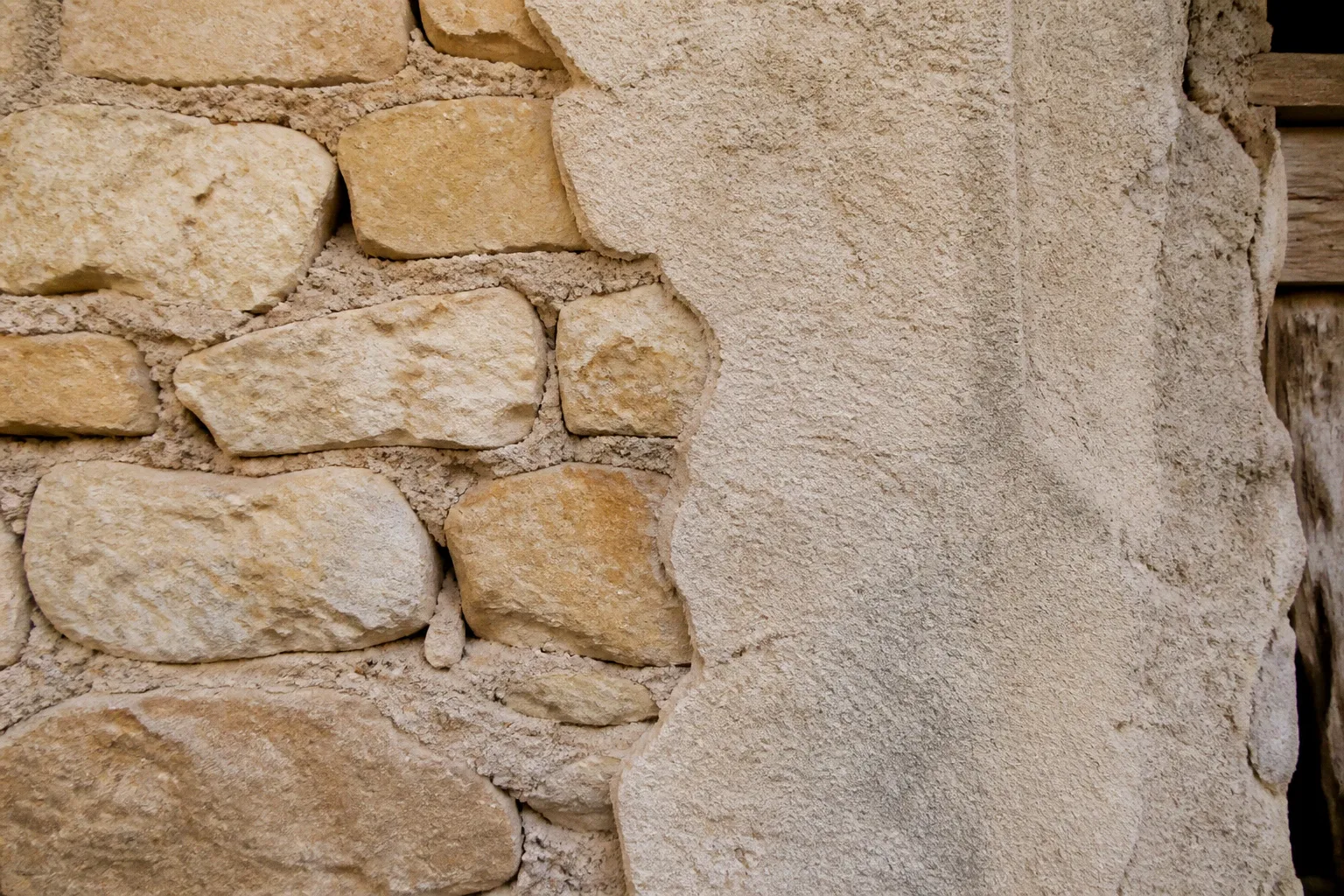
Exposed Stone vs Lime Plaster: Restoring French Barn Walls
This is the point at which many renovation plans turn to the question of exposed stone versus lime plaster—but the choice is not primarily decorative.
For traditional French masonry, the wall finish has to work with the building rather than seal it shut. Exposed stone can bring out the character of a barn conversion, while enduit à la chaux can protect uneven masonry and improve the room’s comfort. The right decision depends on moisture movement, the condition of the stone, the wall’s thickness, and the amount of thermal upgrading you need.
In other words, exposed stone vs lime plaster in French renovation is not simply a question of rustic appearance. It is a decision about how an old wall will dry, age and perform over the next decades.
The wall must breathe before it can look beautiful
Traditional solid stone walls were generally built without the damp-proof courses and layered construction used in modern houses. Their performance depends partly on thickness, partly on the porosity of the stone and mortar, and partly on their ability to absorb and release moisture gradually.
That moisture may enter through driving rain, ground contact, small roof defects, open joints or the ordinary humidity of a lived-in room. In a well-balanced historic wall, it can move through the masonry and evaporate. When the surface is covered with a dense, non-breathable material, the moisture has fewer routes out.
This is why old cement render is such a recurring problem in French property restoration. A cement patch may initially look firm and tidy, but its hardness and low permeability can force moisture to remain within the stonework. Over time, this may contribute to salt efflorescence, crumbling joints and the deterioration of softer stones. The visible damage often appears at the edges of the cement, but the underlying trouble can extend further into the wall.
The same principle applies indoors. A cement-based repair around a window reveal, a hard modern mortar joint or a waterproof coating may seem too small to matter. Yet traditional masonry rarely fails in one dramatic event; it suffers through repeated wetting and drying, with each sealed patch disturbing the balance a little more.
The most sympathetic finish is the one that lets the wall complete its natural drying cycle, not the one that makes it look newest on the day of completion.
Natural hydraulic lime is suited to this kind of work because it remains more compatible with historic masonry. A lime mortar or plaster can allow vapour to pass while offering protection to the joints and stone. The commonly used NHL 3.5 grade, including products such as Saint-Astier Chaux Pure Blanche NHL 3.5, provides a practical balance for many classic French barn repairs: workable enough for pointing and sufficiently robust once cured, without behaving like a rigid cement shell.
That does not mean every old wall should be stripped immediately. Cement render can conceal damaged stone, unstable areas or earlier repairs, and removing it without inspection may expose more work than the first survey suggested. Before deciding on a finish, look for bulging masonry, hollow-sounding areas, persistent damp at the base, cracked lintels and signs of roof or gutter failure. A wall cannot be rescued by a beautiful surface if water is still arriving from above.
When exposed stone is the right expression
Pierre apparente—exposed stone—works best when the masonry itself is strong enough to become the interior finish. In a Dordogne barn, this may mean irregular limestone with broad joints, a mixture of pale and honey-coloured pieces, or a wall whose texture carries more character than any applied decoration could provide.
It is particularly effective on selected elevations rather than automatically on every wall. A gable end, fireplace wall, entrance hall or dining area can carry exposed stone well, while bedrooms and sitting rooms may benefit from the calmer, more continuous surface of lime plaster. This balance avoids turning the entire house into a hard, visually busy shell.
There is also a practical reason to be selective. Exposing stone is not simply a matter of removing an old coating and brushing the surface. Once the mortar is raked out, every joint becomes part of the finished composition. Uneven widths, missing edges and previous patching will all be visible.
The preparation usually begins with removing loose material and raking out the existing joints to a depth of approximately 10 to 20 mm. That depth gives the new breathable pointing mortar enough purchase without unnecessarily disturbing sound masonry. The exposed joints then need to be cleaned carefully, often with a soft brush and controlled methods rather than aggressive pressure that could erode the stone faces.
The quality of the original stone matters as much as its colour. Some stones have a durable outer skin that should be preserved; others are already soft from years of weathering or from moisture trapped behind cement. A wall that looks handsome beneath a coating may still need local rebuilding before it can be presented as pierre apparente. It is unwise to assume that all hidden stonework will be in good condition simply because the visible surface appears promising.
The character of the pointing
For exposed stone, the pointing should support the masonry rather than dominate it. A joint that is too hard, too proud or too sharply coloured can make a traditional wall look newly manufactured. A softer lime mortar, finished back slightly from the stone face or carefully brushed to follow the original construction, tends to sit more naturally.
The sand has a strong influence on the result. Its colour, grain and grading affect whether the finished joints appear warm, pale, sandy or grey. This is one reason a small sample panel is worth making before committing to an entire room. The same lime can produce a very different appearance when mixed with a local-toned sand or applied at a different moisture level.
Exposed stone also brings everyday maintenance into the room. Deep joints collect dust more readily than a plastered surface, and rough stone can make furniture placement more awkward. In a kitchen, the wall behind a sink or cooker needs particular thought; lime pointing is breathable, but it is not a waterproof splashback. A stone wall can be beautiful beside a range, while a smooth lime-finished section may be more sensible directly behind a working preparation area.
Why lime plaster is often the quieter, wiser finish
Traditional lime plaster—enduit à la chaux—offers a different kind of restoration. Rather than displaying every stone, it creates a protective skin that follows the irregularity of the wall while softening its visual noise. In a barn conversion, this can be the difference between a room that feels composed and one that feels permanently unfinished.
Lime plaster suits spaces where you want the thickness and age of the masonry to remain present without exposing every joint. It can be lightly textured, floated more smoothly or built up in several coats, depending on the substrate and the desired interior. The finish may be chalky white, warm cream, muted stone or gently tinted with natural pigments, although the exact colour will change with drying conditions and the aggregate used.
There is a common misconception that plaster hides the history of a building. Poorly chosen plaster can do that, especially when it is applied as a flat, hard modern coat. A well-made lime finish does something more useful: it preserves the wall’s breathable behaviour while allowing the room to be furnished comfortably around it.
It also helps where the stonework is visually inconsistent. A barn may contain several phases of construction, with one section rebuilt in smaller stones and another using larger blocks. Exposed throughout, those changes can be striking or distracting. Lime plaster gives the interior a continuous envelope while allowing arches, reveals, beams and fireplaces to remain as the principal historic details.
The finish is particularly helpful on walls with minor surface irregularities that do not justify rebuilding. Lime can accommodate a degree of movement and unevenness more sympathetically than rigid cement-based products. It is not a cure for structural instability, but it is a compatible surface for an old building that needs to continue behaving like an old building.
Enduit à la chaux versus pierre apparente
| Consideration | Exposed stone (pierre apparente) | Lime plaster (enduit à la chaux) |
|---|---|---|
| Visual effect | Textured, direct and strongly rustic; the masonry becomes the main feature | Softer and more continuous; the age of the wall remains visible through irregularity and depth |
| Preparation | Existing joints are raked out, commonly to 10–20 mm, cleaned and repointed | Loose coatings are removed and the substrate prepared for breathable plaster coats |
| Condition of masonry | Best where the stone is sound and the joints can form an attractive finished pattern | More forgiving where stone is mixed, visually uneven or not worth displaying throughout |
| Moisture behaviour | Breathable when repointed with a compatible lime mortar | Breathable when made with suitable lime and applied to a compatible substrate |
| Thermal performance | Does not provide insulation by itself | Can be combined with breathable materials such as perlite or clay for some thermal improvement |
| Everyday use | Highly tactile but can be dusty or difficult behind wet work areas | Easier to clean and furnish against, though still not a waterproof kitchen finish |
| Design risk | Can become visually heavy if used on every wall | Can feel too uniform if applied without retaining openings, stone details or timber character |
The comparison is rarely all-or-nothing. Many of the most convincing French barn interiors use exposed stone where it explains the building—around an old opening, chimney breast or structural wall—and lime plaster where the room needs light, calm and practical surfaces.
Thermal comfort: thick walls are not insulated walls
A traditional stone wall can be half a metre thick or more, and that mass is one of the pleasures of an old barn. It moderates temperature changes, stores warmth and gives the building a deep, grounded feel. But thermal mass is not the same as insulation.
Stone can delay heat transfer without preventing it. In winter, an uninsulated solid wall may still draw warmth from the room; in summer, it may remain pleasantly cool but only if the building’s ventilation, shading and moisture behaviour are also working properly. Exposed stone alone should never be presented as a complete insulation strategy.
This is where the decision between exposed stone and lime plaster becomes connected to the wider restoration plan. If the barn needs improved thermal performance, a breathable interior build-up may be considered, using materials such as lime mixed with perlite or clay where appropriate. The aim is to improve comfort without trapping moisture against the masonry.
The sequence matters. Insulation, electrical work, window reveals, floor levels and skirting details should be resolved before the final finish is applied. Adding a thick internal lining after the stone has been pointed may alter door openings, reduce room dimensions and hide the very details you intended to preserve.
There are also seasonal realities. A lime finish needs suitable drying conditions, and an old wall may release moisture slowly. Forcing the process with excessive heat can create its own problems. Gentle ventilation and patience are more useful than trying to make a traditional material behave like a fast-drying modern coating.
For a holiday gîte, this practical question becomes even more important. Guests may appreciate a dramatic stone wall, but they also expect rooms that feel dry, easy to heat and comfortable in changing weather. The most photogenic finish is not necessarily the one that gives the best experience in a damp spring week or a hot August afternoon.
Choosing the finish room by room
Rather than selecting one treatment for the entire barn, map the walls according to their condition and use. This is a more reliable route than beginning with an image from a brochure or a renovation photograph.
A useful room-by-room approach looks at five things:
- Where the wall receives water. External elevations, chimney zones, lower courses and areas beneath defective gutters deserve investigation before any decorative decision.
- How the room is used. A dining room can carry a tactile stone feature, while a boot room or kitchen may need smoother, more washable surfaces in working areas.
- What the masonry contributes. A handsome arch, carefully laid gable or old fireplace may be worth exposing; a patchwork of weak stone and repairs may be better unified with lime.
- What the thermal plan requires. If the wall needs a breathable lining, full exposure may be incompatible with the desired performance or detailing.
- How much maintenance you want. Deep, irregular stone is forgiving visually but less forgiving when cleaning and furnishing; lime plaster offers a calmer background for daily life.
This often leads to a combination such as exposed stone in the entrance and living room, lime plaster in bedrooms, and a more robust lime-based finish in circulation spaces. The transition between the two should be deliberate. A timber post, corner, opening or change in wall plane can make the junction feel architectural rather than accidental.
The surrounding materials matter too. Pale lime plaster can make old oak beams appear darker and more substantial. Exposed limestone can sit beautifully beside terracotta, but too much hard texture alongside reclaimed timber, antique iron and patterned textiles can make a room feel crowded. French country interiors work best when the materials are allowed to take turns speaking.
Mixing, quantities and the discipline of a sample panel
For small areas of repointing, a typical working batch may use approximately 10 litres of lime to 30 litres of sand, with a rough coverage of around 2 square metres depending on the depth and width of the joints. These figures are useful for planning materials, but they are not a substitute for a trial mix. Stone size, joint profile, wall absorbency and the thickness of the existing masonry will all change the yield.
The practical mistake is to mix more than can be placed and finished comfortably. Lime mortar is not improved by being left to wait while another task takes priority. It should be prepared consistently, applied into properly prepared joints and protected while it cures. A small test area will show how quickly the wall draws water from the mix and whether the chosen sand produces the right colour once dry.
For an interior lime plaster, make a larger sample on the actual wall if possible. Board samples are helpful for colour, but they do not show how the plaster responds to an uneven, absorbent masonry background. Observe the finish in morning and evening light, beside the floor and under the proposed lighting. A soft cream that looks gentle in a sample pot may become yellow against warm terracotta, while a cool white may make old stone appear grey.
Material storage also has a practical side. Lime should be kept dry and protected from contamination, while sand needs to remain consistent between batches. A change in moisture content can alter workability and yield even when the nominal ratio stays the same. If a wall is being completed over several days, record the mix proportions and sand source rather than relying on memory.
The best finish is rarely produced by chasing absolute uniformity. Traditional walls have variation, and a slightly changing texture is part of their integrity. The craft lies in controlling the variation so that it looks like the building’s own history, not a sequence of unrelated repairs.
Use exposed stone to reveal the structure, and lime plaster to restore the wall’s ability to live quietly in the background.
A practical decision for a French barn conversion
Choose exposed stone when the masonry is sound, the joints have a coherent pattern and the wall deserves to become a principal interior feature. Prepare for careful raking, compatible lime pointing and a finish that will need more attention in dusty or wet working areas.
Choose lime plaster when the wall is visually uneven, when you want a calmer room, or when a breathable thermal improvement is part of the renovation. It is often the more adaptable choice for bedrooms, sitting rooms and large areas where the stone would otherwise dominate.
Choose a combination when the barn contains several histories at once—which is common. A restored opening or fireplace can remain in pierre apparente, while the adjoining walls receive enduit à la chaux. This allows the renovation to honour the old masonry without making every surface perform as a feature wall.
Before ordering materials, inspect the wall during a wet period if you can. Check the roof edge, gutters, floor junction and external pointing. Remove a small area of existing coating rather than assuming what lies beneath it. Then make a sample panel and live with it through changing light.
The final actionable tip is simple: make the moisture decision before the style decision. Once the wall is dry, stable and paired with a breathable material, both exposed stone and lime plaster can belong naturally in a Dordogne barn. If that order is reversed, even the most charming finish may be asked to conceal a problem it cannot solve.