French flea market shopping: a pre-trip checklist
The early opening at a French outdoor market is not a ceremonial detail. By the time a late arrival has found a parking space, unfolded a map, and made the first polite greeting, the most obvious pieces may already have changed hands.
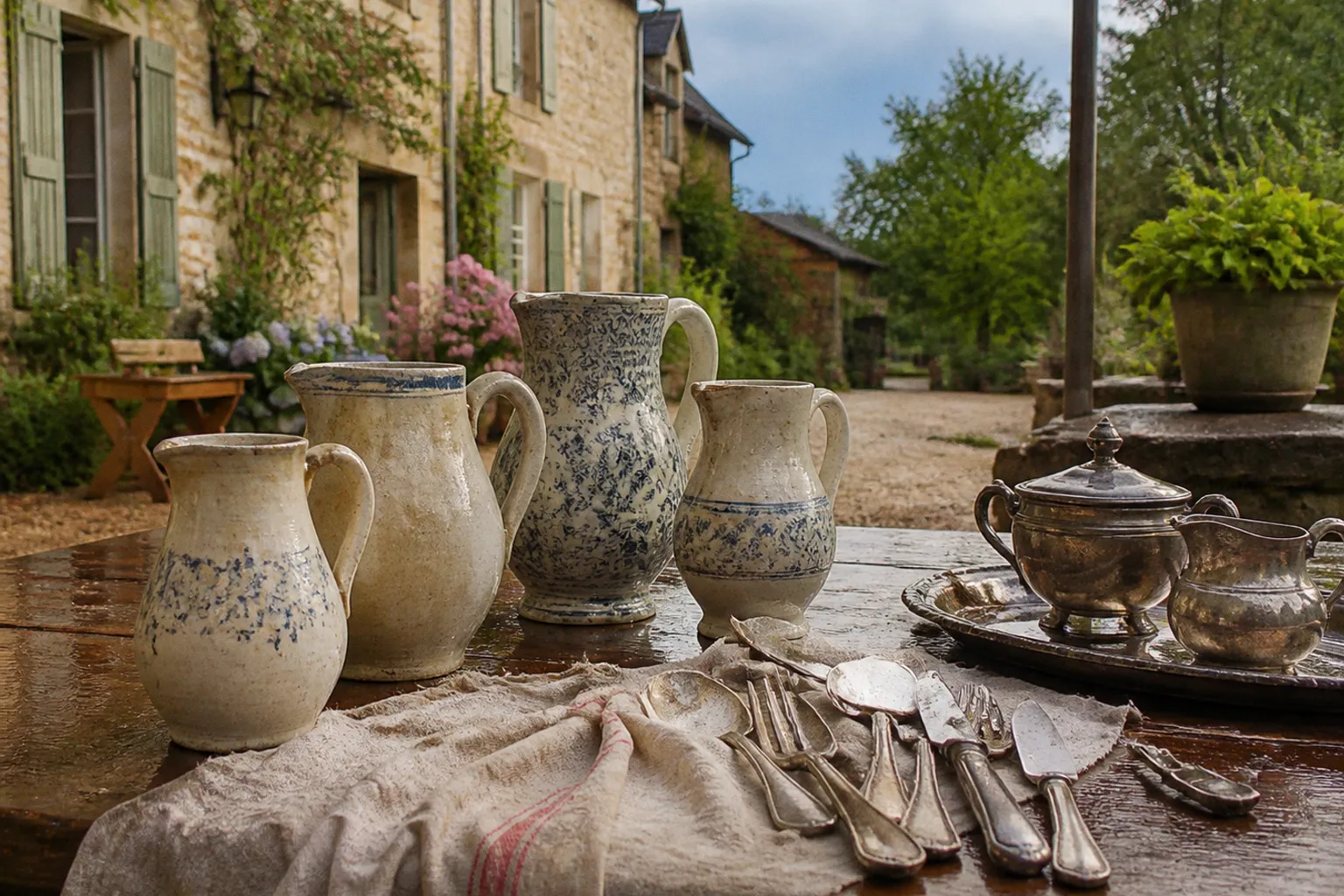
The best tables are often worked quickly: first by dealers and experienced local buyers, then by everyone else.
That does not mean an antique hunt in the French countryside requires military precision. It does require preparation. A one-day vide-grenier sweep or a multi-stop Dordogne brocante route runs more smoothly when the route, payment method, transport, and inspection routine are decided before breakfast rather than improvised beside the first stall.
Treat the French flea market circuit as a deployment, not a day out. Recon the route, pack the loadout, and leave room for the unexpected.
The points that cause most trouble are consistent: confusing one type of market with another, arriving without local information, carrying the wrong cash or no way to move a large find, mistaking a period style for a period object, and negotiating before the social part of the transaction has begun.
Decoding the French Market Hierarchy: Vide-Greniers vs. Brocantes vs. Marchés aux Puces
The first mistake in French flea market shopping is treating every event described in English as a flea market as though it offered the same kind of buying. In France, the distinction between a vide-grenier, a brocante, and a marché aux puces is not absolute in every advertisement, but it gives a useful indication of who is selling, what may be on the tables, and how much preparation the visit deserves.
Vide-greniers: household clearances with uneven rewards
A vide-grenier is, broadly, a clear-out of the attic, garage, cellar, or garden shed. The sellers are usually private individuals rather than professional dealers. Their tables may contain kitchenware, children's toys, old books, linen, tools, small decorative objects, and whatever else no longer has a place at home.
The attraction is not consistency. It is the possibility of finding something good where nobody has applied an antique dealer's price or description. A household clearance can produce an old mirror, a rural worktable, a set of handmade storage jars, or a useful piece of garden furniture alongside boxes of modern clutter. The buyer has to tolerate the unevenness.
Prices are often more approachable than at a professional brocante, and there may be greater room for a friendly discussion. But a vide-grenier is not automatically an antique market. It is better approached as a treasure hunt for country finds than as a dependable source of authenticated period furniture.
Brocantes: more curation, more specialist knowledge
A brocante usually brings together professional or semi-professional sellers. Many dealers travel from one market to another with a van, trailer, or small lorry, and some specialise in particular categories: regional ceramics, furniture, textiles, lighting, metal signs, or decorative objects.
The stock is more likely to be selected and described. It is also more likely to be priced with an understanding of its market. That does not mean every description is definitive, or that every dealer is selling high-value antiques. It means the buyer is more often dealing with someone who knows what the object is, where it might have come from, and what comparable pieces command.
For buying antiques at French brocantes, this is usually the more productive setting. It is possible to ask about restoration, construction, marks, and previous ownership without expecting the seller to know every answer. The important distinction is that a dealer's confidence is evidence of experience, not proof of authenticity.
Marchés aux puces: a destination rather than a convenient stop
A marché aux puces may refer to a permanent flea market, an urban market, or a larger site with several separate areas and a broad range of sellers. The scale and character vary considerably. Some sections may be aimed at professional dealers and collectors; others may be closer to general secondhand trading.
A major permanent market deserves its own time allocation. It is not necessarily the right place to fit between two village events, particularly if the aim is to inspect furniture or compare several specialist dealers. In and around the Dordogne, the regular calendar of local brocantes and vide-greniers will usually be more relevant than a long trip to a permanent urban market, but the same hierarchy still helps when planning a wider French itinerary.
| Market type | Who is usually selling | What the stock may look like | Best approach |
|---|---|---|---|
| Vide-grenier | Local households and private sellers | Mixed household goods, books, tools, linen, toys, and occasional furniture | Search patiently for overlooked pieces and keep expectations flexible |
| Brocante | Professional or experienced secondhand dealers | Selected furniture, ceramics, textiles, lighting, regional objects, and decorative antiques | Inspect carefully, ask informed questions, and compare prices |
| Marché aux puces | A mixture of hobby sellers and professional dealers, depending on the site | A wide range from ordinary secondhand goods to specialist stock | Treat it as a dedicated destination and allow time to cover the site |
The entrance arrangements also vary. A small vide-grenier may be free, while a larger indoor event or festival-style brocante may charge for access. Permanent markets can have different arrangements in different sections. Check the event details rather than assuming that the phrase brocante tells you the entire cost or format.
The market category is therefore a planning tool, not a guarantee. A private seller may unknowingly offer a genuinely old object, while a professional dealer may have a convincing reproduction. The category tells you how to allocate time and how much background information to expect. It does not remove the need to look.
Strategic Sourcing: Using Brocabrac and Local Tabacs to Map Your Route
A good market day begins before the car leaves the property. The Dordogne has enough villages, roads, hills, and seasonal events to make an apparently short drive more complicated than it looks. A route that is sensible on a map may be slow in practice, and two markets advertised for the same morning may have very different opening patterns.
Start with Brocabrac, then verify locally
Brocabrac.fr is a useful starting point for locating vide-greniers, brocantes, and marchés aux puces by town, postal code, or département. Listings generally provide the date, location, type of event, and opening information, often with a map reference.
Use it to build a long list, not to make an unquestioned final decision. Event details can change, and a listing may not convey how large, specialist, or well attended a market is likely to be. For a stay in a Dordogne gîte, begin with the base town and look outward. A nearby Sunday brocante may be a better choice than a theoretically larger event that requires a long drive each way. The value of a market is not only the number of stalls; it is also the time left to inspect them properly.
A useful first pass through the listings should separate:
- events that begin early enough to justify an early start;
- professional brocantes from household vide-greniers;
- indoor markets that may be less weather-dependent;
- specialist fairs where a particular category is likely to appear;
- locations that can be combined without turning the day into a sequence of rushed arrivals.
Do not plan every minute. Leave space for a market that proves more interesting than expected, a conversation with a dealer, or a piece that needs to be collected later.
Ask at the local tabac
The local tabac is more than a place to buy cigarettes or a newspaper. In many French towns it is a practical source of local information, and seasonal paper listings can show larger events that are easy to miss online. Regional booklets and noticeboards may include village fêtes, annual antique fairs, and market dates distributed across a broader area.
Pick up a local calendar soon after arrival and compare it with the route already prepared. The paper listing may not offer the same detail as an online directory, but it can reveal the events that local residents already know about. If your French is limited, the names of the towns, dates, and market terms are usually enough to begin the conversation. A simple question about the next vide-grenier or brocante can produce useful local guidance.
The two sources serve different purposes. Online listings help with search and mapping; local information helps with context. Neither should be treated as a guarantee that a particular dealer or category will be present.
Build a route around the object, not the other way around
If the aim is to find faïence, a small country table, old lighting, or a particular kind of textile, decide how much travel and carrying capacity that search justifies. A market filled with small objects can be easy to combine with lunch or a second village stop. A furniture hunt needs a different route, a vehicle that can accommodate the purchase, and a plan for collection.
Weather is part of this calculation. Outdoor events may continue in light rain, but the number of sellers and the condition of displayed goods can change. Wet weather may make a market less pleasant, but it can also reduce casual attendance and give a determined buyer more time with the dealers who do arrive. That is an opportunity only if the route includes dry storage and sensible clothing.
Map the route ahead of time, but leave one decision to the morning: which market deserves the second pass.
The Antique Hunter’s Toolkit: Cash, Transport, and Essential Gear
A French flea market checklist should be physical. The useful items are not complicated, but forgetting one of them can turn a promising find into a logistical problem.
Cash first
Many countryside sellers, especially at small vide-greniers, do not accept cards. Even when cards are accepted at a larger brocante, a poor connection or a seller's preference may make cash the easier option. Carry euro notes in small denominations rather than relying on one large note for every purchase.
Small notes make ordinary transactions easier and avoid an awkward search for change when a seller has only just begun trading. Keep larger notes separate for a substantial purchase, but do not display the whole day's budget at a table. Cash should be accessible without becoming part of the negotiation theatre.
There is no universal amount that suits every buyer. A light morning spent looking for small objects requires a different budget from a day that includes furniture. Decide in advance whether the trip is primarily for browsing, for small purchases, or for a serious acquisition. That decision affects both the cash carried and the vehicle chosen.
Transport is part of the buying decision
A vehicle with a hatchback or fold-down rear seats is considerably more useful than one with a tightly packed boot. Furniture at a Dordogne brocante may be smaller than expected when viewed alone and much less manageable once wrapped. A table, chair, mirror, wardrobe, or garden object needs space around it, not just a theoretical gap.
Keep the following in the vehicle:
- moving blankets or thick rugs to prevent scratches;
- low-tack painter's tape for securing wrapping or loose drawers;
- bungee cords or suitable straps;
- a clear cargo area;
- a way to keep fragile ceramics separate from heavier objects.
Do not use tape directly on old finishes, painted surfaces, paper labels, or delicate veneer unless the seller has wrapped the item and the tape is being applied to the wrapping. A useful buyer can help with carrying and securing a purchase, but the seller remains responsible for agreeing how it should be handled.
If a dealer offers to hold a purchase while you continue around the market, clarify when and where it can be collected. Large events can have several entrances or separate parking areas. A quick photograph of the stall, a note of the seller's name, or a location marker can prevent a frustrating search later.
The small inspection kit
The most useful gear for preparing for French antique shopping is modest:
- a tape measure for furniture, mirrors, and doorways;
- a small torch for dark interiors, undersides, and poorly lit stalls;
- a jeweller's loupe or magnifying glass for marks and surface details;
- a notebook and pen for prices, dimensions, and stall locations;
- comfortable closed-toe shoes for gravel, grass, and uneven village surfaces;
- water, a snack, sunscreen, and a hat for long outdoor mornings;
- an offline map or downloaded route for areas where the signal is unreliable.
A phone is useful for photographs and notes, but it should not be the only record. A paper note with the asking price, measurements, and stall position is faster than searching through a busy camera roll after walking several rows.
Arrive with enough time for a first circuit. The point of arriving early is not to sprint from table to table. It is to see the market before it becomes crowded, identify pieces that merit a closer inspection, and avoid making an impulsive purchase simply because you fear someone else will take it.
Deciphering Authenticity: Understanding Period Terms and Craftsmanship
The language used by French dealers can be precise, suggestive, or simply conversational. A buyer should listen to the wording without treating it as a certificate.
Époque, style, and dans le goût de
Époque is used to describe an object as belonging to the period named. A label such as époque Louis-Philippe, époque Napoléon III, or époque Art Déco is therefore a claim about date and manufacture. It is not, by itself, independent proof.
Style indicates that an object follows the visual language of a period without necessarily having been made during it. A Louis XV-style chair may be a later production inspired by eighteenth-century forms. Dans le goût de carries a similar caution: the object is in the taste or manner of a period, rather than necessarily from the period itself.
Style pieces can be excellent purchases. They may be well made, useful, and attractive, particularly when the price reflects their date and construction. The problem begins when a later object is priced as though the label style were equivalent to époque. The wording on the tag should be considered alongside the joinery, materials, condition, and asking price.
Regional terms are clues, not guarantees
A term such as régional may connect an object with a place or tradition, but it does not establish a precise workshop, date, or ownership history. References to Périgord, faïence, Aubusson, or another regional association should prompt questions rather than end them.
Ask what the dealer knows and how that knowledge was obtained. Is the object from a known collection, a family clearance, an estate, or a previous dealer? Is there an invoice, old photograph, catalogue entry, or other documentation? The answer may be informal, but the distinction matters. A plausible story is not the same as documented provenance.
A signature, maker's mark, or workshop stamp can be valuable evidence when it is consistent with the object, the materials, and the claimed period. It may support an attribution, but it does not establish provenance or authenticity on its own. Marks can be copied, misread, added later, or associated with a workshop without identifying the exact maker or date.
An unsigned object is not automatically inferior or inauthentic. Many genuine pieces were never marked, and many marked pieces still require close examination. The sensible approach is to treat marks as one part of the evidence and to ask whether they make sense in context.
Weight, patina, and a maker's mark can all offer clues. None of them should be asked to do the work of documented history.
Inspect construction rather than relying on one signal
Weight is sometimes used as a quick test for old wood, but it is not reliable on its own. Modern reproductions can be heavier or lighter than older furniture depending on the species of wood, the thickness of the components, the construction method, and later alterations. An unusually heavy object may simply contain dense timber or additional material; a light object may have lost parts, been built from a different wood, or been made to a different standard.
Lift the piece if it is safe to do so, but use the result only as part of a wider inspection. Look at the underside, the back, the drawer interiors, and the points where components meet. Check whether the construction is consistent throughout. Hand-cut dovetails, old nails, screws, tool marks, replaced hardware, and later repairs can all help establish a chronology, but none should be interpreted in isolation.
For furniture, inspect:
- whether the wear appears where hands, feet, or drawers would naturally produce it;
- whether the finish is consistent with the claimed age or has been artificially distressed;
- whether the back, underside, and interior surfaces tell the same story as the visible front;
- whether joints, veneers, and repairs are appropriate to the period being claimed;
- whether wood has been replaced or heavily restored.
The important question is not whether a piece looks old from across the market. It is whether its materials, construction, wear, and alterations form a coherent account.
Ceramics, metalwork, and surface condition
On ceramics, turn the object over and examine the base. A mark can help identify a manufacturer, region, or period, but marks are also reproduced and sometimes misunderstood. Look for the relationship between the mark and the body of the object: does the wear make sense, is the mark integrated into the manufacture, and are there signs of later alteration?
For faïence and porcelain, inspect rims, handles, foot rings, and repaired breaks under good light. Hairline cracks may be difficult to see when a piece is dusty or displayed among other objects. A small torch is useful, but ask before moving a fragile item or taking it into brighter light.
Metalwork needs a similarly cautious approach. Uneven darkening may be an old surface, but a surface can also be cleaned, coated, painted, or artificially aged. Run a finger over the object only when the material and the seller's permission make that appropriate. Look for wear in raised areas, joins, undersides, and places that would naturally have been handled. A convincing surface treatment is not proof of age.
Condition is not an afterthought. Restoration can be expertly done and still affect value. Ask whether a chair has been reupholstered, whether a mirror has a replacement plate, whether a cabinet has been reworked, or whether a ceramic has been repaired. The right price for a restored piece may be entirely different from the right price for an untouched one.
Provenance deserves its own question
Provenance means a documented history of ownership or custody. A dealer's memory, a family story, or a confident attribution may be useful background, but it is not equivalent to paperwork. Documents may include an old invoice, auction record, estate inventory, exhibition reference, or other traceable record. The amount of documentation appropriate to a small decorative object is not the same as what is expected for a valuable painting or major piece of furniture.
For ordinary market purchases, the practical question is often simple: what exactly does the seller know, and what remains uncertain? If a piece is described as coming from a particular estate, ask whether that is documented or simply reported. If it is presented as a named maker's work, ask what supports the attribution. A responsible seller may be candid about uncertainty. That candour is more useful than a perfectly confident answer unsupported by evidence.
The Art of the Deal: Etiquette and Negotiation in the French Countryside
Negotiation begins before the price. French flea market etiquette is not a performance that has to be mastered perfectly, but basic courtesy matters, particularly in smaller villages where the market is also a social event.
Start with Bonjour. Use s'il vous plaît when asking to inspect something and merci when handing it back. These are small gestures, but they establish the right tone. If your French is limited, a greeting and a clear question are better than launching into an uncertain negotiation in English.
Ask permission before opening a drawer, lifting a textile, turning over a fragile ceramic, or testing a mechanism. Not every object should be handled in the same way. A dealer who sees that you are careful is more likely to spend time explaining the piece and its condition.
Questions should be specific without pretending to know more than you do:
- Do you know where it came from?
- Has it been restored?
- Is the mark original?
- Is the price firm?
- Would you consider a different price if I take these two pieces together?
- Could you hold it while I finish looking around?
The seller may know the answer, may offer an opinion, or may simply say that they are unsure. All three responses are useful. They tell you how much weight to give the description.
How much to offer
There is no universal percentage that works across French markets. A private seller clearing a house, a professional dealer with a carefully researched object, and a seller who has just reduced a price are operating in different circumstances. A rigid rule can make a buyer look less informed, not more.
Begin by establishing whether the price is firm and whether there is a reason for the price: a known maker, unusual construction, restoration, rarity, or simply the seller's own valuation. For a group of smaller objects, a combined offer may be more natural than bargaining over every individual piece. On a substantial item, a respectful offer below the asking price can open a conversation, but it should be based on condition and market context rather than on the assumption that every French dealer expects a dramatic reduction.
Do not confuse negotiation with a demand for a discount. A buyer who has inspected the object, asked sensible questions, and shown genuine interest has a stronger position than one who points at an item and immediately offers half the ticket price.
The first circuit is usually for reconnaissance. Note the pieces you want to revisit, compare similar objects, and return when you know which purchase matters most. This does not mean waiting indefinitely: an unusually good small object may disappear while you are walking the next row. It means making a distinction between a considered purchase and an anxious reaction to the crowd.
If the seller accepts an offer, complete the transaction cleanly. Confirm the price, pay, collect any receipt or contact details that are available, and make sure the object is wrapped appropriately. Thank the dealer and move on. If the offer is declined, accept the answer without turning the exchange into a contest.
Repeat visits change the relationship
For anyone staying in a Dordogne gîte for a week or longer, the local circuit has a useful advantage: dealers often reappear at familiar markets. A courteous first transaction can make a later conversation easier. You may see the same seller with a new group of ceramics, a larger piece of furniture, or an answer to a question that could not be resolved on the first visit.
That is one reason to avoid treating every market as a one-off tourist encounter. Learn the rhythm of the places you visit. Notice which events attract furniture dealers, which are dominated by household clearances, and where local sellers seem to gather. A short, respectful conversation can produce better information than a long online search.
Preparing for French Antique Shopping Before Departure
The practical preparation can be completed the night before without turning the trip into a rigid operation. Check the route, confirm the opening information, and decide what kind of purchase the vehicle can handle. If you are looking for furniture, clear the cargo area. If you are looking for ceramics, bring padding. If the plan is simply to browse, leave enough room for the possibility that browsing will become buying.
Keep the essential items together:
- euro notes in small denominations;
- a phone with offline mapping and enough battery;
- a paper note or notebook for prices, measurements, and stall locations;
- a tape measure and small torch;
- a loupe or magnifying glass for marks;
- moving blankets, straps, and protective packing;
- comfortable shoes and clothing suited to the weather;
- water, food, sunscreen, and a hat;
- any information needed to return to the gîte without relying on a live signal.
Before leaving, write down the address and contact details for the accommodation. A large object may require a change of plan, and a tired driver should not be trying to reconstruct the route from memory after a long morning on foot.
The final check is not whether every item on the list is present. It is whether the plan matches the intended purchase. Carrying a large amount of cash without a transport plan is not preparation. Taking a small car to a furniture-focused market is not flexibility. Arriving early but failing to leave enough time for inspection is not efficiency.
A French flea market rewards attention more than speed. The market hierarchy tells you where to look, local information helps you choose when to go, and the right kit keeps a good find from becoming a problem. Authenticity is approached through several consistent clues rather than one reassuring sign: not weight alone, not a signature alone, and not a dealer's description alone. Provenance, when it matters, comes from a documented ownership history.
That is the useful discipline behind the checklist. Prepare enough to recognise an opportunity, but stay cautious enough to question it. The best purchase is not necessarily the oldest-looking object or the one with the most confident label. It is the piece whose condition, construction, description, price, and history make sense together.