French antique sourcing: brocantes, vide-greniers, or shops?
The first warm weekends of spring create a particular problem for anyone sourcing rustic French furniture: there are suddenly more markets than one kitchen table can hold, but not every market offers the same kind of purchase.
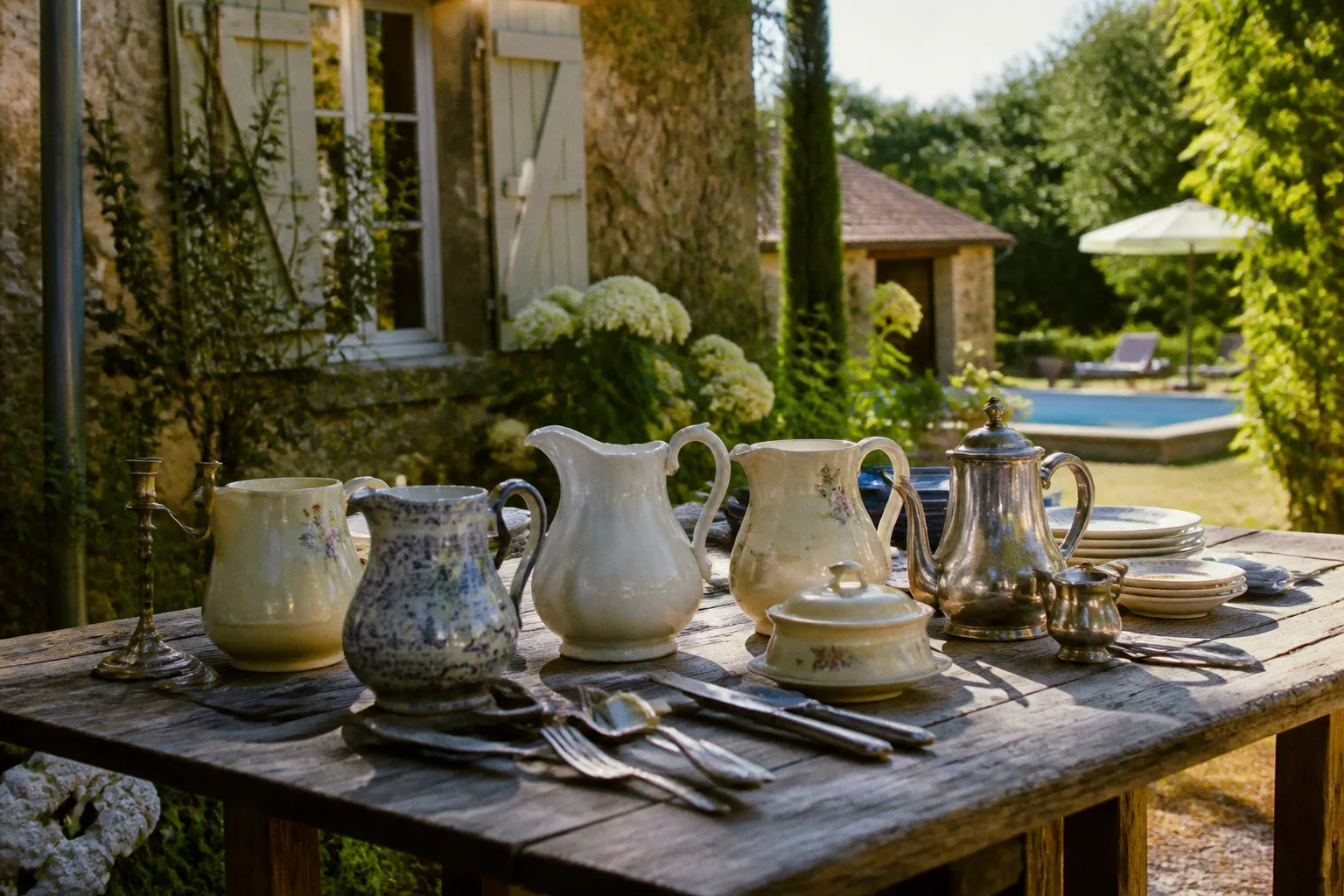
French Antique Sourcing: Brocantes vs Vide-Greniers Guide
A vide-grenier may produce a chipped café bowl, a bundle of old linen, or the exact wooden stool needed for a barn conversion. A brocante may offer better-described furniture, professional advice, and a price that reflects both.
The distinction matters. In French antique shopping, brocante and vide-grenier are not interchangeable terms, even though both may take place under the same village plane trees and both reward patience, cash, and a good eye for proportion. One is primarily a professional market; the other is a private clear-out. If you understand who is selling, you can judge the price, the condition, and the likely history of the object with much greater accuracy.
For anyone buying antiques in France to furnish a Dordogne house, restore a stone property, or bring a little provincial character into a modern home, the most useful question is not simply where to find old things. It is this: what kind of seller and what kind of market will give you the right level of information for the piece you want?
The legal distinction: professional brocanteurs versus private sellers
A brocante is generally organised around professional dealers, known as brocanteurs. These sellers trade in second-hand, vintage, and antique goods as a business. They may operate from a permanent shop, attend travelling markets, or take a stand at a larger organised event. Their stock can range from inexpensive domestic objects to substantial furniture, regional ceramics, architectural salvage, paintings, and collectible pieces.
A vide-grenier, by contrast, is closer to a community-wide attic clearance. The literal sense is a house clear-out: private individuals sell possessions they no longer need. You may find a professional-looking stand among them, but the event itself is built around non-professional sellers offering personal used goods.
That difference does not make one market inherently better. It changes the kind of transaction you are making.
At a vide-grenier, the seller may know only that a cupboard came from a grandparent’s house. They may not know the timber, the age, the original use, or whether a repair is historically meaningful or simply convenient. This can make the market wonderfully open-ended, but it also means that you are buying the object rather than a researched account of the object.
At a brocante, the dealer is more likely to recognise a regional style, identify a butcher’s block from a particular period, or explain whether a painted surface is original, later, or deliberately distressed. That knowledge is part of the price. You are not only paying for the item; you are paying for selection, storage, transport, expertise, and the dealer’s yield on the piece.
A vide-grenier sells you the possibility of a find; a brocante sells you the object with more of its story already attached.
French commercial regulations also make the distinction a practical legal matter. Private individuals who are not registered businesses are restricted to participating in a maximum of two vide-greniers or déballages per year to sell personal used goods. Organisers collect signed attestations from non-professional sellers confirming that they have not exceeded this limit, and those records may be inspected by police or gendarmes.
You will not normally notice this administration while walking around a Sunday market, but it explains why a private seller’s stand is not simply an informal version of a dealer’s business. It is intended for occasional disposal of personal possessions, not continuous commercial trading.
A useful working comparison looks like this:
| Feature | Vide-grenier | Brocante |
|---|---|---|
| Typical seller | Private individual clearing personal possessions | Professional second-hand or antique dealer |
| Product knowledge | Uneven; often limited to family or household history | Usually stronger, though it varies by dealer and speciality |
| Pricing | Often flexible and sometimes modest | More considered, reflecting sourcing, overheads, and expertise |
| Condition information | Buyer usually assesses the piece independently | Dealer may explain repairs, provenance, materials, or use |
| Best for | Small domestic objects, linen, tools, garden pieces, accidental discoveries | Furniture, architectural salvage, regional objects, curated interiors |
| Negotiation | Gentle bargaining is common | Negotiation is possible, especially when buying several pieces |
| Risk | Greater uncertainty about age, repairs, and authenticity | Better context, but professional presentation does not guarantee quality |
The word antique should also be handled with care. At a vide-grenier, a seller may use the word casually, but there is no automatic authentication attached to the label. A supposedly old mirror may be an inherited family item, a twentieth-century reproduction, or simply a mirror with a worn frame. Look at the joinery, wear, surface, hardware, and proportions before you allow a verbal description to set the value.
French flea market types: how the landscape fits together
The French market landscape has several layers, and each suits a different stage of a furnishing or restoration project. When you are sourcing rustic French decor, it helps to think in terms of scale, seller, and search purpose, rather than treating every event as one large flea market.
Vide-greniers: the wide, unpredictable net
Vide-greniers are often the most accessible entry point. They can appear in village centres, school grounds, sports fields, church car parks, and other communal spaces. The atmosphere is mixed: household goods, children’s clothing, old tools, kitchen equipment, books, garden items, and furniture may all sit together without a neat curatorial logic.
That lack of selection is precisely their strength. A dealer has already made decisions about what is worth carrying and displaying. A private seller may put out an object because it no longer fits in the pantry, not because it has market value. This is where the accidental find survives.
For a country house, the strongest vide-grenier purchases are often the items that do not need a grand claim. A stack of mismatched stoneware, a zinc watering can, an old chopping board, a set of iron hooks, a linen tablecloth with darned corners, or a small rush-seated chair can settle naturally into a house. Their usefulness is easier to judge than their age, and usefulness is often the more reliable guide.
The drawback is that you must do more of the work. Check for woodworm, active damp, unstable legs, split boards, missing hardware, unpleasant storage odours, and repairs hidden beneath paint. A small object can be a bargain; a large object can become an expensive transport and conservation project before it reaches your kitchen.
Brocantes: more structure, more interpretation
Brocantes are better suited to buyers who need a particular category or scale. You may be looking for a farmhouse table long enough for a dining room, a pair of shutters for a renovation, a stone trough for a garden, or a chest with the right depth for a narrow corridor. Professional sellers tend to group and present their stock more deliberately, which makes comparison easier.
That structure can also make the market feel less spontaneous. A dealer has often already identified the desirable feature: the regional construction, the unusual patina, the original fittings, or the scarcity of the form. The price will usually reflect that judgement.
This is not a reason to avoid brocantes. It is a reason to ask better questions. If a dealer says a piece is from a certain period or region, ask what features support that assessment. If a cupboard has been restored, ask which parts were replaced and which remain original. If a surface has been stripped, consider whether the current finish will suit your house or whether you are paying a premium for a look you would ultimately soften.
In a restoration project, the distinction between old and appropriate matters. A perfectly genuine piece can still be wrong for the room if its dimensions, storage function, or structural condition do not fit. The best yield from a brocante purchase comes when the object contributes both character and daily use.
Permanent antique shops: slower buying, better concentration
Permanent antique shops, or magasins d’antiquités, are the most useful when you have a defined brief and want to examine pieces without the compression of a one-day market. The dealer may have more specialist knowledge, and the stock may be arranged by period, material, or function.
You will generally have less room for the sort of random low-cost accumulation found at a vide-grenier. But you can spend more time inspecting a chest, cabinet, table, or architectural element properly. This is particularly valuable when the purchase involves weight, joinery, restoration, or transport.
A shop is also a useful place to learn vocabulary. Once you have handled several examples of painted pine, walnut, chestnut, rush seating, forged iron, or regional pottery, your eye becomes more dependable. You begin to notice storage temperature marks on old ceramics, the difference between dry surface wear and recent distressing, and the way a drawer has been made rather than merely how it appears from the front.
Major annual braderies: abundance at a cost
At the largest events, the pleasure comes from scale, but scale changes the rhythm of buying. The Grande Braderie de Lille, held annually on the first weekend of September, is recognised as the largest flea market in Europe, with more than 10,000 sellers and nearly two million visitors. It is an extraordinary example of the French market tradition, but it is not necessarily the most practical destination for every Dordogne furnishing project.
Large braderies reward preparation and stamina. The quantity of stock can be overwhelming, the walking distances substantial, and the competition for desirable pieces intense. They are excellent for understanding the breadth of French second-hand culture, finding unusual objects, and comparing the difference between private clear-out goods and professional stands in the same broad setting.
For a rural interior, however, a smaller regional brocante may produce a better result with less logistical strain. The object still needs to fit through the door, survive the journey, and earn its space in the house. A market’s reputation does not remove those practical constraints.
How to search: use the calendar before you use the car
The outdoor season is strongest from April to October, which gives you a generous but clearly seasonal window for village sales and open-air brocantes. Weather affects both the number of events and the quality of the browsing experience, so a flexible plan is more useful than a single fixed destination.
The common mistake is to search by town alone. A better approach is to search by date, event type, and distance from your base. In rural France, two small markets on the same morning may be more productive than one famous event reached after a long drive. The value lies not just in the number of stalls but in the amount of time you retain for looking carefully.
Dedicated platforms such as vide-greniers.org, Brocabrac, and Agendadesbrocantes.fr are used to locate upcoming vide-greniers and brocantes across France. Printed guides, including L’Agenda des Brocantes, can also be useful when mobile coverage is unreliable or when you are planning several days of travel.
Before leaving, make a short pantry-style plan for the house. This is not a rigid shopping list; it is a set of dimensions and materials that helps you recognise the right piece when it appears.
- Measure the maximum length, depth, and height available for furniture, including doorways, stair turns, and the space needed to open drawers or cupboard doors.
- Decide which materials will sit comfortably with the existing property: chestnut and oak may give a different weight to a room than painted softwood or dark walnut.
- Separate urgent functional needs from decorative wants; a table that must seat eight people has a different buying logic from a small object chosen for a mantelpiece.
- Carry photographs of the room, a tape measure, and a note of the required storage temperature for delicate materials such as wax, old textiles, or certain finishes.
- Leave room in the vehicle for wrapping, and do not assume that a charmingly awkward chair will stack safely beside a stoneware bowl.
This is where sourcing becomes part of country living rather than a hunt for trophies. The piece must enter the household’s working rhythm. A cupboard that stores preserves, a bench that takes muddy boots, or a linen cloth that can withstand regular washing will usually bring more lasting pleasure than an object acquired solely because someone called it rare.
Read the event listing carefully
French event listings may describe a market as a vide-grenier, foire à tout, braderie, or brocante. These terms can overlap in everyday use, but they still give clues about the likely structure.
A vide-grenier or foire à tout usually suggests a broad private clear-out. A brocante may indicate professional dealers, though the exact composition depends on the organiser. A village event can include both, so do not rely on the title alone. Look for details about exhibitors, opening hours, registration, and whether the event is aimed at private sellers, professionals, or both.
If you are searching for architectural salvage or substantial furniture, an event with professional dealers will usually give you a better chance of finding pieces with known dimensions and transport arrangements. If you are looking for small domestic objects, the mixed nature of a vide-grenier may be exactly what you want.
Value, condition, and the logic behind the price
The price of an old object in France is shaped by more than age. At a professional brocante, it may reflect the cost of buying stock, collecting it, cleaning it, storing it, transporting it, repairing it, and displaying it. A vide-grenier seller may price according to personal usefulness, family sentiment, or the simple wish to take the object home again if nobody buys it.
This is why comparing prices across the two market types can be misleading. A table offered by a dealer may be more expensive because it has been selected and made presentable. A similar table at a vide-grenier may be cheaper but require stabilisation, a new finish, replacement hardware, and a vehicle large enough to carry it. The initial price is only one part of the yield.
For furniture, inspect the object in a consistent order:
1. Start with structure. Press gently against corners, test joints, and look for movement in legs, rails, and doors. A little age-related looseness can be repairable; extensive separation or concealed cracking changes the calculation.
2. Study the underside and back. These areas often reveal construction methods, later replacements, fresh timber, modern screws, or signs of previous damp.
3. Look at wear where hands and feet actually work. Drawer pulls, table edges, thresholds, and chair rungs should show wear that makes sense for the claimed age and use.
4. Check for insects and moisture. Small holes are not automatically evidence of active woodworm, but fresh dust, weakened timber, or a musty smell deserves caution.
5. Test function rather than admiring shape. A beautiful cupboard with a warped door may be less useful than a plain one that opens cleanly and offers the storage you need.
6. Ask what has been changed. Repaired does not mean ruined, but you should know whether the repair is sympathetic, structural, decorative, or simply concealed.
For ceramics and glass, inspect rims, handles, foot rings, hairline cracks, and repairs under natural light. For textiles, check the fold lines, stains, fibre strength, and whether the fabric has been stored in a way that has encouraged mildew. Old linen can be robust, but it is not indestructible, and a piece that looks sound on a sunny table may reveal brittle areas after washing.
A dealer’s confidence is useful information, but it is not a substitute for inspection. Likewise, a private seller’s uncertainty does not automatically mean the object is poor. At a vide-grenier, you may be the person who recognises the useful regional form before the seller has considered it valuable.
Buying antiques in France: the etiquette of negotiation
Gentle bargaining is expected at both vide-greniers and brocantes, but the conversation works best when it remains proportionate to the setting. A private seller clearing a family kitchen is not operating a showroom, and a professional dealer is not obliged to treat every object as an emergency sale.
Begin with interest in the piece rather than an immediate challenge to the price. Ask whether the seller knows where it came from, whether there are repairs, and whether the price applies to one item or a group. If you are buying several small pieces, a combined offer is more natural than reducing every item individually.
The strongest reasons for negotiation are practical and visible:
- the piece needs repair that was not reflected in its presentation;
- you are taking several items together;
- you can collect or transport it immediately;
- a pair is incomplete or one item has a defect;
- the object has been displayed for some time and the dealer is willing to adjust the price.
Avoid inventing faults simply to force a reduction. In rural markets, courtesy travels quickly, and a calm, respectful buyer is more likely to hear useful information about another piece in the dealer’s stock. The aim is not to win a performance of bargaining; it is to reach a price that recognises both the object and the work still required.
If you do not speak much French, a few practical phrases help, but tone matters more than perfect grammar. Ask whether the price is firm, whether the seller has other pieces in the same style, and whether the item has been restored. Pointing to a genuine condition issue is clearer than making a vague claim that the price is too high.
There is also a local etiquette around handling. Ask before opening a locked cabinet, moving a fragile arrangement, or lifting a heavy object from the back of a stand. Dealers expect serious buyers to inspect pieces, but they also expect care. At a vide-grenier, where the seller may be unused to commercial transactions, a little explanation prevents awkwardness.
The fairest bargain is usually built on a visible fact: a repair, a group purchase, a transport solution, or a genuine uncertainty about condition.
Regulatory boundaries and high-value purchases
Most visitors will buy objects of modest value, but antique sourcing becomes more complicated when the purchase involves art, precious metals, or a high-value antique. Sales exceeding €5,000, or transactions involving precious metals, art, and high-value antiques, are subject to tax declaration requirements. If a purchase reaches this level, do not treat a casual market conversation as sufficient paperwork.
Ask the professional seller what documentation accompanies the sale and retain receipts, descriptions, and any written details provided. If the item is being exported or transported across borders, the administrative position may require additional advice. The practical point is simple: the more valuable and specialised the object, the less appropriate it is to rely on memory and a handwritten price on a scrap of paper.
False declarations relating to illegal commercial trading at markets can carry serious statutory penalties, including a maximum fine of €30,000 and six months’ imprisonment. This is not something to dramatise during an ordinary Sunday purchase, but it explains the formal registration and seller-attestation systems behind events that may look wonderfully informal from the visitor’s side.
The buyer’s responsibility is more modest but still worthwhile. Know whether you are dealing with a private seller or a professional, be cautious about unverified claims of provenance, and keep a record of substantial purchases. If a piece is important enough to insure, ship, restore, or install permanently into a historic property, it is important enough to document.
When a vide-grenier is the better choice
Choose a vide-grenier when your brief is open and the pleasure lies in discovering useful objects rather than securing a documented antique. These markets are particularly good for:
- everyday kitchenware with signs of genuine use;
- garden tools and simple ironwork;
- old baskets, stools, hooks, and shelves;
- washable linen and practical household textiles;
- small decorative pieces where condition is easy to assess;
- inexpensive experiments in French country style.
The best approach is to arrive with a strong sense of material and function but a relaxed view of period. You do not need every object to be old in the same way. A room often feels more convincing when its contents have accumulated through use, repair, inheritance, and good judgement.
When a brocante or antique shop is the better choice
Choose a brocante or permanent shop when the purchase has structural, financial, or stylistic consequences. This includes:
- a dining table that must fit a specific room;
- a cabinet requiring reliable storage;
- architectural salvage intended for permanent installation;
- a matched pair or a complete set;
- a regional piece whose construction you want explained;
- an object valuable enough to require a receipt and clearer provenance.
A professional setting will not remove the need for your own judgement. It should, however, give you more information with which to make that judgement.
Building a sourcing route for a Dordogne house
For a stay in the Dordogne, antique sourcing works best when it is folded into the week rather than treated as a frantic day of shopping. Start with the function of the property: are you furnishing a rental gîte, restoring a family house, setting up a dining terrace, or looking for small pieces that will travel home easily?
A gîte has a particularly practical yield to consider. Furniture must withstand repeated use, turnover, luggage, children, damp coats, and the occasional glass set down without a coaster. A delicate antique cupboard may be beautiful but unsuitable in a high-traffic corridor. A sturdy bench, a well-made pine dresser, or a group of old stools may provide more of the atmosphere while surviving daily life.
For a private home, the tolerance can be different. You may accept a drawer that sticks slightly, a repaired chair, or a tabletop with old marks because the object will be used more gently and the imperfection is part of its appeal. The correct decision depends on the household, not on a general rule about authenticity.
Plan the route around three levels of commitment:
1. Small, flexible purchases: Begin with vide-greniers for objects that can travel in the car and be assessed quickly. These are low-risk ways to learn local materials and forms.
2. Defined furniture searches: Move to brocantes when you know the dimensions and function of the larger pieces required. Contacting a dealer in advance can save a wasted journey if you need something specific.
3. Specialist or high-value pieces: Use permanent antique shops and established dealers when documentation, restoration advice, or transport is part of the requirement.
This layered approach also protects the household budget. You can spend the early harvest window of the season gathering small, useful pieces while waiting for the right table or cabinet rather than buying a poor substitute simply because the room looks unfinished.
A note on authenticity and atmosphere
French country interiors are often weakened by trying to make every item announce its age. A room with only distressed surfaces, faux-rustic finishes, and objects chosen for visual effect can feel staged even when every purchase was made in France.
Authenticity is usually quieter. It appears in the scale of the furniture, the height of a worktable, the depth of a shelf, the way linen hangs after washing, and the relationship between the house and the garden. A simple market find can feel more truthful than a highly styled object if it performs a real task.
When sourcing, ask whether the object could have lived comfortably in the house. Would the cupboard hold jars, towels, or board games? Would the chair be used without fear? Could the pot remain outside through the season, or does its material require a covered position? These questions connect antique buying to storage temperature, maintenance, and the daily habits of the property.
That is the difference between collecting a look and building an interior. The first can be done in an afternoon. The second depends on repeated, patient decisions.
The practical verdict: which market should you choose?
For unexpected finds and modestly priced household goods, begin with a vide-grenier. You will need to inspect more carefully, ask fewer questions of the seller, and accept that the object’s history may remain uncertain. The reward is a lower-pressure route into French flea market culture and a better chance of finding things no dealer thought worth curating.
For substantial furniture, regional character, and informed discussion, choose a brocante. Expect more structured pricing, but use the dealer’s knowledge actively. Ask about materials, repairs, construction, and collection history, and compare the cost against the work the piece still needs.
For specialist objects, valuable antiques, or restoration-sensitive purchases, use a permanent antique shop or an established professional dealer. Documentation and after-sale clarity become more valuable as the price and consequence of the purchase rise.
And for a large-scale market experience, a major braderie can be memorable, particularly when you are interested in the wider culture of second-hand trading rather than one precise furnishing requirement. Just remember that the largest market is not automatically the most efficient market.
French antique sourcing is not a contest between brocantes and vide-greniers. It is a matter of matching the channel to the object. Go to the private clear-out when you want the possibility of a useful surprise; go to the professional market when you need context; go to the antique shop when the purchase deserves a clearer paper trail.
Before setting out, write down the measurements of the space, the materials that will sit naturally within it, and the repairs you are prepared to undertake. That small preparation sharpens the eye without closing it. You can still follow the unexpected find—but you will know when it has the right yield for your home.