French country gardens: choosing the right landscape style
The hardest decision in French country garden design styles for Dordogne properties is rarely which plants look beautiful in a catalogue.
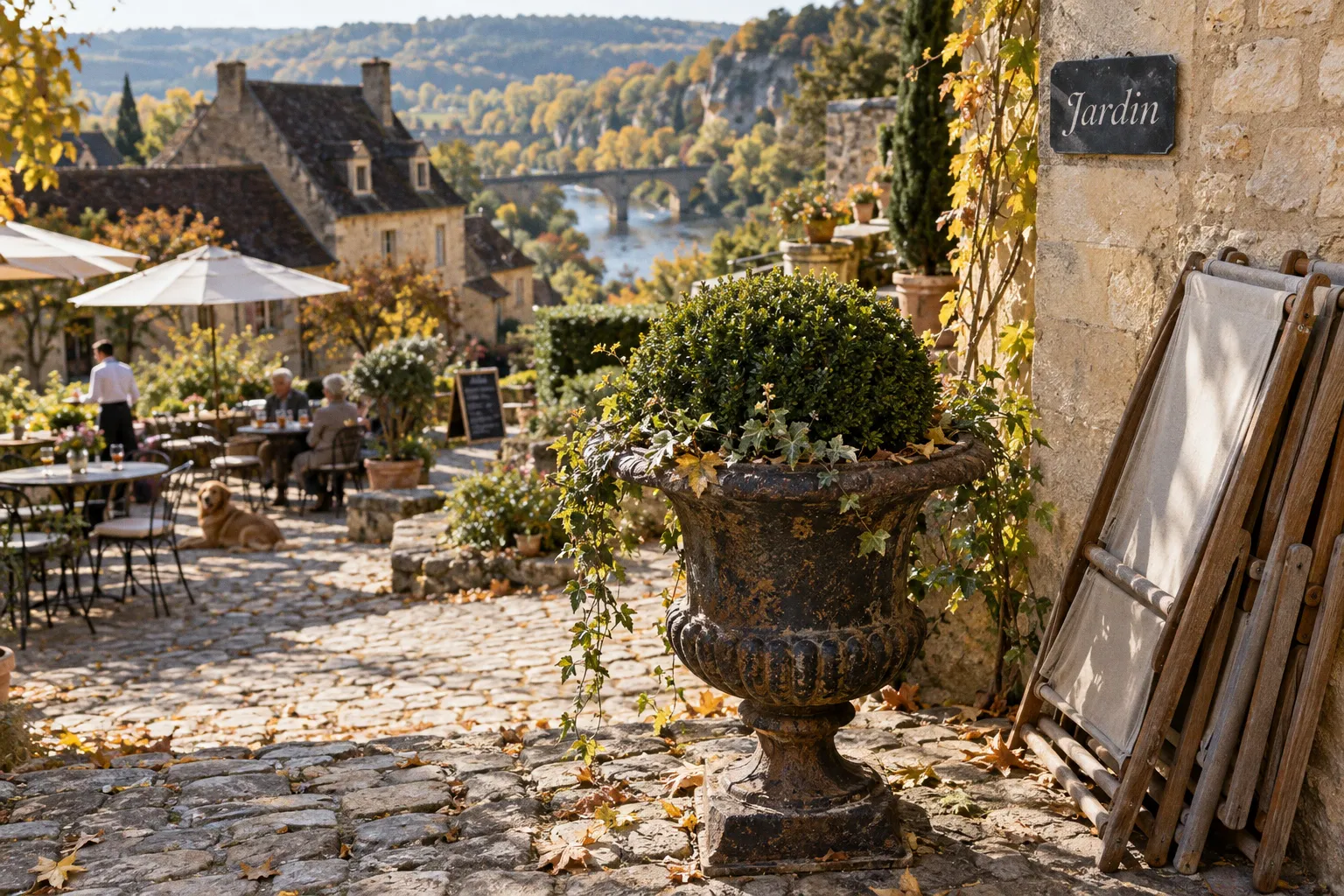
It is deciding how much work the garden should ask of you in July, when the soil is hardening over sandstone, the sun is strong, and a holiday gite may need to look welcoming without requiring daily attention.
A Dordogne garden has to carry several jobs at once. It should belong to the old stone house, offer shade and a place to eat, tolerate hot dry summer periods, and still have enough structure to look composed when guests arrive in spring or autumn. The most successful landscapes do not copy a single French ideal. They borrow the right habits from formal topiary, the traditional Jardin de Curé, Mediterranean gravel gardens and the working potager, then adjust the planting to the property’s soil, exposure and maintenance capacity.
Start with the character of the property, not a garden fashion
French country gardens are often treated as though they have one fixed appearance: clipped box, pale gravel, an urn, perhaps a lavender border and a neatly mown lawn. That arrangement can be handsome, but it is only one part of the regional vocabulary.
In the Dordogne, a garden may be shaped by the geometry of a château, the practical layout of a former farmstead, the enclosed beds of a village presbytery or the dry, stony language of a south-facing terrace. These are not merely decorative differences. Each style carries a different relationship with water, pruning, paths and seasonal yield.
Before choosing a landscape style, look carefully at five conditions:
- The orientation of the house. A south- or west-facing terrace will experience a very different summer from a garden enclosed by mature trees.
- The soil profile. Fertile clay over sandstone can support productive planting, but heavy ground may hold water in winter and become difficult to work once summer dries it.
- The existing shade. Mature walnut, oak or plane trees can determine where guests will actually sit, where herbs will grow and which plants will cope.
- The arrival sequence. A garden seen from a gate or drive needs stronger structure than one discovered gradually from a kitchen door.
- Your harvest window for maintenance. If the property is a holiday rental, pruning, mowing, watering and replanting must fit between bookings rather than depend on daily supervision.
This is why a garden that looks effortless at a Dordogne estate may be the wrong model for a private gite. Large historic gardens have staff, irrigation systems, established hedges and long-term maintenance routines. A smaller property needs a design whose yield is visible from the beginning and whose failures are forgiving.
The right Dordogne garden is not the one with the most French-looking features; it is the one whose structure still works when the owner is away.
The geometry of Périgord: formal gardens with a strong framework
The formal French garden remains the clearest choice when the house has symmetry, a broad façade or a strong approach from the entrance. Its power comes from repetition: clipped lines, framed views, gravel routes and planted shapes that hold their form beyond the flowering season.
Eyrignac et ses Jardins in the Périgord Noir is the regional reference point for this language. Its gardens extend across 10 hectares and use sculpted yew, box, hornbeam and cypress to create a highly maintained topiary landscape. Marqueyssac offers another lesson in structure, with more than 6 km of shaded paths bordered by 150,000 hand-pruned boxwood plants, positioned 130 metres above the Dordogne Valley.
These gardens are valuable not because a private property should reproduce them, but because they show what formal design depends upon:
1. A legible framework. Paths, axes and planted boundaries should be understandable at a glance.
2. Plants that tolerate repeated shaping. Hedges and topiary need species capable of producing dense, reliable growth.
3. A clear maintenance rhythm. Formality is not created by one pruning session; it is preserved through regular attention.
4. A controlled palette. Too many competing plant forms weaken the geometry.
5. A suitable scale. A large clipped hedge may look magnificent beside a manor, but oppressive around a small stone cottage.
For a Dordogne holiday property, formal does not have to mean grand. A compact parterre beside the kitchen, two clipped evergreen masses framing the front door, or a straight gravel walk leading to an orchard can provide the same visual discipline on a much smaller scale.
When formal is the right choice
A structured garden works particularly well when:
- the house has symmetrical windows or a central entrance;
- the property is approached along a long drive;
- the garden is visible from several guest rooms;
- you want the landscape to look ordered outside the main flowering season;
- there is reliable access for pruning and removal of clippings;
- the owners genuinely enjoy, or can budget for, repeated maintenance.
Topiary can also help solve a practical problem: it gives shape to a garden before herbaceous plants are in full growth. For a gite, this matters. Guests may arrive in April, October or during a period when the borders are between displays. Evergreen structure makes the property feel cared for even when the garden is not at peak bloom.
The limitation is equally clear. A formal garden is unforgiving when its edges become untidy. Box, yew or hornbeam may require shaping, and gravel paths need occasional raking and weed control. If the property is occupied only intermittently, use formal planting in smaller, visible areas rather than extending it across the entire grounds.
The Jardin de Curé: productive, intimate and naturally irregular
If formal topiary belongs to the grand approach, the Jardin de Curé belongs to the practical side of French country life. Traditionally associated with a priest’s garden, this layout uses paths in a Greek or Roman cross pattern to divide beds. Those beds can combine vegetables, medicinal herbs and flowers for church decoration.
It is an especially useful model for a smaller Dordogne property because it does not ask the garden to choose between beauty and yield. Rosemary can sit near roses; seasonal vegetables can share space with marigolds or other flowering plants; herbs can be close to the kitchen rather than arranged at the far end of an ornamental border.
The central cross gives the garden order, while the mixed planting keeps it relaxed. This is often a better fit for an old farmhouse, a converted barn or a gite with a modest courtyard than an elaborate parterre would be.
A traditional Dordogne garden feature does not need to be reproduced literally. The important principles are:
- beds that are easy to reach from the paths;
- edible plants placed where they will actually be harvested;
- flowers used for colour, pollination and cutting;
- a modest boundary such as low hedging, timber or stone;
- enough repetition to make the mixture feel intentional.
The Jardin de Curé is also well suited to visitors. Guests understand a garden with a visible purpose: a pot of herbs near the outdoor kitchen, tomatoes or beans in season, a cutting border beside the path. It offers a small experience of rural living without turning the property into a working farm.
Designing the cross without making it look rigid
The classic cross can become overly ceremonial if every bed is the same size and every path is perfectly straight. On a country property, soften the geometry with uneven planting heights, a fruit tree at the centre, reclaimed stone edging or a bench placed slightly off-axis.
The paths do most of the visual work. Gravel is practical and familiar in French country landscaping, but the aggregate should suit the stone of the house. A pale, bright surface beside weathered honey-coloured walls may feel too sharp, while a warmer gravel can settle into the setting more naturally.
The beds should also be sized according to storage and watering. A productive garden that cannot be reached without stepping into the soil will quickly become compacted. Clay soil is especially difficult when wet, and it becomes hard and resistant when dry. Narrower beds, accessible paths and defined planting areas are not fussiness; they are protection for both the soil and the gardener.
Mediterranean influence: the answer to sun, gravel and summer pressure
The Dordogne is not the Mediterranean coast, but its hot, dry summer periods make Mediterranean-influenced design highly relevant, particularly on exposed terraces, slopes and areas beside stone walls. This does not mean filling the garden with plants that belong to a much hotter climate and hoping they will cope. It means borrowing a design language that reduces dependence on a perfect green lawn.
Mediterranean gravel landscaping works through a combination of open ground, strong structural plants, stone, pots and careful placement. It can be especially useful where the soil is thin over rock, where mowing is awkward or where summer watering would otherwise become a constant obligation.
The key is to distinguish between a truly drought-resistant planting scheme and a garden that merely looks dry. Newly planted shrubs and perennials still need establishment care. Even plants that cope well once rooted may require watering during their first seasons, particularly near walls where reflected heat increases stress.
Mediterranean versus formal French garden layout
| Design question | Formal French layout | Mediterranean-influenced layout |
|---|---|---|
| Main visual language | Clipped lines, symmetry and repeated shapes | Gravel, stone, loose planting and sculptural forms |
| Best setting | Symmetrical house fronts, terraces and clear axes | Sunny slopes, courtyards, walls and exposed edges |
| Seasonal strength | Strong structure through winter and between blooms | Good summer performance with texture and open space |
| Maintenance pressure | Regular pruning and edge control | Weed management, establishment watering and selective cutting |
| Relationship with lawn | Lawn may act as a central foil, though summer care can be demanding | Lawn is reduced or replaced by gravel, paving or planted ground |
| Suitable gite use | Formal arrival garden and framed outdoor dining area | Informal seating, hot terraces and low-mowing zones |
For drought-resistant plants for Dordogne gardens, think in terms of placement rather than a universal list. Aromatic herbs, plants with silvery or narrow foliage, and species suited to sunny, free-draining positions can form the backbone of a dry garden. Those same plants may struggle in heavy winter-wet clay, so drainage and exposure matter more than a fashionable plant label.
A gravel garden also needs a weed strategy. Gravel does not eliminate maintenance; it changes it. Weeds often appear where organic matter accumulates, particularly beneath shrubs or along path edges. A properly defined boundary, a sensible depth of aggregate and regular light attention are more useful than the promise of a maintenance-free surface.
Soil, water and the difference between surviving and thriving
Dordogne properties frequently combine fertile clay with sandstone geology, creating a growing environment with real potential but pronounced seasonal contrasts. The same ground may be generous in spring and stubborn in late summer. A garden designed without considering this rhythm will either demand too much water or leave plants sitting in winter moisture they cannot tolerate.
The solution is not to treat every bed in the same way. Divide the property into planting conditions:
Productive clay
Use the more fertile ground for vegetables, fruit, roses and plants that benefit from deeper soil. Improve access rather than repeatedly digging when the soil is wet. Organic matter can help the structure, but the timing of soil work matters; clay should not be worked when it is sticky or waterlogged.
Dry edges and stone walls
These areas heat rapidly and may lose moisture quickly. They suit plants adapted to sun and leaner conditions, provided establishment watering is available. Pots can be useful here because they allow you to position herbs and ornamentals precisely, but they also dry out faster than open ground and need closer attention.
Shaded areas beneath mature trees
Shade is not one condition. Dry shade under established trees is different from cool, moist shade near a wall or water source. Choose the planting according to the actual ground, and resist filling every quiet corner with thirsty lawn.
Paths and access zones
A holiday property needs circulation that remains usable after rain, during dusty summer weather and with outdoor shoes. Gravel, stone or compacted surfaces can define the garden more successfully than a lawn path, especially where guests move between parking, pool, kitchen and terrace.
In Dordogne landscaping, water management is part of the style. A garden that looks relaxed has usually been carefully placed, not simply left alone.
This is where the English-style lawn becomes a poor default. A broad, intensely green lawn may be attractive in a wet spring, but hot dry summers and heavy clay make it demanding to maintain without significant watering. A smaller lawn, edged by gravel or planted beds, often gives a better balance for a private garden or holiday gite.
Structural elements that make a country garden feel finished
Plants are only part of the composition. In the Dordogne, hard materials often carry the visual continuity between the house and the landscape. Gravel paths, stone walls, terracotta, cast iron and timber can make a garden feel established before the planting reaches maturity.
Urns and large containers
Anduze and Medici-style urn planters bring height and punctuation to terraces, entrances and the ends of paths. Use them where their weight and scale make sense: beside a doorway, at a junction, or framing a view. A single well-positioned urn is usually more convincing than a row of decorative containers scattered without purpose.
Containers are also practical for herbs near an outdoor kitchen and for plants that need a more controlled storage temperature during colder periods. That said, pots dry rapidly in summer. Their placement should be chosen with watering access in mind, not just the photograph taken on arrival day.
Gravel
Gravel has a particularly useful role in low-maintenance French garden landscaping because it defines movement while allowing planting to remain informal. It can connect a pool terrace to the house, create a sitting court under a tree or replace awkward strips of lawn.
Choose the path width according to use. A route that only one person can walk comfortably may look charming but becomes inconvenient when guests carry laundry, food or pool equipment. Around dining areas and entrances, a more generous surface will age better and remain easier to sweep.
Wrought iron
A wrought-iron arbor, bench or gate can introduce vertical structure without the visual weight of masonry. It is useful where climbers need support, where a long view needs a stopping point, or where a seating area should feel slightly enclosed.
Keep the metalwork simple. Decorative iron should support the architecture of the property rather than compete with it. In a garden already rich with stone, clipped hedges and pots, one strong iron element is enough.
Stone and reclaimed materials
Local or reclaimed stone can bind a new garden to an old building. Low walls, steps, edging and raised beds can also help resolve changes in level and protect planting from foot traffic. In a barn conversion, this connection is particularly important: the garden should look as though it grew from the building’s practical history, not arrived as a separate design package.
Choosing a style for a holiday gite
Designing a private garden for a holiday gite involves a different calculation from designing a full-time home garden. Guests need comfort immediately, while owners need predictable maintenance between arrivals. The garden should offer discovery, but its most important features must be obvious and robust.
Start with the spaces guests will use most:
1. The arrival area should be clear and reassuring. Use clipped shapes, gravel, pots or a simple planted edge to guide visitors from gate to door.
2. The outdoor dining area needs shade and stable surfaces. A beautiful lawn is less useful than a level table area that remains comfortable in hot weather.
3. The pool route should be easy to read. Avoid delicate borders beside the busiest path, and choose surfaces that do not become difficult to cross barefoot.
4. The kitchen garden should be close enough to interest guests. A small herb bed or a few productive containers are more likely to be used than a remote vegetable plot.
5. The private service areas should be visually screened. Bins, equipment and storage do not need to disappear completely, but they should not dominate the first view of the property.
6. The planting should have several seasons of interest. Evergreen structure, herbs, flowering shrubs and late-season seed heads can prevent the garden from looking empty between peak summer weeks.
A useful approach is to combine styles by zone rather than mixing everything in every border. For example, the entrance may use restrained formal structure, the kitchen side may follow a Jardin de Curé layout, and the sunny pool edge may use gravel and Mediterranean-influenced planting. The result feels coherent when the same materials repeat: one gravel tone, one stone type, a restrained container style and a consistent approach to edging.
Three workable design combinations
Formal entrance, productive courtyard
This suits a symmetrical stone house or a property with a strong front elevation. Use clipped evergreens or hedges to frame arrival, then place herbs, vegetables and flowers in a smaller courtyard near the kitchen.
The advantage is visual order where guests first arrive and useful informality where they spend time. Maintenance is concentrated rather than spread across the property.
Jardin de Curé, with a dry terrace
This is a good fit for a farmhouse or barn conversion with a sheltered central garden. Keep the cross-path structure around mixed beds, then transition toward gravel and sun-loving planting near the terrace or pool.
The change in texture feels natural because the productive beds remain closer to the house, while the driest conditions are handled by a looser landscape.
Formal axis through a natural orchard
If the property has space, a straight gravel path or clipped boundary can create a formal beginning, opening into fruit trees, meadow-like planting or a less managed area beyond. This gives the garden a sense of length without requiring every metre to be intensively maintained.
It is also an honest way to work with the countryside. Not every boundary needs to be turned into a border, and not every view needs to be controlled.
The maintenance promise should be decided before the planting list
The phrase low-maintenance can be misleading. Every garden has a maintenance yield: the amount of beauty, shade, food or privacy it produces in relation to the work required. Formal topiary has a high visual yield but a regular pruning requirement. A gravel garden reduces mowing but still needs weeding and establishment watering. A Jardin de Curé gives herbs and flowers close at hand but needs harvesting, replanting and seasonal clearing.
For a Dordogne property, write down the jobs that must happen during the busiest part of the year:
- watering new planting;
- trimming hedges and topiary;
- mowing and edging;
- clearing paths;
- cutting back herbs and perennials;
- checking pots and containers;
- removing fallen leaves from pool and terrace areas;
- refreshing guest-facing spaces before each arrival.
Then place the most demanding features where they are easiest to reach. A clipped hedge at the entrance can be practical. The same hedge along the furthest boundary may become an expensive obligation. A kitchen garden outside the back door can be productive. One hidden behind an orchard may become neglected.
The best landscape style is therefore not chosen by appearance alone. It is chosen by matching the property’s architecture, soil, sunlight and maintenance window. French country garden design styles for Dordogne properties work when they respect the daily realities underneath the picture: where water is available, how the clay behaves, which path guests will take, and what can genuinely be maintained between stays.
Choose one strong idea for the arrival, one useful idea for the living spaces and one tolerant idea for the wider grounds. Then repeat your materials and let the planting become more generous as it moves away from the house. That approach gives a garden the ease of a lived-in place rather than the brittle perfection of a display—and in the Dordogne, that is usually where the most convincing beauty begins.