French barn rentals: a pre-booking safety checklist
Every luxury Dordogne barn conversion carries a regulatory loadout underneath the restored beams and private pool. Pool safety, fire detection, electrical integrity, and structural geometry are not host preferences.
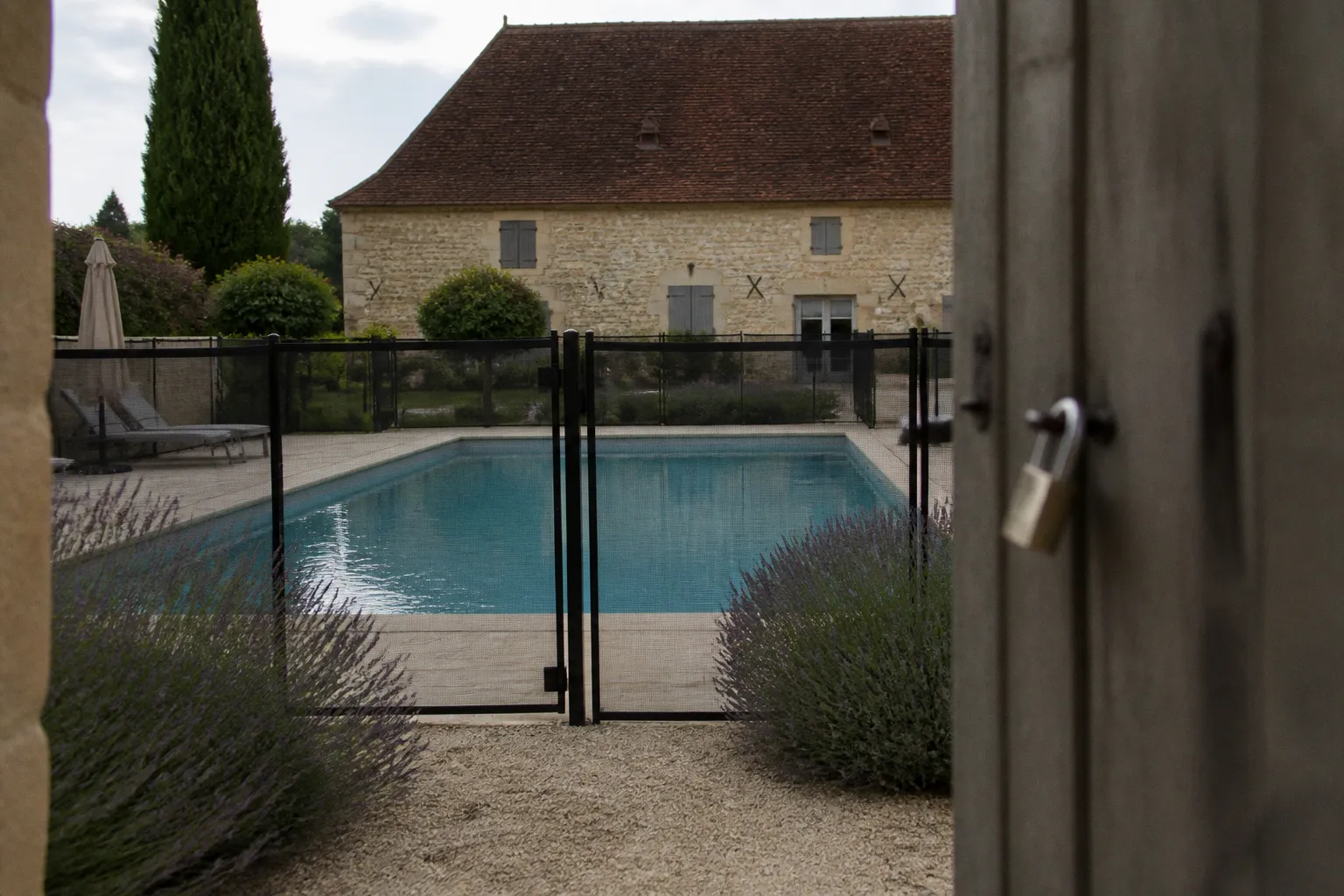
They are codified requirements, and the numbers attached to non-compliance are hard. The ceiling fine for an unprotected pool at a holiday rental runs to €45,000. Smoke detection has been mandatory at every French residential property since March 8, 2015. The electrical diagnostic under the ALUR law has been enforced since January 1, 2018 for installations over 15 years old.
A booking contract that clears without verifying these is a contract signed with the friction points still hidden. This briefing runs the mandatory pre-deployment checklist: what to confirm in writing before the deposit moves, what to inspect on arrival, and which questions separate a prepared host from an unprepared one.
Pool security: clearing the AFNOR terrain
A restored barn with a private pool is the headline draw of nearly every luxury Dordogne rental. It is also the single most heavily regulated feature on the property. Law No. 2003-9, in force since January 1, 2004, applies to every in-ground and semi-inground pool at a seasonal rental. At least one AFNOR-compliant safety device is mandatory. The fine ceiling for non-compliance: €45,000.
French law recognizes four device categories, each anchored to its own AFNOR standard. The owner selects which device to deploy. The booker verifies which one is in place before the deposit moves. Both roles are non-optional.
| AFNOR standard | Device | Function | Verification point |
|---|---|---|---|
| NF P90-306 | Protective barrier | Fixed enclosure around the pool perimeter | Self-closing gate, complete coverage |
| NF P90-307 | Pool alarm | Detects entry or surface displacement | Functional unit, recent battery |
| NF P90-308 | Safety cover / shutter | Mechanical cover rated for child load | Full closure, lock engaged when pool unattended |
| NF P90-309 | Pool enclosure / shelter | Lockable structure over the pool | Self-closing door, functional lock |
The four standards are not interchangeable in practice. A barrier without a self-closing gate is non-compliant. A cover without a working lock is non-compliant. An alarm that fails to trigger is non-compliant. The verification has to land on a specific, working device, not a marketing line in the listing description.
One clarification that cuts through the listing copy: an alarm is a supplementary warning, not a substitute for adult supervision. French safety authorities are explicit on this point. The device detects; the adult watches. A listing that pitches an alarm as the sole line of defense is signalling an unprepared host.
Above-ground removable pools and inflatable pools fall outside the 2003 framework. The moment the pool is dug in or partially buried, the AFNOR requirement applies. Most luxury Dordogne barn conversions sit firmly inside that scope.
On arrival, the verification moves from paperwork to physical. Walk the perimeter. Test the gate. Confirm the alarm powers up. Check the cover or shutter for full closure. The booking-stage conversation sets the record; the on-arrival inspection confirms the device actually works.
The pool is the highest-stakes feature on any French rental listing. €45,000 is the price of skipping the verification call.
Fire detection: DAAF and the ERP threshold
Smoke detection became mandatory across every French residential rental on March 8, 2015. Every gîte, every seasonal let, every short-stay must carry a functioning DAAF — Détecteur Avertisseur Autonome de Fumée. The device must conform to European standard EN 14604 and carry the CE mark. Minimum output: 85 decibels at 3 meters — loud enough to wake a sleeping household through a closed door.
The maintenance line is unambiguous. For holiday and seasonal rentals, the property owner purchases, installs, and maintains the detector, including battery verification. The guest carries no maintenance responsibility under French short-term rental regulations. A booker who arrives to find a chirping unit, a missing unit, or an uncertified unit is looking at a compliance failure, not a housekeeping oversight.
For larger properties, the framework scales up sharply. Any gîte or rental with a total guest capacity above 15 people crosses into the Établissement Recevant du Public (ERP) classification. ERP status brings a heavier requirement set: official evacuation plans, marked emergency exits, accessibility provisions, and direct municipal safety oversight. A 12-person luxury barn operates under the standard rental framework. A 16-person estate venue operates under ERP.
Verification points for the fire sweep:
- At least one functioning DAAF on each sleeping level
- Each device carries EN 14604 and CE marking
- The host can confirm a recent test date
- Batteries fall within the manufacturer's replacement cycle
- For 16+ person properties: ERP documentation, evacuation plan, and exit signage on-site
The DAAF is a small device with a large legal footprint. Verify it on the listing, confirm it on arrival, and one major load drops off the renter's risk profile.
Electrical integrity: the ALUR diagnostic
A converted barn often retains the skeleton of its original electrical installation. The stone walls and exposed beams are the visible feature. The wiring behind them is the hidden one. The ALUR law, enforced since January 1, 2018, requires an electrical diagnostic for French residential properties with installations older than 15 years. The diagnostic assesses circuit safety and identifies shock and fire hazards.
For a luxury barn conversion built or wired before 2010, the 15-year clock has already triggered the requirement. The report is a current-state document — not a guarantee of future safety — but it is the baseline confirmation that a qualified professional has inspected the installation. Without it, the property is non-compliant on paper, and that paper trail is what determines liability if anything goes wrong.
What the diagnostic typically covers:
- Condition of the electrical panel and breaker configuration
- Grounding and bonding across the installation
- Circuit protection across the property
- Wiring condition in accessible areas
- Identification of any shock or ignition risk
What the booker needs to see from the host:
- The diagnostic report dated within a reasonable window
- Confirmation of the installation's age
- Any flagged anomalies and the remediation status
- Coverage of the full installation, not selected circuits
Serious luxury operators have this on file and share it without prompting. Hosts who deflect the question are signalling that the verification was never run. Take the signal seriously.
Structural hazards: mezzanines, balustrades, and converted geometry
Restored barns deliver the dramatic interior — exposed stone, vaulted ceilings, mezzanine sleeping platforms that look out over the living space. The geometry is also the hazard. Children move fast, parents turn away for a moment, and a balustrade that stops at 80 centimeters with bars spaced 15 centimeters apart becomes a fall path.
The recognized safety threshold for mezzanine railings and balcony balustrades at converted gîtes: minimum height of 1 meter, vertical bars spaced no more than 10 centimeters apart. That spacing is calibrated against a small child's head and torso — wider and a child can pass through. Anything lower than 1 meter provides inadequate edge protection.
Geometry does not negotiate with gravity. 1 meter high. 10 centimeters apart. Verify it on the listing photo, then verify it again on arrival.
These are guidelines, not codified law in the same way as pool safety. They are, however, the recognized baseline across the French gîte industry. Any responsible host at a luxury property should meet or exceed them.
The structural sweep covers more than railings. Converted barns introduce specific geometry risks:
- Stair access to mezzanine levels — solid handrail on both sides, even tread depth, consistent riser height
- Original stone walls and beams — no active cracking, no moisture staining, no visible movement
- Balcony or terrace edges — solid parapet, not decorative screening
- Wood burners or fireplaces — installed to current standard, chimney swept within the recommended cycle
- Low eaves at the original truss line — relevant for taller occupants
Luxury does not exempt geometry from gravity. Verify before you sign.
Verifying host documentation and the local layer
The national legal floor — pool devices, DAAF, electrical diagnostic, structural guidance — is uniform across France. Above it sits a local layer that varies by commune and by host. The Attestation de sécurité, where applicable, is filed at the municipal level (Mairie) and depends on individual host documentation and local declarations. Some luxury operators collect these proactively. Others do not.
The booker cannot pull a Mairie file remotely. The booker can run the right conversation with the host before the deposit clears. A serious operator on a luxury Dordogne barn conversion will answer the following without hesitation:
1. Pool — which AFNOR device is installed (NF P90-306, 307, 308, or 309), certification on file, date of last inspection.
2. Smoke detection — number of DAAF units, last battery verification date, EN 14604 confirmation.
3. Electrical — diagnostic report date, installation age, any flagged anomalies.
4. Structural — mezzanine and balcony railing height and bar spacing, particularly for multi-level properties.
5. Heating — wood burner or fireplace condition, chimney sweep schedule where applicable.
6. Insurance — host liability coverage, recommended renter coverage.
A host who answers with documentation and dates is a host who has run the same checklist internally. A host who deflects is signalling that the verification was never performed. The booking decision follows directly from the answer quality.
Ask in writing. Written responses are easier to reference later and create a record of what was confirmed at the booking stage.
Pre-booking gear loadout
Five friction points. Five verifications. Five waypoints between the listing photo and a confirmed deployment.
1. Pool AFNOR device — confirm NF P90-306, 307, 308, or 309. Verify the certification. Inspect on arrival.
2. DAAF smoke detection — EN 14604, CE mark, owner-maintained, functional on arrival, one per sleeping level.
3. Electrical diagnostic — ALUR-compliant report, dated, covering the full installation.
4. Mezzanine geometry — 1 meter railing height, 10 centimeter bar spacing, solid stair access.
5. Host documentation — the six written questions answered before the deposit moves.
Anything unresolved at the booking stage does not get easier at the property stage. The deposit clears, the contract signs, and the responsibility for verification transfers with it. Run the checklist now, or carry the friction later.
Deploy ready.