Limewash paint application: a route to rustic walls
Traditional French limewash paint is not ordinary matte emulsion with a more convincing label.
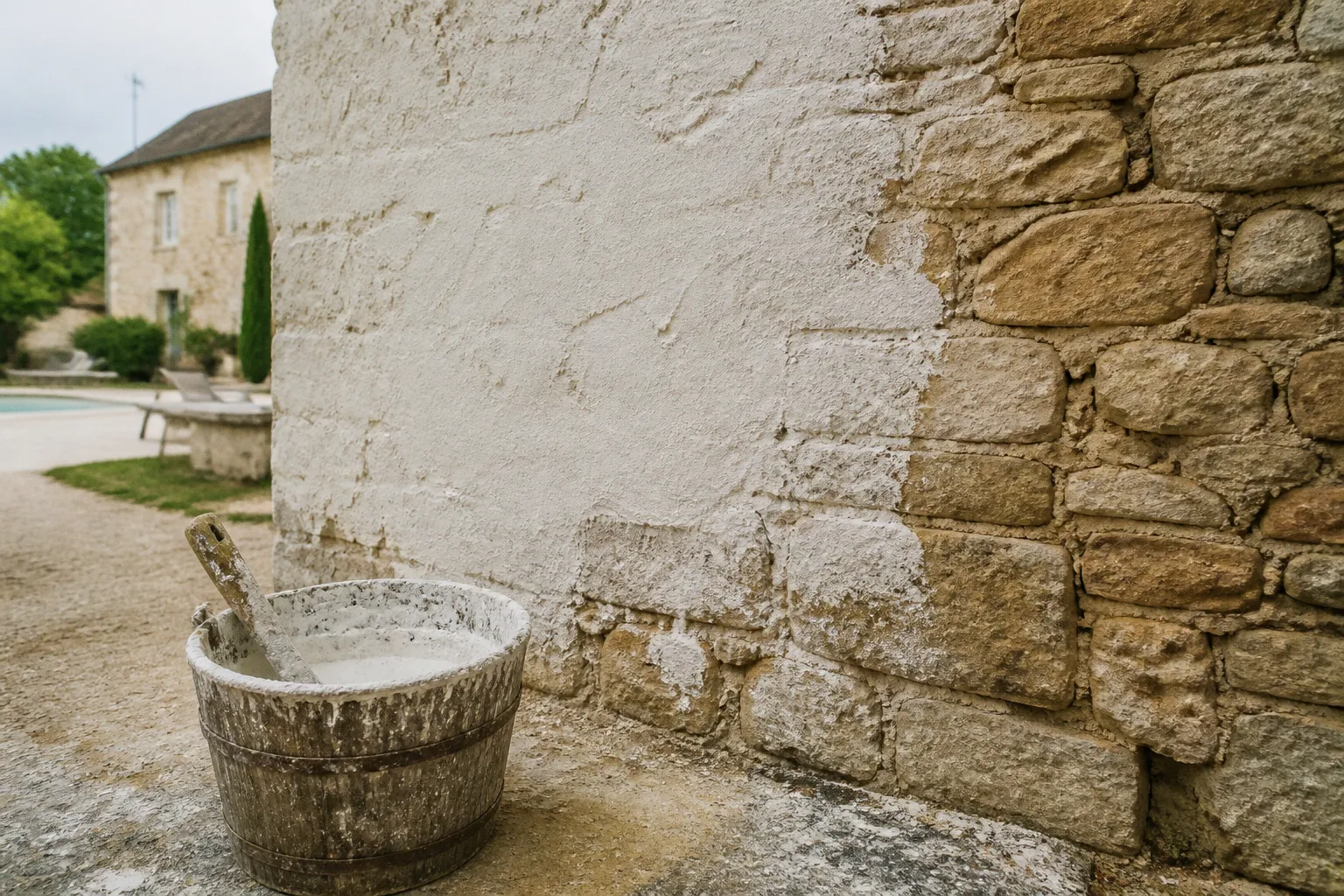
It is a mineral coating that hardens through carbonation, depends on substrate porosity, and can fail within days if the wall is too dry, too cold, too smooth, or badly prepared. The finish associated with old Dordogne houses is therefore a construction result, not a decorative shortcut.
The practical term is badigeon de chaux: a thin suspension of slaked lime or lime putty, water, and usually a mineral pigment. It is applied in several light coats rather than one opaque layer. Wet, it appears darker and more saturated. After curing, it becomes considerably paler and more integrated with the masonry beneath.
That distinction matters in restoration work. Limewash is suitable for lime plaster, unsealed brick, porous limestone, and other mineral surfaces. It is not a universal coating for painted drywall, sealed plaster, or modern gypsum board. On those substrates, adhesion requires a compatible mineral or acrylic primer, and the result is no longer the same as applying limewash directly to traditional masonry.
Limewash does not sit on a wall like plastic paint. It becomes part of the wall’s mineral surface.
The chemistry of carbonation: why limewash breathes
The working material is slaked lime, chemically calcium hydroxide, often sold as hydrated lime or prepared as lime putty. When mixed with water and spread across a porous wall, it begins to absorb carbon dioxide from the atmosphere. Over a period of days or weeks, the calcium hydroxide gradually converts into calcium carbonate, effectively returning to a limestone-like state.
This process is called carbonation. It explains both the strengths and the limitations of traditional French limewash.
A limewashed wall remains vapour-permeable because the coating is mineral rather than polymer-based. Water vapour can move through the finish instead of being trapped behind a dense film. In an old stone building, that is a functional property. Masonry walls often contain residual moisture, seasonal humidity, or minor salt movement. A coating that blocks vapour can force those pressures into the weakest adjacent material: the plaster, mortar joints, or edges around openings.
Limewash also has high alkalinity. Freshly slaked lime can reach a pH of 12 or higher. That assists with sanitation and discourages some organic growth, but it also makes the wet mixture caustic. Gloves and eye protection are not optional accessories. Splashes to the eye are a serious matter, and dust from dry hydrated lime should not be treated as harmless household powder.
The coating remains relatively soft compared with modern masonry paints. This is not necessarily a defect. A soft mineral finish can be renewed with another thin coat, whereas a dense synthetic coating may need mechanical removal before a breathable restoration system can be installed.
Carbonation is affected by the wall and by the room. A porous substrate, moderate humidity, and controlled drying provide better conditions than a heated room with strong cross-ventilation. Rapid drying can leave the surface chalky, weakly bonded, or visibly patchy. During the first two to three days, the fresh limewash should remain lightly moist. This does not mean saturating the wall. It means preventing the surface from losing water before the carbonation process has properly developed.
Formulating a traditional French limewash paint recipe
There is no single historic recipe that applies to every French property. Limewash formulas vary according to the lime product, the absorbency of the wall, the pigment, and the desired opacity. A reliable starting point is a thin mixture rather than a heavy one.
Base proportions
A practical range is:
- One part hydrated lime or lime putty to one part water for a denser first coat on a highly absorbent surface.
- One part lime to two or three parts water for a general-purpose interior limewash.
- One part lime to four parts water for a very thin finishing coat or a more translucent wash.
The correct consistency is closer to milk than to conventional paint. A mix that behaves like emulsion paint is usually too thick. Heavy application produces a fragile surface layer that can crack, powder, or detach as the wall continues to exchange moisture.
The ratio should be adjusted after a test patch. Limestone, lime plaster, and brick do not absorb at the same rate. A wall with open joints may consume the first coat rapidly, while a previously limewashed surface may need a thinner application to avoid building excessive material at corners and texture peaks.
The mixture should be stirred repeatedly during use. Lime and pigment settle. A bucket that looks consistent at the beginning of the morning may produce a noticeably different colour by midday if it has been left undisturbed.
Pigment loading
Natural mineral pigments are the correct family of colourants for this system. Ochres and earth pigments are commonly used because they tolerate the alkaline lime environment and produce the restrained tones associated with French country wall finishes.
Pigment quantity can range from approximately 5% to 20% of the lime weight, depending on the pigment and the required intensity. The upper end is not a default setting. It is a limit to approach cautiously, because excessive pigment can weaken the coating and make colour consistency more difficult.
Wet limewash is deceptive. It normally appears darker and more intense in the bucket and immediately after application. The cured finish is lighter. A colour selected from a wet brush or a digital swatch is therefore not a reliable colour decision.
Pigment should first be dispersed in a small amount of water before being incorporated into the lime mixture. This reduces dry pockets and prevents visible streaking. For a restoration project, retain a sample board showing the dry result, not only the wet mix. Record the lime product, pigment identity, approximate ratio, and number of coats. This is more useful than relying on a paint name such as “old stone” or “farmhouse white”, which has no technical meaning.
Natural binders and fixatives
Traditional additives can improve pigment adhesion and reduce chalkiness, but they do not turn limewash into a modern scrubbable coating.
Possible additives include:
- Alum salt, used as a fixative in some traditional formulations. A commonly cited upper proportion is up to roughly 100 grams per litre, or approximately one part alum to ten parts lime, though the exact quantity depends on the mixture and intended finish.
- Casein, which can improve binding on some mineral surfaces.
- Boiled linseed oil, used sparingly. It is generally capped at around 1% of the total volume because excess oil can reduce vapour permeability and alter the surface appearance.
- Salt, found in some traditional recipes, though its use should be controlled rather than assumed.
Additives are not a substitute for a suitable substrate or correct curing conditions. If limewash is failing because the wall is sealed, dusty, greasy, or too cold, adding more binder usually creates a second problem rather than solving the first.
The formula below is a reasonable test-batch framework, not a claim to reproduce a particular historic mason’s recipe:
| Component | Working range or function | Practical note |
|---|---|---|
| Hydrated lime or lime putty | 1 part | Use a proper slaked-lime product, not agricultural lime |
| Water | 1–4 parts | Increase water for thinner coats and less opacity |
| Natural mineral pigment | 5–20% of lime weight | Add gradually; the dry colour will be lighter |
| Alum | Controlled fixative addition | Use only where the formulation and substrate justify it |
| Boiled linseed oil | Up to 1% by volume | Excess reduces the breathable character of the finish |
| Casein | Natural binder | Useful in selected formulations, not mandatory |
The “authentic” part of limewash is controlled behaviour: thin coats, mineral pigments, porous walls, and patient curing. The colour name alone proves nothing.
Substrate preparation: porosity is the governing variable
The question is not simply how to apply limewash to stone. The first question is whether the stone can receive it.
Traditional limewash adheres properly to porous mineral surfaces, including:
- lime plaster;
- unsealed limestone;
- porous brick;
- mineral render;
- unpainted masonry with open capillaries.
The surface must be sound enough to carry the new coating. Loose dust, friable mortar, powdering old paint, cobwebs, grease, and biological growth will become part of the failure mechanism if they are left in place.
Preparation should be conservative. Aggressive sanding or abrasive blasting can remove the weathered mineral skin of old limestone and damage soft mortar joints. In a historic barn conversion or old gite, the substrate often has more value than the finish. The goal is to remove contamination and loose material without flattening the wall’s original texture.
A practical sequence is:
1. Remove loose and incompatible coatings. Modern gloss paint, vinyl emulsion, and dense masonry coatings may prevent vapour movement. Limewash applied over them can peel in sheets or remain weakly bonded.
2. Brush off dust and friable material. Use a stiff natural or synthetic brush suited to the masonry. Do not polish the wall.
3. Repair open defects with compatible material. Lime mortar or lime plaster is generally more appropriate than hard cement repairs on an old breathable wall. Cement patches create differences in stiffness and vapour movement.
4. Allow repairs to mature. Fresh plaster and mortar contain moisture and may continue to shrink. The wall should not be rushed into decoration.
5. Mist the surface before coating. The wall should be dampened so that it does not extract water from the limewash immediately, but it should not be running wet.
Standard drywall and gypsum plaster require separate treatment. Limewash is chemically and mechanically incompatible with these smooth, low-porosity surfaces unless a suitable mineral-based primer or bonding agent is used. Applying a watery lime mixture directly to ordinary painted drywall and calling the resulting finish traditional is inaccurate.
For interiors, this distinction affects design decisions. A limestone kitchen wall, a lime-plastered bedroom, and a newly boarded ceiling may share a colour palette, but they do not share the same coating specification. The stone wall can receive direct limewash. The gypsum surface needs a prepared base. The finish may be visually related, but the construction is different.
Moisture and salts
Moisture in the wall is not automatically a reason to reject limewash. Breathable finishes are often selected precisely because older masonry needs to release vapour. Persistent liquid damp, however, is a separate building defect. Limewash will not repair leaking gutters, rising damp, failed pointing, or water penetration around a window.
Efflorescence is another warning sign. Salts moving through masonry can disrupt a fresh coat and leave pale deposits. The source of the moisture should be addressed first. Painting over salt activity produces a short-lived visual improvement and a predictable maintenance problem.
The cross-hatch technique and the control of opacity
A traditional limewash application is built through multiple thin coats. The brush matters because the objective is not a perfectly level film. A large masonry brush distributes the suspension into pores and irregularities, while a small brush handles reveals, corners, and junctions.
The usual application method is:
1. Pre-wet the wall with a fine mist. Avoid flooding the surface.
2. Load the brush lightly. Excess material gathers at the bottom of the stroke and creates a visible ridge.
3. Apply a thin first coat. Use cross-hatch or figure-eight movements rather than long, uniform passes.
4. Work in manageable sections. Maintain a wet edge where possible, but do not overwork the limewash once it begins to pull.
5. Allow the coat to cure under controlled conditions.
6. Repeat with further thin coats. The number depends on substrate absorption and the required opacity.
Cross-hatching is functional. It spreads the liquid across an irregular wall from more than one direction and reduces the risk of pronounced brush bands. Figure-eight movements also suit textured masonry because they deposit less material on the highest points than repeated straight strokes.
The wall should not be repeatedly brushed after the mixture starts to dry. That action disturbs the partially carbonated surface and can create drag marks, uneven sheen, and local powdering.
For rustic interiors, variation is acceptable within limits. Some tonal movement is part of the material. Large hard-edged patches, glossy areas, and abrupt overlaps are not rustic character; they are application defects.
A second coat should normally be applied only after the first has had time to stabilise. Exact drying time cannot be assigned without knowing the wall’s porosity, room humidity, temperature, air movement, and coating thickness. A porous French limestone wall in a cool, humid room behaves differently from a thin lime plaster surface beside a radiator.
Managing corners and junctions
Corners are high-risk areas because the brush tends to deposit more material there. The same applies to the edges of recesses, around sockets, above skirting, and at the junction between stone and plaster.
Use less material at these locations and feather the coating into the adjacent field. If a wall meets a timber beam, do not assume the same product should be carried across both surfaces. Timber moves differently, and limewash may chalk or rub away from high-contact areas.
In a furnished rental, footfall and contact patterns also affect durability. A corridor wall, stairwell, and dining room do not receive the same treatment. Limewash is visually effective in low-contact rooms, but hand contact around switches and door reveals will produce a patina faster than on a high wall behind a bed or sideboard.
That is not a reason to eliminate the finish. It is a reason to specify it according to use. A gite presented as a restored rural property should not have a delicate limewashed passageway with no allowance for periodic renewal.
Environmental controls: temperature, humidity, and curing
Limewash needs time to carbonate. The first two to three days are the critical period for preventing rapid drying, particularly on absorbent masonry.
Ambient temperature should remain above 5°C / 41°F during application and early curing. Dark colours require more caution, with a recommended minimum above approximately 8°C / 46°F. Cold conditions slow carbonation. Frost can damage the fresh coating. Direct heat and strong draughts can dry it too quickly.
The working conditions can be summarised as follows:
| Condition | Suitable approach | Failure risk |
|---|---|---|
| Temperature above 8°C | Suitable for most colours, subject to wall condition | Lower risk if drying is controlled |
| Between 5°C and 8°C | Use pale colours and postpone if conditions are unstable | Slow carbonation and weak early film |
| Below 5°C | Do not apply | Frost damage and inadequate curing |
| Strong sunlight or heater nearby | Shade the wall and reduce direct heat | Rapid drying, brush marks, flaking |
| Dry, fast-moving air | Reduce draughts without sealing the room | Surface dries before carbonation develops |
| Moderate humidity | Maintain gentle, stable conditions | Generally favourable for curing |
| Dark pigment load | Use warmer conditions and longer curing control | Uneven colour and slower set |
Light misting during the first two to three days can help maintain the moisture required for carbonation. The wall should remain damp enough to prevent premature drying, not wet enough to wash pigment downward. The correct amount is a matter of observation: if the surface is drying to a dusty powder almost immediately, conditions are too aggressive or the substrate is too absorbent.
Ventilation still matters, particularly indoors. The room should not be sealed indefinitely, but violent air movement is counterproductive. Open windows on opposite sides of a house can produce a wind tunnel effect through a narrow room. That may be useful for drying modern paint. It is not useful for fresh limewash.
Do not plan an application immediately before a cold night, a period of heavy rain affecting exposed masonry, or a property handover that leaves no time for curing. In a rural rental, the schedule has a direct operational consequence. A room may look finished under low evening light and still be vulnerable to rubbing, cleaning, and furniture impact the following morning.
Maintenance, cleaning, and the question of value
Limewash is renewable. This is one of its practical advantages. A worn surface can often receive another compatible coat after cleaning and local preparation. The repair may remain subtly visible because the wall’s absorption and the pigment batch have changed. That is normal for a mineral finish.
It is less suited to aggressive cleaning than a durable acrylic or scrubbable emulsion. High-contact locations should be designed around that limitation. Behind a basin, beside a dining table, or along a narrow stair, a limewashed surface will show use more readily than a hard modern coating.
This becomes a specification issue in luxury self-catering accommodation. The finish must be judged against the operating pattern of the room:
- A bedroom with limited wall contact can carry a soft, low-sheen limewash successfully.
- A reception room with exposed stone and controlled guest traffic is a good candidate for direct limewash.
- A kitchen splash zone requires a different surface strategy unless the limewashed area is protected from water and grease.
- A corridor used by successive groups of guests needs either a robust formulation, a protective design detail, or a maintenance allowance.
- A bathroom wall should not be treated as though it were a dry salon wall. Water exposure and cleaning requirements change the specification.
There is also a visual difference between an aged limewash and a badly maintained one. The former has gradual tonal variation and a coherent relationship with the masonry. The latter has finger marks, stripped patches, splash lines, and abrupt touch-up boundaries. If the property is marketed around restoration quality, those details will be more credible to visitors than a deliberately distressed finish applied over modern plaster.
For those planning a wider French country interior, the wall treatment should be coordinated with the thermal behaviour of the building. Thick stone walls provide thermal mass, moderating temperature swings but also slowing the response of the room to heating. A breathable limewashed surface belongs to that assembly. It is not a decorative film floating independently over the building fabric.
A controlled method for a credible result
A sound application can be reduced to a sequence of physical decisions:
1. Identify the substrate. Establish whether it is lime plaster, stone, brick, gypsum, or a previously painted surface.
2. Confirm porosity. A sealed or glossy wall will not behave like unsealed masonry.
3. Remove contamination and loose coatings. Do not rely on limewash to consolidate a failing base.
4. Repair with compatible mineral materials. Hard cement patches can disrupt an otherwise breathable wall.
5. Prepare a test panel. Let it dry and cure before selecting the final colour.
6. Mix thinly. Begin within the 1:1 to 1:4 lime-to-water range and adjust for absorption.
7. Disperse pigment before adding it. Record the batch proportions.
8. Apply with a dampened brush in cross-hatch or figure-eight strokes.
9. Build opacity through several coats. Do not compensate for a thin mix by laying on one heavy coat.
10. Control the first two to three days. Keep the surface from drying too rapidly and maintain temperatures above the applicable minimum.
11. Assess the cured finish, not the wet one. Colour, chalkiness, and opacity change as carbonation progresses.
Traditional French limewash paint is a viable restoration finish when the wall is mineral, porous, and allowed to cure at a controlled rate. It is a poor choice when the brief requires a hard, washable, uniform film over modern sealed surfaces.
The value verdict is binary. Use limewash where the building fabric can support it and where renewal is part of the maintenance plan. Reject it where the specification demands instant colour accuracy, heavy scrubbing resistance, or concealment of an unresolved damp problem.