Luxury Gite Rental Contracts: Essential Pre-Booking Clauses
A luxury Dordogne rental can look perfectly straightforward until the contract has to answer an awkward question: is this a short seasonal letting, or has the arrangement started to resemble a residential tenancy?
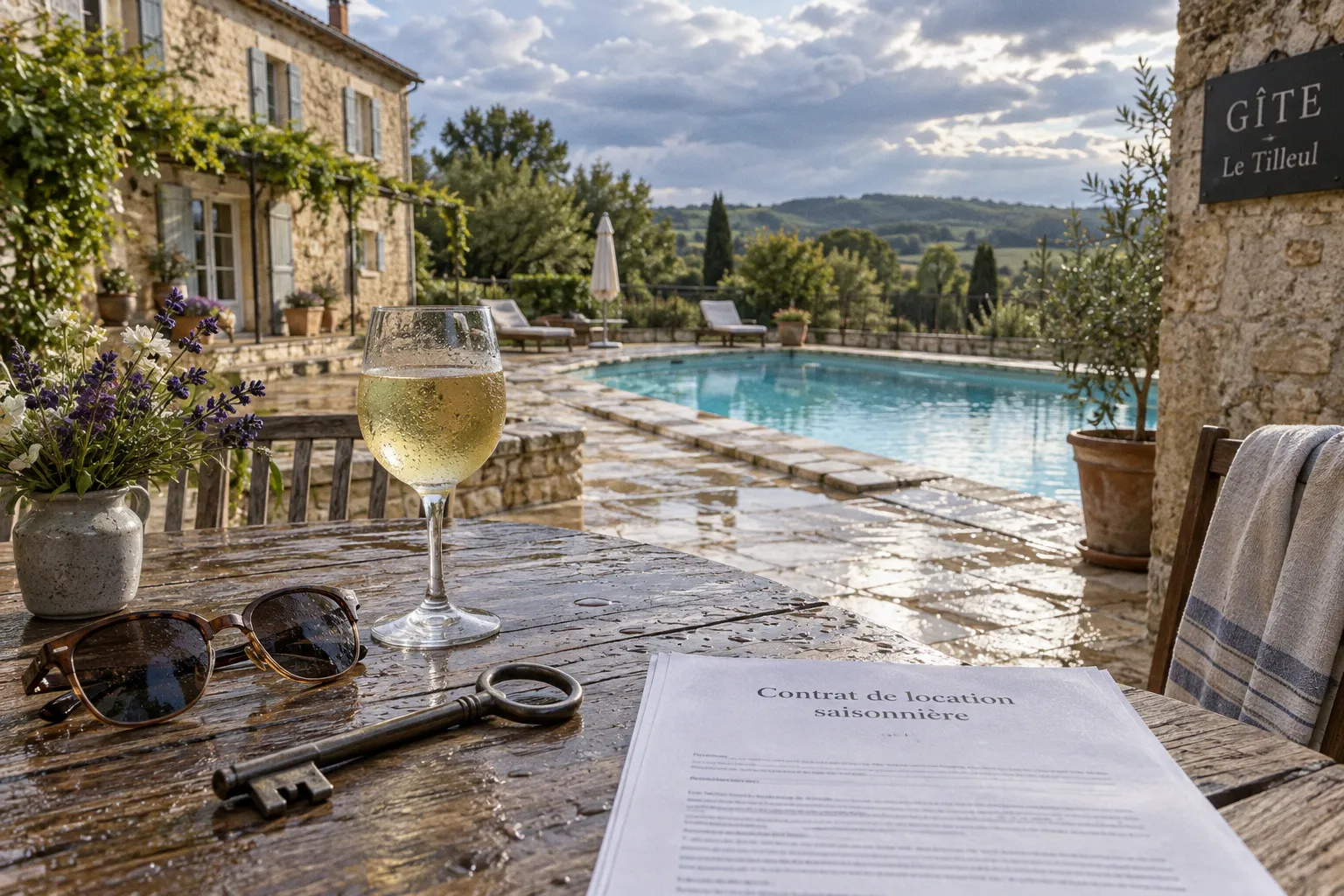
That distinction is not decided by the photographs, the weekly price, or the fact that the property is advertised as a holiday home. It depends on the nature of the accommodation, the purpose of the stay, the wording of the agreement and, in some cases, the length and continuity of the occupation. A booking made for several weeks by a family, a production team or a corporate group may require more careful drafting than a standard Saturday-to-Saturday reservation.
There is also a specific point that should not be blurred: French rules commonly distinguish a meublé de tourisme from other forms of furnished occupation by reference to a stay of no more than 31 consecutive days. That 31-day threshold is important, but it is not a universal switch that answers every legal question by itself. The purpose of the stay, the guest’s situation, the contractual wording and any extension or renewal may still affect which obligations apply.
The contract is therefore not a formality to be signed after the villa has been chosen. It is the document that should explain what has been booked, what is included, what happens when something is damaged, and which rules apply if the stay is cancelled or disputed. A luxury gite rental contract checklist is useful only if it goes beyond the nightly rate and cancellation deadline.
Defining the Legal Framework for Seasonal Rentals in France
A meublé de tourisme is a furnished property offered for short-term occupation by passing guests who do not establish their residence there. It may be a villa, gîte, apartment or other furnished dwelling made available on a daily, weekly or monthly basis, subject to the applicable French rules. Professional letting is not a requirement, and the property is not automatically excluded from being the owner's primary residence.
That point matters in the Dordogne, where the same owner may let a detached house for part of the year, occupy it personally at other times, and use an agency or platform for some bookings. The legal description does not depend simply on whether the owner runs a holiday-letting business. Nor does the word luxury create a separate category of contract. The agreement still needs to identify the property and the basis on which it is being occupied.
A seasonal booking should be distinguished from a conventional residential lease. The parties should not assume that the protections, notice arrangements and obligations associated with a long-term residential tenancy automatically apply to a short holiday stay. Equally, an owner should not try to avoid residential rules merely by placing a holiday-rental label on an arrangement that is, in substance, a longer occupation with a different purpose.
The 31-day threshold, the purpose of the stay and the wording of the agreement
For a furnished tourist rental, the 31-consecutive-day threshold is a material point. A stay of 31 days or fewer will generally fit more naturally within the short-term tourist-rental framework, assuming the other features of the arrangement are consistent with that description. A proposed occupation extending beyond 31 consecutive days deserves closer examination rather than being processed automatically through a standard holiday template.
The threshold should not, however, be treated as the only test. A booking of exactly 31 days may still raise questions if the guest is using the property as a home rather than for a temporary holiday. Conversely, a longer arrangement may involve a particular purpose and contractual structure that require advice on the applicable rules rather than a simple conclusion based on the number of nights. An extension agreed after arrival can also change the practical character of the occupation.
The relevant questions include:
- Is the guest staying temporarily, or is the property being used as a residence?
- Is the booking for a holiday, work assignment, relocation period, renovation project or another purpose?
- Does the guest have exclusive use of a furnished property for a defined period?
- Does the agreement describe a short-term furnished letting, a residential tenancy or something else?
- Does the occupation remain within the 31-consecutive-day period?
- Are there separate arrangements that extend the occupation beyond the dates stated in the original booking?
- Does the guest have another established residence and a clear reason for the temporary stay?
For an ordinary holiday booking, the contract should state the arrival and departure dates, the identity of the contracting parties, the full address of the property and the permitted use. It should also identify the people who may occupy the house. Where an unusual or extended stay is proposed, the owner and guest should obtain advice rather than relying on a standard holiday template.
French law does not make every informal conversation irrelevant, but a written agreement is substantially easier to prove and enforce than a chain of messages or an oral promise. The document should therefore be signed or accepted in a form that records both parties' agreement. Platform terms, agency conditions and the owner's own terms may all be relevant, so the guest should know which document governs if they conflict.
The useful question is not whether a contract looks official. It is whether the written terms accurately describe the property, the stay and the responsibilities accepted by both sides.
A contract for a high-end Dordogne villa should normally include:
- the legal identity and contact details of the owner, agent or management company;
- the property's address and a clear description of the accommodation;
- the booking dates and check-in and check-out arrangements;
- the stated purpose of the stay where it is not an ordinary holiday;
- the total price, taxes and additional charges;
- the payment timetable;
- the security deposit procedure;
- the maximum occupancy and authorised visitors;
- the rules for pets, smoking, events and commercial activity;
- the condition and inventory procedure;
- the cancellation and refund terms;
- the applicable law and dispute-resolution route.
The more expensive or unusual the booking, the less acceptable it is to rely on a generic page of platform conditions. A corporate retreat, family celebration or stay involving outside caterers may need specific provisions that do not appear in the standard template.
Navigating Payment Schedules and Security Deposit Protocols
Payment clauses are where a booking becomes financially real, and where vague language can become expensive. The advance payment that secures the dates is not the same as the security deposit held against damage. They should be separated both in the wording and in the accounting.
An initial payment may be described as a deposit, advance, booking payment or instalment. The contract should explain what happens to it if the guest cancels, if the owner cannot provide the property, or if the parties agree to change the dates. A balance may be due several weeks before arrival, particularly where the owner is turning away other bookings in order to hold a peak-season week. The important point is not that one timetable is universally correct; it is that the dates and consequences are stated before payment.
A guest should be wary of a contract that refers to a non-refundable payment without explaining whether the owner may retain the whole amount, whether a replacement booking changes the position, or whether the guest receives any credit. The same wording can have a very different practical effect depending on the cancellation clause and the circumstances of the loss.
The security deposit is a separate instrument
The security deposit, or caution, is intended to protect the owner against defined losses connected with the stay. It is not an extra part of the rental price and should not be treated as an automatic deduction at checkout.
The contract should state:
- the amount of the deposit;
- whether it is paid by transfer, card pre-authorisation, cheque or another method;
- when it is taken and when it is released;
- what kinds of loss may be deducted;
- whether cleaning beyond the agreed standard is chargeable;
- how the owner will notify the guest of a deduction;
- what evidence may be supplied, such as photographs, invoices or repair estimates;
- how the guest can challenge an amount that appears unjustified.
The form of the deposit matters. A card pre-authorisation is not the same as money transferred into the owner's account. A bank transfer may be harder to recover quickly if the terms are unclear. A cheque may remain unpresented but still represent a substantial commitment. The guest should understand the mechanism before accepting it.
There is no universal return period that applies identically to every luxury gite contract. Some owners can inspect the property immediately; others need to wait for a contractor, a cleaner or a specialist technician. A reasonable agreement should nevertheless set out a clear process rather than allowing the deposit to remain in limbo indefinitely.
The description of the property should also be realistic. A restored stone house containing antique furniture, delicate surfaces, a wine cellar, outdoor equipment and a sophisticated sound system may justify a more substantial deposit than a simply furnished modern villa. That does not give the owner permission to make arbitrary deductions. It makes a detailed inventory more important.
Comparing the main booking routes
The route through which the property is booked changes the practical dispute process, but it does not remove the need to read the underlying terms.
| Booking route | What usually needs close attention | Where a dispute may begin |
|---|---|---|
| Owner-direct booking | Payment instructions, cancellation wording, deposit handling and the owner's identity | Direct correspondence, formal notice or mediation |
| Online travel platform | Platform terms alongside the listing and host conditions, plus automatic payment dates | Platform resolution process and then the applicable legal route |
| Specialist agency | Agency conditions, owner-specific rules, commission structure and responsibility for misdescription | Agency complaint process, mediation where available, or court proceedings |
An agency may be responsible for collecting money but not for every promise made by the owner. A platform may provide a payment system but not guarantee the quality of the property. The contract should make clear who is responsible for answering urgent questions, arranging repairs and returning the deposit.
For anyone comparing Dordogne villa rental security deposit terms, the useful test is simple: could an independent person tell from the document what the deposit is for, what evidence supports a deduction and when the balance will be returned? If not, the clause needs clarification before payment.
A security deposit should protect against identifiable loss, not function as a second, unexplained charge for the holiday.
Managing Occupancy Limits and Liability for High-End Properties
A listing that says a villa “sleeps eight” may describe the number of beds without answering the more important contractual question: how many people may occupy the property, and who counts towards that number?
The agreement should give a clear maximum occupancy and say whether infants and children are included. It should also deal with visitors who are not part of the booking. A family may invite local friends for lunch; a corporate group may bring a caterer; a wedding party may assume that the garden can be used for an evening gathering. None of those uses should be left to implication.
Occupancy limits can be connected to the physical layout of the property, fire-safety arrangements, wastewater capacity, insurance conditions and local restrictions. A guest who adds people without permission may create problems that have nothing to do with the number of beds shown in the advertisement.
The contract should therefore cover:
- the named guests and any permitted substitutions;
- the maximum number of overnight occupants;
- day visitors and the need for prior approval;
- parties, receptions and commercial or promotional activity;
- the use of third-party suppliers;
- parking and access for larger groups;
- pets, including the number and type permitted;
- responsibility for damage caused by guests or invitees.
A particularly useful clause distinguishes ordinary visitors from an event. Ten friends arriving for lunch may create one set of practical issues; a catered celebration with music, hired furniture and outside staff creates another. The owner may need advance information about numbers, timing, parking and insurance. The guest needs to know whether approval is discretionary, subject to a fee, or simply prohibited.
Pool safety: do not reduce compliance to one device
A private pool is one of the attractions of a luxury Dordogne rental, but it is also one of the areas where contracts often become overconfident. French rules for certain private in-ground pools require an approved safety system. A compliant protective barrier is one possible solution, but it is not the only one. Depending on the installation and the applicable requirements, approved systems may include a safety alarm, a pool cover or a shelter.
The contract should not simply state that a particular barrier standard is present and leave the rest unexplained. It should identify the safety equipment installed, indicate how it is to be used and make clear whether the equipment is expected to remain activated or secured when the pool is not supervised. The owner remains responsible for complying with the applicable safety obligations and maintaining the installation. Guests must follow the instructions and supervise children appropriately.
A pool alarm is not a substitute for attentive supervision, and a fence is not a guarantee that a child cannot reach the water if gates are left open. The contract should avoid language that attempts to transfer every aspect of pool safety to the guest. A clause may allocate day-to-day supervision responsibilities without removing the owner's responsibility for the condition and lawful provision of the installation.
The same care is needed for ponds, unfenced drops, play equipment, bicycles, fire pits and steep garden paths. A luxury property may be beautifully presented while still containing ordinary rural hazards. The contract should describe any specific risks that a reasonable guest would not expect from the listing.
Insurance and liability clauses
The owner should have insurance appropriate for the property and its use. A standard home policy may not cover every form of paid short-term letting, and the contract should not imply that the guest is responsible for risks that properly belong to the owner.
The guest's travel insurance may include personal liability, cancellation cover and protection for medical or travel disruption. Those are separate protections. A clause requiring insurance should specify what is actually required and whether proof must be provided. It should not be used as a vague instruction that leaves the guest guessing which exclusions matter.
Indemnity wording deserves particular attention. It may reasonably require the guest to compensate the owner for loss caused by the guest's own breach, negligence or unauthorised use. It should not attempt to exclude responsibility for defects, unsafe equipment, poor maintenance or failures that remain within the owner's control.
A sensible liability clause also explains the guest's duty to report a problem promptly. A leaking appliance, damaged gate or malfunctioning pool system may become more serious if ignored. Reporting it does not automatically mean accepting responsibility. It gives the owner an opportunity to limit the damage and creates a contemporaneous record of what happened.
The Inventory: Evidence, Not a Legal Trapdoor
The inventory is often treated as housekeeping paperwork. In a furnished luxury rental, it is closer to an evidence file.
A useful inventory records the condition of rooms, furniture, appliances, fixtures, outdoor equipment and any items of unusual value. Photographs can be helpful, especially for marks on stone worktops, timber floors, upholstery, pool furniture and decorative objects. A record of meter readings may also be appropriate where utilities are charged separately or where the property has a complex heating system.
The contract should specify:
- whether the inventory is paper, digital or photographic;
- when the guest must report an error or omission;
- who carries out the arrival and departure inspection;
- what happens if the guest arrives outside office hours;
- how pre-existing damage is recorded;
- how a later deduction will be supported.
Failure to complete an inventory does not automatically cancel the guest's claims or make every later dispute impossible. It mainly creates an evidential problem. Without a reliable arrival record, the parties may have to rely on photographs, messages, cleaning reports, witness evidence or the legal presumptions that may apply to the condition of leased premises. That uncertainty can affect both sides.
A guest should photograph obvious damage soon after arrival and send the images through a channel that preserves the date and recipient. An owner should do the same at departure, particularly where a deduction is proposed. The objective is not to create an adversarial ritual. It is to distinguish old wear from new damage before memories and cleaning schedules blur the difference.
The inventory should also distinguish normal wear from damage. A small mark consistent with ordinary use is not necessarily the same as a broken fixture, stained upholstery or missing equipment. If the contract uses a broad phrase such as “all damage,” it should be clarified before signing. Otherwise, a dispute may turn on an undefined standard rather than on the condition of a particular item.
Clarifying Local Taxe de Séjour and Property-Use Obligations
The taxe de séjour is a local visitor tax collected for overnight stays in participating communes or intercommunal areas. It is generally calculated by reference to the number of people and nights, with the applicable amount depending on the local rules and the classification or nature of the accommodation.
The contract should say whether the tax is included in the advertised price, collected separately at booking, added at arrival or handled through the booking platform. A guest should not have to discover an additional charge only after the payment has been made. The document should also explain whether exemptions or special treatment may apply in a particular situation, without suggesting that the owner can decide the amount informally.
In the Dordogne, local administration may vary between areas. A property close to a popular village, a riverside destination or a larger town may fall under different local arrangements from a remote gîte elsewhere in the department. The practical obligation is therefore to identify the relevant local authority and state how the charge is calculated for that booking.
Property-use obligations deserve the same attention. A luxury house is not automatically available for every activity that the architecture appears to accommodate. The contract may restrict:
- smoking inside the property;
- open flames and barbecue use;
- amplified music and quiet hours;
- commercial photography or filming;
- receptions, weddings and private events;
- moving furniture indoors or outdoors;
- use of specialist appliances or equipment;
- access to owners' cupboards, plant rooms or outbuildings;
- disposal of waste and recycling;
- charging electric vehicles or using private equipment.
These rules should be proportionate and intelligible. A guest cannot comply with a condition that has not been disclosed, and an owner cannot reasonably rely on a hidden house rule to justify a substantial charge after departure. If there are local waste-collection arrangements, restricted access roads or limitations on parking, they should be explained before arrival.
Where a property has a pool, tennis court, sauna, gym, bicycles or other facilities, the contract should identify whether use is included in the rental and whether any facility may be closed for maintenance. A photograph of a feature is not necessarily a promise that it will be available without interruption. Equally, a material amenity should not disappear from the booking without a clear remedy.
Standardizing Cancellation Terms and Indemnity Waivers
Cancellation clauses are often written as a sequence of deadlines, but the important issue is the relationship between the deadline, the money paid and the reason for cancellation.
A well-drafted clause should distinguish at least four situations:
1. the guest cancels for personal reasons;
2. the owner cannot provide the property;
3. the property becomes unusable because of serious damage or an essential failure;
4. an event outside either party's reasonable control affects the stay.
The contract should explain whether the result is a refund, a credit, a change of dates, retention of an instalment or a claim for additional loss. It should also say how cancellation must be communicated and when it takes effect. A telephone conversation with a caretaker may not be enough if the formal terms require written notice.
A non-refundable booking is not necessarily a complete answer. The phrase should be read alongside the rest of the contract: what has already been paid, what remains due, whether the owner must try to relet the dates, and what happens if the property is unavailable. The commercial effect may be very different depending on those details.
Guests should also check whether their travel insurance covers cancellation for the reasons that matter to them. Insurance may assist with illness, certain travel disruptions or other defined events, but it does not rewrite the rental contract. The policy wording and exclusions are as important as the headline promise of cancellation cover.
When the owner cannot provide the property
A contract should not discuss only the guest's cancellation. It should set out the owner's obligations if the villa is unavailable, materially misdescribed or affected by damage before arrival.
The remedy may depend on the seriousness of the problem. A failed appliance that can be repaired quickly is not the same as a property made unsafe by fire, flooding, structural damage or loss of essential services. The contract should state who makes urgent decisions, how the guest is notified and whether alternative accommodation is offered or accepted.
Substitution clauses deserve particular scrutiny. An owner may propose another property, but the guest should know whether acceptance is optional, whether the replacement must be comparable and what happens if it is not suitable. A property with a pool, several bathrooms and private grounds should not be replaced silently by accommodation that lacks the features forming the basis of the booking.
Indemnity waivers and unfairly broad exclusions
An indemnity clause can allocate responsibility for a guest's own conduct. It may cover damage caused by unauthorised visitors, misuse of equipment, failure to follow clear instructions or breach of the occupancy rules. That is different from a blanket waiver in which the guest appears to accept every possible risk, including risks created by poor maintenance or unsafe premises.
The wording should be read for what it excludes as well as what it covers. Phrases that attempt to release the owner from liability for any accident, regardless of cause, should prompt questions. So should a clause allowing the owner to make deductions for any loss “at their discretion” without evidence or a process for challenge.
For a high-value booking, the parties may wish to record special arrangements in a signed addendum. This is particularly useful for events, staff accommodation, filming, catering, pets, additional vehicles or equipment brought onto the property. A short tailored clause is usually clearer than forcing an unusual arrangement into a generic paragraph.
The strongest contract is not the one with the longest list of warnings. It is the one that makes unusual uses, financial consequences and responsibility for problems visible before arrival.
What to Resolve Before Paying the Balance
Before the final payment, the guest should be able to answer practical questions without searching through several disconnected documents:
- Who is the contractual landlord or supplier?
- Which terms apply if the platform conditions and the agency conditions differ?
- Is the stay within the 31-consecutive-day tourist-rental framework, and does its purpose create any additional issue?
- What exactly is included in the price?
- Is the taxe de séjour included or charged separately?
- What is the payment schedule and what happens after cancellation?
- How is the security deposit taken, held and returned?
- What is the maximum occupancy, including children and visitors?
- Are parties, catered meals, filming or commercial activity permitted?
- What pool and garden safety equipment is provided?
- How are existing defects recorded?
- Who must be contacted if the property is damaged or an essential facility fails?
- What evidence supports a proposed deduction?
- Which law and dispute process apply?
These are not demands for a contract to predict every inconvenience. They are the minimum points needed to prevent a premium holiday from resting on assumptions. A beautifully renovated gîte may still have an unclear deposit clause; a responsive owner may still be using cancellation terms that do not match the booking platform; an impressive pool may still require written instructions that the listing never mentions.
The best luxury self-catering contract clauses are therefore practical rather than theatrical. They describe the stay accurately, separate the rental price from the security deposit, define the permitted use and preserve a fair route for dealing with damage or cancellation. They also acknowledge the legal significance of the 31-day threshold without pretending that a number alone determines the whole relationship.
For a Dordogne booking, that level of precision is not excessive. It is what allows the owner to protect a valuable property and the guest to enjoy it without discovering, at the least convenient moment, that an important term existed only in somebody's assumption.