Luxury Dordogne gites: pre-booking details to confirm
Before you transfer a deposit for a luxury Dordogne gite — the restored stone barn with the heated pool, vineyard views and cypress-lined drive — a layer of operational detail separates a seamless…
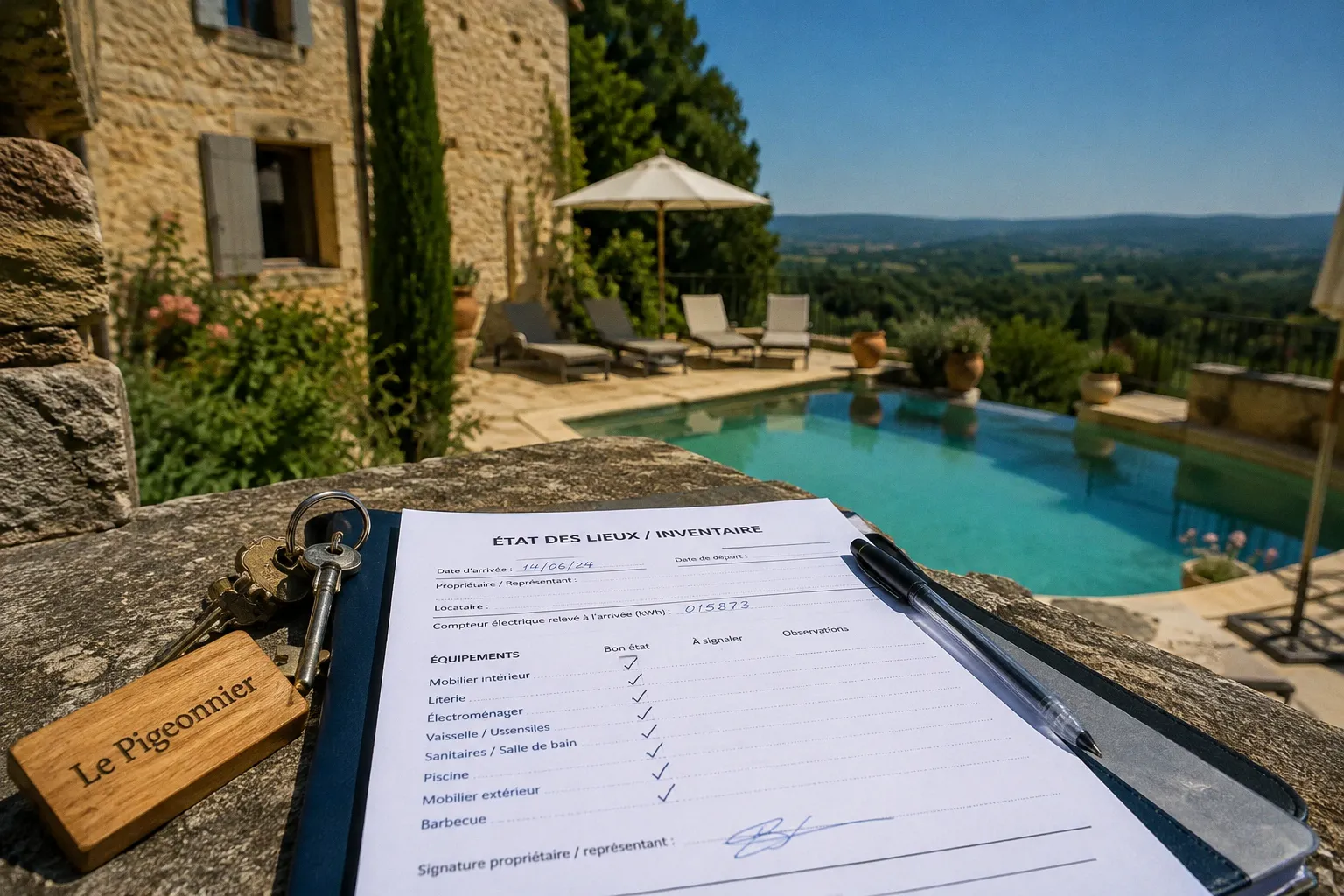
Before you transfer a deposit for a luxury Dordogne gite — the restored stone barn with the heated pool, vineyard views and cypress-lined drive — a layer of operational detail separates a seamless Périgord stay from an expensive argument over a chipped tile, an unexpected energy bill or a tourist tax nobody mentioned at the point of booking.
The brochure sells the setting. The contract defines the stay.
Most travellers concentrate on the photographs, the number of bedrooms and whether the pool looks inviting in late summer. Those things matter, but the friction points in a high-end self-catering rental are usually elsewhere: in the contract wording, the local taxe de séjour, the electricity allowance, the arrival inspection and the instructions hidden under the vague heading of “final cleaning”.
A proper luxury gite rental pre arrival checklist is not bureaucratic overkill. It is how you make sure that the property you have chosen matches the price you are agreeing to pay.
Financial transparency: taxe de séjour and security deposits
Two separate charges deserve attention before you confirm a luxury gite in the Dordogne: the local tourist tax and the security deposit. Neither should be left to an assumption based on the headline weekly rate.
Tourist tax: confirm what the quoted price actually includes
The taxe de séjour is a local levy collected from visitors and passed to the commune or the relevant local authority. Depending on the booking route, it may be collected by the owner, an agency or an online platform.
With a direct booking, it is not necessarily included in the first quote you receive. Ask whether the displayed price includes the tax, and if it does not, ask for the calculation in writing before transferring any money.
Rates can vary according to the accommodation’s official classification and the local authority’s annual decision. The draft figure may therefore differ between two otherwise similar properties in different communes. A classified luxury property in or near a major tourist destination may attract a higher rate than an unclassified or differently classified property in a smaller village.
The practical questions are straightforward:
- What is the rate per adult per night?
- Is it calculated only for the nights actually occupied?
- Which members of the group are exempt?
- Is the amount included in the balance, collected separately on arrival or processed through the booking platform?
- Can the owner provide the calculation for the exact dates and number of guests on the booking?
Children under 18 are generally exempt from the taxe de séjour. That exemption needs to be reflected in the calculation rather than treated as an informal discount. If the booking party includes teenagers, give the ages and ask the host to confirm how they have been counted.
Do not rely on an old quotation copied from a previous season. Municipal rates can change, and the amount shown in an online listing may not be the amount applied to a new reservation.
Security deposits: the amount is only one part of the question
A security deposit, or caution, is normal for a self-catering property, particularly one containing valuable furniture, antique finishes, extensive outdoor equipment or a private pool. The important point is not simply whether the deposit feels high. It is how it is collected, what the owner can deduct from it and when the balance will be returned.
Some properties request a few hundred euros. Larger estates may require €1,000 or more. There is no useful universal figure for a “normal” luxury rental deposit: the property’s own terms control, provided they are made clear before the booking is concluded.
The collection method affects your practical protection:
| Collection method | What to confirm | Main concern |
|---|---|---|
| Card pre-authorisation | When the hold is released and whether it becomes an actual charge | The release may depend on the owner or payment provider completing the checkout process |
| Bank transfer | Exact amount, recipient, refund deadline and currency | A refund can take longer and may involve exchange-rate exposure |
| Cash | Receipt, inspection procedure and refund timing | Without a written receipt, there is a weak record of what was paid |
| Platform payment | Platform rules and the route for contesting a deduction | The owner’s terms and the platform’s dispute process may not be identical |
Ask whether the deposit is returned automatically after the final inspection or only after the owner confirms that there is no damage. Ask also whether the terms allow deductions for cleaning, missing inventory, late departure or utility consumption, or whether those charges are dealt with separately.
A phrase such as “damage will be charged as necessary” is too open-ended to be useful on its own. The contract should explain how damage is assessed, whether photographs or invoices are used, and whether you will be given an opportunity to respond before a deduction is made.
The condition report matters here. A guest who leaves without documenting a pre-existing stain or cracked glass may find it difficult to establish that the problem was present before arrival. Photographs are not a substitute for a signed document, but they create a time-stamped record that can clarify what happened.
The least stressful luxury booking is the one where tax, deposit and possible surcharges are itemised before you sign.
Make the payment trail work for you
Keep the quote, contract, payment confirmation and subsequent email exchanges together. If the booking is arranged by telephone, send a short follow-up email recording the points agreed during the call and ask the owner to confirm them.
This is particularly important where the arrangement is made directly with an individual owner or a small agency. Verbal terms are harder to prove, so request written confirmation in the contract or by email. That applies to a promised early arrival, a waived cleaning charge, a particular pool temperature or an agreement that a pet will be accepted. A friendly conversation may be perfectly genuine, but it is poor evidence once memories differ.
Utility management: understand energy allowances and meter readings
A luxury gite is still a self-catering property, not a hotel with invisible utilities. Heating, cooling and pool equipment can have a noticeable effect on consumption, especially in a large stone house with several bedrooms and multiple bathrooms.
The contract may include a daily electricity allowance and charge for use above that amount. Do not assume that a high rental price means unlimited energy.
Electricity allowances
Many French gite contracts include an allowance of up to 8 kWh per day within the base rate, although the figure varies and some premium properties set a different threshold. Treat 8 kWh as a point to verify, not as an entitlement that applies to every booking.
That allowance may cover ordinary lighting, refrigeration, routine cooking and normal appliance use. It can be exceeded by a combination of air conditioning, electric heating, tumble-drying, repeated oven use, charging equipment and other high-draw appliances.
A long summer stay can create a different pattern from a weekend in May. A party using reversible air conditioning in several bedrooms, running laundry frequently and charging an electric vehicle at the property may consume far more than a couple who opens the windows and uses the kitchen lightly. The relevant question is not whether the allowance sounds generous in isolation; it is whether it fits the way your group will use the house.
Before booking, request the following details:
- The number of kWh included per day or per stay.
- Whether the allowance is calculated by calendar day, night occupied or a fixed period.
- The price per kWh above the allowance.
- Whether the overage is based on the owner’s tariff, a stated rate in the contract or another calculation.
- Whether pool heating, air conditioning, electric vehicle charging or other equipment is excluded from the allowance.
- How the meter reading is taken at arrival and departure.
- Whether guests receive a photograph or written record of both readings.
“Utilities included” is not sufficiently precise if another clause introduces a consumption threshold. Ask the owner to reconcile the two statements in writing.
Meter readings should be part of arrival, not an afterthought
At check-in, photograph the electricity meter clearly enough to show the reading. If the property has more than one meter, record each one. Note the date and, if possible, the time. The same process should be followed at checkout.
The reading should ideally be taken in the presence of the guest and the owner or representative. That is not always possible with a key-safe arrival, so agree in advance how the process will work. A guest who is expected to photograph the meter independently should know where it is, which display is relevant and how the owner will receive the image.
If the owner sends an energy charge after departure, the calculation should show:
1. The opening reading.
2. The closing reading.
3. The total consumption.
4. The allowance deducted.
5. The rate applied to the balance.
6. Any separate equipment charge included in the invoice.
A consumption charge that cannot be connected to identifiable readings is difficult to evaluate. It is reasonable to ask for the calculation rather than accepting a rounded figure.
Water, gas, internet and other services
Water and Wi-Fi are often included, but “often” is not the same as “always”. Older rural properties may use a private water supply, a septic system or a heating arrangement that requires specific instructions. These details do not necessarily indicate a problem; they indicate that the owner needs to explain how the house operates.
Ask whether:
- Gas bottles or heating fuel are included.
- The septic system places restrictions on cleaning products or toilet use.
- Water pressure varies when several bathrooms operate at once.
- Wi-Fi reaches all bedrooms and outdoor areas where guests are likely to work.
- A power cut or internet failure is handled by the owner, a supplier or the guest.
The purpose is not to interrogate the property. It is to avoid discovering its operating rules when the dishwasher is full, the pool pump is showing an alert and the nearest shop is closed.
The état des lieux: master the property condition inspection
The état des lieux is the formal record of the property’s condition and inventory. It is one of the most useful documents in a deposit dispute, but only if it is completed carefully and reflects the actual state of the house.
What should be recorded
The inspection should cover more than whether the front door opens. It should identify the condition of rooms, furniture, appliances, equipment and exterior areas. In a restored Dordogne property, that may include delicate stone surfaces, old timber, terracotta floors, exposed beams, antique pieces and original shutters that show ordinary signs of age.
A detailed inventory may include:
- Kitchen equipment, cookware and serving pieces.
- The number and condition of glasses, plates, cutlery and utensils.
- Bed linen, bath towels and pool towels.
- Outdoor chairs, loungers, parasols and cushions.
- Barbecue equipment and cleaning tools.
- Keys, remotes, fans, heaters and appliance controls.
- Pool equipment and safety devices.
- Existing marks, chips, stains, cracks and worn upholstery.
The document should distinguish between normal wear and damage attributed to the current stay. A faded cushion, a minor mark on an old table and a freshly broken item are not the same thing. If the inventory uses broad language such as “all equipment in good condition”, ask for an amendment where something is visibly worn or incomplete.
The owner or representative should conduct the inspection with you at both check-in and check-out where practical. Both sides should sign the record, and you should receive a copy. If the arrival is self-service, ask when and how the inspection will be completed.
A disciplined arrival inspection
You do not need to turn the first hour of a holiday into a forensic exercise. You do need a method.
Start with a walk through the property before unpacking. Photograph each room from the doorway, then take closer images of anything that could later be disputed. Include marks on walls and floors, stains on upholstery, chipped crockery, damaged garden furniture and the condition of the pool area.
Daylight is useful. Hairline cracks, faint water marks and scuffs on pale stone can disappear under warm interior lighting. If you arrive after dark, record what you can and ask for a second inspection in daylight.
Photographs should be stored somewhere other than the phone on which they were taken. Upload them or send them to yourself so that they retain a clear date and are not lost if the device fails.
Then compare the physical inventory with the written one. Count the items that matter rather than assuming that a large kitchen automatically contains everything needed for a large group. A property may have eight dining chairs but only six wine glasses, or a barbecue but no usable utensils. Those are not necessarily deal-breakers, but they are worth documenting before the first meal.
Check practical systems while the representative is present:
- How the oven, hob, dishwasher and washing machine operate.
- Where the electrical consumer unit is located.
- Which doors or shutters should be locked at night.
- How to control air conditioning or heating.
- Where rubbish and recycling are taken.
- How the pool cover, alarm or barrier works.
- Whom to contact if a pump, appliance or access system fails.
If the host does not provide a formal état des lieux at check-in, create a written record yourself and send it promptly by email. List the problem, attach the photograph and ask the owner to acknowledge receipt. A silent assumption that “they already know about it” is less useful than a short written notification.
The same principle applies to a defect discovered during the stay. Report it as soon as possible. A cracked glass identified on the first evening is a different matter from an empty cupboard discovered after a week, when nobody can easily establish when the problem arose.
A condition report is not an accusation. It is a shared record of where the property and its inventory stood when the stay began.
Checkout is a second inspection
Departure morning is usually rushed, but it is precisely when the condition record becomes important. Allow time to return furniture, gather keys, check cupboards and photograph the meter. If the owner or manager is present, complete the checkout inspection together and keep a copy of any signed document.
Do not leave a pile of rubbish, used linen or pool equipment in an arrangement that could be mistaken for damage or non-compliance. Equally, do not accept a new charge without asking what condition or contractual obligation it relates to.
Pool protocols and seasonal heating surcharges
The private pool is often the reason guests choose a luxury Dordogne gite. It is also the feature most likely to create a mismatch between expectation and reality.
A photograph cannot tell you whether the pool is heated, whether the heating is running during your dates, whether the cover must be used overnight or whether children can access the water directly from the terrace. Those details belong in the booking conversation.
Pool heating: temperature, timing and price
Pool heating is commonly treated as a separate service, particularly outside the main summer period. For stays in May, June, September or October, a host may offer heating for an additional daily charge, a minimum activation period or a flat seasonal fee.
The key is to distinguish “the pool can be heated” from “the pool will be heated for your booking”. Confirm:
- Whether heating is available on your exact dates.
- When the system will be switched on.
- The target water temperature.
- Whether the target is guaranteed, indicative or affected by weather.
- The charge structure: daily, weekly, flat-rate or consumption-based.
- Whether there is a minimum number of days.
- Whether the pool cover must remain in place when the pool is not in use.
- What happens if the heating system fails.
The heating technology also matters. A heat pump, solar cover, electric system and gas-fired arrangement do not deliver warmth in the same way or at the same speed. You do not need an engineering report, but you do need a realistic description. “Heated pool” should not be allowed to carry an imagined temperature in your head.
A pool that feels comfortable in July may be too cold for small children in May. Conversely, a host may not activate the system automatically in a shoulder month unless the request and surcharge were agreed before arrival.
Safety arrangements
French rules require appropriate safety arrangements for private pools accessible to paying guests. Common systems include a protective barrier with a self-closing gate, an immersion or perimeter alarm, a safety cover or an enclosed shelter.
Ask which system is installed and how it is used. A safety device that guests do not know how to activate is not much help on the first evening. Request a demonstration at arrival, including the procedure for replacing the cover, resetting the alarm and securing the gate.
This is especially important when the pool is close to the house, when the terrace has several access points or when the property is marketed to families. Pool safety does not remove the need for supervision, but it should form part of the property’s normal operating instructions.
Confirm also whether:
- The pool is private or shared.
- There are set opening and closing times.
- The pool is inspected during the stay.
- A pool technician may enter the grounds and on which days.
- Pool towels are supplied.
- Diving, inflatables, glassware or night swimming are restricted.
- The pool remains open if the heating system is unavailable.
The best questions to ask French gite owners are not dramatic ones. They are precise: who comes to maintain the pool, what notice will they give, and which part of the cost is already included in the booking?
Defining expectations for cleaning and house inventory
“Cleaning included” sounds reassuring until you discover that it means only professional cleaning after departure, while the guest is still expected to empty the fridge, clean the barbecue and leave the kitchen ready for the cleaner.
That arrangement may be perfectly reasonable. The problem is the lack of definition.
What the cleaning fee may cover
A standard end-of-stay service may include cleaning floors and bathrooms, changing or laundering linen, sanitising the kitchen and preparing the property for the next guests. It may not include the work associated with an unusually untidy departure, a neglected barbecue, excessive rubbish or furniture moved between rooms.
Ask what the final cleaning fee covers and what remains the guest’s responsibility. If the property is marketed as a full-service or hotel-style rental, identify exactly what that package adds.
Possible extras include:
- Mid-stay cleaning.
- A linen or towel change.
- Grocery pre-stocking.
- Fresh flowers or welcome arrangements.
- Private chef or catering support.
- Additional poolside service.
- Laundry during the stay.
- A departure clean that includes the kitchen and barbecue without guest preparation.
These services are valuable when they match the way you plan to use the house. They are less valuable when the listing suggests a hotel service but the contract quietly transfers routine departure work back to the guest.
The house inventory is part of the experience
The French holiday villa amenities checklist should cover more than the glamorous elements. A wine cellar, outdoor kitchen and designer loungers will not compensate for a kitchen that lacks enough pans for the number of guests or a dining table without sufficient chairs.
Before committing, ask whether the following are supplied and in what quantity:
- Bed linen and bath towels.
- Pool towels.
- Hairdryers.
- A coffee machine and the type of capsules or filters required.
- Basic cooking equipment.
- Food storage containers.
- A washing machine and drying facilities.
- A cot, high chair or stair gate if needed.
- Outdoor lighting.
- Barbecue fuel or charcoal.
- Cleaning products and bin bags.
- Wi-Fi access instructions.
- Fans or air conditioning in the bedrooms.
Do not interpret the absence of an item as a failure. Some owners expect guests to bring specialist equipment, and some properties deliberately keep the kitchen simple. The useful point is to find out before arrival, when a local shop may be a long drive away and Sunday opening hours are limited.
What guests may be expected to do
A normal departure list may ask guests to:
- Strip used beds and place linen in a specified location.
- Run or empty the dishwasher.
- Remove food from the fridge.
- Take rubbish and recycling to the designated containers.
- Wipe kitchen surfaces and the hob.
- Clean the barbecue after use.
- Return furniture and pool loungers to their original positions.
- Close shutters, windows and gates.
- Leave keys, remotes and access fobs as instructed.
The exact list should appear in the house rules or booking terms. If the contract imposes a cleaning fee and a lengthy guest-cleaning requirement, ask the owner to explain how the two responsibilities fit together.
Local recycling instructions also deserve attention. Sorting arrangements vary, and rural properties may use communal containers rather than a collection directly outside the house. A quick explanation at check-in prevents a full bin being left in the wrong place and later treated as a chargeable departure problem.
The booking details to confirm before money moves
The most useful dordogne gite booking details to confirm are the ones that affect either the final price or your ability to use the property as expected. Keep the questions in one email or ask the owner to incorporate the answers into the contract.
Confirm:
1. The taxe de séjour. Ask for the rate per adult per night, the treatment of under-18s, the calculation for your dates and the collection method.
2. The security deposit. Record the amount, payment method, possible deductions and expected refund process.
3. Electricity and other utilities. Establish the included allowance, overage rate, meter-reading procedure and any excluded equipment.
4. The état des lieux. Confirm that the arrival and departure condition checks will be completed, signed and shared with you.
5. Pool heating. Pin down availability, target temperature, activation dates, price and the consequences of a system failure.
6. Pool safety. Ask which protective device is installed and request a demonstration on arrival.
7. Cleaning. Separate the professional cleaning service from the tasks expected of guests, including the barbecue, rubbish and kitchen.
8. House inventory. Check linen, towels, kitchen equipment, outdoor furniture, Wi-Fi and any child equipment required by your group.
9. Arrival and departure times. If your flight or drive does not fit the standard window, agree an alternative in writing rather than relying on a message sent casually.
10. Local operating rules. Ask about rubbish, recycling, quiet hours, septic systems, parking and access for pool or garden maintenance.
11. Communication during the stay. Obtain a phone number or message route for urgent problems and establish who is responsible for repairs.
12. Written confirmation. Make sure significant promises made during a call or viewing are captured in the contract or confirmed by email.
A verbal agreement is not automatically meaningless, but it is harder to prove when the parties remember it differently. Written confirmation is the sensible protection, particularly for anything involving money, equipment, access or a change to the standard terms.
The aim is not to make a host defend every adjective in the listing. It is to turn imprecise promises into usable information. “Pool available” becomes pool availability on your dates. “Utilities included” becomes a stated allowance and overage rate. “Cleaning provided” becomes a clear division of responsibility. That is the difference between reading a description and understanding a rental.
Lock the contract before you lock the rental car.
The Dordogne delivers much of what the photographs promise: Périgord light, stone villages, river valleys, market mornings and long evenings around an outdoor table. A luxury gite can make those elements feel effortless, but only when the practical layer has been handled with the same care as the restoration.
Check the charges before the deposit. Record the condition before unpacking. Confirm the pool before assuming it will be warm. Clarify the cleaning before departure morning. These are small pieces of preparation, but they protect the part of the holiday that matters most: arriving at a house that matches both the photographs and the invoice.