Dordogne Gite Styles: Farmhouse, Manoir, or Restored Barn
When you are choosing a Dordogne holiday home, the first decision is rarely the swimming pool.
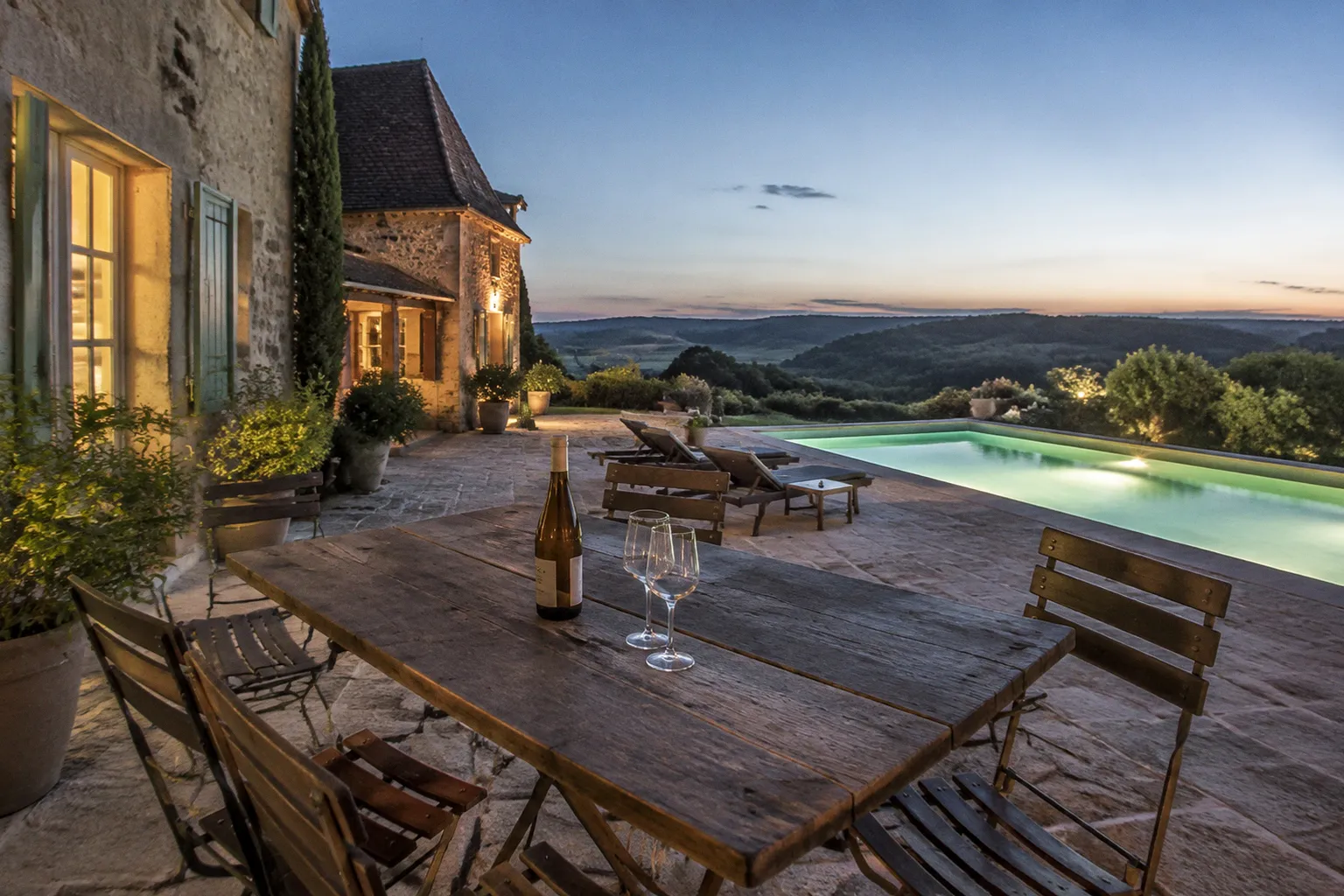
Most luxury rentals now offer some version of the outdoor life: a private heated pool, a shaded dining terrace, perhaps an outdoor kitchen for long lunches that begin with market tomatoes and end well after the cheese has softened.
The more useful question is architectural: do you want the formal rooms and period weight of a manoir, the practical warmth of a traditional farmhouse, or the generous volume of a converted barn? These are the principal luxury Dordogne rental property types, and each creates a noticeably different holiday, even when the bedroom count, pool dimensions, and standard of finish look similar online.
A manoir may suit a gathering built around shared meals and old stone character. A farmhouse often works beautifully for families who want several outdoor corners, easy movement between kitchen and garden, and a sense of local craftsmanship. A restored barn can be the right yield for a mixed-age group that needs open space, games, high ceilings, and a less formal rhythm.
The best choice is not the property with the most impressive photograph. It is the one whose rooms, storage temperature, shaded areas, and daily circulation match the way your group actually lives.
The historic manoir: grandeur with a practical heartbeat
Many Dordogne manoirs date from the 17th or 18th century. They are not necessarily castles, and the distinction matters: a manoir is generally a substantial historic country house, often built for a gentleman’s household, with a scale and finish that go beyond an ordinary rural dwelling.
The visual language is immediately recognisable. You may find exposed oak beams, grand fireplaces, thick stone walls, stone sinks known as lavebos, tall windows, and a sequence of rooms rather than one uninterrupted living space. The architecture has a natural formality, even when the interiors have been carefully modernised.
That formality can be a great pleasure, particularly for a group that enjoys gathering at a long table, dressing for dinner occasionally, and making the house itself part of the holiday. It also brings practical questions that are easy to overlook in a listing description.
A historic house may have several staircases, changes in floor level, thick walls that affect mobile signal, and bedrooms distributed across different wings or floors. None of these features is a flaw. They are simply part of the yield of choosing a building with genuine age. A manoir gives you atmosphere and spatial separation, but it may not give every guest the same degree of convenience.
What a manoir does especially well
- Creates a strong sense of place. Period beams, fireplaces, stonework, and original fittings make the property feel rooted in the Périgord rather than interchangeable with a luxury villa elsewhere in Europe.
- Handles larger gatherings with confidence. Historic manoirs often offer high-capacity accommodation, with some large country houses sleeping between 12 and 34 guests.
- Separates social and quiet time. Multiple reception rooms allow one part of the group to play cards, read, or prepare food while another group is outside or around the pool.
- Makes long meals feel natural. A substantial dining room or formal kitchen-dining arrangement gives structure to market produce, local wine, and the slow preparation of a shared meal.
- Works well for milestone holidays. Several households can share the house without everyone needing to follow the same timetable.
The potential drawback is that the house may ask more of you. A grand fireplace is beautiful, but it is not necessarily the place to put a television or a child’s board game. A stone sink may be a wonderful period detail, but modern food preparation will usually take place in a newer kitchen nearby. The pleasure comes from the conversation between old and new, not from expecting the historic fabric to behave like a newly built holiday villa.
A manoir gives a group room to gather without requiring everyone to live at the same pace.
For families with young children, look closely at the relationship between bedrooms, bathrooms, the kitchen, and the pool terrace. If the pool is visible from the main living areas, supervision may be easier. If the house is arranged across several levels, the adults may gain welcome privacy while younger children require more deliberate boundaries.
The same applies to older guests. A first-floor bedroom with a private staircase may be perfectly comfortable for one person and unhelpful for another. In a historic property, the floor plan deserves as much attention as the photographs.
The traditional farmhouse: rustic character with the easiest daily rhythm
The classic Dordogne farmhouse is usually less ceremonious than a manoir and often more immediately practical for a family holiday. Traditional farmhouses and restored rural houses commonly use rough-hewn stone, Périgord limestone, clay tiles, lime plaster, and oak timber structures. Their beauty tends to sit in the materials and proportions rather than in grand scale.
A farmhouse often has a lower, more connected relationship with the garden. Kitchens open towards terraces; shaded corners appear beneath deep rooflines; bedrooms may be grouped more closely together; and the transition from breakfast to pool to evening supper feels straightforward. For many guests, this is the most comfortable form of luxury: not theatrical, but quietly well resolved.
The crucial misconception is that rustic means basic. A carefully restored farmhouse can include en-suite bedrooms, air conditioning, a heated private pool, an outdoor kitchen, and a terrace designed for serious cooking and dining. The original building materials provide the character, while the services and equipment are brought up to the standard expected of a premium French holiday home.
Why families often settle well into a farmhouse
A farmhouse tends to support the repeated actions that shape a self-catering holiday:
1. Unpack once and spread out. Bedrooms are often arranged around a central living area, making it easier for each household to establish its own storage and routine.
2. Move between inside and outside. The kitchen, terrace, and pool area may sit in a practical sequence, reducing the amount of carrying hot dishes, wet towels, and breakfast coffee across the property.
3. Cook without making a production of it. A good farmhouse kitchen feels like a working room, not simply a decorative backdrop. There is space to wash market vegetables, store bread, cool wine, and prepare a meal in stages.
4. Use the garden throughout the day. A shaded terrace matters at lunchtime, while an open area may be more pleasant in the late afternoon. This is the rural equivalent of having several useful rooms.
5. Keep different ages comfortable. Children can play outside while adults remain close to the kitchen, and teenagers can usually find a corner that is neither fully supervised nor completely isolated.
The farmhouse is often the strongest option for guests who want local character without too much ceremony. It has the right balance for a week in which some people plan a market visit, others want a slow breakfast, and nobody wants to dress the entire household according to one timetable.
The details that separate a good farmhouse from a merely pretty one
Traditional materials are not enough on their own. Ask how the restoration has handled the demands of modern use.
A thick stone wall can moderate heat beautifully, but air conditioning may still be valuable during a hot summer harvest window. Original floors may be full of charm but less forgiving underfoot than contemporary surfaces. A low beam may be part of the building’s history, yet awkward for taller guests. An outdoor kitchen is only useful if it includes practical preparation space, lighting, refrigeration, and a sensible route back to the main kitchen.
Look for descriptions of how the property works rather than relying on labels such as rustic, authentic, or exclusive. The strongest farmhouse rentals explain where people eat, where the pool sits in relation to the house, how bedrooms are distributed, and whether the terrace remains shaded at the hours when you are most likely to use it.
The converted barn: modern volume inside a traditional shell
A restored barn rental in France offers a different proposition. The building may retain traditional stone, clay tiles, oak framing, and the broad proportions of an agricultural structure, but the interior is often reorganised around space rather than a sequence of small rooms.
Converted luxury barns commonly feature open-plan living areas, high vaulted ceilings, and generous communal zones. Some include games spaces, which can be a decisive advantage for families or groups travelling with older children. The architectural character remains visible, but the daily experience is more contemporary than in a period manoir or tightly arranged farmhouse.
This is the property type for a group that wants to hear the whole house working around it. Someone can read near the sitting area while another prepares lunch, children play a game at one end of the room, and the doors remain open towards the terrace. There is less separation, but more shared volume.
The barn’s particular strengths
- Open-plan living suits informal groups. You are less likely to lose contact with the rest of the household while cooking or supervising children.
- High ceilings create breathing room. This can make a large group feel less crowded, especially in bad weather when everyone is indoors.
- Games and entertainment are easier to accommodate. A converted barn may have enough space for table football, billiards, table tennis, or a dedicated play area, although the exact provision varies by property.
- The architecture feels both old and current. Exposed stone and timber can sit comfortably beside contemporary lighting, streamlined kitchens, and wide glazed openings.
- Large tables and flexible seating are natural. This matters when a group eats together on some evenings but needs informal grazing space on others.
The open-plan arrangement also has its limits. Sound travels. Cooking smells travel. Early risers and late sleepers may not enjoy being connected to the main living volume. A barn can feel wonderfully sociable when the group is in harmony and surprisingly exposed when different households have different habits.
For that reason, the bedroom plan matters enormously. A barn with several en-suite bedrooms, a separate sitting room, or a games area away from the main sleeping wing will be more adaptable than a single large volume with little retreat space.
Farmhouse versus manoir versus barn: the practical comparison
The differences become clearer when you compare the buildings by the decisions that shape a week rather than by appearance alone.
| Planning point | Historic manoir | Traditional farmhouse | Converted barn |
|---|---|---|---|
| Overall atmosphere | Formal, historic, layered | Warm, grounded, domestic | Spacious, sociable, contemporary |
| Best for | Large gatherings, celebrations, multi-generational groups | Families and mixed groups seeking an easy daily rhythm | Groups who value shared space, games, and modern volume |
| Typical architectural details | Exposed beams, grand fireplaces, stone sinks, historic room sequences | Limestone, rough-hewn stone, clay tiles, lime plaster, oak timber | Stone walls, timber framing, vaulted ceilings, open-plan interiors |
| Social layout | Several rooms and stronger separation | Connected kitchen, living, terrace, and garden zones | One main communal volume with flexible use |
| Privacy | Usually strongest, especially in larger houses | Moderate, depending on bedroom placement | Variable; open-plan living may reduce acoustic privacy |
| Pool relationship | May be set apart from the principal house or gardens | Often closely tied to the terrace and everyday living areas | Frequently designed as part of a modern indoor-outdoor arrangement |
| Main point to inspect | Stairs, floor levels, bedroom distribution | Shade, storage, kitchen flow, restoration quality | Sound, heating and cooling, bedroom separation |
| Likely holiday rhythm | Long meals, separate activities, a sense of occasion | Market cooking, pool time, garden living | Shared activity, flexible meals, indoor-outdoor gatherings |
There is no hierarchy here. A barn is not a lesser farmhouse because it has fewer small rooms, and a farmhouse is not less luxurious because its character is quieter than a manoir’s. The right building is the one that supports your group’s habits with the least friction.
Character is only half the decision: look at the modern layer
A successful luxury gite is a balance between inherited structure and current use. The stone, beams, and tiles provide the voice of the building; the kitchen equipment, bathrooms, temperature control, pool design, and outdoor furniture determine whether you can live comfortably in it for a week.
The pool
Private heated pools are common among high-end Dordogne properties, with typical dimensions broadly ranging from about 8.5 by 4 metres to 12 by 4 metres. That is enough for serious swimming at some properties, but dimensions alone do not tell you how the pool will function.
A pool used mainly for cooling off needs good shade, comfortable loungers, and an easy route to the house. A pool expected to entertain a large family needs generous surrounding space, safe access, and enough seating that wet guests are not constantly crossing the dining area. If heating matters to you, confirm how it is provided, the season in which it operates, and whether there are any property-specific conditions.
The position can matter more than the length. A pool close to the kitchen terrace makes lunch and supervision easier. A pool set further into the grounds can create a quieter retreat, but children and adults will travel back and forth with towels, drinks, and sun cream. That circulation becomes part of your daily holiday yield.
Kitchens and outdoor cooking
Self-catering is not simply the presence of an oven. It is the ability to prepare several meals without turning every evening into a logistical exercise.
For a farmhouse, inspect whether the kitchen has enough worktop and cold storage for a market shop. In a manoir, check whether the impressive dining room is matched by a kitchen that can feed the stated guest capacity. In a barn, find out whether the open-plan kitchen has adequate ventilation, because a beautiful central island does not automatically make a practical working kitchen.
An outdoor kitchen can be an excellent feature, particularly during warmer months. It keeps grilling, salad preparation, and evening drinks close to the pool and terrace. But ask whether it has a refrigerator, sink, lighting, and shelter from sudden weather. A barbecue at the far edge of the garden is not the same thing as a functioning second kitchen.
Your pantry plan should also reflect the local shopping rhythm. Dordogne markets reward a flexible approach: buy what is at its best, then adapt the meal rather than arriving with a rigid menu. That is easier when the property has useful refrigerator space, a proper chopping surface, and somewhere cool to store bread, fruit, and wine between meals.
Bedrooms and bathrooms
The headline capacity can conceal several different arrangements. A property sleeping 12 may offer six well-separated en-suite bedrooms, or a mixture of doubles, twin rooms, and family rooms with shared bathrooms. Both may suit different groups.
For multi-generational travel, ground-floor bedrooms and accessible bathrooms can be more valuable than an additional reception room. For several couples, en-suite facilities and acoustic separation may prevent small inconveniences from becoming the theme of the week. For families with children, twin rooms near the parents may be more useful than a spectacular attic bedroom reached by a narrow staircase.
Do not treat the bedroom plan as an administrative detail. It determines who can sleep late, who hears the kitchen opening in the morning, and whether each household has a comfortable place to retreat when the weather turns.
Cooling, heating, and storage
A thick-walled historic building may remain pleasantly cool in some conditions, but this should not be assumed to replace air conditioning. High summer in southwest France can make sleeping comfort a central part of the decision, particularly in converted barns with large upper volumes or bedrooms beneath the roof.
Ask which rooms have air conditioning, where the controls are located, and whether the system is designed for sleeping areas as well as communal rooms. In a manoir, thick masonry may moderate temperature while upper floors respond differently. In a barn, vaulted spaces may be airy but harder to cool evenly. In a farmhouse, the arrangement may be comfortable in the main rooms but warmer in an extension.
The same practical thinking applies to storage. A beautiful kitchen with insufficient refrigerator capacity will show its weakness by the second market visit. A family rental needs somewhere for beach towels, pool equipment, shopping bags, and outdoor shoes. These are not glamorous details, but they determine whether the house continues to feel luxurious after the first unpacking.
Luxury in a Dordogne rental is not only the finish on the stone; it is how little effort the house demands at lunchtime, bedtime, and after the market.
Matching the building to the size and temperament of your group
Capacity is not just a number on a booking page. It describes how many people can sleep in the property, not necessarily how comfortably they can share its working spaces.
A small gite sleeping four to six can feel intimate in the best sense, particularly when the kitchen, terrace, and pool are arranged as one easy circuit. A larger house sleeping 12 or more needs a different level of planning. There must be enough refrigeration, hot water, table space, pool seating, and bathroom capacity to support the group at its busiest.
For a group of couples, a manoir may provide the best balance of privacy and shared grandeur. Several bedrooms and reception rooms allow people to gather without being obliged to remain together from breakfast onwards.
For a family with children, a farmhouse may offer the most forgiving arrangement. The house is often close enough to the garden for supervision but relaxed enough for people to move in and out without ceremony. A pool terrace, outdoor kitchen, and shaded dining area can carry much of the holiday.
For teenagers, a barn with a games space and open communal areas may have the strongest appeal. They can remain part of the household while having an activity that is not simply sitting at the main dining table. Still, check whether the sleeping areas are genuinely separate from late-night adult conversation.
For a mixed-age or multi-generational group, map the day rather than choosing by style. Who wakes first? Who needs a quiet room? Who will cook? Who will supervise the pool? Does anyone need to avoid stairs? Where will everyone sit if rain keeps the group indoors? These questions reveal the correct property category surprisingly quickly.
Understanding the price range without comparing unlike houses
Luxury Dordogne rental rates span a broad field, from approximately €1,100 / £1,600 per week to more than €5,950 / £10,500 for large estates. The range reflects much more than architectural labels.
A small farmhouse and a high-capacity manoir are not direct competitors. The price may reflect guest capacity, number of bathrooms, pool heating, the extent of restoration, air conditioning, grounds, outdoor kitchens, and the amount of private space available to each household. A converted barn with a substantial games area and generous communal rooms may command more than a smaller historic house, even if the manoir has older stonework and more decorative detail.
When comparing properties, separate the features that change your holiday from those that simply photograph well:
- A private heated pool may extend the useful swimming window, particularly outside the hottest part of summer.
- En-suite bedrooms reduce morning congestion in a large group.
- Air conditioning in bedrooms can matter more than decorative fireplaces during a hot week.
- A shaded terrace may deliver more daily value than an additional indoor sitting room.
- A properly equipped kitchen supports self-catering rather than merely displaying it.
- A games room can absorb wet-weather energy and give different age groups their own activity.
- A pool close to the main living areas may simplify family life, while a more distant pool can offer welcome quiet.
- Secure storage and laundry facilities prevent the house from becoming untidy after several days outdoors.
The right comparison is therefore not farmhouse against manoir in the abstract. It is one specific property against another, measured against the way your group eats, sleeps, swims, and spends time together.
Choosing your Dordogne luxury gite
If you are still undecided, begin with the holiday you want to repeat each day.
Choose a manoir when period architecture, formal entertaining, privacy between households, and a strong sense of historic place are central to the experience. It is particularly compelling for larger gatherings where the house needs to offer several distinct modes of living.
Choose a traditional farmhouse when you want the easiest connection between kitchen, terrace, garden, and pool. It is often the most natural fit for families and mixed groups who value warmth, local materials, and practical comfort over grand rooms.
Choose a converted barn when your group thrives on shared space, modern interiors, high ceilings, indoor games, and flexible communal living. It is a strong option for guests who want traditional Dordogne materials without the more compartmentalised plan of an older country house.
Then check the details that will carry the week: bedroom distribution, shade at the pool, refrigerator capacity, temperature control, bathroom numbers, and the route from the kitchen to the dining terrace. Read the floor plan if one is available. If it is not, ask direct questions before booking.
The architectural label gives you a useful first direction, but the daily practicalities make the final decision. In the Dordogne, the finest holiday home is the one that lets the old stone, the warm pool, the market produce, and the people you brought with you work together without unnecessary effort.