Luxury gite locations: choosing your ideal Dordogne setting
The wrong luxury gite rental location can undermine an otherwise excellent property. A restored barn with a heated pool is of limited value if every excursion requires a narrow lane, a long drive and a return after dark.
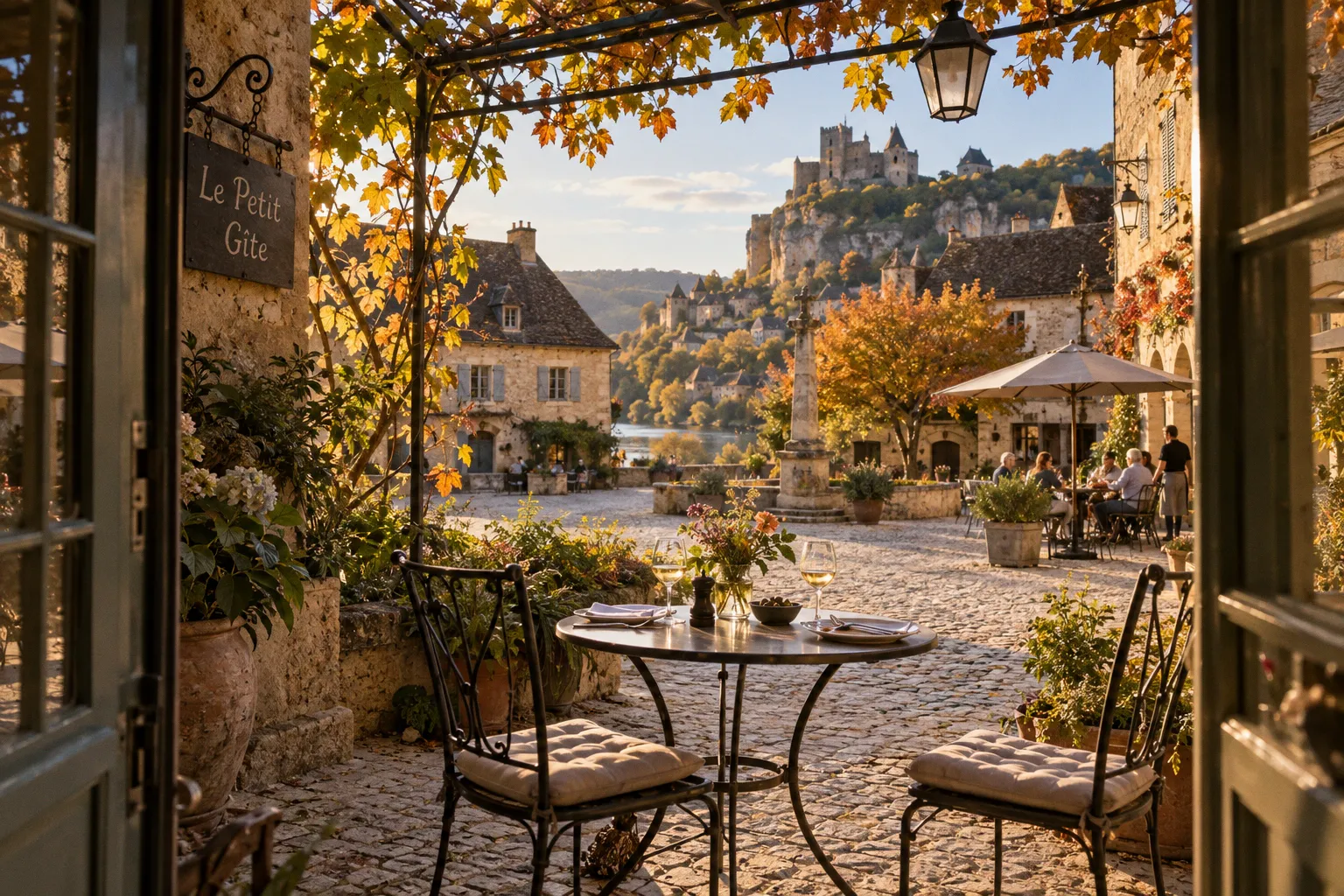
Equally, a villa within walking distance of a market town may sacrifice the privacy, thermal mass and acoustic separation that justify a premium rural rental.
The Dordogne is not one uniform holiday market. Its four historic zones — Périgord Noir, Vert, Blanc and Pourpre — produce different property settings and different travel patterns. A riverside house near a castle valley, a secluded farmhouse estate and a village villa may all be marketed as luxury accommodation. Their practical performance is not comparable.
The useful question is not which setting is most attractive in brochure photography. It is which setting matches your tolerance for driving, footfall, noise, slope, exposure and operational distance.
The four Périgord zones: a location decision before a property decision
The Dordogne’s regional divisions are not merely administrative labels. They indicate the landscape, settlement density and likely use of a property.
| Zone | Typical setting | Operational character | Best suited to |
|---|---|---|---|
| Périgord Noir | Castle-lined valleys, wooded hills, river settlements and historic villages | Strong sightseeing access, higher seasonal visitor footfall in established destinations | First-time visitors, cultural itineraries, families combining pool time with major sites |
| Périgord Vert | More rural countryside, woodland, meadows and lower-density settlements | Greater privacy and quieter roads; fewer immediate concentrations of restaurants and attractions | Long stays, large groups, guests prioritising land and low noise |
| Périgord Blanc | The area around Périgueux, with more open landscapes and urban access | More practical for supplies, services and regional travel; less defined by concentrated tourist villages | Guests wanting a rural base without complete logistical isolation |
| Périgord Pourpre | Vineyard country around Bergerac, villages, estates and wine routes | Strong food-and-wine orientation, with useful access to Bergerac and surrounding markets | Culinary trips, airport convenience and guests who want countryside without deep remoteness |
Périgord Noir is the most obvious choice for travellers focused on the Dordogne Valley, medieval architecture and established destinations such as Sarlat-la-Canéda. The area includes well-known settlements including Beynac-et-Cazenac, Castelnaud-la-Chapelle, Domme and La Roque-Gageac. These locations offer proximity metrics that are difficult to reproduce from a remote estate: restaurants, river activities, castles and market towns are concentrated within a manageable touring area.
That concentration has a cost. In peak periods, the same access that makes a property convenient can increase road traffic and pedestrian movement. A villa described as village-adjacent may sit close to a public route, a car park or a popular viewpoint. The accommodation can remain private while the wider setting is not.
Périgord Vert generally produces a different rental proposition. Land is more likely to be a central part of the asset. The property may be a detached farmhouse, a restored agricultural building or a small estate with generous grounds. This is useful when the holiday is designed around the house rather than a sequence of daily excursions. It is less efficient if the group expects to walk to cafés, buy provisions spontaneously or divide the day between several attractions.
Périgord Blanc occupies a more practical position. The countryside around Périgueux can provide rural accommodation while retaining better access to services. It is not automatically the strongest choice for panoramic valley views or castle proximity, but it can reduce the friction of a self-catering stay. This matters with children, larger groups and longer bookings, where repeated supply runs expose the difference between a picturesque address and a workable one.
Périgord Pourpre, centred on Bergerac and its surrounding wine country, suits a different travel brief. Vineyard-adjacent properties can provide a coherent base for cellar visits, food markets and village touring. Bergerac also offers a useful transport reference point. A house in this zone may feel less enclosed by valley walls than a Périgord Noir property, with more open views and a clearer relationship to agricultural land.
The location determines the daily operating cost of the holiday: not just fuel, but time, noise exposure, access difficulty and the number of decisions required before dinner.
The secluded estate: privacy measured in land, access and acoustic separation
A secluded gite is not defined by the number of trees visible from the terrace. It is defined by the relationship between the property and its nearest neighbours, public routes and service points.
At the upper end of the market, private grounds can extend to substantial acreage, with some estates offering up to 50 acres. That scale changes the use of the property. The pool terrace is less likely to face another holiday rental. Children can move between zones without immediately reaching a road. Outdoor dining is not dependent on the behaviour of the next house.
But acreage is not the same as usable privacy. A large property can still have a direct sightline to a neighbouring roof, a public footpath crossing the grounds or a shared approach road. The auditor’s question is simple: where can another person stand, and what can they see?
A proper assessment separates the grounds into functional areas:
- Arrival and parking: Is the final approach suitable for ordinary rental cars, or does the listing conceal a steep, unmade or exceptionally narrow lane?
- Pool zone: Is the pool screened from neighbours and roads? Is the terrace large enough for the stated occupancy without forcing every guest into one seating area?
- Dining terrace: Does it have shade at the time it will be used, or is the principal table exposed to late-afternoon heat?
- Sleeping wing: Are bedrooms positioned away from the main living room, pool equipment and exterior dining?
- Service access: Can maintenance, cleaning or pool servicing occur without passing through the principal outdoor space?
- Boundary condition: Are the limits of the property clear, secure and useful, particularly for children or dogs?
Privacy also has an acoustic component. A remote house may still transmit sound from a road, farm machinery, a campsite or a nearby village fête. Conversely, a property with a neighbouring house may perform well if the buildings are separated by topography and mature planting. Visual isolation is not enough. Noise travels across open land, particularly in dry conditions.
The building itself should also be read as infrastructure, not decoration. A restored stone barn can offer strong thermal mass, holding internal temperatures more steadily than lightweight construction. That does not eliminate the requirement for effective ventilation, shading or correctly sized air-conditioning. Thick walls are an asset, not a substitute for mechanical performance.
For summer occupancy, the relevant questions include:
- Are the bedrooms naturally shaded or located beneath a roof exposed to prolonged solar gain?
- Does the air-conditioning have sufficient BTU capacity for the floor area and occupancy?
- Are the external shutters operational, or merely retained as architectural features?
- Is there cross-ventilation, and can windows remain open without compromising security?
- Does the pool heating system support the advertised season, or is the pool only heated under restricted conditions?
Luxury is often claimed through materials: exposed stone, oak beams, handmade tiles and polished concrete. These are legitimate quality indicators, but they do not resolve thermal comfort or circulation. A beautiful upper-floor bedroom with weak ventilation is still a poor bedroom in a hot week.
When rural privacy earns its premium
A secluded estate is usually the strongest fit for guests who expect to spend substantial time on site. The property needs to carry the holiday. That requires more than a pool.
The kitchen must support the stated number of occupants without congestion. Refrigeration capacity matters. So does the distance between the kitchen, dining table and outdoor cooking area. A large farmhouse with one compact refrigerator and limited worktop can create operational failure on the first evening, regardless of the quality of its fittings.
The living areas need several occupation zones. In a group of eight or more, one room is rarely enough. A secondary sitting room, games room or shaded exterior space allows different footfall patterns through the day. This is particularly relevant in shoulder seasons when the pool is less reliable and guests spend more time indoors.
Secluded properties are also more exposed to supply-chain inconvenience. A missing ingredient is not a short walk away. The same applies to pharmacy access, fuel, medical services and replacement household items. The house may be ideal for a planned week and inefficient for an improvised one.
Hilltop villages and bastides: proximity traded against movement
A hilltop or perched village offers a different form of luxury. The value lies in access, identity and reduced dependence on the car. Settlements such as Domme and Belvès, along with nearby bastides including Monpazier, provide direct contact with historic streets, viewpoints, markets and village services.
The disadvantage is physical circulation. Historic settlements were not planned around modern luggage, multiple cars, prams, pool equipment or wide delivery vehicles. A villa may be close to a restaurant in map terms but separated from its parking by steps, a slope or a restricted lane. “Walkable” needs to be interrogated.
For a property in a village, assess the following:
1. Door-to-car distance. Determine where vehicles can stop for unloading and whether that point remains usable during busy periods.
2. Vertical movement. Count external steps between parking, entrance, bedrooms and pool. A panoramic terrace can involve repeated stair use throughout the day.
3. Surface condition. Old paving and polished stone can become slippery when wet, particularly around plunge pools and terraces.
4. Night-time footfall. Restaurants and bars create activity after the main sightseeing period. A quiet afternoon does not guarantee a quiet bedroom.
5. Pool privacy. A rooftop or courtyard pool may be private from the street but overlooked from upper windows or adjacent terraces.
6. Waste and servicing. Historic cores can require shared collection points or scheduled access rather than direct property servicing.
7. Vehicle access. Sat-nav instructions are not a substitute for checking the actual final approach.
Village positioning can be excellent for couples or smaller groups who want to combine self-catering with regular meals out. It is also useful for guests who dislike driving after wine tasting or who want a short route to morning bread and a market.
For families, the calculation is less straightforward. A central villa may reduce car use but increase supervision requirements. Public streets, drops, stairs and traffic become part of the property’s operating environment. A rural farmhouse with a secure boundary may be safer and easier, even if every excursion requires a vehicle.
The building type matters as well. A village villa may occupy a converted stone house with thick masonry and small openings. Thermal mass can moderate temperature, but upper floors may retain heat if roof insulation and ventilation are inadequate. Some historic interiors have limited ceiling height, restricted window opening or irregular floor levels. These details are not defects in themselves. They are constraints that should be priced into the decision.
Village centre versus village edge
The distinction between a property in a village centre and one on its edge is often more useful than the label “hilltop villa”.
A centre property maximises proximity metrics. Shops, cafés and restaurants may be reachable on foot. The rental can support a more flexible daily schedule. Guests can return for lunch, collect provisions or leave one member of the party without a car.
An edge property may preserve the visual relationship with the village while improving parking, outdoor space and acoustic separation. It can be the better compromise when the group wants heritage access without sleeping above a restaurant or navigating a narrow core on every arrival.
The exact setting should therefore be described in operational terms: walking route, gradient, road surface, parking arrangement, external noise and pool exposure. A photograph of a church tower or valley panorama does not answer any of these questions.
Choosing between riverside and hilltop gites
Riverside and hilltop properties are often presented as opposing versions of the same experience. In practice, they have different environmental and logistical profiles.
A riverside gite can provide direct visual access to the water, proximity to canoeing routes and a more horizontal landscape. It may be near settlements that developed along the river corridor, including areas around major castle and village attractions. This can reduce the distance between the property and daytime activities.
Water introduces additional management issues. Pool and river are not interchangeable. A private heated pool offers controlled depth, sanitation and predictable access. The river brings current, changing levels, slippery banks and restrictions that vary by location. A listing that shows both should make the distinction clear.
Flood exposure is also a location question. Not every riverside property is at meaningful risk, and the existence of a river view does not establish a hazard. However, low-lying access roads, basement storage, garden drainage and seasonal ground conditions deserve more scrutiny than they would at a higher elevation. The practical issue is not to reject riverside accommodation, but to understand how the site behaves after heavy rain and during high visitor periods.
Hilltop properties usually provide stronger elevation, long views and separation from the immediate river corridor. Their principal penalty is movement. Roads can be steep and narrow. Walking routes into the village may be manageable for one person and inconvenient for a family carrying shopping, swimming equipment and luggage.
The comparison is best made against actual holiday behaviour:
| Requirement | Riverside gite | Hilltop or perched gite |
|---|---|---|
| Access to water-based activities | Often more direct, depending on the exact river position | Usually requires a descent and return journey |
| Walking to restaurants | Possible near established settlements; not guaranteed | Often strong if the property is within the historic core |
| Pool privacy | Depends on river path, neighbouring houses and public access | Depends on elevation, sightlines and terrace orientation |
| Parking and unloading | Frequently easier outside dense historic centres | Can be restricted by slopes, narrow lanes or village controls |
| Views | River corridor, wooded banks and nearby elevations | Wider valley or roofline views, often from exposed terraces |
| Heat management | Lower elevations may feel more enclosed or humid | Exposed terraces can increase solar gain and wind |
| Group logistics | Efficient for mixed activities if roads are accessible | Better for village-based routines, less efficient for repeated vehicle movement |
| Main risk to investigate | Floodplain access, public paths and seasonal water conditions | Gradient, parking, steps and night-time return routes |
Neither setting is universally superior. A family that wants a private pool, secure grounds and short drives to castles may prefer a riverside estate. A couple combining markets, restaurants and walking may accept the vertical circulation of a hilltop villa. The property brief must come before the view.
A river view is not a pool specification, and a village address is not proof of walkable access. Each claim needs a physical interpretation.
Rural farmhouse versus village villa rental
The rural farmhouse and the village villa are not simply different architectural styles. They produce different patterns of occupancy.
A farmhouse rental normally distributes activity horizontally: kitchen, terrace, pool, lawn, outbuildings and parking occupy separate zones. This is useful for larger groups. Noise can dissipate across the site, and guests can use the house without sharing every movement with the rest of the party.
A village villa distributes activity vertically or compactly. Bedrooms may sit above living areas. The pool may occupy a courtyard. The terrace may be the principal outdoor room. The property can be efficient, but the layout is less forgiving when occupancy approaches the maximum.
For a farmhouse, inspect:
- The distance between bedrooms and the main social areas.
- Whether the pool is visible from the house and safely enclosed where required.
- The number of bathrooms relative to bedrooms, not merely the presence of en-suite labels.
- The surface between the house, pool and parking in wet conditions.
- The reliability of mobile signal and internet service if the property is marketed for longer stays.
- The presence of external lighting on paths, steps and parking areas.
- Whether outbuildings are genuinely habitable or simply photographed as secondary features.
For a village villa, inspect:
- The exact number of floors used by guests.
- Bedroom separation from street noise and neighbouring accommodation.
- The loading procedure on arrival and departure.
- The route to the nearest food shop, including slope and evening lighting.
- Whether the pool terrace is overlooked from public or private elevations.
- The availability of shaded exterior seating.
- The impact of local events, deliveries and seasonal hospitality businesses.
A farmhouse with extensive grounds may look less convenient on a map but deliver lower daily friction once occupied. A village villa can reduce transport time while increasing dependence on stairs, parking discipline and local activity. This is the central trade-off in a Dordogne holiday property setting comparison.
The pool is a location feature, not an accessory
For a premium self-catering rental, the pool often determines whether the location succeeds. Its specification should be assessed separately from the building.
A private heated outdoor swimming pool is a strong differentiator, especially in a secluded property. But the phrase does not establish the heating method, the operating period, the temperature target, the cover system or the conditions under which heating is provided. Those details affect actual use.
The pool’s position also matters:
- A south-facing terrace may maximise solar gain but provide little afternoon shade.
- A pool below a stone retaining wall may be screened from neighbours but exposed to falling leaves and maintenance demands.
- A pool beside the main dining terrace can support supervision and social use but may transmit noise directly to bedrooms.
- A pool at the far end of a large estate can improve privacy but make supervision and evening access less convenient.
- A heated pool in a wind-exposed position may lose heat rapidly despite an adequate system.
The same applies to outdoor furniture. A property may sleep ten but offer dining for six under cover. That is not a minor furnishing issue. It changes the usable capacity of the rental.
Luxury standards should be read through performance. Materials, pool equipment, glazing, insulation, ventilation and external shading are more informative than a room count alone. A property can hold an official French classification of up to five stars as a Meublé de tourisme 5 étoiles, but that classification should not be assumed for every high-end listing. Nor does a star classification answer every question about privacy, setting or group suitability.
Historic access, markets and proximity metrics
Location selection becomes more precise when the holiday is converted into a route plan.
Guests focused on castles and historic villages will usually place a higher value on Périgord Noir and nearby valley corridors. Beynac-et-Cazenac, Castelnaud-la-Chapelle, Domme and La Roque-Gageac are among the recognised villages and destinations that draw regular interest. A property within the wider area can make a cultural itinerary efficient, but “near” remains an incomplete measurement.
The relevant proximity metrics include:
- Driving time under normal conditions, not only the shortest digital route.
- The last section of road and whether two cars can pass.
- Parking availability at the destination.
- The return route after evening meals or events.
- Access to a market town for a full grocery shop.
- The number of activities available without repeating the same road network.
- Whether the property’s location allows one group member to stay behind without creating a transport problem.
Sarlat-la-Canéda is an important reference point in Périgord Noir, while Bergerac performs a similar anchoring role in Périgord Pourpre. Périgueux provides a practical urban reference for Périgord Blanc. These towns are not interchangeable. Their value depends on the intended route and on whether the group wants urban services, market access, food culture or historic-site density.
A property can also be too close to a major attraction. This is a familiar failure in rural tourism. The house benefits from a strong view and an excellent photograph, but the road below carries buses, delivery vehicles or seasonal traffic. A riverfront terrace may face a popular route. A bastide property may overlook the same square used for local events. The correct response is not to avoid the destination. It is to assess the direction of sound, the position of bedrooms and the seasonal pattern of activity.
The market-town test
Every luxury gite should pass a basic market-town test before it is selected. The test is not about finding the closest settlement by straight-line distance. It is about the viability of ordinary self-catering.
A workable base should provide a realistic route to:
- A full grocery shop.
- Fresh bread and basic daily provisions.
- A pharmacy or general medical service.
- A fuel station or reliable transport connection.
- Restaurants suitable for the group’s preferred schedule.
- A market or food producer route, if these are central to the trip.
The rural farmhouse vs village villa rental decision often turns on this test. The farmhouse may offer better land and privacy but require deliberate provisioning. The village villa may be more forgiving for short stays, late arrivals and mixed groups with different appetites for driving.
Matching location type to the structure of the stay
A one-week holiday and a three-week stay place different demands on a property.
For a short stay, proximity has disproportionate value. Time lost on repeated drives cannot be recovered. A village-edge villa or a river corridor property may allow the group to combine sightseeing with pool use without spending every day in the car.
For a longer stay, privacy and internal performance become more important. The group will notice bedroom separation, storage, laundry provision, pool maintenance, internet reliability and the quality of the shaded outdoor space. A secluded estate can justify its distance if the house supports several distinct daily routines.
The composition of the group changes the calculation again.
Families with children
A secure boundary, shallow pool access, shaded play areas and short transfer routes normally outweigh a perfect historic address. A hilltop setting may create unnecessary risks through steps, traffic and exposed terraces. A rural estate can work well if the approach road, boundary and pool supervision arrangements are clear.
Multi-generational groups
Ground-floor sleeping options and bathroom distribution are decisive. A steep village property can be unsuitable even when the central location is excellent. A farmhouse with one accessible bedroom, separated living zones and level access to the terrace may perform better.
Couples and small groups
A village centre or vineyard-adjacent villa may provide more value than acreage. The group can use restaurants, markets and wine routes without paying for rooms and grounds it will rarely occupy. Privacy still matters, but the required scale is lower.
Food and wine itineraries
Périgord Pourpre and the Bergerac area offer a logical base for vineyard visits and culinary travel. The property should have a kitchen capable of genuine self-catering, a dining arrangement that works for the full party and a sensible route back from tastings. A beautiful kitchen that functions only as a display space is not a luxury feature.
Guests working remotely
Rural isolation can become a technical liability. Confirm internet performance, workspace separation, indoor temperature control and backup mobile connectivity. A village-edge or Périgord Blanc property may provide a better balance between landscape and service infrastructure than a deeply secluded estate.
What a credible luxury specification should contain
A premium listing should allow the location and building to be evaluated without interpretation by marketing language. Terms such as “exclusive”, “private” and “panoramic” are not useless, but they require physical definitions.
A credible specification should identify:
- The exact pool type, heating arrangement and usable season.
- The number of bedrooms and bathrooms, including whether bathrooms are shared.
- The floor distribution and any internal or external steps.
- Parking capacity and the final road surface.
- The nearest village or market town by practical route.
- The degree of privacy from neighbours, roads and public paths.
- The heating and cooling system, including bedroom provision.
- The principal construction materials and any known thermal limitations.
- The extent of the grounds and which areas are available to guests.
- The location of outdoor dining, shade and evening lighting.
- Any restrictions affecting children, pets, events or pool use.
Official five-star classification can support a premium positioning, but it is only one data point. It does not convert an exposed terrace into a shaded one or a remote farmhouse into a walkable village base. The classification should sit alongside the physical audit, not replace it.
The same discipline applies to panoramic views. A stated 180-degree valley view is a meaningful spatial claim, but it does not indicate whether the view is available from the bedrooms, whether it requires standing at one point on the terrace or whether the terrace is exposed to full-day solar gain. View width and outdoor usability are separate measurements.
The final selection: choose the failure you can tolerate
There is no single best Dordogne location for a luxury stay. There are only settings with different failure modes.
Choose a secluded estate if privacy, land, pool use and acoustic separation are the primary requirements. Accept that supplies, restaurants and attractions will require planning and vehicle use.
Choose a hilltop village or bastide villa if walkability, historic fabric, restaurants and market access matter more than level circulation and guaranteed quiet. Confirm parking, stairs, bedroom exposure and pool privacy before booking.
Choose a riverside property if water-based activities, valley access and a strong landscape connection are central to the itinerary. Separate the river from the pool specification and investigate access conditions, public paths and low-lying routes.
Choose Périgord Pourpre if vineyards, food, Bergerac access and open agricultural landscapes define the trip. Choose Périgord Blanc when service access and regional flexibility are more valuable than concentrated tourist scenery. Use Périgord Noir for the strongest density of castles, villages and established Dordogne Valley routes. Use Périgord Vert when the property itself is intended to be the principal destination.
The binary verdict is straightforward. If the holiday is built around the house, pay for land, thermal performance, pool engineering and privacy. If it is built around daily movement, pay for proximity, access and a location that reduces transport friction. A luxury gite earns its rate only when its physical setting continues to work after the photographs stop doing the selling.