Private pool maintenance: ensuring pristine water in luxury gites
A private pool is a legal safety installation, a chemical system, and a high-footfall piece of infrastructure. In a luxury gite, it is also one of the first features guests inspect.
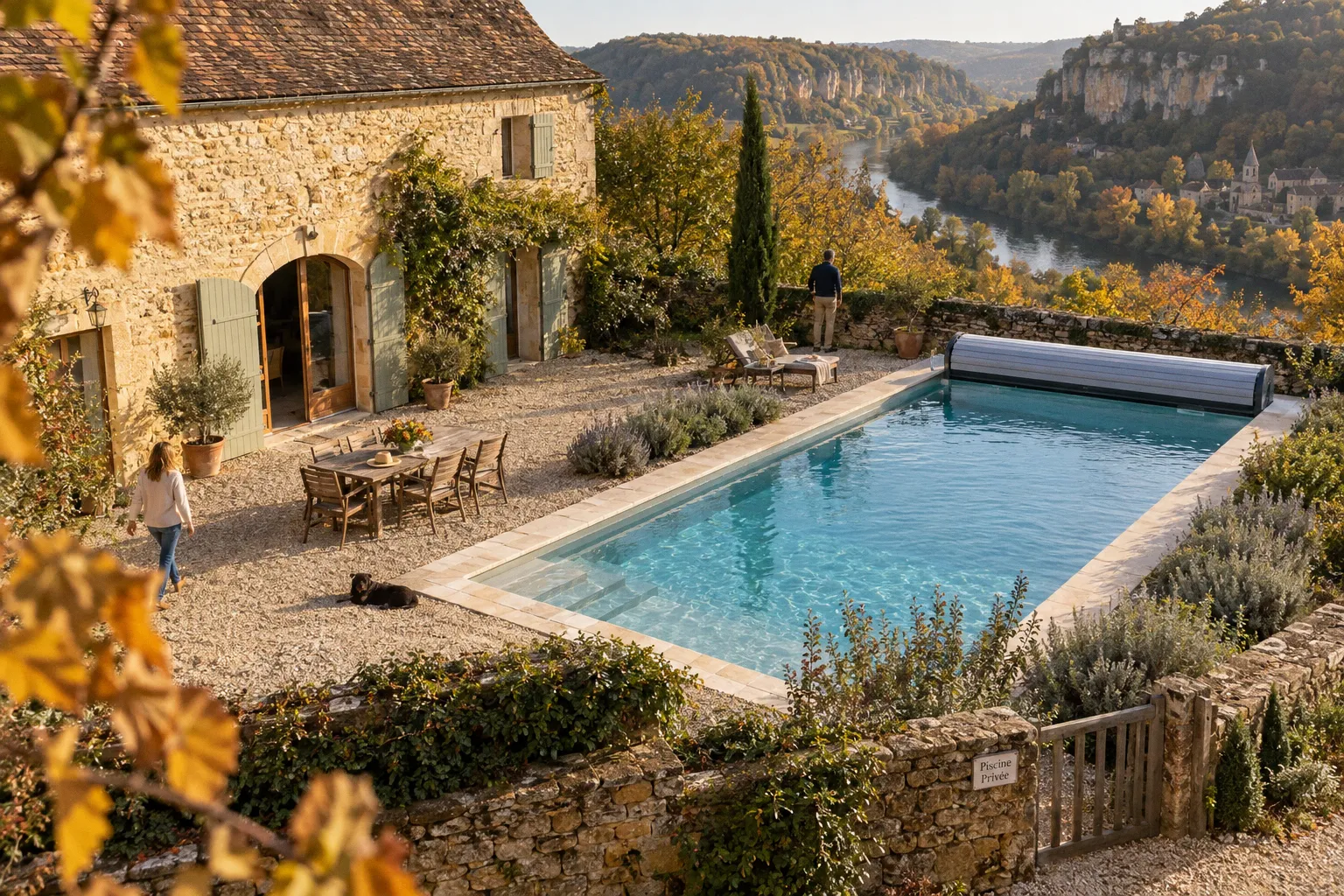
A pool can look acceptable in photographs and still have unstable pH, inadequate sanitizer, overloaded filtration, or a safety device that is present but incorrectly installed.
The relevant standard is not “crystal clear water”. Clarity is only the visible result. Proper private pool maintenance standards for luxury gites require four controls to operate together: compliant drowning prevention, measured water chemistry, sufficient filtration, and documented routine care.
A rural rental adds logistical complications. The property may be several kilometres from the nearest pool technician. Source water may have a high mineral load. A turnover day can place more bathers into the water than the system was designed to handle. Guests may not report a blocked skimmer or a malfunctioning pump until the water has already deteriorated.
French pool safety regulations are not optional
Under French national law, private in-ground and semi-in-ground swimming pools, including those serving gîtes and seasonal holiday rentals, must have at least one AFNOR-certified safety device. The requirement has applied since 1 January 2006 under legislation enacted on 3 January 2003.
The four approved categories are:
- Safety barriers, covered by NF P90-306.
- Water immersion alarms, covered by NF P90-307.
- Safety covers, covered by NF P90-308.
- Pool enclosures or shelters, covered by NF P90-309.
The device must be appropriate to the physical configuration of the pool. A compliance label on a product is not enough if the installation leaves access points, gaps, or operating failures.
For barriers, the minimum height is 1.10 metres under NF P90-306. The barrier must restrict access rather than merely mark the pool perimeter. Gates, latches, hinges, and ground clearances are the usual failure points. A gate that does not self-close consistently is not performing its intended function, regardless of how new the surrounding fencing appears.
A safety cover under NF P90-308 must resist a minimum load of 100 kg. That does not mean it should be treated as a terrace, a diving platform, or a storage surface. Its purpose is to prevent immersion and withstand a defined load. Tracks, fixing points, tensioning systems, and the condition of the cover itself require inspection.
Immersion alarms have a different weakness. They depend on correct positioning, power supply, sensitivity, and user behaviour. An alarm switched off for convenience is not an operating safety system. Nor is a device rendered ineffective by floating equipment, excessive wind disturbance, or a pool shape outside its approved operating conditions.
Non-compliance can expose the owner to civil liability and fines of up to €45,000. Where reckless non-compliance contributes to an accident, criminal consequences may be more serious. A guest waiver does not remove the owner’s legal obligation to provide compliant protection.
A pool safety device is not a decorative feature. It is a piece of life-safety equipment with a defined operating condition.
The inspection should begin outside the water
Before testing chemistry, inspect the access route. This is where many practical failures are found.
Check:
- Whether the pool enclosure, barrier, or cover is fully operational at the time guests are permitted to use the pool.
- Whether gates close and latch without manual assistance.
- Whether furniture, storage boxes, benches, or garden equipment create an unintended climbing route.
- Whether the alarm has power and displays its operating status.
- Whether the cover can be deployed and secured by one person without improvised handling.
- Whether the pool area remains accessible from the house, terrace, outbuilding, or parking area.
- Whether operating instructions are visible and written in language guests can understand.
Luxury rental properties often have several external living spaces. A pool may be controlled from the principal terrace but remain accessible from a lower lawn, pool house, or side path. The perimeter must be assessed as a physical system, not as a single photograph.
Water chemistry: clear is not the same as sanitary
Water quality is controlled by measurement. Visual inspection has limited value. Water can be clear while pH is outside the effective range for chlorine, or while sanitizer concentration is inadequate for current bather load.
For most chlorine-managed pools, a practical pH target is generally between 7.2 and 7.6. Some standard chlorine systems operate within a narrower range, commonly around 7.0 to 7.4. The equipment manufacturer’s operating instructions should determine the final setting.
The pH value affects several things at once:
- Disinfectant performance.
- Eye and skin comfort.
- Corrosion risk in metal components.
- Scaling on tile, heaters, and pipework.
- The accuracy of chemical dosing.
- The useful life of seals, liners, and mechanical parts.
A drifting pH is not a cosmetic defect. It changes the behaviour of the whole treatment system. If the water becomes too alkaline, chlorine can become less effective and scale may accumulate. If the pH falls too low, irritation and corrosion become more likely.
Free chlorine for a residential rental pool is commonly maintained in the range of 1 to 3 ppm. Systems without stabilizer may operate around 0.4 to 1.4 mg/L, while stabilized systems may use approximately 2 to 5 ppm. These ranges are not interchangeable. Cyanuric acid, dosing equipment, water temperature, sunlight exposure, and the type of chlorine product all alter the operating envelope.
Total alkalinity is another control parameter. A commonly cited range is 80 to 120 ppm, or approximately 10 to 30 °F. Alkalinity acts as a buffer against rapid pH movement. If it is unstable, repeated pH correction becomes a symptom rather than a solution.
A workable chemistry record
A professional maintenance record should include the following fields:
| Parameter | Operational purpose | Typical reference range |
|---|---|---|
| pH | Controls sanitizer effectiveness, comfort, scaling, and corrosion | 7.2–7.6 for many chlorine pools |
| Free chlorine | Indicates available disinfectant | 1–3 ppm for many residential pools |
| Total alkalinity | Buffers pH against rapid movement | 80–120 ppm |
| Water temperature | Influences swimmer comfort, chemical demand, and biological activity | Record actual reading and trend |
| Filter pressure | Indicates loading and restriction | Compare with the clean-filter baseline |
| Water level | Protects skimmer and circulation performance | Maintain within the equipment’s operating range |
The table is a control tool, not a substitute for judgment. If chlorine is within range but the water remains dull, investigate filtration, circulation, combined chlorine, contamination, and bather load. Adding more chlorine without identifying the fault is poor maintenance practice.
Likewise, if pH changes sharply after correction, the operator should examine alkalinity, source water, dosing accuracy, and the possibility of overcorrection. Chemical additions should be recorded with time and quantity. Unlogged treatment is difficult to audit and easy to repeat unnecessarily.
Routine maintenance for high-traffic rental pools
A private pool at an owner-occupied house has a different operating pattern from a Dordogne holiday villa used by successive families. Guests bring sunscreen, body oils, grass, insects, leaves, and dust into the water. They may also use the pool for longer periods and with less regard for the effect on filtration.
Maintenance frequency should respond to use. The following schedule is a practical baseline for a rental property.
Daily: surface and operating condition
Surface debris should be removed daily during the swimming season. Leaves and insects consume operator time, but they also contribute organic load as they break down.
The daily inspection should cover:
1. Surface debris and visible contamination.
2. Water level at the skimmer.
3. Pump operation and unusual noise.
4. Filter pressure against the clean baseline.
5. Return jets and visible circulation.
6. Water clarity, colour, and surface film.
7. Safety equipment and access control.
8. Chemical readings, particularly after heavy use or heat.
A pump running without adequate water at the skimmer can draw air and lose prime. A pump operating continuously against a blocked filter can increase pressure and strain seals. Both problems can remain unnoticed in a property where nobody is present between guest stays.
Every two to three days: baskets and circulation points
Skimmer baskets and the pump pre-filter basket should generally be cleaned every two to three days, with shorter intervals during periods of heavy debris or high occupancy.
The pump should be switched off before opening the pre-filter housing. The basket should be inspected for cracking, distortion, or a poor fit. A broken basket can allow debris into the impeller and may eventually restrict flow.
This is also the point to inspect the lid seal and lubricate or replace it according to the equipment manufacturer’s instructions. Air entering through the suction side can produce bubbles, unstable prime, and reduced hydraulic performance.
Twice weekly: walls, steps, and waterline
Pool walls should be brushed twice weekly as a routine baseline. Steps, corners, overflow channels, skimmer throats, and the waterline require particular attention. These are low-flow areas where deposits and biofilm can establish before the main pool looks visibly dirty.
A robotic cleaner can remove floor debris, but it does not replace brushing. It also does not correct poor circulation or a contaminated waterline. Equipment should be cleaned after use and stored in a dry, protected location rather than left exposed beside the pool.
Weekly: floor cleaning and system review
The pool floor should be vacuumed or cleaned with a robotic system weekly. Frequency should increase after storms, landscaping work, or unusually heavy use.
The weekly review should include:
- Filter pressure and recorded trend.
- Pump basket and skimmer flow.
- Chemical readings.
- Dosing equipment and tubing.
- Salt cell, if the pool uses salt chlorination.
- Automatic cover or alarm function.
- Visible pipework, unions, valves, and equipment-room leaks.
- Condition of ladders, handrails, drain covers, and submerged fittings.
A pressure reading is useful only when compared with the clean-filter reference. There is no universal pressure value for every installation. Pump size, filter type, pipe length, elevation, and hydraulic design all affect the number. A rising pressure trend is more informative than an isolated figure.
The correct maintenance interval is set by bather load, weather, debris, and equipment behaviour. A calendar alone is not a maintenance strategy.
Filtration capacity and the rural property problem
Filtration is the mechanical half of water treatment. Chlorine does not remove every suspended particle, and chemical adjustment cannot compensate for inadequate circulation.
The system needs enough hydraulic capacity to move water through the filter, skimmer, treatment equipment, and return lines without excessive restriction. Oversized pumps are not automatically superior. They can increase energy consumption, raise filter pressure, create noisy operation, and reduce the practical life of components. Undersized systems may fail to turn over and clean the pool adequately during periods of high use.
A proper audit should identify:
- Pump make, model, and rated flow.
- Filter type and filtration area.
- Pipe diameter and visible restrictions.
- Number and location of skimmers.
- Return jet configuration.
- Presence of a heater, heat pump, salt cell, or automated dosing unit.
- Filter clean pressure and normal operating pressure.
- Backwash, rinse, or cartridge-cleaning procedure.
- Drainage arrangements for backwash water.
- Electrical protection and weather exposure.
Sand, cartridge, and diatomaceous earth filters have different service requirements. A cartridge filter requires removal and cleaning at suitable intervals. A sand filter requires correct backwash and rinse cycles. The operator should not backwash simply because the calendar says so, nor delay it when pressure and flow indicate loading.
The equipment room should be dry, ventilated, and accessible without crossing guest sleeping or dining areas. Chemical storage must be segregated and secure. Chlorine products and acids should not be stored together. A rural rental with a locked technical room and poor ventilation creates a different risk profile from a purpose-built plant room.
Heat also affects demand. Warmer water increases the rate of chemical consumption and can encourage biological growth. A pool cover reduces evaporation and debris entry, but it can also retain heat. When a cover is used, operators need to monitor temperature, sanitizer, and water condition rather than assuming the covered pool is protected from degradation.
Preparing between guest turnovers
Turnover periods are where a professional standard becomes visible. A short changeover window should not be treated as proof that the pool is ready merely because the surface is clear.
The outgoing guest’s use should trigger a structured inspection. Check for:
- Missing or damaged pool equipment.
- Unreported contamination.
- Low water level from evaporation or splashing.
- Unusual filter pressure.
- Loose drain covers or fittings.
- Chemical readings outside the normal operating range.
- Cover, barrier, or alarm damage.
- Sunscreen residue at the waterline.
- Excessive debris in baskets and the filter.
If a pool has received heavy use, a chemical correction may be required before the next arrival. The correction should be based on measured readings and the system’s documented procedure. Guests should not be permitted to swim while chemicals are being added or while the water is outside the safe operating range.
The property manager should also record the time of treatment and the point at which the pool is returned to service. This is particularly relevant where check-in and check-out occur on the same day. A rushed visual reset is not equivalent to a completed maintenance cycle.
Documentation is part of the physical standard
Records do not make an unsafe pool safe. They do show whether the property is being managed systematically and whether defects are being corrected rather than forgotten.
A suitable log can remain concise. It should record:
- Date and time.
- Water temperature.
- pH and free chlorine.
- Total alkalinity when tested.
- Filter pressure.
- Cleaning performed.
- Chemical additions.
- Equipment faults.
- Safety-device inspection.
- Name or initials of the person completing the check.
- Action required and completion date.
Photographs can support the record where a repair, damaged cover, failed latch, or unusual water condition requires evidence. They should supplement the inspection rather than replace it.
A maintenance log is also useful for identifying gradual change. If filter pressure rises every week, if pH requires repeated correction, or if chlorine consumption increases without a corresponding change in occupancy, the system may have a mechanical or water-quality fault.
The same principle applies to safety devices. Record the condition of barriers, gates, covers, alarms, and enclosures. A device that works intermittently should be treated as defective until repaired. Guests should not be expected to compensate for unreliable equipment through careful behaviour.
Seasonal care in the Dordogne
Summer operation is the obvious priority, but the pool’s condition is determined during the periods when it is not being used.
Before opening for the season, inspect the complete hydraulic circuit, clean the filter, test circulation, verify dosing equipment, and check all safety devices. Remove winter covers carefully so that accumulated debris does not enter the pool. Water chemistry should be brought into range before guest use rather than corrected after the first booking.
During hot weather, inspection frequency may need to increase. Higher temperature, sunlight, thunderstorms, and concentrated bather load can produce rapid changes in water chemistry. Heavy rain can dilute or contaminate the pool and introduce organic material from surrounding land.
At closing, winterisation should follow the equipment design and local conditions. The operator should consider water level, pipe protection, pump drainage, chemical dosing, cover security, and frost exposure. A property that is empty for several weeks still requires a defined maintenance plan. Pool water cannot safely be ignored for an extended period during warm conditions.
Rural properties have an additional issue: local access. If the technical room is locked, the power supply is isolated, or the property manager cannot reach the site promptly, a minor pump fault can become a full water-quality failure. Maintenance planning must include proximity metrics: who can attend, how quickly, with which replacement parts, and under whose authority.
The audit standard for a luxury gite
A premium rental should not be judged by the size of its pool alone. The useful questions are physical and operational:
- Is the safety device AFNOR-compliant and fully functional?
- Can a guest access the pool from every approach without passing through an effective control point?
- Are pH and sanitizer readings measured and recorded?
- Is the filtration system sized and maintained for the actual bather load?
- Are cleaning intervals adapted to weather and occupancy?
- Is there a clear response to contamination, equipment failure, or chemical imbalance?
- Can a technician reach the property quickly enough to manage a failure between bookings?
- Does the owner retain evidence of routine inspection and corrective work?
The best luxury gite pool is not necessarily the most elaborate installation. It is the one where safety equipment, chemistry, filtration, cleaning, and documentation operate as a single controlled system.
The verdict is binary. If the pool is compliant, measured, filtered, and serviced to a recorded schedule, it is a credible premium amenity. If it is merely clear in the marketing photographs, it is an unverified liability with a high operating cost.